 Skip to content
Reactor pressure rating is the maximum internal pressure a vessel can safely contain at a specified temperature, established through engineering calculations governed by the ASME Boiler and Pressure Vessel Code (BPVC) Section VIII. ASME compliance confirms that a reactor’s design, fabrication, testing, and documentation meet these code requirements for legal operation and insurance validity.
This guide covers safety and performance implications of pressure ratings, ASME codes and certification processes, common compliance challenges, material selection factors, and resale and redeployment considerations.
Pressure ratings protect personnel and equipment by defining the safe operating envelope; exceeding the Maximum Allowable Working Pressure (MAWP) eliminates engineered safety margins and can result in catastrophic vessel failure or voided insurance coverage.
ASME BPVC Section VIII Division 1 applies a safety factor of 3.5 to ultimate tensile strength, while paragraph UG-99 mandates hydrostatic testing at a minimum of 1.3 times MAWP before any vessel receives a code stamp. Authorized Inspectors verify Manufacturer’s Data Reports, and National Board registration confirms code-compliant construction.
Matching reactor pressure ratings with ASME requirements becomes complex when documentation is missing, welding records are incomplete, or a vessel’s code status is unknown. Engineering evaluations, fitness-for-service assessments, and R-stamp repairs provide resolution paths.
Material properties directly determine achievable pressure ratings; alloys like Hastelloy C-276 and 316L stainless steel support higher allowable stresses than glass-lined configurations, while corrosion allowance requirements vary by service severity.
For used or refurbished reactors, verified documentation including U-1 forms, WPS/PQR records, and inspection histories is essential for legal transfer, redeployment across jurisdictions, and compliance with international equivalents such as the Pressure Equipment Directive (PED) 2014/68/EU, EN 13445, and the UK’s Pressure Systems Safety Regulations 2000.
Why are pressure ratings important for reactor safety and performance?
Pressure ratings are important for reactor safety and performance because they define the maximum internal pressure a vessel can safely contain during operation. Exceeding these limits risks catastrophic failure, personnel injury, and regulatory violations. The following sections explain how ratings are determined and what happens when reactors operate outside their designated limits.
How are reactor pressure ratings determined?
Reactor pressure ratings are determined through engineering calculations that account for material strength, wall thickness, operating temperature, and corrosion allowance. Engineers establish the design pressure as the most severe coincident pressure and temperature condition expected during normal operation, then apply code-mandated safety factors to derive the Maximum Allowable Working Pressure (MAWP).
The consequences of inadequate pressure rating determination are significant. According to Chemical Process Safety, severe overpressure damage to a highly engineered nickel-clad reactor resulted in over $500,000 in damage. Regulatory frameworks such as ASME Section VIII, the Pressure Equipment Directive (PED) 2014/68/EU, and the UK’s Pressure Systems Safety Regulations 2000 (PSSR) each prescribe specific methodologies for calculating and validating these ratings.
What risks arise from operating reactors outside their pressure rating?
The risks that arise from operating reactors outside their pressure rating include vessel rupture, uncontrolled release of hazardous materials, personnel fatalities, and voided insurance coverage. MAWP represents the maximum pressure permissible at the top of a vessel in its normal operating position at a specific temperature; exceeding this threshold eliminates the engineered safety margin.
Key consequences of exceeding pressure ratings include:
- Catastrophic vessel failure from stress beyond material yield strength.
- Loss of containment releasing toxic or flammable process media.
- Regulatory enforcement actions and facility shutdowns.
- Voided industrial insurance policies due to non-compliance with ASME or EN standards.
For procurement engineers evaluating new surplus and quality used batch reactors, verifying that the nameplate MAWP aligns with intended process conditions is a non-negotiable first step before commissioning.
Understanding these safety implications establishes the foundation for selecting the correct ASME codes and standards.
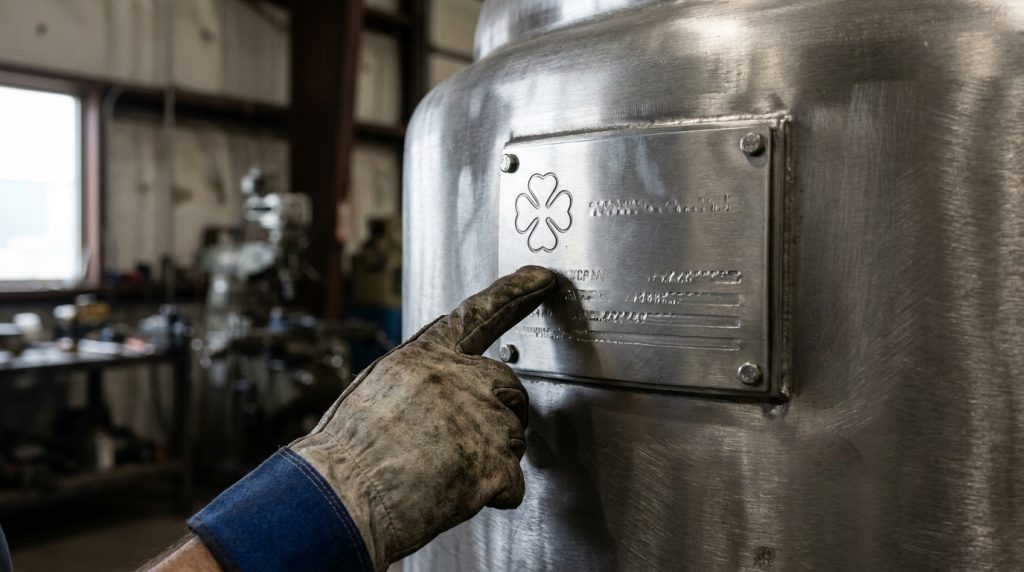
What are the key ASME codes and standards for reactor pressure vessels?
The key ASME codes and standards for reactor pressure vessels center on ASME BPVC Section VIII, which governs design, fabrication, and testing requirements. The subsections below cover how the BPVC applies to reactors and which specific code sections are most relevant.
How does the ASME Boiler and Pressure Vessel Code (BPVC) apply to reactors?
The ASME Boiler and Pressure Vessel Code (BPVC) applies to reactors by establishing mandatory rules for design pressure, fabrication quality, and hydrostatic testing that every pressure vessel must satisfy before receiving a code stamp. Under ASME BPVC Section VIII Division 1, the standard safety factor is 3.5, meaning allowable stress equals ultimate tensile strength divided by 3.5.
Before Code stamping, ASME paragraph UG-99 requires that all vessels undergo hydrostatic testing at a minimum of 1.3 times the MAWP, corrected for the stress ratio between test and design temperatures. An Authorized Inspector verifies the Manufacturer’s Data Report (form U-1 for multi-chamber vessels, U-1A for single-chamber vessels). National Board registration confirms the vessel was constructed in accordance with the ASME Code.
Non-compliance with recognized codes like ASME or EN may void industrial insurance coverage for accidents. For procurement engineers evaluating batch reactors, verified BPVC compliance is not optional; it is the baseline that protects both personnel safety and operational continuity.
What are the main ASME code sections relevant to pressure vessel reactors?
The main ASME code sections relevant to pressure vessel reactors are:
- Section VIII, Division 1 provides rules for the construction of pressure vessels, covering design, materials, fabrication, and inspection requirements.
- Section VIII, Division 2 provides alternative rules with higher allowable stresses, permitting thinner walls when more rigorous analysis and testing are performed.
- Section IX governs welding and brazing qualifications, requiring a written Welding Procedure Specification (WPS) and a Procedure Qualification Record (PQR).
- Section V covers nondestructive examination methods used to verify weld and material integrity.
- Section II specifies permissible materials, their properties, and allowable stress values at various temperatures.
International equivalents include the EU’s Pressure Equipment Directive (PED) 2014/68/EU, EN 13445, CE marking, and the UK’s UKCA marking. According to IMARC Group, the global pressure vessel market was valued at USD 26.3 billion in 2025 and is estimated to reach USD 35.9 billion by 2034, reflecting continued demand for code-compliant reactor vessels worldwide.
Understanding which sections apply helps procurement teams verify that documentation packages are complete before acquiring new surplus or quality used equipment.

How do manufacturers and operators ensure ASME compliance for reactors?
Manufacturers and operators ensure ASME compliance for reactors through a structured certification process involving documentation, inspection, hydrostatic testing, and stamp verification. The steps differ for new fabrication versus used or refurbished vessels.
What steps are involved in ASME certification for pressure vessels?
The steps involved in ASME certification for pressure vessels include design review, material verification, welding qualification, fabrication inspection, hydrostatic testing, and final documentation. Each step requires oversight by an Authorized Inspector before the vessel receives its ASME stamp.
Key certification steps include:
- Preparing a written Welding Procedure Specification (WPS) and Procedure Qualification Record (PQR), as required under ASME Section IX.
- Completing fabrication under Authorized Inspector surveillance at defined hold points.
- Performing hydrostatic testing per UG-99 at a minimum of 1.3 times the MAWP, corrected for the Lowest Stress Ratio.
- Filing the Manufacturer’s Data Report (U-1 form for multi-chamber vessels, U-1A for single-chamber vessels).
- Applying the National Board registration number and NB symbol to the nameplate.
According to Boardman Inc., the U-1 form serves as the Manufacturer’s Data Report for pressure vessels, documenting every parameter from design pressure to material traceability.
How does ASME stamp verification work for used or refurbished reactors?
ASME stamp verification for used or refurbished reactors works by confirming the original certification records, validating current vessel integrity, and ensuring any repairs or alterations comply with the National Board Inspection Code (NBIC). The R-stamp is required for repairs and alterations of pressure-retaining items per the NBIC, according to the National Board.
Verification typically involves:
- Locating the original nameplate data, including the U-stamp, National Board number, MAWP, and design temperature.
- Gathering the Manufacturer’s Data Report and any subsequent repair or alteration documentation.
- Performing non-destructive examination (NDE) and visual inspection to confirm remaining wall thickness and structural integrity.
- Conducting recertification engineering analysis to validate the current MAWP based on measured conditions.
When original documentation is incomplete, operators should cross-reference National Board records, which confirm that a pressure-retaining item was constructed in accordance with the ASME Code. For reactors operating across multiple jurisdictions, equivalent standards such as the Pressure Equipment Directive (PED) 2014/68/EU, EN 13445, CE marking, and the UK’s PSSR 2000 may also apply.
With compliance verification established, the next consideration is addressing common challenges when reactor pressure ratings do not align with current ASME requirements.
What are common challenges in matching reactor pressure ratings with ASME requirements?
Common challenges in matching reactor pressure ratings with ASME requirements include gaps in welding documentation, missing Manufacturer’s Data Reports, and unknown pressure histories. The subsections below address documentation compliance gaps and how to handle reactors with unknown ASME status.
How can operators address gaps in documentation or code compliance?
Operators can address gaps in documentation or code compliance by reconstructing welding records, performing engineering analyses, and engaging Authorized Inspectors to verify current vessel condition. ASME Section IX requires a written Welding Procedure Specification (WPS) and a Procedure Qualification Record (PQR) for every code-compliant weld. When these documents are missing, operators must requalify welds through new testing or obtain alternative evidence that original fabrication met code intent.
Practical steps to close compliance gaps include:
- Locating original U-1 or U-1A Manufacturer’s Data Reports from fabrication records or National Board archives.
- Commissioning a Fitness-for-Service assessment per API 579-1/ASME FFS-1 to evaluate current integrity.
- Performing non-destructive examination (NDE) such as ultrasonic thickness testing, radiography, or magnetic particle inspection.
- Engaging an R-stamp holder for any repairs or alterations required to restore code conformity.
For reactors operating under the EU’s Pressure Equipment Directive (PED) 2014/68/EU or the UK’s Pressure Systems Safety Regulations 2000 (PSSR), similar documentation requirements apply. Proactive gap analysis before acquisition or redeployment prevents costly compliance surprises.
What happens if a reactor’s pressure rating or ASME status is unknown?
A reactor’s pressure rating or ASME status being unknown triggers a mandatory engineering evaluation before the vessel can be placed into service. Without verified documentation, the reactor cannot legally carry an ASME stamp, and most jurisdictions prohibit operation of unregistered pressure vessels.
The typical resolution path involves:
- Conducting a thorough visual and dimensional inspection to identify nameplate data, material grades, and construction details.
- Performing a Maximum Allowable Working Pressure (MAWP) calculation based on measured wall thickness, identified material properties, and corrosion allowance.
- Completing hydrostatic testing at a minimum of 1.3 times the calculated MAWP to validate pressure integrity.
- Obtaining review by an Authorized Inspector who can verify whether the vessel meets ASME Section VIII requirements for re-rating or registration.
Non-compliance with recognized codes like ASME or EN may void industrial insurance coverage for accidents, according to the TT Club’s 2025 industry risk assessment. This financial exposure makes proper evaluation essential rather than optional. For procurement teams sourcing used batch reactors, confirming ASME status before purchase eliminates downstream liability.
With compliance challenges identified, material selection further influences how pressure ratings align with code requirements.
How does material selection impact reactor pressure ratings and ASME compliance?
Material selection impacts reactor pressure ratings and ASME compliance by determining allowable stress values, corrosion resistance, and maximum operating temperatures. The following subsections cover why glass-lined and alloy reactors differ in pressure considerations, and which testing methods verify material integrity.
Why do glass-lined and alloy reactors have different pressure rating considerations?
Glass-lined and alloy reactors have different pressure rating considerations because their material properties impose distinct mechanical limits under pressure and temperature. Glass-lined reactors rely on a brittle coating bonded to a carbon steel substrate; thermal shock or excessive pressure can fracture the lining, so design pressures remain conservative. Alloy reactors fabricated from materials such as Hastelloy C-276 or 316L stainless steel tolerate higher allowable stresses. According to SJZ Metalsin Tech, Hastelloy C-276 carries a maximum allowable stress of 27.3 ksi at 100°F (38°C), decreasing to 22.3 ksi at 1,000°F (538°C). Corrosion allowance requirements also differ: common additions for carbon steel vessels range from 1/16 in (1.5 mm) to 1/8 in (3 mm) depending on service severity, while high-alloy materials often need minimal or no corrosion allowance.
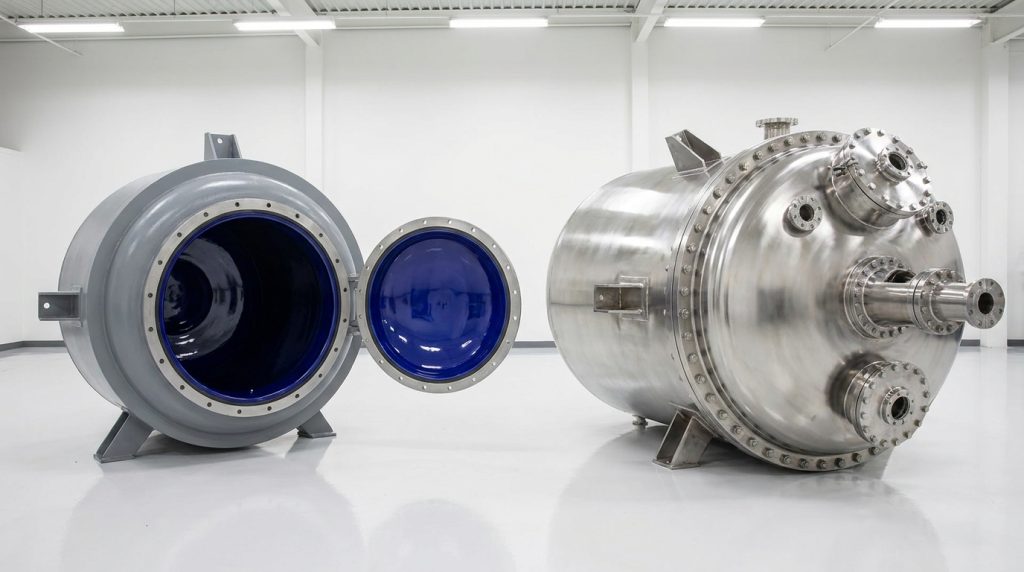
What testing methods verify material integrity for ASME compliance?
The testing methods that verify material integrity for ASME compliance include hydrostatic testing, non-destructive examination (NDE), and documented material traceability. Hydrostatic testing is mandatory before Code stamping under ASME Section VIII, paragraph UG-99. The standard hydrostatic test pressure must reach at least 1.3 times the Maximum Allowable Working Pressure (MAWP), corrected for the stress ratio between test and design temperatures. Additional NDE techniques, such as ultrasonic thickness measurement, radiographic examination, and magnetic particle inspection, confirm that welds and base materials meet required integrity thresholds without causing damage to the vessel.
For reactors crossing jurisdictional boundaries, equivalent standards such as the Pressure Equipment Directive (PED) 2014/68/EU, EN 13445, and the UK’s Pressure Systems Safety Regulations 2000 (PSSR) impose parallel material verification requirements, including CE marking or UKCA marking documentation.
Understanding material-specific pressure limitations simplifies compliance when sourcing or redeploying used reactor equipment.
How does ASME compliance affect the resale, refurbishment, or redeployment of reactors?
ASME compliance affects the resale, refurbishment, or redeployment of reactors by determining whether a vessel can legally transfer ownership, undergo modifications, or operate in a new jurisdiction. The subsections below cover required documentation for transactions and how upgrades influence ongoing code adherence.
What documentation is needed when buying or selling a used ASME-rated reactor?
The documentation needed when buying or selling a used ASME-rated reactor includes:
- The original Manufacturer’s Data Report (U-1 form or U-1A for single-chamber vessels), which confirms the vessel was built to ASME BPVC Section VIII.
- National Board registration number and nameplate data, confirming construction in accordance with the ASME Code.
- Hydrostatic test records demonstrating pressure integrity at minimum 1.3 times MAWP.
- Welding Procedure Specifications (WPS) and Procedure Qualification Records (PQR) per ASME Section IX.
- Maintenance and inspection history, including any R-stamp repairs or alterations performed under the National Board Inspection Code (NBIC).
Without these records, non-compliance with recognized codes like ASME or EN may void industrial insurance coverage for accidents, according to TT Club’s 2025 Year in Focus report. For procurement engineers evaluating used batch reactors, missing documentation often represents the single greatest barrier to redeployment.

How do refurbishing and upgrades influence ongoing ASME compliance?
Refurbishing and upgrades influence ongoing ASME compliance by triggering recertification requirements whenever pressure-boundary components are altered. Any repair or alteration to a pressure-retaining item requires an R-stamp holder per the National Board Inspection Code (NBIC).
The recertification process involves:
- Gathering original design documentation and confirming MAWP at current wall thickness.
- Performing nondestructive examination (NDE) and visual inspection to verify remaining corrosion allowance.
- Engineering analysis to confirm the modified vessel still meets ASME Section VIII Division 1 or Division 2 rules.
- Authorized Inspector sign-off before the reactor returns to service.
Jurisdictions outside the United States impose parallel obligations. The EU’s Pressure Equipment Directive (PED) 2014/68/EU, the UK’s Pressure Systems Safety Regulations 2000 (PSSR), and Germany’s Product Safety Act (ProdSG) each mandate documented inspection and compliance verification after modifications.
Understanding these requirements before purchase simplifies the path from acquisition to operational deployment.
How should you approach reactor pressure rating and ASME compliance when utilizing the inventory and solutions from International Process Plants?
You should approach reactor pressure rating and ASME compliance by leveraging International Process Plants’ inventory of new surplus and quality used batch reactors, which includes documented code-stamped vessels meeting ASME Section VIII and international equivalents such as the EU’s Pressure Equipment Directive (PED) 2014/68/EU and EN 13445.
Can International Process Plants’ subsidiaries help source ASME-compliant reactors or systems?
Yes, International Process Plants’ subsidiaries can help source ASME-compliant reactors and systems. Universal Glasteel Equipment (UGE) focuses on glass and glass-lined equipment, while Gale Process Solutions (GPS) focuses on new alloy equipment. International Process Plants maintains an inventory of 10,000+ pieces of equipment across warehouses in South Carolina (US), Germany, and the United Kingdom, with a large reactor inventory. Each vessel includes relevant documentation such as Manufacturer’s Data Reports and nameplate data to support code conformity verification. For facilities operating under PED or the UK’s Pressure Systems Safety Regulations 2000 (PSSR), International Process Plants currently available inventory spans jurisdictions requiring ASME stamping, CE marking, or UKCA marking.
What are the key takeaways about reactor pressure rating and ASME compliance we covered?
The key takeaways about reactor pressure rating and ASME compliance are:
- Design pressure, MAWP, and pressure rating describe the same fundamental concept: the maximum safe operating envelope for a reactor vessel at a given temperature.
- ASME BPVC Section VIII governs construction; compliance, conformity, and code adherence all refer to meeting these requirements through certification, stamping, and National Board registration.
- Hydrostatic testing at 1.3 times MAWP validates pressure integrity before any vessel receives a code stamp.
- Material selection directly affects allowable stress and corrosion allowance, which in turn determines achievable pressure ratings.
- Documentation, including U-1 forms, WPS/PQR records, and inspection reports, is essential for resale, redeployment, and insurance validity.
- International standards such as PED 2014/68/EU, EN 13445, and PSSR 2000 apply alongside ASME for facilities operating across global jurisdictions.
International Process Plants simplifies this process by offering batch reactors with traceable compliance histories, saving procurement engineers weeks of documentation recovery and re-certification effort.

 EN
EN  ES
ES  FR
FR  PL
PL  DE
DE  AR
AR  UR
UR  HI
HI  NL
NL  TR
TR  IT
IT  UK
UK  RU
RU  JA
JA  PT
PT  ZH
ZH