 Skip to content
Selecting between batch and continuous reactors is a process engineering decision driven by production volume, product flexibility requirements, and capital recovery timelines. Batch reactors are closed systems where all reactants are charged at the start and products discharged collectively at the end; continuous reactors maintain steady inflow and outflow throughout the process duration.
This guide covers reactor operating principles, performance comparisons across efficiency and safety metrics, selection criteria based on product type and volume, transition challenges during plant conversion, and equipment sourcing strategies.
Batch reactors dominate applications requiring multi-product flexibility, accounting for approximately 45% of the polymerization reactor market revenue due to their suitability for specialty production. ROI timelines for batch systems typically span 1 to 2 years, making them practical for facilities producing fewer than 100,000 tons per year (approximately 220,462,000 lb per year).
Continuous reactors excel in high-volume, steady-state production where quality consistency matters most. Continuous systems can require 27 times less peak heating than equivalent batch vessels and can halve operational costs for complex chemical production, though ROI periods extend to 2 to 4 years.
Performance comparisons reveal that safety considerations hinge on hazardous material inventory size, while quality control differences range from 2 to 3 sigma in batch pharmaceutical operations to a 6 sigma target for continuous manufacturing.
Selection depends on matching reactor type to actual production demands, regulatory requirements across jurisdictions (ASME, PED, CE marking), and environmental targets. We also cover how companies optimize asset redeployment during reactor transitions and how International Process Plants supports procurement from an inventory of 10,000+ pieces of process equipment.
What Are Batch Reactors and How Do They Work?
Batch reactors are closed systems where all reactants are loaded at the start, the reaction proceeds without continuous material exchange, and products are discharged collectively at the end. The sections below cover common industrial uses and key advantages and limitations.

When Are Batch Reactors Commonly Used in Industry?
Batch reactors are commonly used in industries that require flexible production of multiple products or small-volume specialty chemicals. Pharmaceutical manufacturing, specialty polymers, and fine chemicals production rely heavily on batch processing because recipes, residence times, and operating conditions can change between campaigns without equipment modifications.
According to a 2022 study published in the Chemical Engineering Journal, batch reactors currently account for approximately 45% of the total polymerization reactor market revenue, driven by their suitability for specialty polymer production. This dominance reflects how batch systems accommodate varying formulations and short production runs that continuous systems cannot justify economically.
Key industries using batch reactors include:
- Pharmaceutical active ingredient synthesis
- Specialty and fine chemical production
- Polymer and resin manufacturing
- Agrochemical formulation
- Food and flavor processing
For procurement engineers evaluating reactor types, batch systems remain the practical choice whenever product diversity outweighs throughput volume.
What Are the Key Advantages and Limitations of Batch Reactors?
The key advantages and limitations of batch reactors center on flexibility versus throughput efficiency.
Advantages:
- Flexibility to produce multiple products in a single vessel
- Lower capital investment for small-volume or variable production
- Simpler regulatory compliance with established lot traceability
- Easier cleaning and product changeover between campaigns
- Shorter ROI timelines, typically 1 to 2 years
Limitations:
- Lower throughput compared to continuous systems for high-volume production
- Batch-to-batch variability affecting product consistency
- Higher labor requirements per unit of output
- Downtime during charging, discharging, and cleaning cycles
- Mass transfer limitations can slow apparent reaction kinetics, as identified in specialty chemical applications
For most facilities producing fewer than 100,000 tons per year (approximately 220,462,000 lb), batch reactors deliver the operational flexibility that justifies these trade-offs.
With batch reactor fundamentals established, understanding continuous reactor operation reveals where each system excels.
What Are Continuous Reactors and How Do They Operate?
Continuous reactors operate with a steady inflow of reactants and outflow of products throughout the process duration. The sub-sections below cover preferred applications and the benefits and drawbacks of continuous reactor systems.
In Which Applications Are Continuous Reactors Preferred?
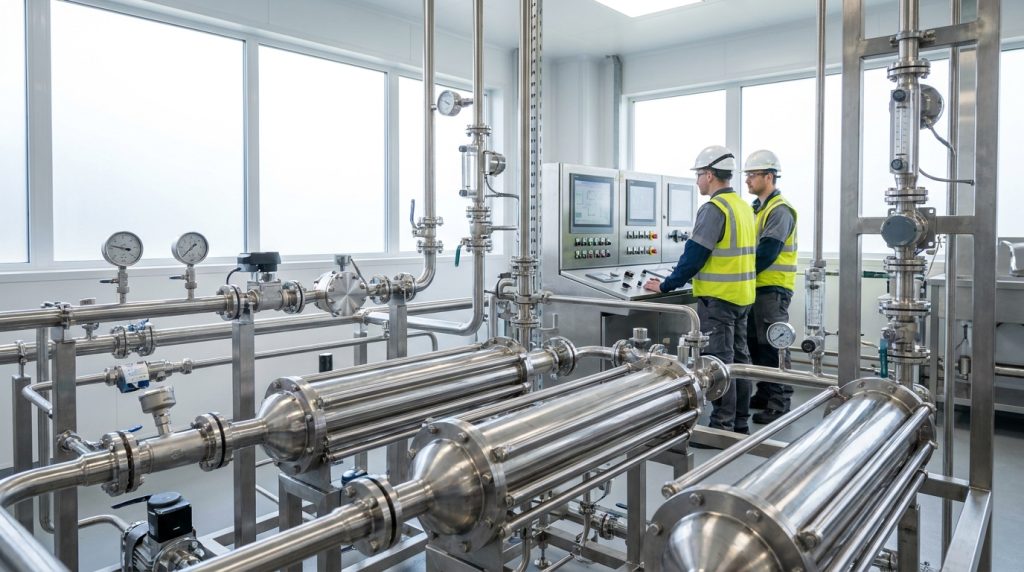
Continuous reactors are preferred in high-volume, steady-state production applications where consistent product quality and throughput are critical. Pharmaceutical manufacturing, bulk petrochemicals, and large-scale polymer production represent primary use cases.
Industrial-scale process reactors designed for commercial production typically range from 1,000 to 1,000,000 L (264 to 264,172 gal), according to GlobalSpec’s process reactor selection guide. These capacities align with continuous operation, where uninterrupted feed streams maximize output from a given vessel footprint.
Regulatory drivers also favor continuous systems. The FDA’s guidance on continuous manufacturing emphasizes material tracking for precise batch definition and lot traceability. In pharmaceutical production, the industry currently operates at 2–3 sigma quality (6.7–30.9% defects), and the transition to continuous manufacturing targets 6 sigma, approximately 0.0003% defects. For procurement engineers evaluating reactor investments, applications with stable demand and strict quality specifications consistently justify continuous configurations.
What Are the Benefits and Drawbacks of Continuous Reactors?
The benefits of continuous reactors include higher throughput consistency, reduced per-unit operating costs, smaller equipment footprints relative to output, and tighter process control. The drawbacks include higher initial capital expenditure, longer return-on-investment timelines of 2 to 4 years, reduced flexibility for product changeovers, and greater complexity in startup and shutdown procedures.
Key benefits:
- Steady-state operation eliminates batch-to-batch variability.
- Smaller reactor volumes handle equivalent annual production compared to batch vessels.
- Reduced intermediate storage lowers inventory holding costs.
- Inline monitoring enables real-time quality adjustments.
Key drawbacks:
- Capital costs and engineering complexity increase significantly.
- Product changeovers require extensive cleaning and revalidation.
- Low-volume or specialty products rarely justify continuous infrastructure.
- Equipment failures halt entire production lines without buffer inventory.
According to a 2025 Qoblex guide on continuous process manufacturing, ROI timelines for continuous systems typically span 2 to 4 years, compared to 1 to 2 years for batch operations. For most process engineers, the decision hinges on whether annual production volume sustains continuous operation long enough to recover that initial investment.
With continuous reactor fundamentals established, the next section compares batch and continuous systems on key performance factors.
How Do Batch and Continuous Reactors Compare on Key Performance Factors?
Batch and continuous reactors compare on key performance factors across three critical dimensions: efficiency and scalability, safety and quality, and cost with maintenance requirements.

How Do Reactors Differ in Efficiency, Scalability, and Flexibility?
Reactors differ in efficiency, scalability, and flexibility based on their operational design. Continuous reactors achieve superior energy efficiency and throughput at steady state. According to AM Technology, the Coflore Rotating Tube Reactor (RTR) requires 27 times less peak heating and 5.9 times less peak cooling compared to an equivalent 13.6 m³ (3,593 gal) batch reactor. Batch reactors offer greater flexibility for multi-product facilities, since operators can switch chemistries between cycles without hardware changes. Continuous systems scale by increasing flow rate or adding modular units in parallel, while batch systems scale by increasing vessel volume or running additional cycles. For processes requiring frequent recipe changes or small-volume specialty production, batch reactors remain the more adaptable choice.
What Are the Safety and Quality Considerations for Each Reactor Type?
The safety and quality considerations for each reactor type center on hazardous material inventory and process consistency. Continuous reactors hold smaller volumes of reactive material at any given time, which reduces the severity of potential releases. According to a 2017 study at Texas A&M University, safety levels in batch and continuous reactors are influenced by inventory size; exceeding a threshold of 10,000 lb (4,536 kg) of material at its boiling point in a continuous reactor can impact its Fire and Explosion Index (F&EI). Batch reactors concentrate larger volumes in a single vessel, increasing potential exposure during exothermic runaway events. From a quality standpoint, continuous processes maintain tighter parameter control through real-time monitoring, reducing batch-to-batch variability. Vessels in both configurations must comply with ASME Section VIII, PED (2014/68/EU), and CE or UKCA marking requirements depending on jurisdiction.
How Do Costs and Maintenance Requirements Compare Between Reactors?
Costs and maintenance requirements compare differently depending on production volume and timeline. Batch systems carry lower initial capital expenditure and shorter return on investment timelines of 1 to 2 years. Continuous systems demand higher upfront investment in instrumentation, automation, and process analytical technology (PAT), with ROI periods typically spanning 2 to 4 years. However, continuous operation reduces labor costs per unit, minimizes cleaning downtime between campaigns, and lowers energy consumption per kilogram of product. Batch reactor maintenance centers on vessel internals, agitator seals, and jacket integrity between campaigns. Continuous reactor maintenance focuses on pump reliability, inline sensor calibration, and fouling prevention in narrow-bore tubes or static mixers.
With performance trade-offs clarified, the next step is identifying which selection factors apply to your specific process.
What Factors Should Guide the Selection Between Batch and Continuous Reactors?
The factors that should guide selection between batch and continuous reactors include product type, production volume, process complexity, regulatory requirements, and environmental impact. The subsections below address how each factor influences reactor choice.
How Do Product Type, Volume, and Process Complexity Affect Your Choice?
Product type, volume, and process complexity affect your choice by determining whether batch flexibility or continuous throughput delivers greater value. Fine chemicals, typically priced at $10/kg ($4.54/lb) or higher with production volumes below 100,000 tons per year (approximately 220,462,000 lb), favor batch reactors because frequent recipe changes and small lot sizes align with batch operational flexibility.
High-volume commodity production favors continuous reactors. According to a 2023 feature in The Chemical Engineer (IChemE), converting batch production to continuous processing can halve energy and other operational costs for complex chemical production. Process complexity matters here: reactions requiring precise residence time control or multi-step sequential additions often benefit from continuous flow configurations that maintain steady-state conditions.
For procurement engineers evaluating reactor acquisitions, matching reactor type to actual production volume prevents overspending on continuous infrastructure that sits underutilized, or underinvesting in batch capacity that creates scheduling bottlenecks.
Are There Regulatory or Environmental Concerns to Consider?
Yes, there are regulatory and environmental concerns to consider when selecting between batch and continuous reactors. Regulatory frameworks such as ASME Section VIII, the Pressure Equipment Directive (PED), CE marking, and UKCA marking govern reactor construction standards across global jurisdictions. Continuous reactors require validated material tracking systems to define lot boundaries and ensure traceability, while batch reactors inherently define lots by individual batch runs.
Environmental impact is equally significant. According to the IPCC AR6 Working Group III report, industrial processes were the largest incremental contributors to global industrial emissions between 2010 and 2019, accounting for 40% of the increase. Continuous reactors generally reduce waste generation and energy consumption per unit of product, making them favorable where emissions reduction targets drive capital planning decisions.
Balancing compliance burden against environmental performance goals helps procurement teams select reactors aligned with both current regulations and anticipated sustainability mandates.
What Are Common Challenges and Solutions When Transitioning Reactor Types?
Common challenges when transitioning reactor types include equipment sizing mismatches, process revalidation requirements, and capital redeployment logistics. The following subsection covers how companies can optimize asset redeployment during plant conversion.
How Can Companies Optimize Asset Redeployment or Plant Conversion?
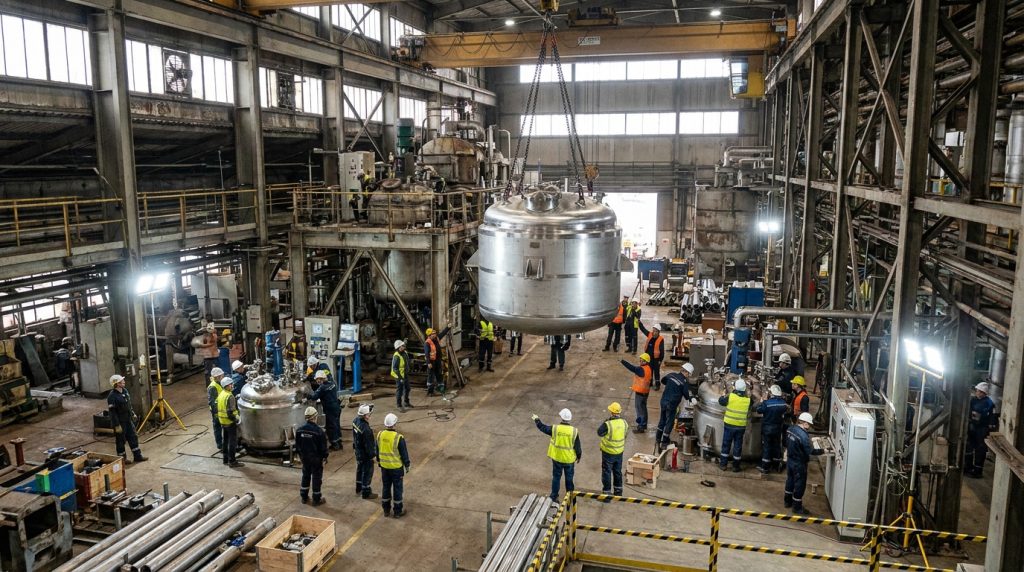
Companies can optimize asset redeployment or plant conversion by matching existing equipment capacities to new process requirements, staging transitions through pilot-scale validation, and sourcing quality used equipment to reduce capital outlay. According to AchieveChem (2024), steel reactor capacities follow standardized tiers: lab-scale units range from 1 to 100 L (0.26 to 26.42 gal), pilot-scale from 100 to 1,000 L (26.42 to 264.17 gal), and industrial-scale from 1,000 to 100,000 L (264.17 to 26,417.29 gal). Understanding these capacity tiers helps procurement teams identify reusable assets during conversion projects.
Key strategies for optimizing plant conversion include:
- Auditing existing reactor vessels against target process parameters such as pressure ratings (per ASME Section VIII or PED 2014/68/EU) and temperature limits before committing to new purchases.
- Validating process chemistry at pilot scale before full-scale redeployment to confirm residence time and heat transfer compatibility.
- Sourcing new surplus and quality used reactors that meet required specifications, reducing lead times compared to new fabrication.
- Ensuring compliance documentation (CE marking, UKCA marking, or CRN) transfers with redeployed equipment across jurisdictions.
For most operations, the biggest overlooked risk in reactor transitions is not the chemistry itself but the mismatch between existing jacket ratings and new process temperature requirements. Confirming thermal capacity early prevents costly retrofits downstream.
With transition strategies defined, the right equipment partner can accelerate procurement and delivery timelines.
How Can International Process Plants Support Reactor Selection and Procurement?
International Process Plants supports reactor selection and procurement by offering new surplus and quality used process equipment from an inventory of 10,000+ pieces, with warehouses in the US, Germany, and the United Kingdom.
Can IPP Help Source and Deliver the Right Reactor Equipment for My Needs?
Yes, International Process Plants can help source and deliver the right reactor equipment for your needs. With 46+ years of experience and operations across 15 countries, International Process Plants specializes in matching procurement engineers with batch reactors, CSTRs, and supporting process equipment built to ASME Section VIII, PED, and CE marking standards.
Because much of our reactor inventory consists of batch reactors, we are particularly well positioned for facilities requiring flexible, multi-product vessels in materials such as 316L stainless steel and Hastelloy C-276. For operations evaluating continuous processing, the global microreactor technology market, valued at USD 629.69 million in 2025, is projected to reach USD 3.43 billion by 2035 according to Quintile Reports, reflecting growing demand for modular continuous equipment that International Process Plants can help procure.
What Are the Key Takeaways When Choosing Between Batch and Continuous Reactors?
The key takeaways when choosing between batch and continuous reactors center on production volume, flexibility requirements, and financial timeline:
- Batch reactors operate as closed systems where all reactants are charged at the start and products discharged collectively at the end, making them ideal for specialty chemicals, multi-product campaigns, and volumes under 100,000 tons per year (approximately 220,462,000 lb per year).
- Continuous reactors such as CSTRs and Plug Flow Reactors (PFRs) maintain steady inflow and outflow, delivering higher throughput and tighter quality control for large-volume, single-product operations.
- ROI timelines for batch processing typically range from 1 to 2 years, while continuous manufacturing ROI generally requires 2 to 4 years.
- Safety considerations differ by inventory size; holding thresholds above 10,000 lb (4,536 kg) in a continuous reactor can affect the Fire and Explosion Index (F&EI).
For most procurement decisions, matching reactor type to your actual production flexibility needs and capital recovery timeline yields better outcomes than defaulting to either technology based on industry trends alone. International Process Plants can help evaluate both options against your specific process requirements.

 EN
EN  ES
ES  FR
FR  PL
PL  DE
DE  AR
AR  UR
UR  HI
HI  NL
NL  TR
TR  IT
IT  UK
UK  RU
RU  JA
JA  PT
PT  ZH
ZH