
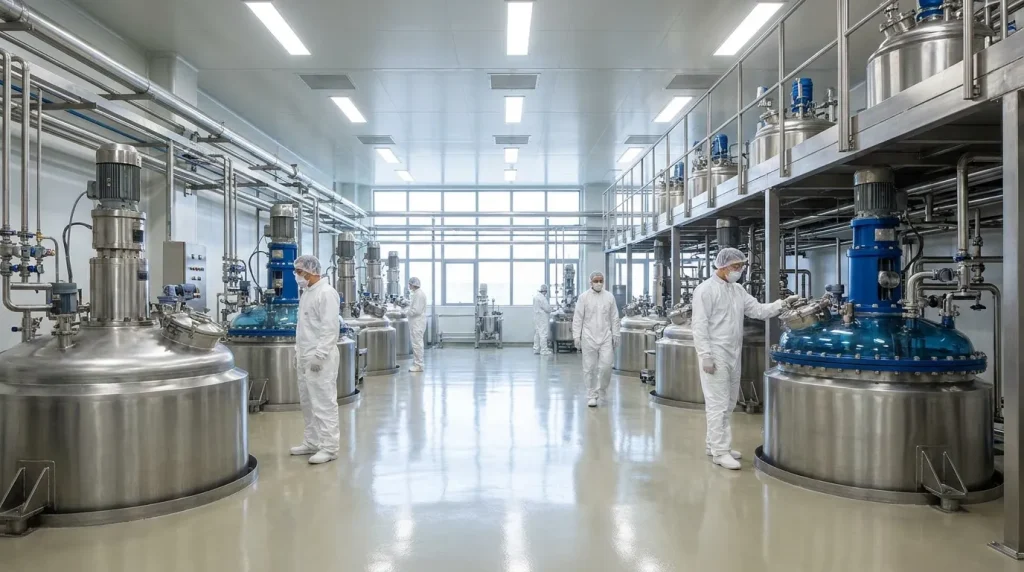
Glass-lined reactor failures are defects in the fused-glass coating that protects a steel vessel’s interior from corrosive process chemicals. Chips represent localized material loss from impact, cracks are linear fractures that make pressure ratings indeterminate, and discontinuities are pinholes or discontinuities detectable only through electrical spark testing.
This guide covers the root causes of glass-lining damage, detection and inspection methods, operational and financial risks of continued use, repair and replacement decision-making, and prevention through maintenance programs.
Manufacturing defects originate during the glass-fusing process at 750–850 °C (1,382–1,562 °F), where thermal expansion mismatches and improper adhesion create latent weak spots that escape visual detection. Operational damage follows from mechanical impact, thermal shock, and hydroblasting; even a 1 lb (0.45 kg) object falling 9 in. (229 mm) can fracture the lining. Aggressive chemicals, including hydrofluoric acid, hot phosphoric acid, and alkaline solutions above pH 11.5, dissolve the glass network from within.
Identifying these defects relies on high-voltage spark testing per ISO 2746:2015, eddy-current thickness mapping on grid intervals, and structured visual inspection programs. Early detection separates a minor tantalum plug repair from a full reglassing project or unplanned shutdown.
Operating with compromised linings risks product contamination, regulatory holds in pharmaceutical production, and indeterminate vessel pressure ratings. Unplanned shutdowns carry costs that far exceed routine inspection programs.
Repair options range from tantalum plugs for defects up to 4 in. (10 cm) in diameter to factory reglassing and full vessel replacement. When cumulative damage makes repair uneconomical, sourcing quality used glass-lined reactors from International Process Plants provides a faster, lower-cost alternative to new fabrication.
What Causes Chips, Cracks, and Discontinuities in Glass-Lined Reactors?
Chips, cracks, and discontinuities in glass-lined reactors result from manufacturing defects, operational damage, and chemical exposure. The following subsections explain how each cause contributes to lining failure.
How Do Manufacturing Defects Lead to Reactor Failures?
Manufacturing defects lead to reactor failures when flaws introduced during the glass-fusing process compromise lining integrity before the vessel enters service. Porcelain enamel is chemically bonded to its substrate metal by fusing glass frits at 750–850 °C (1,382–1,562 °F), and several variables can go wrong during this step. According to research published in the Journal of Materials and Environmental Sciences, factors affecting adhesion include the chemical composition of the enamel, the type of steel substrate, surface roughness, and the glazing temperature.
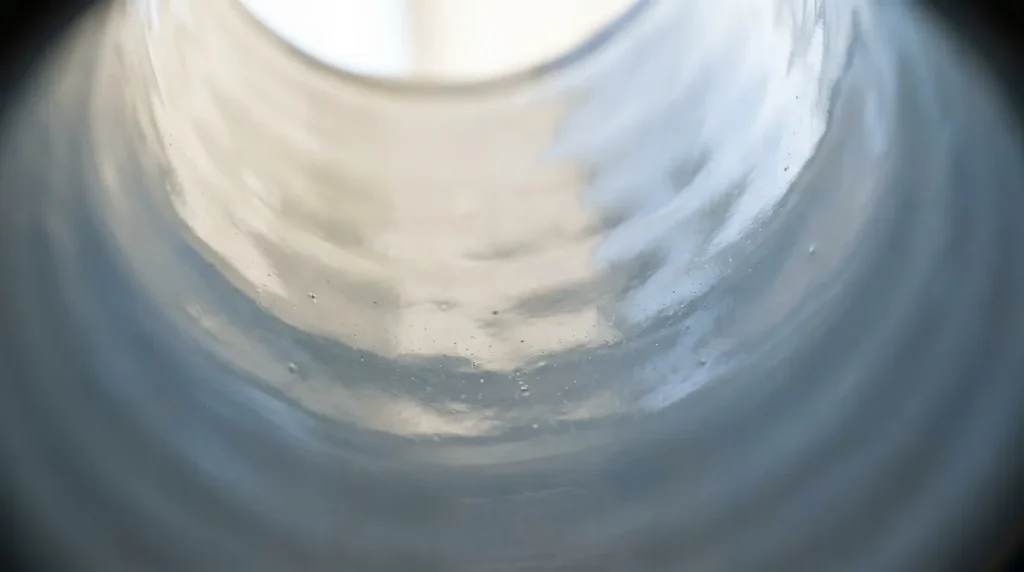
A mismatch between the coefficient of thermal expansion (CTE) of the glass coating and the underlying metal can cause cracks or delamination, reducing bonding strength. Improper formulation creates weak spots that become discontinuities once the vessel is pressurized. These latent defects often escape visual detection and require high-voltage spark testing per ISO 2746:2015 to identify before commissioning.
How Do Operational Practices Contribute to Damage?
Operational practices contribute to damage through thermal shock, mechanical impact, and excessive pressure during routine use. Glass-lined reactors can fail when subjected to rapid temperature changes, physical strikes, or hydroblasting forces that exceed the lining’s tolerance.
Key operational damage thresholds include:
- Impact: Allowing a hard object heavier than 1 lb (0.45 kg) to fall from greater than 9 in. (229 mm) can cause glass damage, as reported by De Dietrich Process Systems.
- Hydroblasting: Water pressures exceeding 2,000 PSI (137.9 bar) at a nozzle distance less than 12 in. (305 mm) risk fracturing the lining.
- Thermal shock: Glass can fail under rapid heating or cooling cycles during operation, leading to loss of primary containment.
A chip represents localized glass-lining material loss, commonly from impact, producing an exposed area that may develop into a pinhole, discontinuity, or crack-propagation point. Once glass becomes chipped, scratched, or cracked, the allowable stress and pressure rating become indeterminate. For reactors normally rated at 100 to 150 PSI (6.89 to 10.34 bar), this uncertainty makes continued operation a serious risk.
What Role Do Chemical Exposures Play in These Failures?
Chemical exposures play a critical role in these failures by dissolving or degrading the glass lining from within. While glass-lined steel resists most acids and solvents, specific chemical environments attack the silica-based coating aggressively.
The most damaging chemical exposures include:
- Hydrofluoric acid (HF): Particularly corrosive to silica-containing materials at any temperature or concentration, as documented by Oak Ridge National Laboratory.
- Hot, concentrated phosphoric acid: Penetrates the glass network under elevated temperatures.
- Highly alkaline chemicals: At pH 11.5 and above, the high solubility of glass network formers (silicon, aluminum, zirconium) triggers rapid, congruent dissolution of the lining, according to research published by Pacific Northwest National Laboratory in Geochimica et Cosmochimica Acta.
Glass degradation depends on the material’s chemical composition, short- and medium-range structural order, and environmental conditions such as temperature, pH, and solution chemistry. Many operators underestimate how quickly alkaline cleaning agents or caustic process streams erode glass linings, particularly at elevated temperatures. Even brief exposures above the critical pH threshold can initiate irreversible surface dissolution.
Understanding these chemical boundaries is essential for selecting the right detection and inspection methods.
How Can You Identify Chips, Cracks, and Discontinuities in Glass-Lined Equipment?
You can identify chips, cracks, and discontinuities in glass-lined equipment through visual inspection and non-destructive testing methods such as spark testing and eddy-current thickness measurement. Early detection prevents substrate corrosion and unplanned shutdowns.
What Visual Inspection Techniques Are Used to Detect Damage?
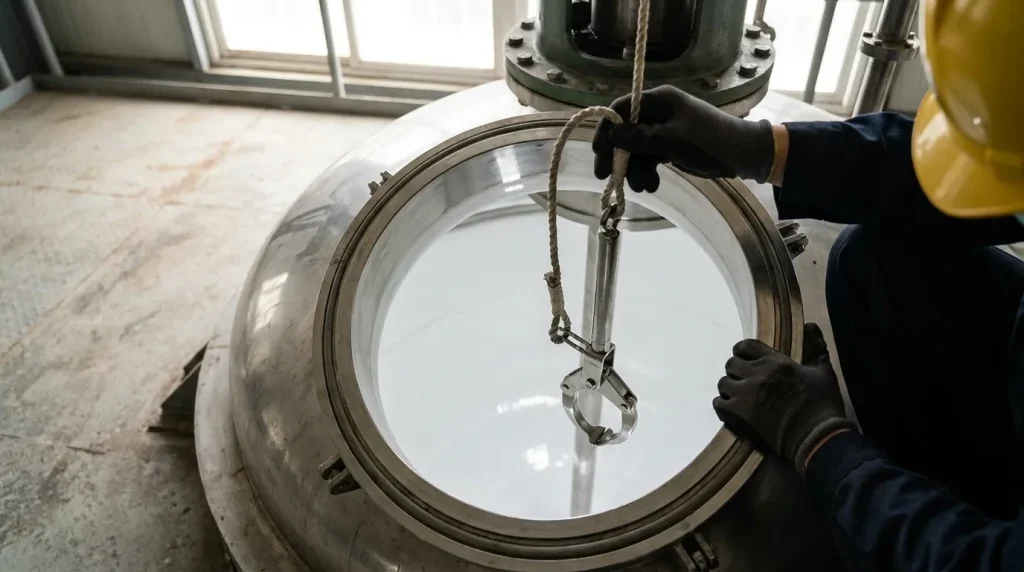
Visual inspection techniques used to detect damage in glass-lined equipment include direct surface examination under high-intensity lighting, looking for discoloration, roughness changes, and exposed metal. Inspectors check nozzle areas, baffles, and agitator zones where impact and erosion concentrate. According to Химическая инженерия, the key to a long, healthy life for glass-lined equipment is an inspection and maintenance program designed for early detection of damage. Surfaces must be clean and dry before examination, since moisture can mask pinholes and hairline cracks. Documenting each inspection with photographic records and grid-mapped notes creates a baseline for tracking progressive wear over time.
Which Non-Destructive Testing Methods Help Spot Hidden Flaws?
Non-destructive testing (NDT) methods that help spot hidden flaws include high-voltage spark testing, eddy-current thickness measurement, and low-voltage discontinuity detection. A discontinuity is a pinhole, void, or weak spot in a non-conductive lining over a conductive metal substrate, detected when electrical continuity is created through the defect. ISO 2746:2015 describes two high-voltage test methods: Test A detects and locates defects in vitreous and porcelain enamels, while Test B detects both defects and weak spots. Eddy-current probes measure remaining glass thickness with readings mapped on a grid pattern. Combining spark testing with thickness mapping gives process engineers a complete picture of lining integrity before scheduling repairs.
With damage properly identified, the next step is understanding the risks of continued operation.
What Are the Risks of Operating Reactors with Chips, Cracks, or Discontinuities?
The risks of operating reactors with chips, cracks, or discontinuities include compromised safety, product contamination, indeterminate pressure ratings, and significant financial losses. These consequences affect both personnel protection and batch integrity.
How Do These Failures Impact Safety and Product Purity?
These failures impact safety and product purity by exposing the carbon steel substrate to corrosive process chemicals and by introducing metallic contaminants into the batch. Once the glass lining is breached, even at a single pinhole, aggressive media attack the underlying steel directly. According to a study at Oak Ridge National Laboratory, SS-316 coupons exposed to hydrofluoric acid lost approximately 60% of their mass in four weeks, yielding a corrosion rate of 550 mpy (13.97 mm/year). Substrate corrosion at a chip or discontinuity site progresses beneath the surrounding intact lining, undermining structural integrity in ways that are invisible from the vessel surface.
As noted in AIChE’s Chemical Engineering Progress, once glass becomes chipped, scratched, or cracked, the allowable stress and pressure rating become indeterminate. A reactor operating at its normal rating of 100 to 150 PSI (6.89 to 10.34 bar) may no longer safely contain that pressure. For pharmaceutical production, the risk extends beyond mechanical failure: the ICH Q3D guideline identifies interactions with processing equipment as a source of elemental impurities in drug products. Iron and chromium leaching from exposed steel can force batch rejection and trigger regulatory action.
What Financial and Operational Consequences Can Result?
Financial and operational consequences from glass-lining defects include unplanned shutdowns, scrapped batches, emergency repairs, and cascading production delays. According to a 2022 Siemens study on industrial downtime, unplanned outages now cost Fortune Global 500 companies 11% of yearly turnover, totaling nearly $1.5 trillion, up from $864 billion (8% of turnover) two years earlier. While that figure spans all industries, glass-lined reactor failures contribute disproportionately in chemical and pharmaceutical plants because a single compromised vessel can halt an entire process train.
The cost implications extend beyond the immediate repair:
- Batch contamination from exposed substrate requires disposal of in-process material, raw materials, and intermediates.
- Regulatory hold times increase when product purity documentation cannot be verified.
- Emergency procurement of replacement reactors or components carries premium pricing and extended lead times compared to planned purchasing.
For most operations, the total cost of an undetected discontinuties or crack far exceeds the cost of routine spark testing and thickness measurement programs. Proactive detection remains the most reliable strategy for controlling both risk and expenditure.
Understanding these financial consequences clarifies why prompt repair or replacement decisions matter.
How Should You Respond When Chips, Cracks, or Discontinuities Are Detected?
You should respond by assessing defect severity and choosing between field repair, factory reglassing, or replacement. The subsections below cover available repair methods and the conditions that warrant retiring or reconditioning glass-lined equipment.
What Repair or Replacement Options Are Available?
The repair or replacement options available for damaged glass-lined reactors include tantalum plugs, tantalum patches, factory reglassing, and full vessel replacement. According to Химическая инженерия, damaged areas can be repaired with a tantalum plug for small holes up to 4 in. (10 cm) in diameter, or a tantalum patch comprising a sheet of tantalum with a PTFE gasket for larger areas of damage.
Qualified personnel, typically the equipment manufacturer or an experienced contractor, should perform all glass-lined equipment repairs. Reglassing or sourcing a good used replacement vessel also offers a strong path forward.
When Is It Necessary to Retire or Recondition Glass-Lined Equipment?
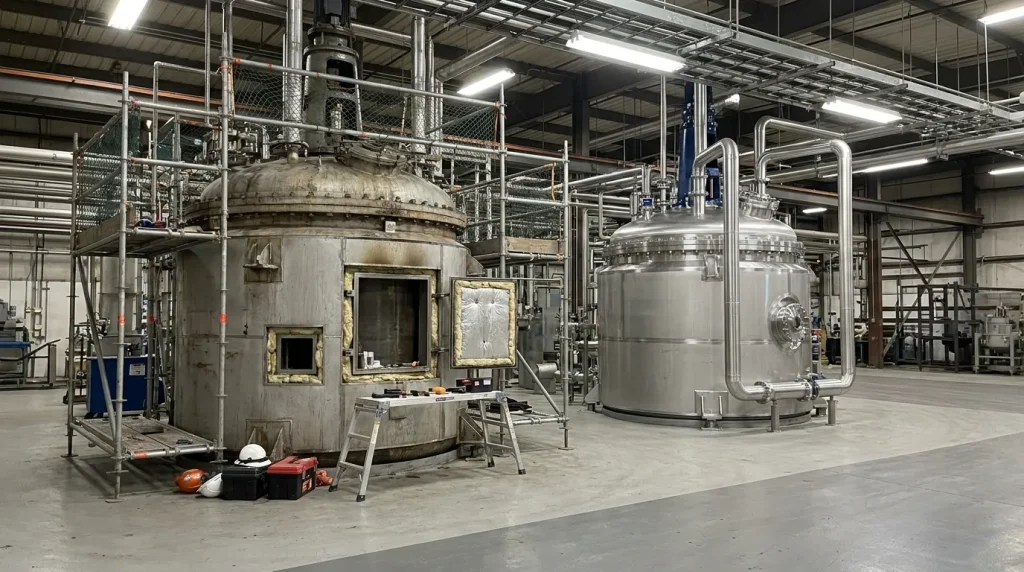
It is necessary to retire or recondition glass-lined equipment when lining thickness, defect severity, or cumulative repair history makes continued service unreliable.
Key indicators that signal retirement or reconditioning is necessary:
- Glass thickness falls below the minimum threshold despite localized repairs.
- Multiple overlapping patches reduce vessel integrity or usable surface area.
- Process chemistry involves aggressive reactants that have degraded lining quickly, such as those in pharmaceutical, specialty chemical, or polymer production
Major glass-lined equipment manufacturers offer field repair and reglassing services. However, reglassing involves manufacturing costs plus non-destructive examination and recertification. For procurement teams weighing total cost, a quality-inspected replacement can also restore production faster and at lower cost than buying new equipment.
How Can You Prevent Chips, Cracks, and Discontinuities in Glass-Lined Reactors?
You can prevent chips, cracks, and discontinuities in glass-lined reactors by combining disciplined operator practices with a structured maintenance program. The following subsections cover operational best practices and maintenance intervals.
What Best Practices Should Operators Follow?
Operators should follow best practices that address the three primary damage vectors: mechanical impact, thermal shock, and chemical exposure. Preventing these failures starts before any process begins.
- Never allow hard objects heavier than 1 lb (0.45 kg) to fall from greater than 9 in. (23 cm) onto glass-lined surfaces, as even this modest impact energy of approximately 1.02 J can cause glass damage.
- Keep hydroblasting pressures below 2,000 PSI (137.9 bar) and maintain nozzle distance greater than 12 in. (30.5 cm) from lined surfaces.
- Observe published temperature limits: standard glass-lined steel operates up to 500°F (260°C) and down to -94°F (-70°C).
- Avoid introducing fluorides at any concentration, hot concentrated phosphoric acid, or highly alkaline chemicals at elevated temperatures.
- Follow written thermal ramp procedures to prevent thermal shock during heating and cooling transitions.
For most facilities, the simplest gains come from enforcing impact-prevention protocols, since mechanical damage remains the most common and most preventable cause of glass-lining failure.
How Does Regular Maintenance Reduce Failure Risks?
Regular maintenance reduces failure risks by catching damage at the earliest possible stage, before exposed steel corrodes and before minor defects propagate into safety incidents. According to Химическая инженерия, glass-lined equipment should be inspected at regular maintenance intervals ranging from several times a year to once every two years, depending on the severity of service.
A structured program should include:
- Scheduled spark testing per ISO 2746 or AMPP SP0188-2024 after each batch campaign or turnaround.
- Glass-thickness measurements mapped on a grid at 24–36 in. (61–91.5 cm) intervals, with frequency increasing to every three to six months for aggressive chemistries.
- Documentation of all readings to track thinning trends over time.
Early detection is what separates a minor tantalum plug repair from a full reglassing project or unplanned shutdown. Facilities that treat inspection as a routine operating expense, rather than a reactive measure, consistently achieve longer equipment service life.
With prevention and maintenance strategies established, sourcing reliable replacement equipment becomes the next consideration.
How Can International Process Plants Help with Glass-Lined Reactor Failures?
International Process Plants helps with glass-lined reactor failures by supplying good used and new surplus glass-lined systems that meet ISO 28721 quality requirements for process plant service. The subsections below cover sourcing through Universal Glasteel Equipment (UGE) and key takeaways from this guide.
Can Universal Glasteel Equipment (UGE) Provide Replacement or Refurbished Glass-Lined Systems?
Yes, Universal Glasteel Equipment (UGE) can currently provide replacement glass-lined systems. As International Process Plants’ subsidiary focused on glass and glass-lined equipment, UGE supplies good used and new surplus glass-lined reactors, receivers, and components for pharmaceutical, specialty chemical, and agrochemical applications.
Sourcing good used glass-lined equipment through UGE typically costs approximately 50% of new equipment pricing. Replacing a failing reactor quickly with a quality-verified vessel eliminates that contamination pathway.
UGE’s glass-lined inventory includes vessels rated for standard service up to 500°F (260°C) and down to -94°F (-70°C). Every unit undergoes inspection before sale, so buyers receive equipment with verified lining integrity rather than inheriting hidden defects.
What Are the Key Takeaways About Common Glass-Lined Reactor Failures, Chips, Cracks, and Discontinuities Explained?
The key takeaways about common glass-lined reactor failures, chips, cracks, and discontinuities are:
- Chips, cracks, and discontinuities each expose the steel substrate to corrosive process media, making every defect type an urgent integrity concern.
- Manufacturing variables, operational practices like thermal shock and mechanical impact, and aggressive chemical exposures all contribute to glass-lining failure.
- Spark testing and thickness measurement at intervals of three to six months for aggressive service detect damage before it compromises safety or product purity.
- When damage is moderate to severe, reglassing or full replacement is often more efficient and cost-effective than repeated field repairs.
- Good used glass-lined reactors from International Process Plants offer a cost-effective alternative at roughly 50% of new pricing, with verified lining condition and faster delivery than reglassing or new fabrication.
Early detection paired with a reliable sourcing strategy keeps glass-lined reactor systems productive and compliant across pharmaceutical, chemical, and specialty applications.

 RU
RU  EN
EN  ES
ES  FR
FR  PL
PL  DE
DE  AR
AR  UR
UR  HI
HI  NL
NL  TR
TR  IT
IT  UK
UK  JA
JA  PT
PT  ZH
ZH