 Przejdź do treści
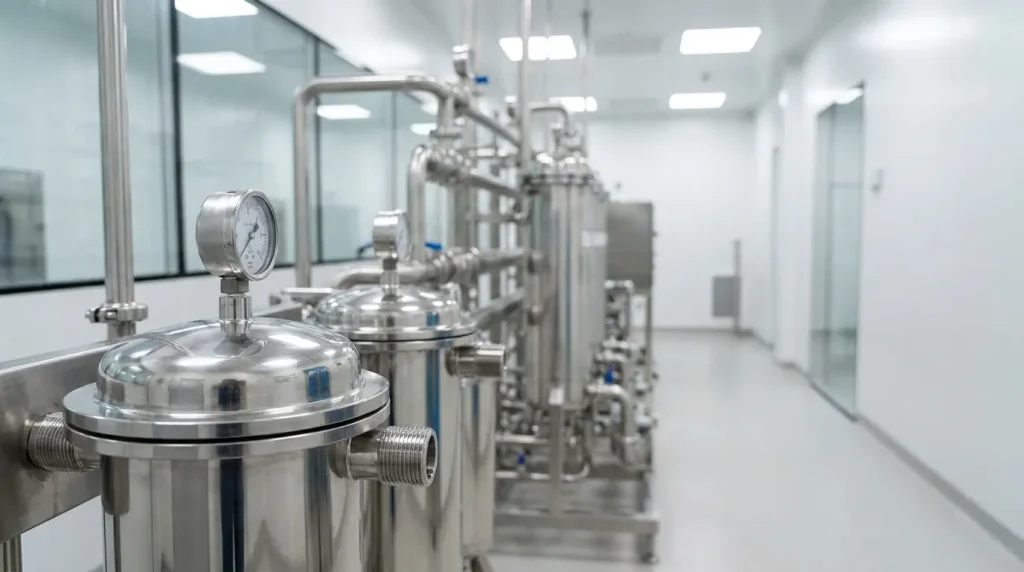
cGMP filters for pharma are filtration systems designed, manufactured, and validated to meet current Good Manufacturing Practice standards established by regulatory authorities including the FDA, EMA, PIC/S, and WHO. These filters remove microorganisms, particulates, and fibers from process streams to protect drug product integrity and patient safety.
This guide covers regulatory compliance requirements, filter selection criteria, contamination control strategies, maintenance best practices, and equipment sourcing considerations.
Regulatory frameworks from multiple authorities govern filter specifications, with FDA 21 CFR Part 211 mandating non-fiber-releasing filters at 0.2 micron (0.00008 in) (or 0.45 micron (0.00018 in) if the manufacturing conditions so dictate) pore ratings for injectable products if use of a fiber-releasing filter is necessary, while EudraLex Volume 4, Annex 1 requires comprehensive Contamination Control Strategies across pharmaceutical facilities.
Filter selection depends on material compatibility with process fluids, validation status, and certification documentation. USP 665 and USP 1665 standards now establish mandatory extractables and leachables testing for plastic components, ensuring product-contact materials do not compromise drug formulations.
Maintenance protocols vary by cleanroom classification, with ISPE analysis recommending preventive maintenance intervals of 6 months for Grade A and B areas and 1 year for Grade C and D areas. Documentation requirements include integrity test results and lot traceability information.
Advancements in filtration technology offer improved efficiency and reduced energy consumption. Nanofiber media achieves 99.97% particle capture at lower pressure drops, while single-use systems eliminate cleaning validation requirements for multi-product facilities.
How do cGMP requirements influence the selection of filters for pharmaceutical applications?
cGMP requirements influence filter selection by mandating specific performance standards, material compatibility, and validation protocols that ensure patient safety. The subsections below cover the main filter types used in pharmaceutical processes and how regulatory authorities define and enforce these standards.
What are the main types of cGMP filters used in pharmaceutical processes?
The main types of cGMP filters used in pharmaceutical processes are membrane filters, depth filters, HEPA filters, and sterilizing-grade filters. Depth filters capture particles throughout their matrix, making them suitable for clarification and prefiltration stages.
HEPA filters protect cleanroom environments by removing 99.97% of airborne particles at 0.3 micron (0.000012 in). According to a 2018 ISPE analysis of 804 HEPA filters over 4.33 years, media leak failure rates reached only 1.4%, with recommended preventive maintenance intervals of 1 year for Grade B areas to maintain 95-98% pass rates.
Sterilizing-grade filters undergo bacterial challenge testing to confirm retention capability. Each filter type serves distinct cGMP applications, from air handling to final product processing.
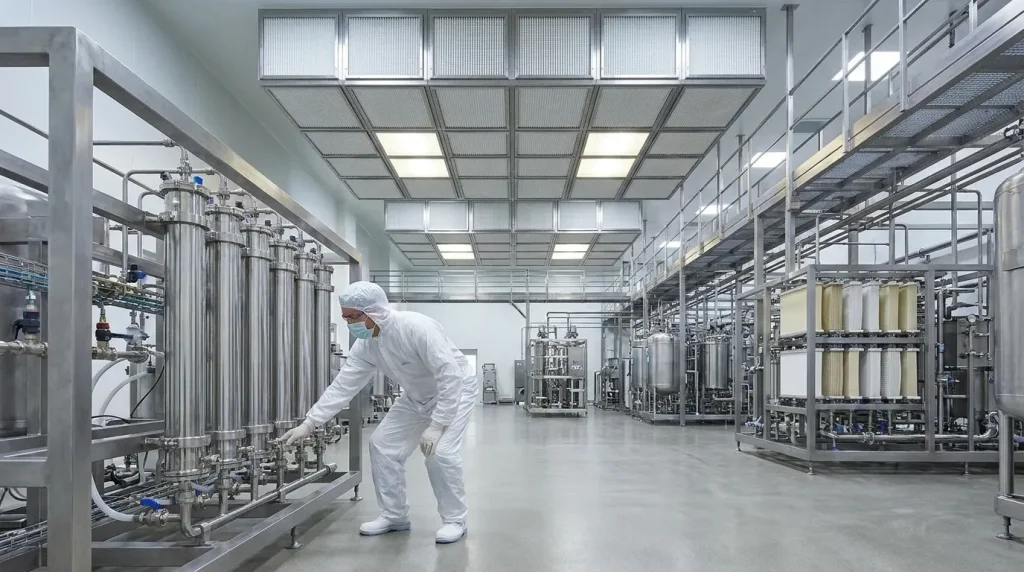
How do regulatory authorities define and enforce cGMP standards for filtration?
Regulatory authorities define and enforce cGMP standards for filtration through published guidelines, inspection programs, and enforcement actions.
Key regulatory frameworks include:
- FDA (United States): 21 CFR Part 211 mandates non-fiber-releasing filters with maximum 0.2 micron (0.00008 in) (or 0.45 micron (0.00018 in) if the manufacturing conditions so dictate) pore ratings for injectable products if use of a fiber-releasing filter is necessary.
- EMA (European Union): EudraLex Volume 4, Annex 1 specifies cleanroom grades A through D and requires Contamination Control Strategies
- PIC/S: Harmonizes inspection standards across 57 participating authorities globally
- WHO: Provides prequalification guidance for markets lacking mature regulatory infrastructure
According to a 2023 Mabion regulatory comparison, EU GMPs require a Qualified Person and defined validation batches, while FDA inspections carry stricter enforcement through warning letters and import alerts. North America holds over 45.6% of the 2025 pharmaceutical filtration market share, partly driven by these stringent standards.
Eight African countries have achieved WHO Maturity Level 3 certification, indicating stable regulatory systems. Manufacturers exporting globally must align filtration practices with the most stringent applicable framework to avoid compliance gaps during inspections.
What are the key considerations when choosing cGMP-compliant filters for pharma?
The key considerations when choosing cGMP-compliant filters for pharma are material compatibility, validation status, and certification documentation. These factors determine whether a filter will protect product integrity while satisfying regulatory inspections.
How does filter material compatibility affect pharmaceutical product safety?
Filter material compatibility affects pharmaceutical product safety by determining whether the filter will introduce contaminants, react with process fluids, or release extractables into the drug product. Incompatible materials can compromise entire batches and trigger costly recalls.
Materials must resist chemical attack from solvents, acids, bases, and active pharmaceutical ingredients at varied process temperatures. USP 665 and USP 1665 standards now establish mandatory extractables and leachables testing requirements for plastic components in pharmaceutical manufacturing, according to Element Materials Technology. These standards govern single-use systems to ensure safety, efficacy, and quality of biopharmaceutical products.
The European Commission’s EudraLex Volume 4, Annex 1 requires facilities to implement a Contamination Control Strategy defining all critical control points and assessing the effectiveness of design, procedural, technical, and organizational controls. Filter material selection sits at the center of this strategy.
Common cGMP-compliant filter materials include:
- Polyethersulfone (PES) for low protein binding
- Polyvinylidene fluoride (PVDF) for aggressive solvents
- Polytetrafluoroethylene (PTFE) for broad chemical resistance
- Borosilicate glass fiber for HEPA applications
- 316L stainless steel for high-temperature steam filtration
Material compatibility documentation should accompany every filter purchase, enabling quality teams to verify suitability before installation.

What is the significance of filter validation and certification in cGMP processes?
The significance of filter validation and certification in cGMP processes is that they provide documented evidence the filter performs consistently under actual operating conditions. Without validation, manufacturers cannot demonstrate process control during regulatory inspections.
Validation encompasses bacterial challenge testing, integrity testing, and extractables profiling. A Parenteral Drug Association survey found that 73.0% of organizations do not file health-authority notifications for Grade A HEPA filter recertification failures, and 57.8% have no requirement to discard filters based on age. This gap between regulatory expectations and industry practice creates compliance risk.
Certification documents should include:
- Bacterial retention data for sterilizing-grade filters
- Integrity test specifications
- Lot traceability information
- Extractables profiles per USP standards
Procuring used process equipment requires verifying that associated filtration systems retain valid certifications or can be revalidated cost-effectively.
How do cGMP filters contribute to contamination control in pharmaceutical production?
cGMP filters contribute to contamination control by removing microorganisms, particulates, and fibers from process streams before they reach finished drug products. The following subsections explain how retention features protect purity and what happens when non-compliant filters enter the process.
How do microbial and particulate retention features impact product purity?
Microbial and particulate retention features impact product purity by creating physical barriers that prevent contamination from reaching sterile drug formulations. Membrane filters with 0.2 micron (200 nm) pore ratings capture bacteria and larger particulates, while 0.1 micron (100 nm) filters retain smaller microorganisms including mycoplasma.
Key retention mechanisms include:
- Absolute-rated membranes that guarantee no passage of particles above the stated size
- Depth filtration media that trap contaminants throughout the filter matrix
- Hydrophobic barriers in vent filters that block liquid while allowing sterile gas exchange
- HEPA filters achieving 99.97% efficiency at 0.3 micron for cleanroom air handling
These features work together within a facility’s Contamination Control Strategy. According to European Commission EudraLex Volume 4, Annex 1, manufacturers must implement a CCS across the facility to define all critical control points and assess the effectiveness of all controls employed to manage risks to medicinal product quality.
What are common risks if non-cGMP filters are used in pharma?
The common risks if non-cGMP filters are used in pharma include product contamination, batch rejection, regulatory enforcement actions, and patient safety incidents. Non-compliant filters may release fibers, shed particles, or fail to meet validated retention specifications.
Specific risks include:
- Fiber shedding into injectable products, which FDA 21 CFR Part 211 explicitly prohibits
- Extractables and leachables migrating into drug formulations from untested filter materials
- Inconsistent microbial retention leading to sterility test failures
- Undocumented filter performance making batch release impossible
A 2025 WHO and UNODC report documented over 1,300 deaths from contaminated medicines over 90 years, predominantly affecting children in low- and middle-income countries. While these incidents involved excipient contamination rather than filter failures specifically, they underscore why every component in pharmaceutical manufacturing requires rigorous qualification.
Using non-validated filters undermines the entire quality system. Without proper documentation, manufacturers cannot demonstrate compliance during inspections, potentially triggering warning letters, import alerts, or facility shutdowns.
What are best practices for maintaining and monitoring cGMP filters in pharma operations?
Best practices for maintaining and monitoring cGMP filters in pharma operations include scheduled inspections, condition-based replacement strategies, and rigorous documentation systems. The following subsections detail inspection frequencies and traceability requirements.
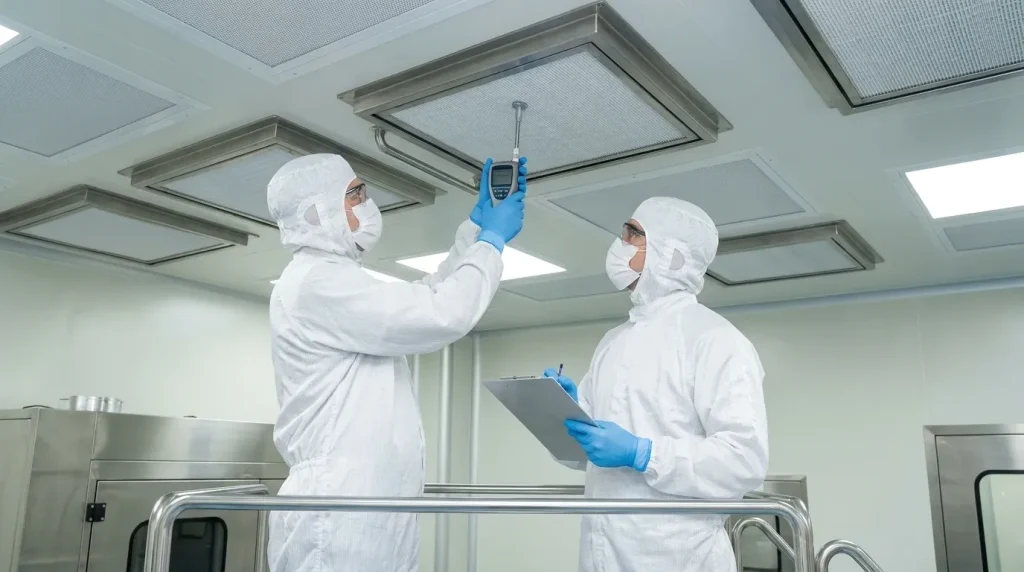
How frequently should cGMP filters be inspected or replaced in pharmaceutical plants?
cGMP filters should be inspected or replaced based on cleanroom classification and operational criticality. According to ISPE’s 2018 Weibull distribution analysis of 804 HEPA filters over 4.33 years, recommended preventive maintenance intervals are 1 year for Grade B areas to achieve a 95 to 98% pass rate.
Most facilities combine multiple monitoring approaches:
- Conditional monitoring based on performance data
- Scheduled time-based replacement cycles
- Continuous tracking of leak-test results, particle counts, and velocity-test measurements
Grade A filters in aseptic zones require the most frequent verification due to direct product exposure. For facilities serving global markets, align inspection schedules with both FDA expectations and EudraLex Annex 1 requirements, which mandate continuous air pressure monitoring in cleanrooms.
What documentation is required for cGMP filter traceability and compliance?
The documentation required for cGMP filter traceability and compliance includes integrity test results. WHO guidelines specify that SOPs must contain clear, step-by-step instructions covering procedures, safety precautions, sample preparation, and complete data recording.
Essential documentation elements include:
- Filter specifications
- Integrity and leak-test certificates from each verification cycle
Facilities manufacturing injectable products must maintain additional records proving compliance with 21 CFR Part 211 requirements for non-fiber-releasing filters. Electronic batch records should link filter documentation directly to affected product lots for rapid traceability during audits or recalls.
With documentation systems established, advancements in filtration technology offer new ways to enhance manufacturing efficiency.
How do advancements in cGMP filtration technology enhance pharma manufacturing efficiency?
Advancements in cGMP filtration technology enhance pharma manufacturing efficiency by improving particle capture rates, reducing energy consumption, and enabling faster changeovers. The following subsections examine current innovations in filter design and materials, and compare single-use versus reusable systems.
What are current innovations in filter design and materials for the industry?
Current innovations in filter design and materials for the pharmaceutical industry include nanofiber media, advanced monitoring systems, and improved membrane chemistries. Nanofiber filtration technology achieves 99.97% efficiency at pressure drops as low as 6 mm H₂O, providing energy savings and PFAS-free construction for HVAC and specialized applications, according to Matregenix.
Modern facilities increasingly combine condition-based monitoring with scheduled replacement strategies. A Parenteral Drug Association survey of 65 industry organizations found that 82.0% track filter leak-test results, 78.7% monitor particle counts, and 77.0% track velocity-test results. This data-driven approach optimizes filter lifespan while maintaining compliance. From a practical standpoint, investing in real-time monitoring systems often pays for itself through reduced unplanned downtime and extended filter service intervals.
How do single-use and reusable cGMP filter systems compare?
Single-use and reusable cGMP filter systems compare across key factors:
| Czynnik | Single-Use Systems | Reusable Systems |
| Cleaning validation | Eliminated | Required between batches |
| Cross-contamination risk | Lower | Higher without proper protocols |
| Changeover time | Faster | Slower |
| Capital cost | Lower initial investment | Higher initial investment |
| Operating cost | Higher consumable expense | Lower per-batch cost |
| Best fit | Multi-product facilities, CMOs | High-volume, single-product lines |
Single-use systems eliminate cleaning validation requirements and reduce cross-contamination risks, making them attractive to contract manufacturing organizations and multi-product facilities. Reusable systems remain cost-effective for dedicated production lines with high annual throughput. The choice depends on production volume, product portfolio complexity, and facility changeover frequency.
With filtration technologies continuing to evolve, pharmaceutical companies must also consider how these advancements apply when sourcing used or refurbished process equipment.
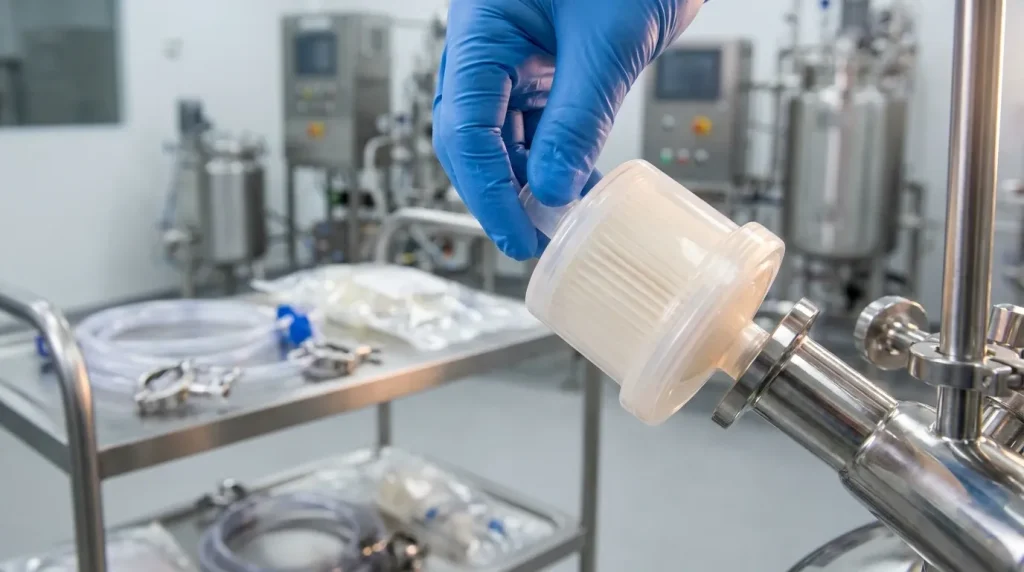
How should pharmaceutical companies approach cGMP filter needs when sourcing used or refurbished equipment?
Pharmaceutical companies should approach cGMP filter needs when sourcing used or refurbished equipment by verifying complete documentation, confirming regulatory compliance history, and assessing equipment condition against current validation requirements. The sections below explain how quality used equipment can meet both regulatory and budget objectives, followed by a summary of key takeaways.
Can sourcing used cGMP-compliant process equipment from International Process Plants help meet regulatory and budget goals?
Yes, sourcing used cGMP-compliant process equipment from International Process Plants can help meet both regulatory and budget goals when proper due diligence confirms the equipment’s compliance history. The key is verifying that any process equipment, including vessels, reactors, and filtration housings, maintains documentation showing it was originally built and operated to cGMP standards.
According to FDA 21 CFR Part 211, filters for liquid filtration in injectable drug manufacturing must not release fibers, with any fiber-releasing filter followed by a non-fiber-releasing filter rated at 0.2 micron (0.45 micron if conditions dictate). This requirement applies equally to new and used equipment.
International Process Plants maintains an inventory of over 15,000 pieces of equipment, including pharmaceutical-grade vessels and process systems from facilities that operated under FDA, EMA, and PIC/S oversight. When evaluating used equipment for cGMP applications, we provide:
- Original equipment specifications and material certifications (316L, 316, 304, 304L stainless steel)
- Historical validation documentation when available from decommissioned facilities
- Traceability records supporting requalification efforts
- Technical support for integration into existing contamination control strategies
For companies managing capital expenditure constraints while maintaining compliance, good used equipment offers a practical middle ground. A quality used reactor vessel at approximately 50% of new equipment cost allows budget allocation toward fresh filter media and revalidation activities.
What are the key takeaways about cGMP filters for pharma we covered?
The key takeaways about cGMP filters for pharma are that regulatory compliance drives every filtration decision, validation documentation is non-negotiable, and equipment sourcing strategy directly impacts both product safety and capital efficiency.
Throughout this article, we established that:
- cGMP filter selection requires alignment with FDA, EMA, PIC/S, and WHO standards governing pore size, material compatibility, and fiber release prevention
- Filter types serve distinct purposes: HEPA for cleanroom air, membrane for sterile liquid filtration, and depth filters for clarification
- Validation and certification create the audit trail regulators require, with recommended maintenance intervals of 6 months to 1 year depending on cleanroom grade
- Extractables and leachables testing under USP 665 applies to all product-contact components
- Single-use systems reduce cross-contamination risk but increase consumable costs; reusable systems require rigorous cleaning validation
For pharmaceutical companies balancing compliance with budget realities, International Process Plants offers access to quality used process equipment with documented provenance. Our 46 years of experience serving pharmaceutical, chemical, and industrial clients across 15 countries means we understand both the regulatory landscape and the practical engineering requirements. Contact International Process Plants to discuss how our inventory of pharmaceutical-grade vessels, reactors, and process systems can support your next project while preserving capital for critical consumables like filter media and validation activities.


 PL
PL  EN
EN  ES
ES  FR
FR  DE
DE  AR
AR  UR
UR  HI
HI  NL
NL  TR
TR  IT
IT  UK
UK  RU
RU  JA
JA  PT
PT  ZH
ZH