 Passer au contenu
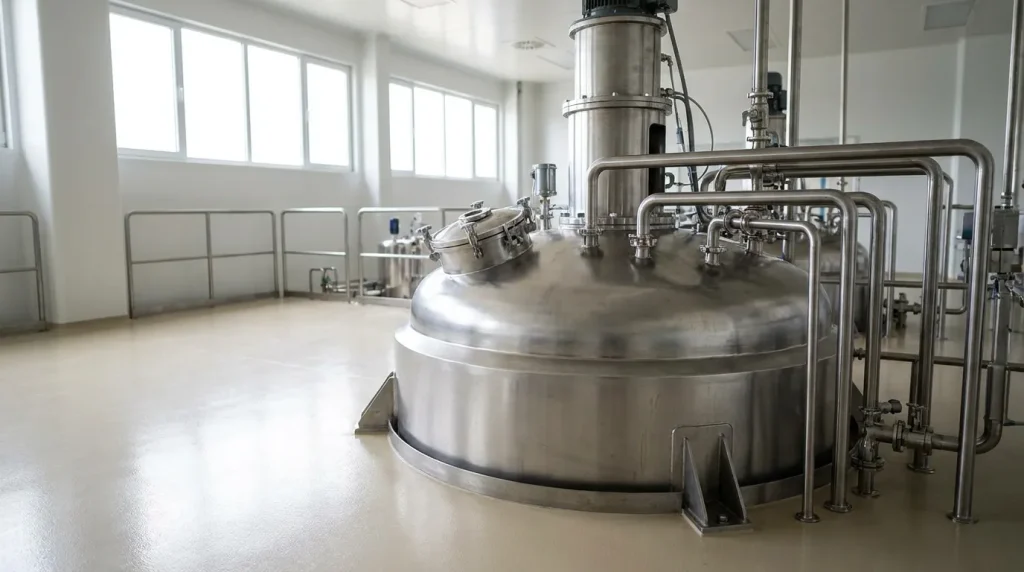
Reactor cleaning and clean-in-place (CIP) procedures are validated methods for removing process residues from reactor vessels to maintain product purity, operator safety, and regulatory compliance. This guide covers the operational risks of inadequate cleaning, standard cleaning methods and CIP cycle design, safety and chemical hazard controls, global compliance standards, and equipment considerations for different reactor types.
Residue buildup in batch reactors creates serious hazards, from uncontrolled exothermic reactions and toxic gas generation to accelerated corrosion in alloys such as 316L stainless steel and Hastelloy C-276. Cross-contamination between production campaigns can alter the identity, strength, and purity of finished products, triggering regulatory action in pharmaceutical and chemical manufacturing.
CIP systems address these risks by circulating chemical solutions and water rinses through the reactor without disassembly, following a defined sequence of pre-rinse, caustic wash, intermediate rinse, acid rinse, sanitization, and post-rinse. Each stage requires validated time, temperature, concentration, pressure, and flow matched to the specific soil type and vessel geometry.
Operator protection during these procedures depends on proper PPE selection, lockout/tagout protocols, confined space controls, and chemical exposure monitoring aligned with recognized occupational limits. Facilities must also align cleaning protocols with the governing fabrication standard for each vessel, whether ASME BPE, PED 2014/68/EU, API 510, or CE/UKCA marking requirements.
Cleaning effectiveness varies significantly across reactor types. Glass-lined vessels restrict chemical and mechanical options.
Why Is Reactor Cleaning Essential for Safe Industrial Operations?
Reactor cleaning is essential for safe industrial operations because residue buildup creates chemical hazards, degrades product quality, and compromises equipment integrity. The subsections below cover specific risks from inadequate cleaning and its direct impact on product safety.
What Risks Arise from Inadequate Reactor Cleaning?
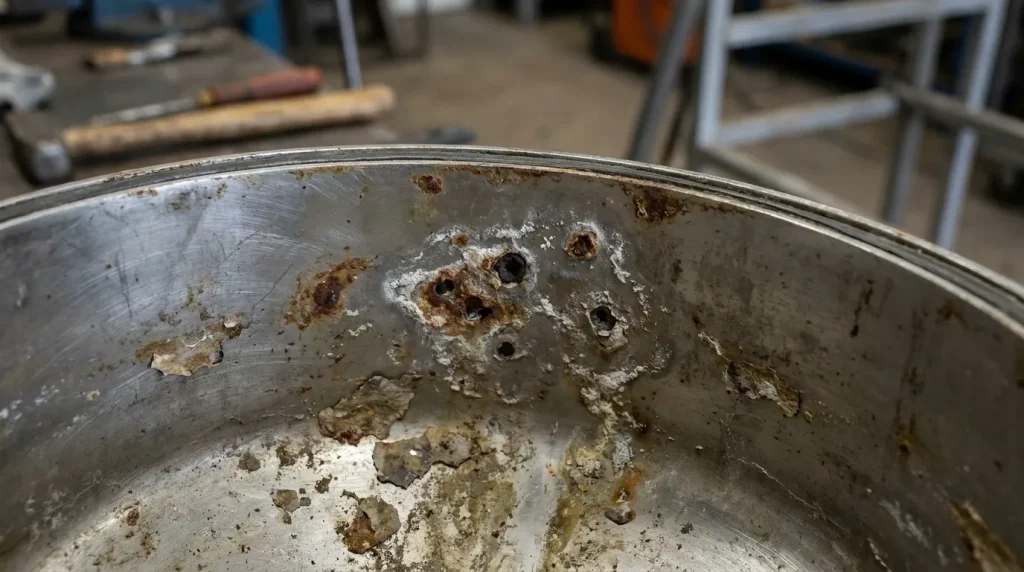
The risks that arise from inadequate reactor cleaning include chemical cross-contamination, uncontrolled exothermic reactions, corrosion acceleration, and operator exposure to hazardous residues. Leftover process materials can react unpredictably with subsequent batches, generating toxic gases or dangerous pressure spikes inside the vessel. Accumulated deposits also trap moisture beneath their surface layer, accelerating pitting and crevice corrosion in alloys such as 316L and Hastelloy C-276.
Operator safety is equally compromised when cleaning agents lack established exposure limits. According to a 2025 NIOSH report, no OSHA or NIOSH occupational exposure limits exist for peracetic acid; the ACGIH Threshold Limit Value Short-Term Exposure Limit is only 0.4 ppm as a 15-minute time-weighted average. Without rigorous cleaning protocols, residual chemicals create unmonitored inhalation risks for maintenance crews entering reactor vessels.
What Are the Standard Cleaning Methods for Reactors?
The standard cleaning methods for reactors fall into two broad categories: manual cleaning and automated clean-in-place (CIP) systems. Each method suits different reactor configurations, soil types, and regulatory requirements.
What Differences Exist Between Manual Cleaning and CIP Systems?
The differences between manual cleaning and CIP systems center on automation, labor requirements, and validation complexity. Manual cleaning requires operators to disassemble reactor components, physically scrub interior surfaces, and visually inspect results. CIP systems circulate chemical solutions and rinses through the reactor without disassembly.
Key distinctions include:
- Access requirements: Manual cleaning demands confined-space entry into the reactor vessel; CIP keeps operators outside.
- Repeatability: CIP delivers consistent, programmable wash cycles; manual results vary with operator technique.
- Validation: CIP parameters (flow rate, temperature, chemical concentration, contact time, pressure) can be logged automatically, simplifying cleaning validation for regulated facilities.
- Cost profile: CIP requires higher upfront capital for spray devices, pumps, and controls, but reduces labor costs and downtime per cycle.
According to the International Society for Pharmaceutical Engineering, FDA inspections of cleaning processes have been occurring with greater frequency, making automated CIP documentation increasingly valuable for pharmaceutical batch reactors. For most process facilities running repeated batch campaigns, CIP offers a clear advantage in both compliance and throughput.
When Should Each Reactor Cleaning Method Be Used?
Each reactor cleaning method should be used based on production volume, soil type, and regulatory environment.
- CIP systems suit high-frequency batch operations in food, pharmaceutical, and fine chemical production where validated, repeatable cleaning is mandatory. According to research from the Technical University of Denmark, CIP is a widely used technique in food and pharmaceutical industries, and its execution is critical for food safety and public health.
- Manual cleaning is appropriate for infrequent product changeovers or older reactor vessels that lack CIP-compatible nozzle configurations.
- Hybrid approaches combine CIP for routine inter-batch cleaning with periodic manual intervention for stubborn residues or annual deep-cleaning inspections.
Reactor geometry, wetted-surface material (316L stainless steel, Hastelloy C-276, glass-lined carbon steel), and jacket design all influence which method delivers reliable soil removal. Understanding these factors helps determine whether equipment upgrades or operational adjustments are needed to maintain safe, compliant cleaning cycles.
What Does a Typical CIP (Clean-in-Place) Process Involve?
A typical CIP process involves a structured sequence of automated cleaning stages that remove residues from reactor vessels without disassembly. The main stages and the chemicals used in each step determine cleaning effectiveness.
What Are the Main Stages of an Effective CIP Cycle?
The main stages of an effective CIP cycle follow a validated sequence designed to remove specific soils from process equipment. A standard cycle includes:
- Pre-rinse removes loose residues and bulk soils using water at controlled temperature and flow rate.
- Caustic wash circulates an alkaline solution (typically sodium hydroxide) to dissolve organic deposits such as fats, proteins, and polymer residues.
- Intermediate rinse flushes caustic solution from all wetted surfaces before the next chemical stage.
- Acid rinse neutralizes alkaline residues and removes mineral scale or inorganic deposits.
- Sanitize applies a chemical sanitizer or thermal treatment to reduce microbial contamination on product-contact surfaces.
- Post-rinse uses purified water to remove all remaining chemical traces, leaving the reactor ready for the next production batch.
Each stage requires validated time, temperature, concentration, and flow parameters specific to the reactor geometry and the process soil being cleaned. Skipping or shortening any stage compromises the entire cycle’s effectiveness.
Which Chemicals and Equipment Are Commonly Used in CIP for Reactors?
The chemicals commonly used in CIP for reactors include caustic soda (sodium hydroxide), phosphoric acid, nitric acid, citric acid, and sanitizing agents such as peracetic acid or chlorine-based solutions. Chemical selection depends on the soil type, reactor metallurgy, and the product being manufactured.
Key CIP equipment includes:
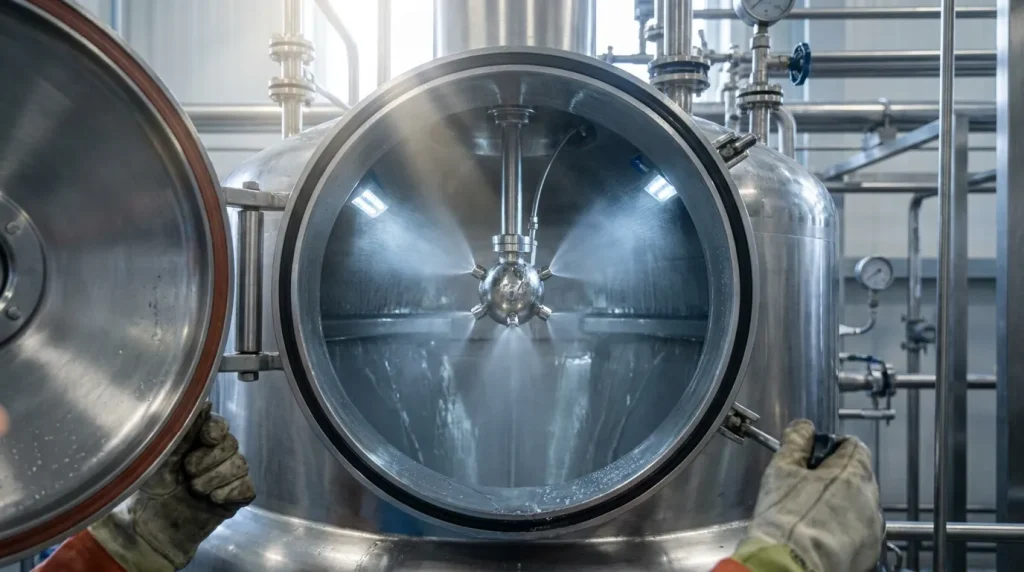
- Spray balls or rotary jet heads that distribute cleaning solutions across interior vessel surfaces.
- CIP supply and return tanks that hold fresh and recirculated cleaning solutions.
- Centrifugal pumps that maintain the flow velocity needed for effective surface contact.
- Échangeurs de chaleur that regulate solution temperatures during caustic and acid stages.
- Automated control systems with sensors for temperature, conductivity, and flow rate to ensure repeatable cycle parameters.
According to a review published in Comprehensive Reviews in Food Science and Food Safety (2023), CIP is the most commonly used cleaning and sanitation system for processing lines, equipment, and storage facilities in the global dairy processing industry. This widespread adoption reflects how effectively automated CIP reduces human error compared to manual methods. For reactors constructed from 316L stainless steel or Hastelloy C-276, chemical compatibility with each cleaning agent must be verified to prevent corrosion or surface degradation.
With the CIP process stages and chemistry established, maintaining operator safety throughout these procedures requires specific protocols and protective measures.
How Can You Ensure Safety During Reactor Cleaning and CIP Procedures?
You can ensure safety during reactor cleaning and CIP procedures by combining proper PPE selection, chemical hazard controls, and certified inspection protocols. The following subsections cover required protective equipment and strategies for minimizing chemical exposure and cross-contamination.
What PPE and Safety Protocols Should Be Followed?
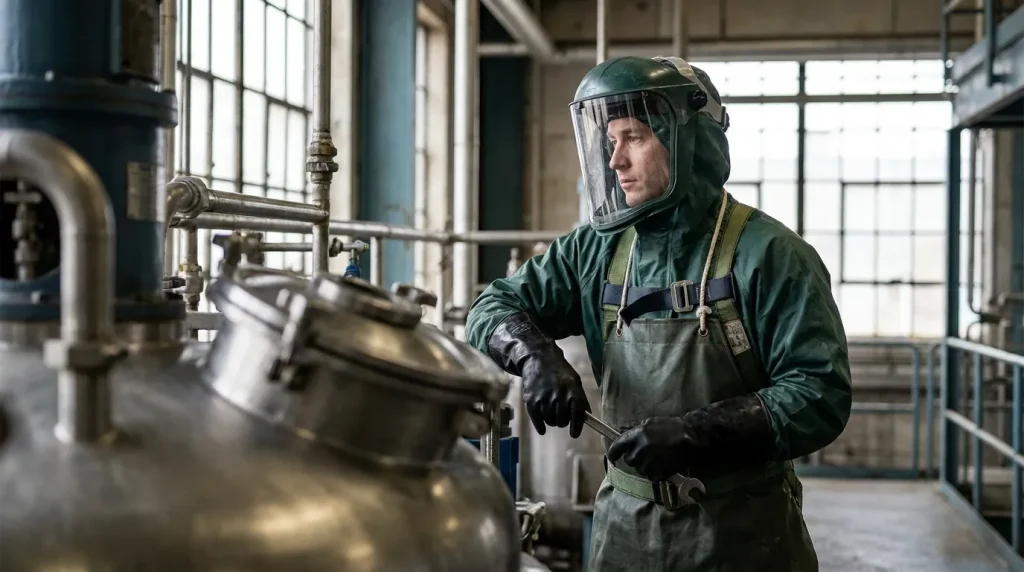
The PPE and safety protocols that should be followed include chemical-resistant gloves, full-face shields, splash-proof goggles, and acid/alkali-resistant suits rated for the specific cleaning agents in use. Respiratory protection is essential when working with volatile chemicals such as peracetic acid or sodium hydroxide in enclosed reactor vessels.
Beyond personal equipment, safety protocols require several procedural controls:
- Lockout/tagout (LOTO) procedures on all reactor agitators, valves, and pumps before manual entry or inspection.
- Confined space entry permits with continuous atmospheric monitoring for oxygen levels and toxic vapors.
- Emergency eyewash and shower stations positioned within 10 seconds of the cleaning area.
- Pressure verification to confirm the vessel is fully depressurized and isolated before opening any manway or nozzle.
API 510 Pressure Vessel Inspector certification validates the expertise of inspectors who examine pressure vessels and ensure their reliability and safety, according to the American Petroleum Institute. Scheduling certified inspections before and after intensive cleaning campaigns catches early signs of corrosion or gasket degradation that cleaning chemicals can accelerate.
How Can You Minimize Chemical Hazards and Cross-Contamination Risks?
You can minimize chemical hazards and cross-contamination risks by implementing exposure controls, proper chemical segregation, and validated rinse verification at every stage. CIP cycles commonly use caustic solutions (sodium hydroxide, CAS 1310-73-2) and acid rinses, both of which pose significant contact and inhalation hazards if handled improperly.
Key controls include:
- Reviewing Safety Data Sheets (SDS) for every cleaning agent before use, following COSHH assessment principles as outlined by the UK Health and Safety Executive.
- Setting workplace exposure limits aligned with recognized standards; for example, peracetic acid carries a Threshold Limit Value Short-Term Exposure Limit of 0.4 ppm as a 15-minute time-weighted average, per the American Conference of Governmental Industrial Hygienists.
- Segregating incompatible chemicals in separate storage areas to prevent accidental mixing.
- Verifying final rinse water quality through conductivity or TOC testing to confirm no cleaning agent residues remain before the next production batch.
For facilities handling multiple product families, dedicated CIP circuits or validated changeover procedures prevent active ingredient carryover between batches. With chemical hazards controlled, the next consideration is aligning these practices with the compliance standards that govern reactor cleaning across global jurisdictions.
What Compliance Requirements and Industry Standards Apply to Reactor Cleaning?
Compliance requirements for reactor cleaning span pressure vessel codes, regional conformity directives, and industry-specific hygiene standards. The following subsection covers how ASME, API, PED, and CE/UKCA standards shape cleaning procedures.
How Do ASME, API, PED, and CE/UKCA Standards Affect Cleaning Procedures?
ASME, API, PED, and CE/UKCA standards affect cleaning procedures by defining vessel design, material, inspection, and documentation requirements that directly govern how reactors must be maintained and cleaned.
ASME BPE (Bioprocessing Equipment) provides requirements for equipment used in pharmaceutical and bioprocessing industries, covering materials, design, fabrication, inspections, testing, and certification. These specifications dictate surface finish tolerances that cleaning protocols must achieve.
Key standards influencing reactor cleaning include:
- ASME Section VIII governs pressure vessel construction and sets inspection intervals that include post-cleaning verification.
- API 510 certifies pressure vessel inspectors who verify vessel integrity after cleaning and maintenance cycles.
- PED 2014/68/EU applies to stationary pressure equipment with a maximum allowable pressure above 0.5 bar (7.25 PSI), requiring conformity assessment that covers maintenance procedures.
- CE marking confirms European conformity, while UKCA marking serves the same function for the United Kingdom market.
Cleaning protocols must align with the specific standard under which a reactor was fabricated and certified. A vessel built to ASME BPE tolerances, for instance, requires validated cleaning cycles that maintain those surface finishes. Overlooking the governing standard during cleaning risks voiding the vessel’s certification, a costly mistake that proper documentation prevents.
With standards defining the baseline, cleaning becomes more complex when reactor types and conditions vary.
What Are the Key Challenges and Solutions When Cleaning Different Reactor Types?
The key challenges when cleaning different reactor types center on surface compatibility, vessel scale, and equipment age. Glass-lined and alloy reactors each demand distinct cleaning approaches, while large-scale or aged equipment introduces additional complexity.
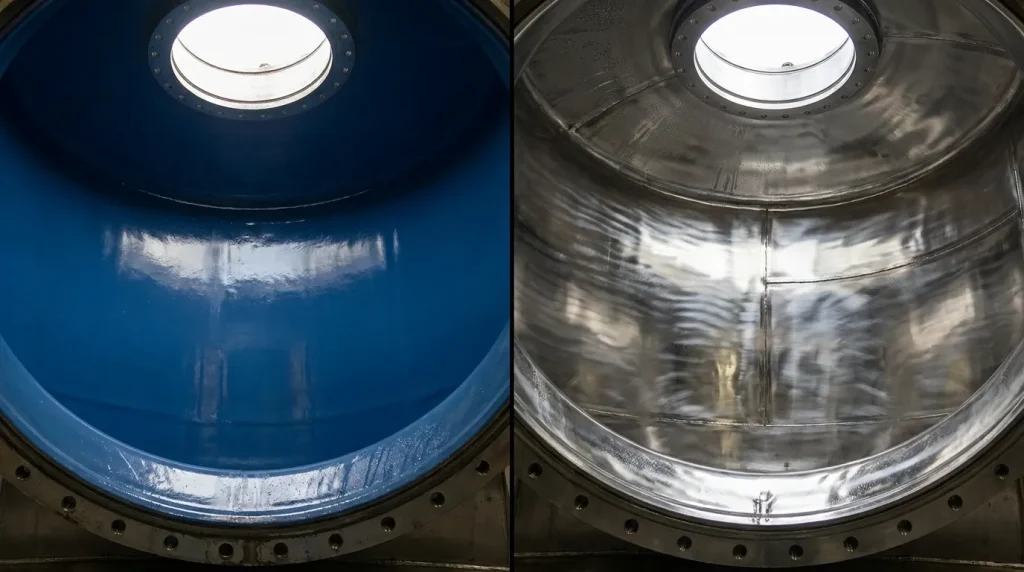
How Does Cleaning Differ for Glass-Lined vs. Alloy Reactors?
Cleaning differs for glass-lined vs. alloy reactors primarily in chemical compatibility, mechanical limits, and surface finish considerations. Glass-lined reactors require pH-neutral or mildly acidic cleaning agents because strong caustic solutions above pH 12 can damage the glass coating. Mechanical scrubbing must avoid abrasive tools that chip or crack the lining, since even small defects expose the base metal to corrosion.
Alloy reactors built from 316L or 304 stainless steel tolerate a broader range of cleaning chemicals, including caustic and acid washes. However, surface finish directly affects cleanability. According to a 2022 study published in Biomedical Instrumentation & Technology, rougher surfaces above a nominal Ra of 250 produced higher ATP readings, and different surface finishes showed different cleanabilities despite similar nominal Ra values. Smoother electropolished finishes on alloy vessels clean more effectively and reduce microbial retention.
What Special Considerations Are Needed for Large-Scale Equipment?
The special considerations needed for large-scale equipment include extended cleaning cycle times, structural inspection requirements, and modified chemical concentrations. Large reactors require higher flow rates and longer contact times to ensure cleaning solutions reach all internal surfaces, including baffles, dip tubes, and bottom outlets.
How Should You Approach Reactor Cleaning and CIP Procedures with Industrial Process Plant Equipment Solutions?
You should approach reactor cleaning and CIP procedures with equipment that supports validated cleaning cycles and meets global compliance standards. The following sections cover how International Process Plants can help and the key takeaways from this guide.
Can International Process Plants’ Equipment Offerings Help with Reactor Cleaning and Safe Operation?
International Process Plants supplies new surplus and quality used batch reactors, vessels, and process equipment built to standards that directly support CIP integration. Equipment constructed to the ASME Bioprocessing Equipment (BPE) standard meets hygienic design requirements for pharmaceutical, bioprocessing, and personal-care manufacturing, covering materials, fabrication, and certification. For facilities operating in Europe or the UK, International Process Plants also supplies vessels compliant with the Pressure Equipment Directive 2014/68/EU and CE/UKCA marking requirements.
According to the International Society for Pharmaceutical Engineering, CIP design integration and cleaning chemical selection are vital components of every pharmaceutical manufacturing process, with regulatory inspections of cleaning processes increasing in frequency. With over 15,000 pieces of currently available equipment across warehouses in the United States, Germany, and the United Kingdom, International Process Plants helps procurement engineers source CIP-compatible reactor vessels without the lead times of new fabrication.
What Are the Key Takeaways About Reactor Cleaning and CIP Procedures: Best Practices for Safe Operation We Covered?
The key takeaways about reactor cleaning and CIP procedures covered in this guide are:
- Inadequate reactor cleaning creates cross-contamination, product quality failures, and regulatory noncompliance risks across chemical and pharmaceutical operations.
- CIP systems remove soil from product contact surfaces in process position by circulating chemical solutions and water rinses, eliminating the need for disassembly.
- A validated CIP cycle follows a defined sequence: pre-rinse, caustic wash, rinse, acid rinse, sanitize, and post-rinse, customized to the specific soil and equipment.
- Surface finish, reactor metallurgy, and vessel age all influence cleaning effectiveness, requiring method selection matched to the specific equipment.
- Compliance with ASME BPE, PED 2014/68/EU, API 510, and CE/UKCA standards governs how cleaning procedures are designed, validated, and documented.
- PPE selection, chemical hazard controls, and exposure monitoring protect personnel handling caustic and acidic CIP solutions.
International Process Plants provides the equipment foundation, so your team can focus on optimizing cleaning protocols rather than retrofitting incompatible hardware.

 FR
FR  EN
EN  ES
ES  PL
PL  DE
DE  AR
AR  UR
UR  HI
HI  NL
NL  TR
TR  IT
IT  UK
UK  RU
RU  JA
JA  PT
PT  ZH
ZH