 Passer au contenu
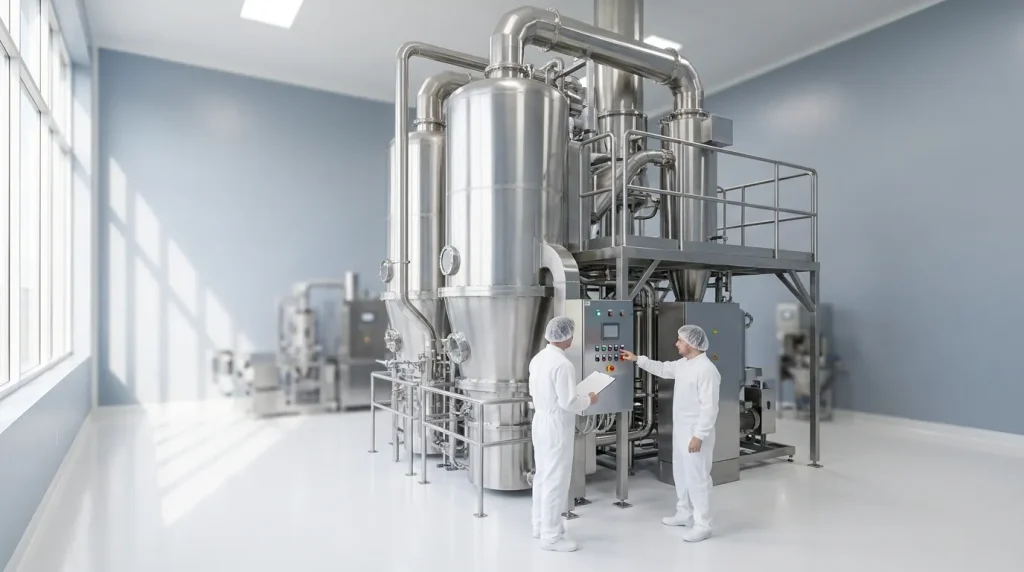
Dryer commissioning, IQ/OQ/PQ, and validation in process industries is the systematic approach to verifying that drying equipment is properly installed, operates within design parameters, and consistently produces acceptable results under production conditions. This documented process ensures regulatory compliance and product quality before full-scale manufacturing begins.
This guide covers the commissioning lifecycle from planning through mechanical completion, Installation Qualification (IQ), Operational Qualification (OQ), and Performance Qualification (PQ) protocols, regulatory frameworks governing pharmaceutical and food-grade applications, and documentation practices that support audit readiness.
The commissioning lifecycle begins with structured phases including Factory Acceptance Testing and mechanical completion verification, where teams confirm installations match approved drawings and specifications. Common challenges such as instrumentation drift, airflow distribution problems, and thermal expansion mismatches require contingency planning during this phase.
Installation Qualification (IQ) establishes the documentation foundation through material certificates, welding qualifications, P&IDs, and calibration records traceable to national and/or international standards. Systematic checklists verify physical installation, utility connections, and safety system functionality.
Operational Qualification (OQ) confirms performance through functional challenge testing, temperature mapping confirming that temperatures fall within specified ranges such as ±2°C (±3.6°F) for fluid bed dryers in pharmaceutical applications, and HEPA filter integrity verification. Deviation management follows ISO 31000 risk principles to prioritize corrective actions based on severity, likelihood, and potential impact on safety, quality, and operational performance.
Performance Qualification (PQ) validates performance of the dryer under actual operating conditions to confirm it consistently achieves required process outcomes, such as moisture content, throughput, and product quality. It demonstrates that the dryer operates reliably and repeatably within established production parameters.
Industrial dryer commissioning and qualification practices are guided by applicable equipment safety standards, quality management systems, process validation frameworks, and industry-specific requirements. Applicable requirements may include ISO 9001 quality management principles, ISO 12100 machinery risk assessment, IEC/EN electrical safety standards, ASME pressure equipment requirements where applicable, and ISO 50001 energy management practices for energy performance improvement. The distinction between qualification (equipment capability) and validation (process consistency) determines documentation scope throughout the equipment lifecycle.
Risk management and change control practices maintain validated states and support regulatory inspections across applications such as pharmaceutical, chemical, and food processing.
Why Is Dryer Commissioning Critical for Process Plant Operations?
Dryer commissioning is critical for process plant operations because it verifies that equipment functions safely, meets design specifications, and produces consistent product quality before full-scale production begins. The subsections below cover the sequential phases of commissioning and the common challenges teams encounter during this process.
What Are the Phases and Steps Involved in Dryer Commissioning?
The phases and steps involved in dryer commissioning follow a structured sequence that builds verification upon verification. The process begins with planning, where teams establish acceptance criteria, assign responsibilities, and develop detailed test protocols. Factory Acceptance Testing (FAT) follows, allowing engineers to verify equipment performance at the manufacturer’s facility before shipment.
After delivery, mechanical completion confirms the installation matches drawings and specifications. Pre-commissioning extends this phase to include flushing, cleaning, pressure testing, and drying with super-dry air or soft foam pigs to prepare the system for operation. Full commissioning then tests the dryer under actual operating conditions, verifying that critical process parameters such as inlet temperature, outlet temperature, airflow rate, and feed concentration perform within design limits.
This phased approach catches defects early, when corrections cost less and cause minimal schedule disruption.

What Are the Common Challenges Encountered During Dryer Commissioning?
The common challenges encountered during dryer commissioning include instrumentation calibration drift, utility supply inconsistencies, and integration failures between the dryer and upstream or downstream equipment.
- Temperature sensor accuracy issues that affect inlet and outlet readings
- Airflow distribution problems causing uneven drying across the product bed
- Control system logic errors in PLC programming or HMI interfaces
- Seal and gasket failures under thermal cycling conditions
- Coordination gaps between mechanical, electrical, and process teams
Thermal expansion mismatches present particular difficulty, as dryers operate across wide temperature ranges, from ambient to over 200°C (392°F) in many applications. Equipment that passes static checks may fail when exposed to actual operating temperatures. Teams that anticipate these challenges build contingency time into commissioning schedules rather than assuming linear progress.
With commissioning phases established, Installation Qualification (IQ) provides the documented evidence that the dryer meets its design specifications.
How Is Installation Qualification (IQ) Performed on Industrial Dryers?
Installation Qualification for industrial dryers is performed by systematically verifying that the equipment is installed according to manufacturer specifications and documented design requirements. The subsections below detail the specific documents and checklists required to complete IQ successfully.
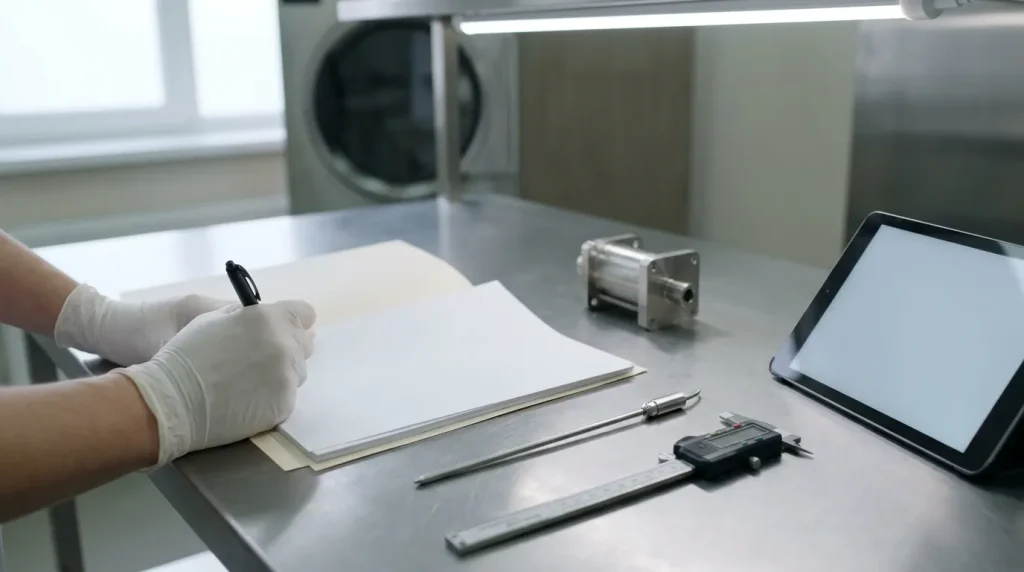
What Documents and Records Are Needed for IQ of Dryers?
The documents and records needed for IQ of dryers include a comprehensive supplier document package containing material certificates verifying materials of construction such as 316L stainless steel, welding qualifications, P&IDs, and calibration certificates for all installed instrumentation in compliance with national and/or international standards. This package must confirm compliance with applicable codes such as ASME Section VIII and the Pressure Equipment Directive (PED) in the EU when dryers include pressure-containing components.
Essential IQ documentation includes:
- Equipment purchase specifications and approved drawings
- Material certificates verifying metallurgy (e.g. 316L, 316, 304, Hastelloy C-276)
- Factory Acceptance Test (FAT) reports
- Calibration certificates and instrument records with traceable measurements, supported by ISO/IEC 17025-accredited laboratories where applicable
- Installation drawings confirming utility connections and spatial requirements
- Applicable regulatory conformity documentation, such as CE marking or UKCA marking documentation for equipment placed on the European or UK markets
What Checklists Should Be Completed During Dryer IQ?
The checklists that should be completed during dryer IQ cover physical installation verification, utility connections, and safety system confirmation. Each checklist item requires documented evidence that installation matches approved specifications.
Standard IQ checklists include verification of:
- Equipment identification (model, serial number, capacity in both gal/L or ft³/m³)
- Physical installation against layout drawings
- Utility connections (steam, compressed air, electrical, cooling water)
- Instrument loop verification for temperature, pressure, and airflow sensors
- Safety interlocks and emergency stop functionality
- Grounding and bonding per electrical codes
The commissioning process confirms installation matches drawings and specifications through systematic checking and testing at mechanical completion. Any discrepancy between installed configuration and approved documentation requires formal deviation recording before proceeding to operational qualification.
How Does Operational Qualification (OQ) Confirm Dryer Performance?
Operational Qualification confirms dryer performance by verifying that equipment operates within specified parameters under controlled conditions. OQ testing challenges all functional systems to prove they meet design specifications before production begins.
What Tests and Protocols Are Used in Dryer OQ?
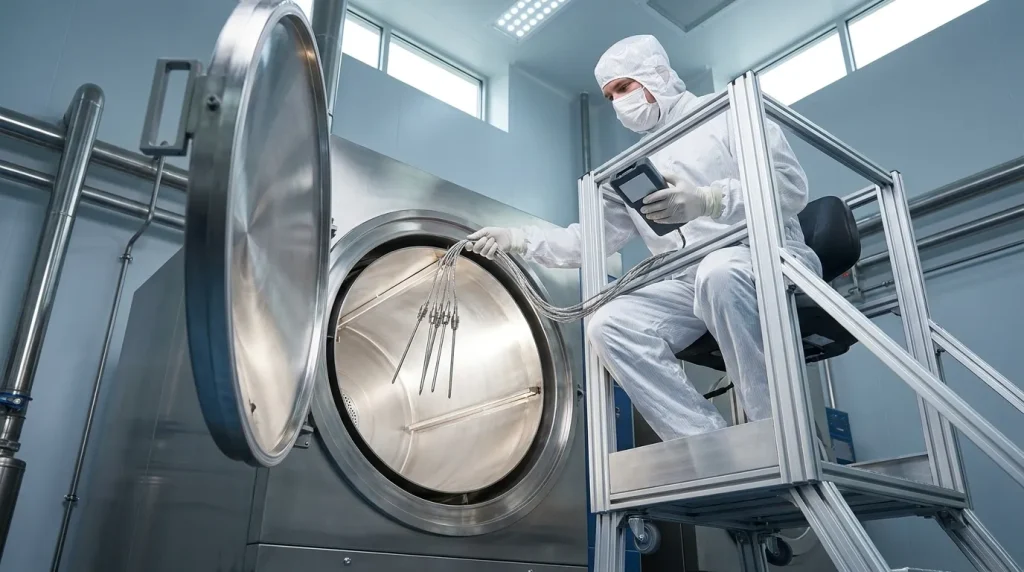
The tests and protocols used in dryer OQ include functional challenge testing, temperature mapping, and filter integrity verification. OQ protocols check temperature uniformity across the bed by verifying that temperature does not fall outside of specified ranges, such as ±2°C (±3.6°F) for fluid bed dryers in pharmaceutical applications. Test all safety interlocks, and confirm HEPA filter integrity using DOP/PAO aerosol challenge methods.
Standard OQ test categories include:
- Temperature mapping with calibrated probes at multiple bed locations
- Airflow verification against design specifications
- Safety interlock challenge testing (high temperature, low airflow, overpressure)
- Control system response testing across operating ranges
- Alarm function verification at setpoint limits
Each test requires documented acceptance criteria, calibrated instruments, and trained personnel signatures. Test protocols must specify the exact sequence, environmental conditions, and pass/fail boundaries before execution begins.
How Are Deviations and Nonconformances Managed During OQ?
Deviations and nonconformances during OQ are managed through formal documentation, root cause investigation, risk-based corrective action, and retesting. The pharmaceutical industry, for example, categorizes deviations as minor, major, or critical, with each category requiring proportionate investigation depth.
When a test result falls outside acceptance criteria, the deviation must be recorded immediately with scientific justification. ISO 31000 risk management principles support investigation prioritization by applying risk scoring methods that evaluate the severity, likelihood, and impact of equipment or process deviations.
Corrective and Preventive Action (CAPA) follows a structured process:
- Document the deviation with exact observations and conditions
- Classify severity based on impact to qualification objectives
- Investigate root cause using appropriate analytical tools
- Implement corrective action and verify effectiveness
- Update protocols if systemic issues are identified
Industry benchmarks target corrective and preventive actions (CAPA) closure within around 90 days, though well-managed programs sometimes achieve averages near 50 days. Unresolved critical deviations require OQ repetition after corrective measures are implemented.
How Does Performance Qualification (PQ) Verify That a Dryer Consistently Meets Performance Requirements?
Performance Qualification (PQ) verifies that a dryer consistently achieves the intended process results under normal operating conditions, including product quality, moisture targets, throughput, and process stability. Key areas include performance testing during PQ and how PQ results support broader process validation activities.
What Performance Tests Are Included During Dryer PQ?
Dryer PQ evaluates whether the equipment can repeatedly achieve required performance targets under normal operating conditions. Testing typically includes moisture removal performance, throughput or capacity verification, temperature uniformity, airflow performance, energy consumption, and repeatability across multiple production runs. Results are compared against predefined acceptance criteria to confirm that the dryer operates reliably and produces consistent outcomes. These tests may also identify performance variations caused by changes in operating parameters, material properties, or production conditions.
How Do PQ Results Support Process Validation?
PQ demonstrates that a dryer can perform consistently within established operating limits, while process validation evaluates whether the overall drying process reliably achieves the intended result. PQ data can support validation by providing evidence that the equipment is capable of maintaining critical conditions such as temperature, airflow, residence time, and moisture control. In regulated industries, this information may be incorporated into validation documentation to demonstrate process reliability. For broader industrial applications, PQ results help confirm that the dryer meets production, quality, and efficiency objectives.
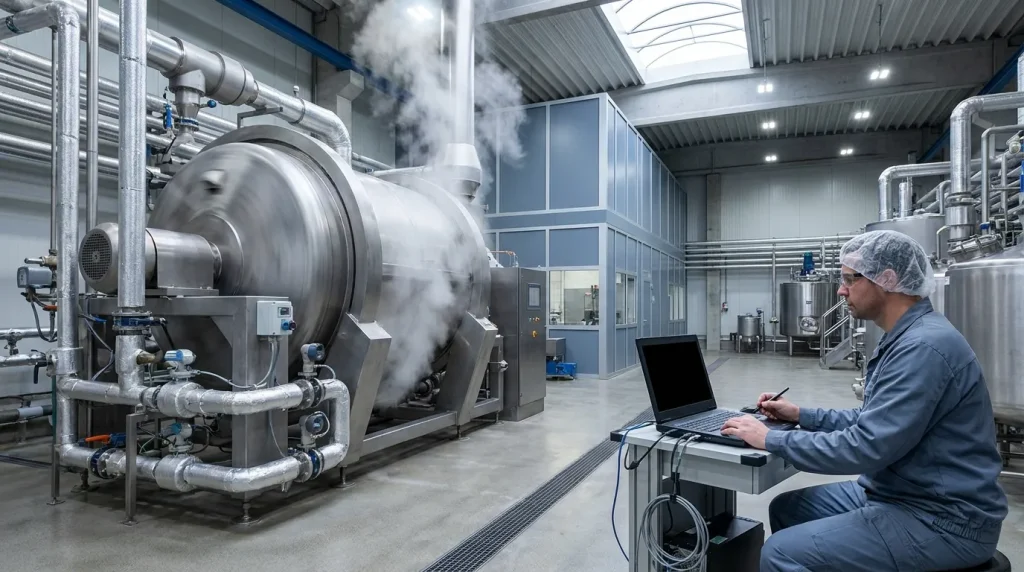
What Are the Key Validation Requirements for Pharmaceutical and Food-Grade Dryers?
The key validation requirements for pharmaceutical and food-grade dryers include a documentation chain of meeting IQ/OQ/PQ protocols, material traceability certificates, calibration records, and compliance with regional GMP frameworks.
Key regulatory frameworks affecting pharmaceutical and food-grade dryers include:
- EU GMP Annex 15: Requires lifecycle-based qualification with quality risk management integration for pharmaceutical manufacturing processes
- FDA 21 CFR Part 211: Governs US pharmaceutical manufacturing process controls
- Health Canada GUI-0031: Establishes GMP guidelines for pharmaceutical manufacturing
- ANVISA RDC No. 658/2022: Mandates validation for Brazilian pharmaceutical operations
- ISO 22000: Framework for identifying food safety hazards, implementing controls, and maintaining documented procedures
- 3-A Sanitary Standards: sanitary design requirements for food processing equipment
- EHEDG guidelines: hygienic design of food processing equipment
The following subsections explain how regulatory standards shape validation processes and clarify the distinction between qualification and validation.
How Do Regulatory Standards Influence Dryer Validation Processes?
Regulatory standards influence dryer validation processes by mandating documented evidence that equipment performs as intended. Dryer validation processes are guided by quality management principles, machinery safety standards, equipment acceptance testing practices, and industry-specific requirements. Frameworks like ISO 9001, FAT/SAT procedures, ISO 12100 machinery risk assessment, and ISO 50001 energy management principles support documented verification that equipment is installed correctly, operates safely, and meets intended performance requirements.
Pharmaceutical manufacturing requires additional qualification: PIC/S GMP Guide Annex 15 (EU, UK, Australia, Canada), equivalent to EU GMP Annex 15, states that “qualification and validation should establish and provide documentary evidence” that facilities, equipment, and processes are suitable for their intended use.
Key regulatory frameworks affecting dryer validation include:
- ISO 9001 Quality Management Systems: Framework for documented processes, quality control, and continual improvement to ensure equipment and operations consistently meet defined requirements
- Factory Acceptance Testing (FAT) and Site Acceptance Testing (SAT) Procedures: Verify that dryers are manufactured, installed, and operated according to approved specifications before and after site installation
- ISO 12100 Machinery Safety Risk Assessment: Guides hazard identification and risk reduction measures to support safe dryer design, operation, and maintenance
- ISO 50001 Energy Management Systems: Supports monitoring and improvement of dryer energy performance through structured energy management practices
- Applicable Pressure Equipment Standards and Regulations: Requirements such as PED 2014/68/EU or ASME Section VIII may apply where dryers incorporate pressure-rated vessels or components.
IQ documentation must include material certificates, welding qualifications, P&IDs, and calibration certificates traceable to national and/or international standards. Facilities operating across multiple jurisdictions can benefit most from harmonizing documentation to the most stringent applicable standard.
What Is the Difference Between Qualification and Validation for Dryers?
The difference between qualification and validation for dryers is that qualification demonstrates equipment capability, while validation proves process consistency. The WHO defines qualification as “documented evidence that premises, systems or equipment are able to achieve the predetermined specifications,” whereas validation is “action of proving and documenting that any process, procedure or method actually and consistently leads to the expected results.”
| Aspect | Qualification | Validation |
| Focus | Equipment capability | Process consistency |
| Scope | IQ, OQ, PQ protocols | Ongoing production evidence |
| Output | Equipment release | Process approval |
| Frequency | Installation and changes | Continuous lifecycle |
Qualification confirms the dryer meets mechanical and operational specifications. Validation extends this by demonstrating that production batches consistently meet quality attributes under actual operating conditions with representative product loads.
What Documentation and Risk Management Practices Are Essential for Dryer IQ/OQ/PQ and Validation?
Documentation and risk management practices essential for dryer IQ/OQ/PQ and validation include complete qualification records, risk scoring matrices, change control procedures, and audit-ready file organization. These practices ensure regulatory compliance and provide defensible evidence during inspections. The following sections cover audit readiness strategies and change control application.
Which Best Practices Improve Audit Readiness for Dryer Validation?
Best practices that improve audit readiness for dryer validation include maintaining organized documentation systems, implementing proactive risk assessment, and aligning records with global regulatory expectations. Many regulatory standards reflect standards similarly enforced across multiple jurisdictions.
Key practices for audit-ready documentation:
- Maintain chronological validation master files with version control and approval signatures
- Store deviation reports, CAPA records, and risk assessments in cross-referenced folders
- Keep calibration certificates current and traceable to ISO/IEC 17025 accredited laboratories
- Archive change control records showing pre-approval assessments and post-implementation verification
- Organize supplier documentation packages including material certificates (e.g. 316L SS, 304SS), welding qualifications, and P&IDs
Quality risk management principles like ISO 31000 integrate into the CAPA process using risk scoring matrices that prioritize investigations based on severity, likelihood, and potential impact of nonconformances. This systematic approach demonstrates to auditors that your facility addresses issues proportionally to their severity.
How Should Change Control Be Applied During the Validation Lifecycle?
Change control should be applied during the validation lifecycle through formal assessment procedures that evaluate every modification for its impact on validated state. Any change to equipment, process parameters, or documentation requires documented evaluation before implementation.
Change control requirements by category:
| Change Type | Assessment Level | Requalification Scope |
| Software updates | Impact assessment | OQ verification minimum |
| Replacement parts (like-for-like) | Documentation review | IQ verification |
| Process parameter adjustment | Risk-based evaluation | OQ/PQ as indicated |
| Equipment relocation | Full requalification | Complete IQ/OQ/PQ |
Effective change control links directly to your risk management framework. Each proposed change receives a risk score based on its potential effect on critical process parameters such as inlet temperature (affecting drying rate) or air velocity (influencing fluidization). Higher-risk changes trigger more extensive requalification protocols.
How Can International Process Plants Support Dryer Commissioning and Validation Projects?
International Process Plants supports dryer commissioning and validation projects by supplying new surplus and quality used drying equipment with comprehensive documentation packages. The following subsections explain how IPP’s equipment solutions facilitate compliance and summarize the key takeaways from this guide.
Can IPP’s Equipment Solutions Facilitate Dryer IQ/OQ/PQ and Validation Compliance?
Yes, IPP’s equipment solutions can facilitate dryer IQ/OQ/PQ and validation compliance through documentation support and equipment traceability. With over 15,000 pieces of equipment in inventory across warehouses in Eastover, South Carolina (US), Germany, and the United Kingdom, IPP provides access to fluid bed dryers, spray dryers, tray dryers, and vacuum dryers from established manufacturers.
Equipment from IPP’s inventory includes material certificates for construction materials such as 316L, 316, 304, and 304L stainless steel, supporting IQ documentation requirements. Original equipment documentation, calibration records, and P&IDs can transfer with units. For stringent applications such as pharmaceuticals, this documentation package reduces the burden of establishing material traceability and operating history during installation qualification.
Process engineers benefit from IPP’s 46+ years of experience sourcing equipment that meets industry, application, and jurisdiction-specific regulatory frameworks such as ASME Section VIII, PED (Pressure Equipment Directive), and CE marking requirements. Our technical team can assist in identifying dryers with the instrumentation and control capabilities needed for OQ temperature mapping and interlock verification testing.
What Are the Key Takeaways About Dryer Commissioning, IQ/OQ/PQ, and Validation Guide We Covered?
The key takeaways about dryer commissioning, IQ/OQ/PQ, and validation are:
- Commissioning follows a structured sequence: Planning, Factory Acceptance Testing (FAT), and Mechanical Completion verify that installations match specifications before qualification begins
- IQ establishes the documentation foundation: Material certificates, welding qualifications, P&IDs, and calibration records should demonstrate compliance with national and/or international standards
- OQ confirms operational performance: Functional testing of interlocks, temperature mapping within specified ranges, such as ±2°C (±3.6°F) for fluid bed dryers in pharmaceutical applications, and HEPA filter integrity checks validate dryer operation
- Regulatory frameworks drive requirements: ISO 9001, ISO 12100, FAT/SAT procedures, ISO 50001, and applicable pressure equipment regulations define expectations for equipment quality, safety, commissioning, and performance verification
- Risk management integrates throughout: ISO 31000 principles guide CAPA prioritization and deviation classification
- Documentation supports audit readiness: Structured protocols, deviation records, and change control procedures demonstrate validated states to inspectors
When sourcing drying equipment for your process application, International Process Plants provides access to quality used and new surplus dryers with documentation to support your commissioning and qualification activities.

 FR
FR  EN
EN  ES
ES  PL
PL  DE
DE  AR
AR  UR
UR  HI
HI  NL
NL  TR
TR  IT
IT  UK
UK  RU
RU  JA
JA  PT
PT  ZH
ZH