 跳至内容
跳至内容 
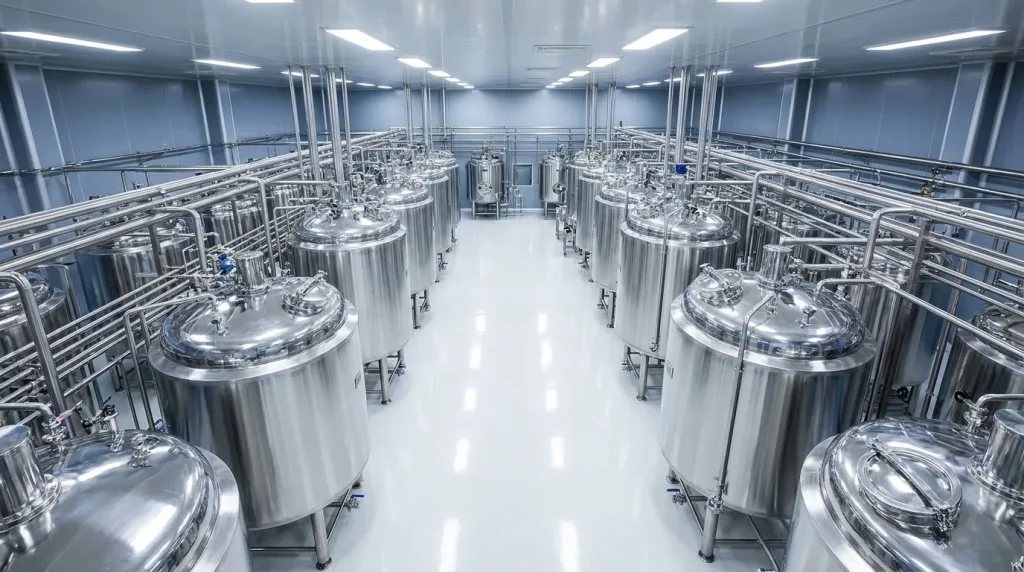
Sanitary tanks are specialized storage and processing vessels designed to meet stringent hygienic requirements that prevent contamination and ensure product safety in food, dairy, and pharmaceutical manufacturing.
This guide covers regulatory standards and compliance frameworks, tank types and material specifications, design features that enable cleanability, industry-specific requirements for food, dairy, and pharma applications, and procurement strategies for used equipment.
Regulatory frameworks including 3-A Sanitary Standards, EHEDG guidelines, and ASME BPE specifications govern how sanitary tanks must be constructed, with requirements covering surface finishes, weld quality, and dead leg elimination. These standards ensure vessels can be cleaned effectively between production runs.
Tank configurations range from simple storage vessels to jacketed processing tanks with agitators, each serving distinct functions while meeting hygiene requirements. Material selection centers on 304 and 316L stainless steel, with surface finish specifications as fine as 15 µin (0.38 µm) for pharmaceutical applications.
Each industry imposes unique demands. Dairy processing requires precise temperature control for pasteurization cycles. Pharmaceutical manufacturing mandates full material traceability and GMP-compliant construction. Food processing emphasizes CIP compatibility and complete drainability.
Procurement teams evaluating used sanitary tanks can achieve substantial cost savings while maintaining compliance, provided they verify documentation, inspect surface conditions, and confirm regulatory certifications before purchase.
Why Are Sanitary Tanks Essential in Food, Dairy, and Pharmaceutical Processing?
Sanitary tanks are essential in food, dairy, and pharmaceutical processing because they prevent contamination and ensure product safety through hygienic design. The following sections explain the specific standards these vessels must meet and how regulations shape their construction.
What Specific Hygiene Standards Must Sanitary Tanks Meet in These Industries?
The specific hygiene standards sanitary tanks must meet in these industries include 3-A Sanitary Standards, EHEDG guidelines, and FDA requirements. According to the 3-A Sanitary Standards Institute, 3-A standards specify the criteria for design and fabrication of equipment contacting comestible products, establishing the benchmark for hygienic food equipment design.
Key requirements across these standards include:
- Non-porous, seamless stainless steel surfaces cleanable to hygiene zone standards
- Elimination of crevices where residues or microorganisms can harbor
- Controlled surface finishes appropriate for the application’s contamination risk level
- Complete drainability to prevent product pooling
3-A Standard 32-04 for Uninsulated Tanks, last revised in 2020, covers design specifications for non-insulated sanitary storage vessels used across all three industries. Meeting these standards is non-negotiable for processors seeking regulatory approval and consistent product quality.
How Do Regulatory Guidelines Impact the Design and Use of Sanitary Tanks?
Regulatory guidelines impact the design and use of sanitary tanks by mandating specific construction details, material choices, and cleanability features. The EHEDG Guideline 8 on Hygienic Design Principles (Fourth Edition, December 2025) outlines hygienic design considerations applicable for a risk-based approach to prevent food product contamination.
These regulations drive several design requirements:
- Operators select 304 or 316L stainless steel weld fittings with controlled surface finishes to comply with FDA, 3-A, and EHEDG guidance
- Dead legs must be less than twice the pipe diameter in length per ASME BPE recommendations, since stagnant areas trap product or cleaning solutions
- Properly finished welds create continuous, smooth interior surfaces that prevent microorganism harborage
- Pharmaceutical tanks, blenders, and IBCs all require GMP-compliant design and fabrication
For procurement teams evaluating used sanitary tanks, understanding which regulatory framework governs your specific application determines whether a vessel can be qualified for service or requires modification before deployment.
What Types of Sanitary Tanks Are Commonly Used in Food, Dairy, and Pharma Sectors?
The types of sanitary tanks commonly used in food, dairy, and pharma sectors are storage tanks, mixing tanks, and processing tanks. Each type serves distinct functions while meeting hygiene requirements. The following sections explain functional differences, material choices, and specialty applications.
How Do Storage, Mixing, and Processing Tanks Differ?
Storage, mixing, and processing tanks differ in their primary functions, internal components, and operational requirements.
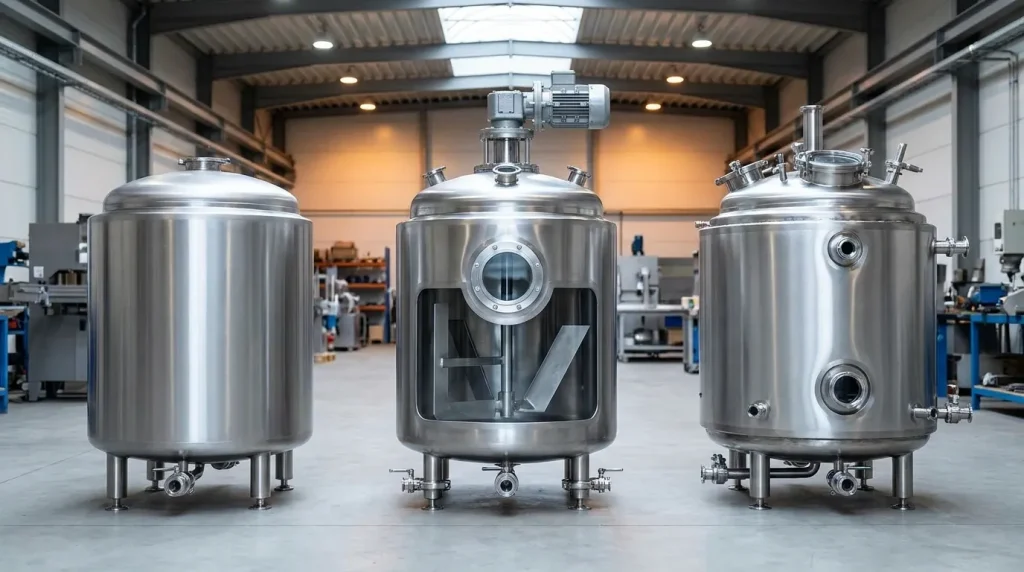
- Storage tanks hold raw materials or finished products at stable temperatures without mechanical agitation. Silo-type vessels for bulk dairy or ingredient holding fall into this category.
- Mixing tanks incorporate agitators or impellers to blend ingredients, dissolve solids, or maintain homogeneous suspensions. These vessels often include baffles and variable-speed drives.
- Processing tanks perform active transformation such as pasteurization, fermentation, or reaction. They typically feature jacketed walls for heating or cooling, precise temperature control, and CIP/SIP connections.
From a procurement perspective, mixing and processing tanks command higher prices due to their mechanical complexity. Storage tanks, while simpler, still require full sanitary certification for product-contact surfaces.
What Materials Are Most Suitable for Sanitary Tanks in These Applications?
The materials most suitable for sanitary tanks in these applications are 304 and 316L stainless steel, with surface finish being equally critical to material selection.
316L stainless steel dominates pharmaceutical applications because of its superior corrosion resistance and weldability. 304 stainless steel serves many food and dairy applications where chloride exposure is minimal. According to Astropak Corporation, the sanitary minimum surface finish standard is 32 µin (0.8 µm), while pharmaceutical-grade finishes reach 15 µin (0.38 µm).
Both grades require passivation to maximize corrosion resistance. Surface porosity matters as much as alloy composition; even the correct material fails hygiene requirements if finished improperly.
How Are Glass-Lined and Alloy Sanitary Tanks Used?
Glass-lined and alloy sanitary tanks are used for aggressive chemistries or high-purity applications where stainless steel alone cannot provide adequate corrosion resistance.
- Glass-lined tanks protect against acidic or highly reactive products in pharmaceutical synthesis and specialty food processing. The glass layer creates an inert, non-contaminating surface.
- Hastelloy C-276 tanks handle chloride-rich or oxidizing environments that would pit standard stainless grades.
Glass-lined vessels require careful handling; thermal shock or mechanical impact can damage the protective layer. When sourcing used glass-lined equipment, inspection of the glass integrity is essential before purchase.
With tank types and materials established, the next section covers key design features that enable sanitary performance.
What Are the Key Design Features and Components of Sanitary Tanks?
The key design features of sanitary tanks include smooth, crevice-free interior surfaces, self-draining geometries, and hygienic connections that enable complete cleaning. The following sections cover how cleanability is built into tank construction and how agitators, valves, and fittings contribute to sanitary performance.
How Is Cleanability Achieved in Sanitary Tank Construction?
Cleanability in sanitary tank construction is achieved through surface finish specifications, weld quality, and geometry that eliminates product-trapping areas. According to Astropak Corporation, the sanitary minimum surface finish standard is 32 µin (0.8 µm), while pharmaceutical applications often require finishes as fine as 15 µin (0.38 µm). These polished surfaces prevent microbial adhesion and allow cleaning solutions to contact all areas uniformly.
Key design elements that enable cleanability include:
- Continuous interior welds ground flush with parent material
- Sloped tank bottoms (typically 3° to 6°) for complete drainage
- Radiused corners instead of sharp angles where walls meet bottoms
- Elimination of dead legs (stagnant areas must be less than twice the pipe diameter per ASME BPE guidelines)
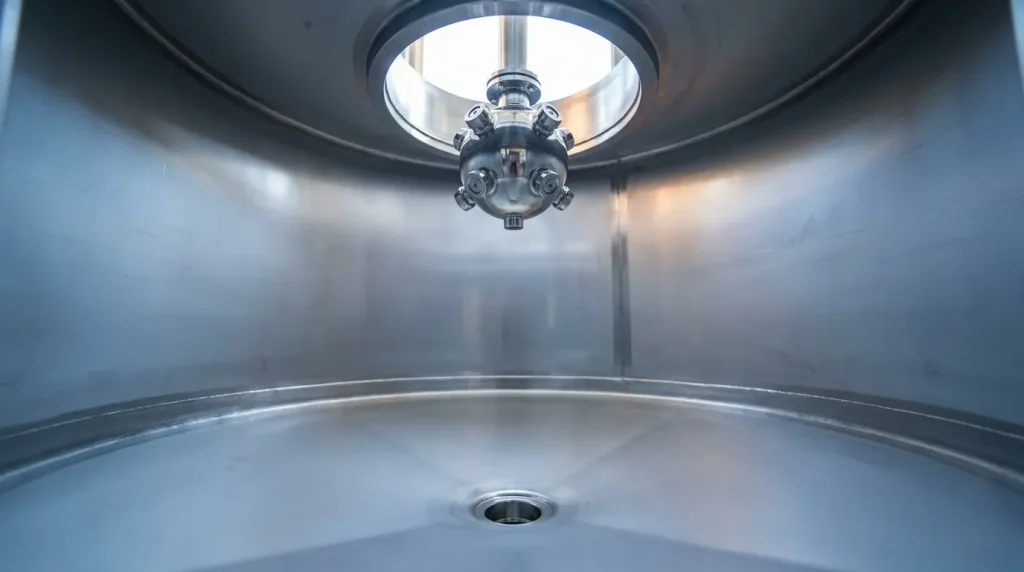
Clean-in-place (CIP) compatibility drives much of this design philosophy. Tanks feature spray ball or rotary jet mounts positioned to reach all interior surfaces, with outlet valves located at the lowest point.
What Role Do Agitators, Valves, and Fittings Play in Sanitary Performance?
Agitators, valves, and fittings play critical roles in maintaining product integrity and enabling thorough cleaning throughout sanitary tank operations. These components must match the hygienic standards of the tank shell itself; a single poorly designed fitting can compromise an otherwise compliant vessel.
Sanitary agitators feature polished shafts, hygienic seal designs, and impellers with smooth surfaces free of crevices. Mechanical seals or magnetic drives prevent contamination at the shaft entry point.
According to Cole-Parmer, tri-clamp sanitary fittings are the gold standard for maintaining cleanliness and preventing contamination in food, dairy, pharmaceutical, and beverage processing. Common sanitary valve types include:
- Diaphragm valves for precise flow control with no dead space
- Butterfly valves for high-flow applications
- Ball valves for on/off service
- Check valves to prevent backflow contamination
All connections should conform to recognized standards such as DIN 32676 or 3-A specifications, ensuring interchangeability and verified hygienic performance. Properly specified fittings and valves directly support CIP effectiveness and regulatory compliance.
How Do Sanitary Tank Requirements Differ Across Food, Dairy, and Pharmaceutical Uses?
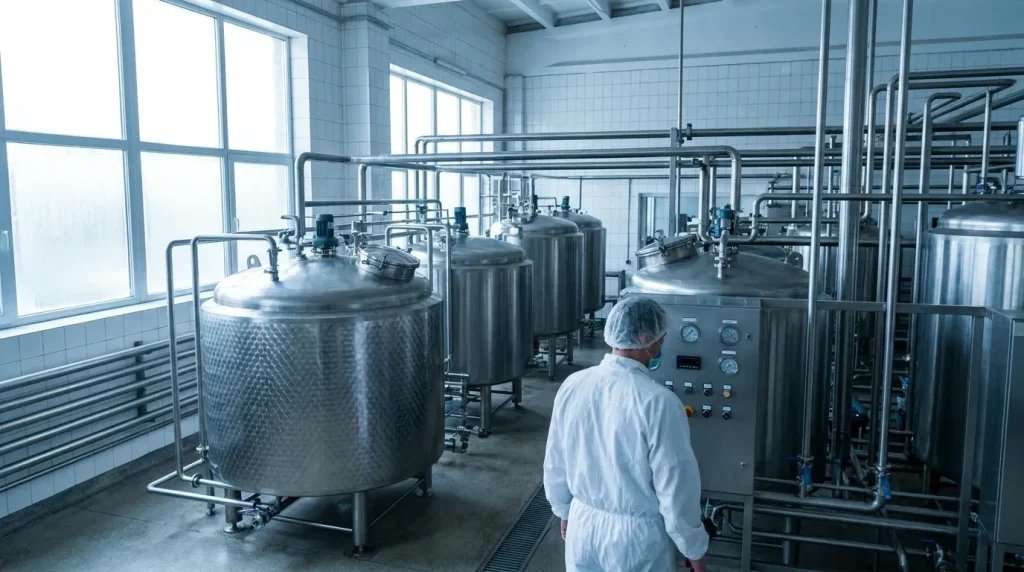
Sanitary tank requirements differ across food, dairy, and pharmaceutical uses in their governing standards, temperature tolerances, and contamination control protocols. Food processing follows FDA 21 CFR and 3-A guidelines, dairy operations require precise pasteurization temperatures under 3-A Standard 13-12, and pharmaceutical manufacturing demands GMP-compliant designs with stricter material traceability.
What Temperature and Pressure Considerations Are Unique to Each Industry?
The temperature and pressure considerations unique to each industry reflect the distinct processing demands of food, dairy, and pharmaceutical applications.
Dairy processing requires the most precise temperature control due to pasteurization requirements:
- HTST pasteurization: 72°C (161°F) for 15 seconds minimum
- Vat pasteurization: 63°C (145°F) for 30 minutes
- Ultra pasteurization: 138°C (280°F) for 2 seconds
食品加工 tanks typically operate at moderate temperatures for cooking, mixing, and holding. Vessel operating temperatures range from ambient to approximately 121°C (250°F) for sterilization cycles, with jacket ratings designed to handle steam or glycol heating systems at corresponding pressures.
Pharmaceutical applications demand the widest temperature range. Tanks must accommodate steam-in-place (SIP) sterilization at 121°C to 134°C (250°F to 273°F) while also supporting cold storage for biologics near 2°C to 8°C (36°F to 46°F). According to Mordor Intelligence’s 2025 dairy processing equipment market analysis, the sector’s USD 13.38 billion valuation reflects heavy investment in temperature-controlled systems. Pharmaceutical tanks generally require higher pressure ratings to withstand repeated SIP cycles.
How Are Cross-Contamination Risks Minimized?
Cross-contamination risks are minimized through validated cleaning procedures, hygienic design features, and equipment accessibility requirements that vary by industry.
食品加工 relies on CIP systems with documented cleaning protocols. All product contact surfaces must be accessible for inspection and verified clean between production runs.
Dairy operations require complete drainability and the elimination of dead legs. 3-A Standard 13-12 mandates tank designs that prevent milk residue accumulation in crevices or low-flow areas.
医药制造 imposes the strictest requirements:
- Cleaning validation proving residue reduction to safe levels
- Complete traceability of all product contact materials
- Surface finish specifications of 15 µin to 32 µin (0.38 µm to 0.8 µm) Ra
- Dedicated equipment for potent compounds when cross-contamination poses patient risk
Multi-product pharmaceutical facilities evaluate equipment cleanability to ensure no residues can hide in crevices. This often means specifying electropolished 316L stainless steel surfaces and sanitary fittings that disassemble for manual inspection when CIP alone cannot provide adequate assurance.
Understanding these industry-specific requirements helps procurement teams specify tanks that meet regulatory expectations from day one.
What Are the Main Benefits and Challenges of Using Sanitary Tanks?
The main benefits of sanitary tanks include contamination prevention, regulatory compliance, and extended product shelf life. The main challenges involve specialized maintenance requirements and higher upfront costs. Below we examine how these vessels protect product integrity and where operational hurdles arise.
How Do Sanitary Tanks Improve Product Quality and Safety?
Sanitary tanks improve product quality and safety by eliminating contamination pathways through hygienic design. Non-porous 316L stainless steel surfaces with finishes of 32 µin (0.8 µm) or finer prevent microbial harborage. Crevice-free welds and sloped bottoms ensure complete drainage, leaving no residue between batches.
According to Duva Sanitary, a single dead leg can require hours of additional cleaning, extra chemicals, and risk revalidation if not addressed, potentially compromising product quality or causing unplanned downtime. Proper sanitary tank design eliminates these dead legs entirely.
Tri-clamp fittings allow tool-free disassembly for inspection, while CIP-compatible geometry ensures cleaning solutions reach every interior surface. For pharmaceutical applications, full material traceability through MTRs and heat numbers supports batch documentation requirements.
What Are the Common Maintenance and Operational Challenges?
The common maintenance and operational challenges for sanitary tanks include rigorous cleaning validation, surface finish preservation, and specialized component replacement.
Key challenges include:
- CIP system calibration: Flow rates, temperatures, and chemical concentrations require regular verification to maintain cleaning effectiveness
- Gasket and seal replacement: Elastomeric components degrade over time and need scheduled replacement to maintain sanitary integrity
- Surface finish monitoring: Electropolished surfaces can degrade from abrasive cleaning or chemical attack, requiring periodic re-passivation
- Documentation burden: Each cleaning cycle, inspection, and repair must be recorded for regulatory compliance
Operational teams must balance thorough cleaning against production schedules, as extended CIP cycles reduce available processing time. Higher upfront equipment costs and the need for trained personnel add to total cost of ownership.
Understanding these trade-offs helps procurement teams select tanks that balance hygienic performance with practical maintenance requirements.
What Should You Consider When Buying Used or Refurbished Sanitary Tanks?
When buying used or refurbished sanitary tanks, you should verify compliance with current hygiene standards and assess the total cost of ownership against new equipment. The following sections cover condition verification methods and cost advantages.
How Can You Verify the Condition and Compliance of Pre-Owned Tanks?
You can verify the condition and compliance of pre-owned tanks through documentation review, physical inspection, and third-party certification. Key verification steps include:
- Requesting Material Test Reports (MTRs) with heat numbers for 316L stainless steel traceability
- Confirming surface finish measurements meet the 32 µin (0.8 µm) sanitary minimum
- Reviewing pressure test records and checking for compliance with the EU Pressure Equipment Directive (PED), ASME Section VIII, or CE/UKCA marking
- Inspecting weld integrity for continuous, smooth interior surfaces
- Verifying 3-A Sanitary Standards certification or EHEDG compliance documentation
According to Steelhead Composites, pressure vessel recertification processes follow internationally recognized ISO standards and the EU Pressure Equipment Directive for compliance verification. Always request CIP system test records and inspect tri-clamp fittings for wear or damage before purchase.

What Are the Cost Advantages Versus New Equipment?
The cost advantages versus new equipment include acquisition savings of approximately 50% and faster deployment timelines. Good used sanitary tanks typically cost around 50% of new equipment prices while delivering comparable performance when properly inspected.
According to Zwirner Equipment, a properly reconditioned dairy tank can cost substantially less than new equipment while being almost as good, with reconditioning processes including sandblasting, recoating, pressure testing, and bearing/seal replacement. Additional cost benefits include:
- Reduced lead times compared to new equipment manufacturing
- Lower capital expenditure freeing funds for other process improvements
- Immediate availability from established inventory sources
For operations expanding capacity or replacing aging equipment, good used tanks offer a practical balance between budget constraints and compliance requirements.
How Should You Approach Sanitary Tank Selection and Asset Redeployment With International Process Plants?
You should approach sanitary tank selection and asset redeployment with International Process Plants by evaluating compliance documentation, material certifications, and application-specific requirements. The sections below explain our supply capabilities and summarize the key takeaways from this guide.
Can International Process Plants Supply Reliable Used or Refurbished Sanitary Tanks for Food, Dairy, and Pharma Applications?
Yes, International Process Plants can supply reliable used sanitary tanks for food, dairy, and pharma applications. We maintain an inventory of 15,000+ pieces of equipment across warehouses in Eastover, South Carolina (US), Germany, and the United Kingdom, including sanitary vessels constructed from 316L, 316, 304, and 304L stainless steel.
Our sanitary tank inventory includes vessels designed to meet critical industry standards:
- 3-A Sanitary Standards for dairy and food contact equipment
- ASME BPE specifications for pharmaceutical applications
- ISO 14159 hygienic design criteria
- EU Pressure Equipment Directive (PED) compliance
According to the 3-A Sanitary Standards Institute, over 50 guidelines govern equipment used in food, dairy, beverage, and pharmaceutical processing. International Process Plants verifies that tanks in our inventory meet these requirements through documentation review and inspection protocols.
Pressure vessel recertification follows internationally recognized ISO standards and the EU Pressure Equipment Directive for compliance verification. We provide Material Test Reports (MTRs), dimensional drawings, and process history documentation when available. For buyers operating across multiple regions, our global warehouse network simplifies logistics while ensuring equipment meets both CE marking requirements in Europe and applicable standards in North America.
What Are the Key Takeaways About Sanitary Tanks for Food, Dairy and Pharma We Covered?
The key takeaways about sanitary tanks for food, dairy, and pharma covered in this guide include regulatory compliance requirements, material specifications, design features, and procurement strategies.
Essential points to remember:
- Sanitary tanks must meet 3-A, EHEDG, FDA, and ASME BPE standards depending on application
- 316L stainless steel with surface finishes of 32 µin (0.8 µm) or finer prevents microbial contamination
- CIP/SIP compatibility and dead leg elimination are critical design features
- Pasteurization tanks require specific temperature capabilities: HTST at 72°C (161°F), LTLT at 63°C (145°F), or UP at 138°C (280°F)
- Tri-clamp fittings per DIN 32676 provide the sanitary connection standard across industries
- Good used sanitary tanks typically cost approximately 50% of new equipment while maintaining compliance capability
International Process Plants offers procurement engineers and plant managers access to quality used sanitary tanks with verified documentation. Contact us to discuss your specific capacity, material, and compliance requirements.

 ZH
ZH  EN
EN  ES
ES  FR
FR  PL
PL  DE
DE  AR
AR  UR
UR  HI
HI  NL
NL  TR
TR  IT
IT  UK
UK  RU
RU  JA
JA  PT
PT