 مواد پر جائیں۔
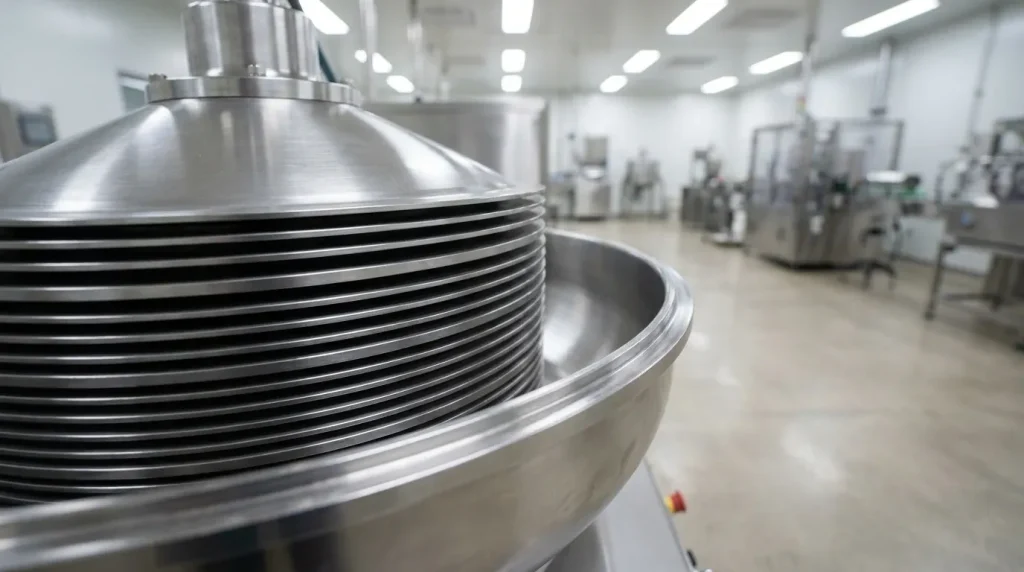
Disc stack centrifuge cleaning and CIP (clean-in-place) refers to the systematic removal of residues and biological material from centrifuge internals to maintain separation efficiency and product purity. Proper cleaning prevents contamination, extends component life, and ensures regulatory compliance across chemical, pharmaceutical, food processing, and other applications.
This guide covers the consequences of inadequate cleaning, manual and automated cleaning methods, troubleshooting approaches, and compliance considerations for used equipment procurement.
Inadequate cleaning creates measurable risks including microbial contamination, accelerated bearing wear, and separation failure from unmaintained disc stacks. CDC guidelines identify improper cleaning and disinfection protocols as major contributors to disease transmission in process systems; centrifuges require periodic cleaning and inspection to maintain performance, reliability, and prevention of component degradation with frequency depending on factors such as feed characteristics, operating environment, equipment design, and OEM recommendations.
Manual cleaning procedures target components that automated CIP cannot fully address, including disc stack plates, bowl assemblies, seals, and spray devices. Specialists use riboflavin tests to verify cleaning thoroughness, and proper tool selection based on wetted materials like 316L stainless steel or Hastelloy C-276 prevents surface damage during hands-on maintenance.
Automated CIP cycles follow programmed sequences that vary by industry, often including a pre-rinse, caustic wash at 140°F to 185°F (60°C to 85°C), intermediate rinse, acid wash, and final rinse. Optimizing parameters such as flow velocity at minimum 1.5 m/s (4.9 ft/s), chemical concentration between 1% and 2%, and contact time of 10 to 15 minutes per phase determines whether cycles effectively remove residues or allow biofilm accumulation.
Troubleshooting inconsistent CIP results requires systematic verification of spray ball function, chemical concentrations, and temperature ranges before investigating equipment faults. Real-time monitoring sensors can detect conditions for maintenance in high-density processes before visible accumulation compromises separation performance.
Hygienic design requirements vary by sector and depend on market destination, with pharmaceutical applications governed by Title 21 Part 211 CFR and food and pharmaceutical processing equipment commonly evaluated against standards and guidelines such as EHEDG and 3-A Sanitary Standards.
Why Is Thorough Cleaning and CIP Essential for Disc Stack Centrifuge Performance?
Thorough cleaning and CIP are essential for disc stack centrifuge performance because residue accumulation directly compromises separation efficiency, product purity, and equipment longevity. The following sections examine specific risks of inadequate cleaning and establish appropriate cleaning frequencies.
What Are the Main Risks of Inadequate Cleaning in Disc Stack Centrifuges?
The main risks of inadequate cleaning in disc stack centrifuges include microbial contamination, accelerated component wear, and separation failure. According to CDC guidelines, major reasons for disease transmission in process systems include inadequate cleaning, improper disinfectant selection, and failure to follow recommended protocols.
Specific consequences of poor cleaning practices include:
- Residual soil harboring microorganisms that compromise product sterility
- Damaged protective coatings from aggressive cleaning methods or neglect
- Water exposure to sensitive components such as sensors, seals, and wiring
- Accelerated bearing failure when contamination degrades lubrication quality
Major rebuilds and comprehensive inspections of centrifuges may be required after several thousand operating hours, but timing is typically determined by OEM recommendations, condition monitoring, and component wear. Skipping or shortening required cleaning cycles may reduce downtime in the short term, but can increase the risk of product contamination, solids buildup, corrosion, and accelerated component wear. Cleaning practices should be based on the centrifuge design, process material, and application requirements.
How Often Should Disc Stack Centrifuge Cleaning and CIP Be Performed?
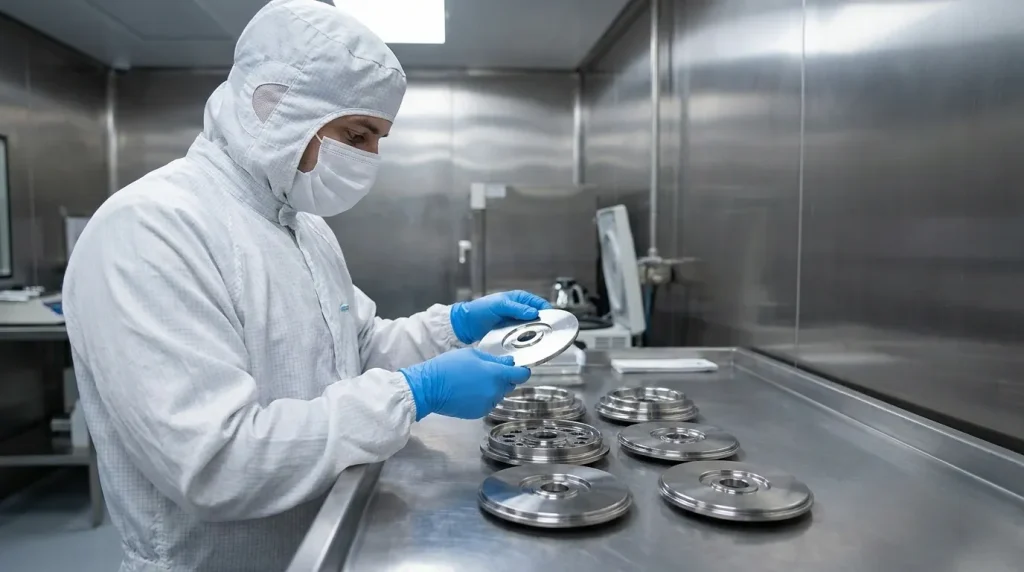
Disc stack centrifuge cleaning and CIP should be performed based on process type, product characteristics, and solids loading. Standard intervals include CIP cycles between production batches, manual inspections monthly, and comprehensive cleaning, inspections, and refurbishment activities scheduled according to OEM recommendations and equipment condition.
Key factors that determine cleaning frequency:
- Solid contamination levels in the feed stream
- Product viscosity
- Regulatory requirements for the specific industry
- Manufacturer recommendations for the centrifuge model
Online CIP processes have become standard for applications ranging from synthetic biology to liquid-liquid separation. Self-cleaning bowl designs allow more frequent automated cycles without extended downtime. Operators should monitor separation performance trends and consider adjusting CIP frequency when efficiency begins to decline, rather than waiting for scheduled intervals alone.
With cleaning fundamentals established, the next section details manual cleaning procedures for components that automated CIP cannot fully address.
What Are the Best Practices for Manual Cleaning of Disc Stack Centrifuges?
The best practices for manual cleaning of disc stack centrifuges involve systematic disassembly, targeted component cleaning, and proper reassembly with thorough inspection. Disc stack centrifuges with self-cleaning bowls can reduce production downtime to approximately 1 hour restart time, saving as much as 5 to 13 hours compared to full manual cleaning procedures. The following subsections cover critical components and recommended tools for effective manual cleaning.
Which Components Require Special Attention During Manual Cleaning?
The components that require special attention during manual cleaning are the disc stack, bowl assembly, seals, and spray devices. These units generally require check-up and manual cleaning around once a month.
Critical components include:
- Disc stack plates: Accumulated solids between plates reduce separation efficiency
- Bowl interior surfaces: Residue buildup affects hydraulic performance
- Seals and gaskets: Degradation causes leaks and contamination
- Spray balls and nozzles: Blockage leads to incomplete cleaning and high pressure with low flow symptoms
- Feed and discharge ports: Residual “dragout” (dirty solution remaining in equipment) compromises subsequent batches
Separation specialists recommend monitoring performance before and after CIP cycles and conducting visual inspection during planned maintenance to detect “dirty caustic” conditions that reduce cleaning effectiveness.
What Tools and Materials Are Recommended for Effective Manual Cleaning?
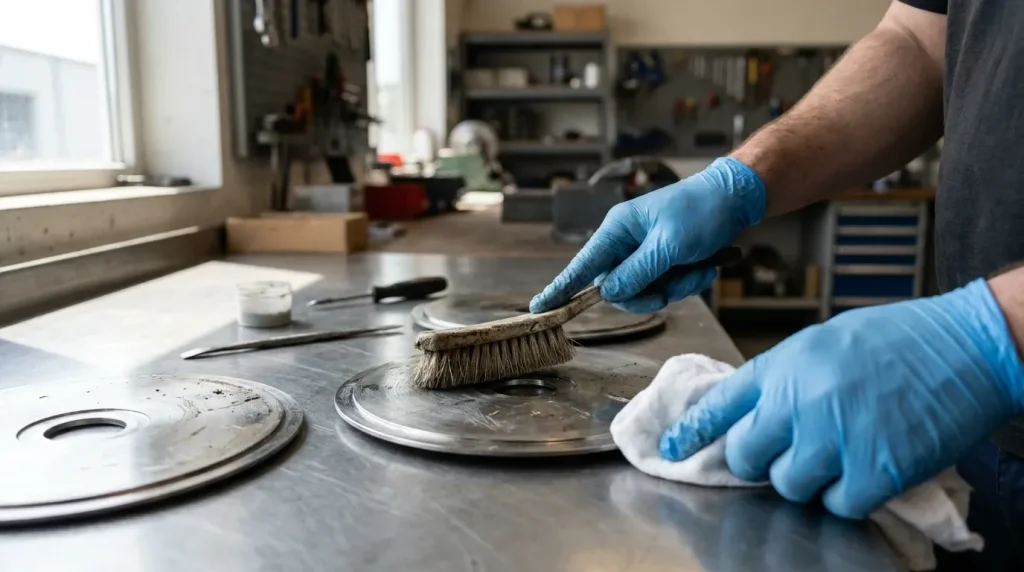
The tools and materials recommended for effective manual cleaning include non-abrasive brushes, approved solvents, lint-free cloths, and inspection equipment. Alcohols are commonly used as hand-wipe solvents in clean room environments for manual cleaning of equipment parts.
Essential cleaning supplies:
- Non-metallic brushes sized for disc plate spacing
- Lint-free wipes for final surface preparation
- Approved cleaning solutions compatible with wetted materials (316L, 316, Hastelloy C-276)
- Torque wrenches for proper reassembly specifications
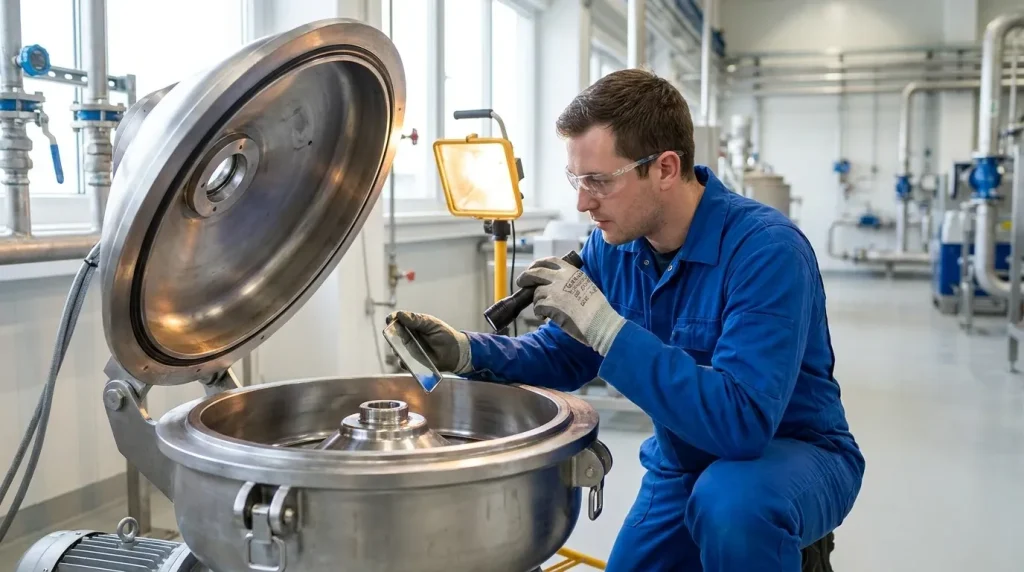
- Inspection mirrors and borescopes for interior examination
Riboflavin tests can verify cleaning thoroughness while minimizing solvent consumption by revealing contaminated areas under UV light. This verification method confirms complete soil removal before returning equipment to service.
With manual cleaning fundamentals established, automated CIP systems offer an alternative approach for routine maintenance cycles.
How Does Automated CIP (Clean-in-Place) Work for Disc Stack Centrifuges?
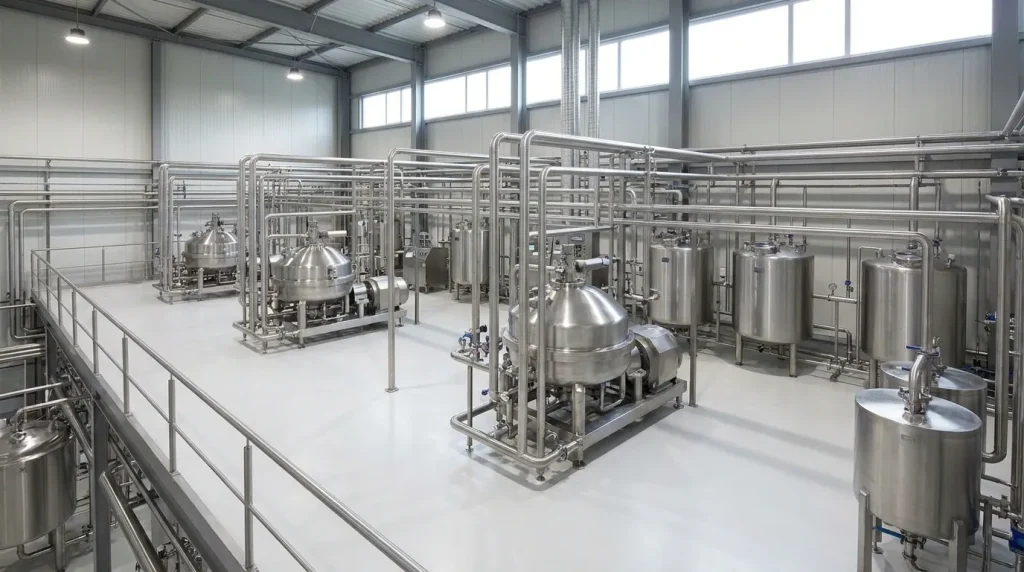
Automated CIP for disc stack centrifuges works by circulating cleaning solutions through the centrifuge bowl and internal passages without disassembly. The process follows a programmed sequence of rinses, chemical washes, and final rinses to remove residual solids and biological material.
What Are the Key Steps in a Typical Disc Stack Centrifuge CIP Cycle?
The key steps in a typical disc stack centrifuge CIP cycle are:
- Pre-rinse to flush loose solids and residual product
- Caustic wash at 140°F to 185°F (60°C to 85°C) to dissolve organic residues
- Intermediate rinse to remove caustic solution
- Acid wash to neutralize and remove mineral deposits
- Final rinse to clear all chemical traces
According to Central States Industrial, this 5-step sequence is standard across food and dairy processing applications. For brewery centrifuges, operators often use a 1% caustic concentration at approximately 160°F (71°C). Incomplete CIP cycles allow residual biological particles to accumulate on downstream membrane filtration systems, creating cascading process problems.
Which Cleaning Agents and Parameters Optimize CIP Outcomes?
Because CIP requirements vary significantly by equipment design, soil characteristics, process chemistry, and industry regulations, cleaning agents, concentrations, temperatures, and cycle times should always be established in accordance with the equipment manufacturer’s recommendations and applicable industry guidelines.
General CIP parameters often considered include:
- درجہ حرارت: around 140°F to 185°F (60°C to 85°C) for caustic; around 122°F (50°C) for acid
- Concentration: around 1% to 2% caustic; acid concentration varies by deposit type
- Contact time: around 10 to 15 minutes per wash phase
- Flow velocity: around 1.5 m/s (4.9 ft/s) minimum to ensure turbulent contact
For example, caustic solutions such as sodium hydroxide are commonly used to remove organic soils such as proteins and fats, while acid solutions such as phosphoric or nitric acid may be used to address mineral deposits. Peracetic acid may be used as a sanitizer in certain applications.
A common CIP failure is operators cutting contact time to speed production turnover, which can lead to biofilm accumulation that requires costly manual intervention later.
With CIP parameters established, operators must also know how to identify when cleaning cycles fail to deliver expected results.
What Common Challenges and Troubleshooting Steps Apply to Centrifuge Cleaning and CIP?
Common challenges in centrifuge cleaning and CIP include inconsistent cycle results and residue build-up that compromises separation efficiency. The following sections address detection methods and corrective actions for these issues.
How Can Operators Detect and Prevent Residue Build-Up?
Operators can detect and prevent residue build-up through systematic monitoring and early intervention strategies. Key detection methods include:
- Visual inspection of disc stacks and bowl surfaces during scheduled maintenance
- Pressure differential monitoring across the centrifuge inlet and outlet
- Separation efficiency tracking through product quality analysis
- Single trend analysis of key indicators to detect early deposition
Real-time biomass monitoring with sensors such as the ABER OPTURA SPY can help operators track changes in high-density cell cultures and identify changes in the process environment to support prevention strategies. Prevention requires maintaining proper CIP chemical concentrations, ensuring adequate flow velocities, and adhering to validated cycle times. For operations processing viscous or high-solids feeds, increasing CIP frequency and extending caustic contact time reduces risk.
What Should Be Done If CIP Results Are Inconsistent or Unreliable?
If CIP results are inconsistent or unreliable, operators should systematically verify each cleaning parameter before investigating equipment faults. A structured troubleshooting approach includes:
- Confirming chemical concentrations match validated specifications (typically 1-2% caustic)
- Verifying temperatures reach target ranges, typically around 140°F to 185°F (60°C to 85°C)
- Checking spray ball function for blockages that cause high pressure and low flow
- Validating pump rotation direction after any maintenance or corrective actions
Common failure modes stem from spray ball blockage, which leads to incomplete cleaning coverage and localized residue. Separation specialists emphasize that “dirty caustic” can lead to ineffective CIP cycles, recommending performance monitoring before and after each cycle. When issues persist, inspect seals, gaskets, and tubing for deterioration that allows cleaning solution bypass. Documenting each troubleshooting step creates a reference for recurring problems and supports compliance audits.
With troubleshooting protocols established, understanding relevant industry standards ensures cleaning practices meet regulatory requirements.
How Do Industry Standards and Guidelines Impact Centrifuge Cleaning and Compliance?
Industry standards and guidelines impact centrifuge cleaning and compliance by establishing mandatory requirements for validation, documentation, and equipment design across different sectors. The following subsections cover relevant codes and certifications, plus how regulatory requirements differ by industry.
What Are the Relevant Codes and Certifications for Cleaning and CIP (ASME, API, PED, CE)?
The relevant codes, certifications, and standards for cleaning and CIP include ISO standards, ASME BPE, EHEDG, and 3-A certifications. Each addresses different aspects of equipment design and hygienic cleaning capability.
Key standards for centrifuge cleaning compliance:
- ASME BPE: Provides design requirements for bioprocessing equipment, including material and surface finish considerations that support cleanability and CIP suitability
- EHEDG and 3-A certifications: Provide internationally recognized hygienic design guidelines and certification programs that support cleanability and sanitary operation in food, beverage, and related applications
- ISO 14159: Specifies hygiene requirements for machinery design, ensuring centrifuges can be effectively cleaned and sanitized
For equipment destined for UK markets, UKCA marking applies post-Brexit. Canadian installations may require CRN (Canadian Registration Number) for pressure-containing components, and EU markets equally require PED (Pressure Equipment Directive 2014/68/EU) compliance for pressure-rated components in centrifuge systems.
How Do Regulatory Requirements Vary Among Industrial Sectors?
Regulatory requirements vary among industrial sectors based on product contact, contamination risk, and end-use criticality. Pharmaceutical applications face some of the strictest documentation burdens, while oil and gas operations often prioritize equipment integrity.
Pharmaceutical sector: In the United States, pharmaceutical cleaning validation is conducted within the cGMP framework outlined in Title 21, Part 211 of the Code of Federal Regulations. Manufacturers must establish documented procedures demonstrating that cleaning processes effectively control residues and prevent contamination risks.
Food and beverage sector: EHEDG and 3-A certifications drive equipment selection, with emphasis on surface finish (typically Ra ≤ 0.8 µm or 32 µin) and drainability.
Oil and gas sector: API standards dominate. Centrifuge leaking due to deteriorating tubing, seals, or gaskets can produce contamination and directly impact separation effectiveness, making seal integrity verification critical during cleaning inspections.
کیمیکل پروسیسنگ: PED compliance and ASME Section VIII govern pressure-rated components, with cleaning requirements driven by product changeover.
Understanding which standards apply to your application prevents costly compliance gaps when integrating centrifuges into validated processes. The sections below explain how International Process Plants supports these requirements and summarize the key practices covered in this guide.
Can International Process Plants’ Equipment Solutions Help Ensure Reliable Centrifuge Cleaning and Performance?
Yes, International Process Plants can help ensure reliable centrifuge cleaning and performance through our inventory of new surplus and quality used disc stack centrifuges sourced from facilities with documented CIP histories. Industry experts recommend that potential centrifuge users consult specialist equipment suppliers for the design of CIP systems to clean centrifuge internals effectively. International Process Plants can provide equipment documentation and technical information to help buyers assess whether a centrifuge meets the requirements of their intended application. Applicable considerations may include hygienic design standards, bioprocessing requirements, and pressure equipment regulations depending on the equipment type and market.
Our technical team assesses separation efficiency and CIP system integrity before listing equipment. Critical equipment failures can shut down entire business units, resulting in total loss of output. International Process Plants provides detailed equipment histories, material certifications, and technical documentation to support your cleaning validation requirements across a multitude of processing applications.
What Are the Key Takeaways About Disc Stack Centrifuge Cleaning and CIP Best Practices We Covered?
The key takeaways about disc stack centrifuge cleaning and CIP best practices are:
- Cleaning frequency matters: Schedule CIP cycles based on product type, solids loading, and manufacturer recommendations, with some equipment requiring significant refurbishment in the range of approximately 8,000 to 16,000 operating hours, though actual timing is determined by OEM recommendations, inspection findings, and component condition
- Manual cleaning complements CIP: Components like disc stacks, bowl internals, and seals require periodic hands-on inspection and cleaning beyond automated cycles
- CIP parameters must be precise: Maintain proper fluid velocities, correct chemical concentrations, and wash temperatures between around 140°F to 185°F (60°C to 85°C), all according to manufacturer guidelines
- Detection prevents failures: Monitor separation efficiency trends, pressure differentials, and downstream product quality to catch residue build-up early
- Compliance drives equipment selection: Verify ASME BPE, EHEDG, 3-A, ISO 14159, and other applicable standards compliance based on your industry’s regulatory requirements
For procurement engineers evaluating disc stack centrifuges, these practices directly play a role in separation reliability, regulatory compliance, and total cost of ownership. International Process Plants offers equipment solutions that support these requirements, with used and new equipment options available globally from our warehouses in the United States, the United Kingdom, and Germany.

 UR
UR  EN
EN  ES
ES  FR
FR  PL
PL  DE
DE  AR
AR  HI
HI  NL
NL  TR
TR  IT
IT  UK
UK  RU
RU  JA
JA  PT
PT  ZH
ZH