
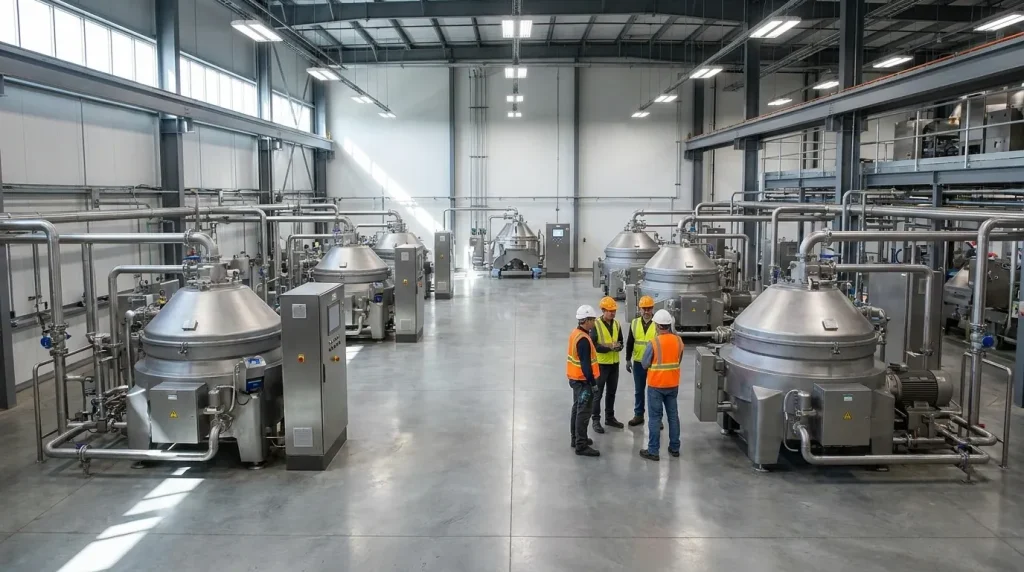
G-force, RPM, and centrifuge size parameters (such as bowl diameter where applicable) are three interdependent parameters that influence centrifuge separation efficiency, throughput capacity, and equipment suitability for specific industrial applications. Understanding their mathematical relationships enables process engineers to select equipment that matches particle characteristics, fluid viscosity, and production requirements.
This guide covers the fundamentals of centrifugal force calculation, the operational relationship between rotational speed and separation outcomes, sizing considerations for capacity and force generation, parameter optimization for industrial applications, and equipment selection guidance.
G-force represents the relative centrifugal force that drives separation by pushing denser particles outward. The formula RCF = (RPM)² × 1.118 × 10⁻⁵ × r (with radius in centimeters) or RCF = 0.0000284 × r × (RPM)² (with radius in inches) reveals a critical squared relationship: doubling RPM produces a fourfold increase in separating force. According to some manufacturer guides, industrial sedimentation centrifuges typically generate forces ranging around 3,000 and 10,000 G, while filtration-type centrifuges typically run below 2,000 G.
RPM adjustments directly control available centrifugal force, but optimal settings depend on feed rate, differential speed, and the density difference between separated phases. Running at maximum speed is not always ideal, as excessive force can re-emulsify separated phases or damage shear-sensitive products.
Centrifuge size represents an engineering trade-off between processing capacity and mechanical constraints. Larger separation chambers or rotating assemblies can provide greater volumetric capacity and may generate higher g-forces at the same rotational speed; however, allowable maximum RPM generally decreases as the rotating diameter increases to maintain safe operating stresses. A centrifuge with a 24 in (610 mm) rotating diameter operating at 3,000 RPM may deliver identical g-force to a 36 in (914 mm) design operating at a lower speed, but with different throughput, maintenance, and energy profiles.
Parameter misapplication can lead to bearing wear, incomplete separation, product degradation, and in severe cases, catastrophic failure. Proper specification matching reduces disposal costs, extends equipment life, and ensures consistent separation results across production cycles.
What Is G-Force in a Centrifuge and Why Does It Matter?
G-force in a centrifuge is the relative centrifugal force (RCF) that drives separation by pushing denser particles outward from the axis of rotation. Understanding g-force is important because it determines separation efficiency, throughput capacity, and equipment suitability for specific applications. The subsections below explain how g-force is calculated and which applications require high or low g-force levels.
How Is G-Force Calculated in a Centrifuge?
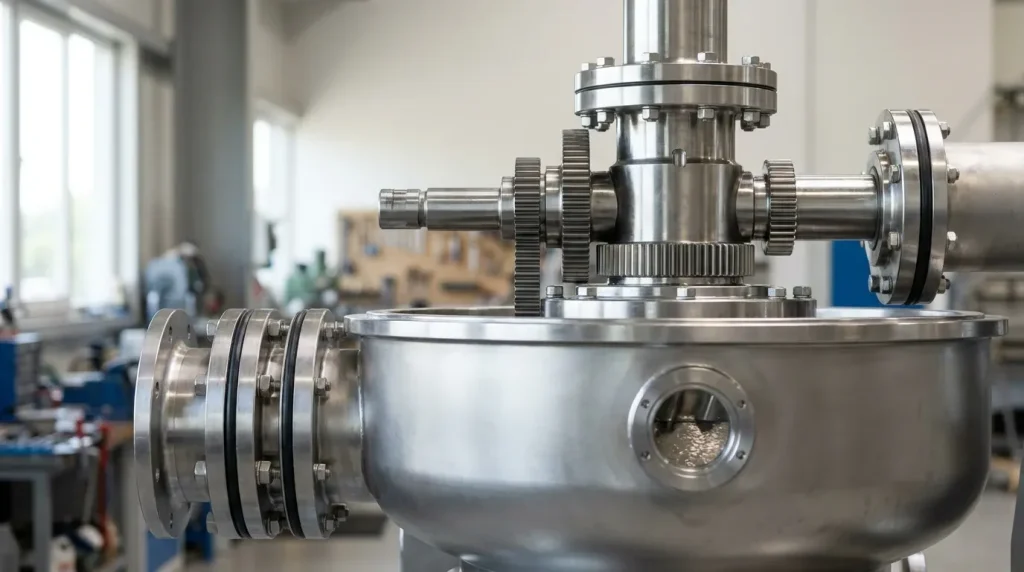
G-force in a centrifuge is calculated using the formula RCF = (RPM)² × 1.118 × 10⁻⁵ × r, where r is the radius in centimeters. For imperial measurements, the formula becomes RCF = 0.0000284 × r × (RPM)², with r in inches. These formulas reveal a critical relationship: doubling the RPM produces a fourfold increase in g-force because rotational speed is squared.
For practical reference, a centrifuge with a 4 in (10 cm) radius spinning at 3,000 RPM generates approximately 1,006 g. Industrial decanter centrifuges can operate at g-forces up to around 4,000 g or more depending on the application. Process engineers should always calculate RCF rather than relying on RPM alone, since two machines at identical speeds but different radii can produce vastly different separating forces.
What Are the Typical Applications Requiring High or Low G-Force?
The typical applications requiring high or low g-force depend on particle characteristics, fluid viscosity, and separation objectives.
High g-force applications (3,000–10,000 G):
- Fine particle sedimentation in pharmaceutical manufacturing
- Oil-water separation in petrochemical processing
- Clarification of fermentation broths
- Sludge dewatering in wastewater treatment
Low g-force applications (under 2,000 G):
- Filtration-type centrifuges for coarse solids removal
- Sugar crystal separation
- Salt recovery processes
- Fragile cell harvesting in biotechnology
Sedimentation-type centrifuges typically generate around 3,000 to 10,000 G, while filtration-type centrifuges generally operate below 2,000 G. Selecting the appropriate g-force range prevents product degradation in shear-sensitive applications and ensures adequate separation in challenging slurries.
With g-force fundamentals established, understanding how RPM directly influences this critical parameter becomes essential.
What Does RPM Mean in the Context of Centrifuges?
RPM (revolutions per minute) measures how many complete rotations a centrifuge’s rotating assembly completes in one minute. The following subsections explain how RPM connects to g-force and why speed adjustments directly affect separation outcomes.
How Are RPM and G-Force Related?
RPM and g-force are related through a squared mathematical relationship: doubling the rotation speed produces a fourfold increase in relative centrifugal force. This squared relationship means small RPM changes create large g-force shifts. The formula RCF = (RPM)² × 1.118 × 10⁻⁵ × r (with radius in centimeters) or RCF = 0.0000284 × r × (RPM)² (with r in inches) shows that both speed and bowl radius determine the final separating force. Operators must account for this exponential effect when adjusting settings, since a modest 20% RPM increase yields a 44% increase in g-force.
How Does Adjusting RPM Influence Separation Efficiency?
Adjusting RPM influences separation efficiency by controlling the centrifugal force available to drive particles or liquids apart. Higher speeds accelerate sedimentation of denser solids, while lower speeds suit more delicate emulsions or shear-sensitive slurries.
Key factors that interact with RPM adjustments include:
- Feed rate: faster inflow requires higher RPM to maintain residence time
- Differential speed: the gap between speeds of rotating components, where applicable, affects centrifuge operation; in decanter centrifuges, the bowl-to-scroll RPM difference governs solids transport.
- Drum parameters: pool depth and weir settings shift the effective separation zone
Separation efficiency optimization is a primary concern across industrial applications, with operators balancing drum parameters and precise feed-rate control to improve performance. Running at maximum RPM is not always ideal; excessive speed can re-emulsify separated phases or damage shear-sensitive products. Matching RPM to the specific density difference and particle size of your process stream yields the best results.
With RPM’s role in separation established, the next section examines how rotational radius, influenced by factors such as bowl, basket, or rotor dimensions, amplifies or limits these effects.
How Does Rotational Radius Impact Centrifuge Performance?
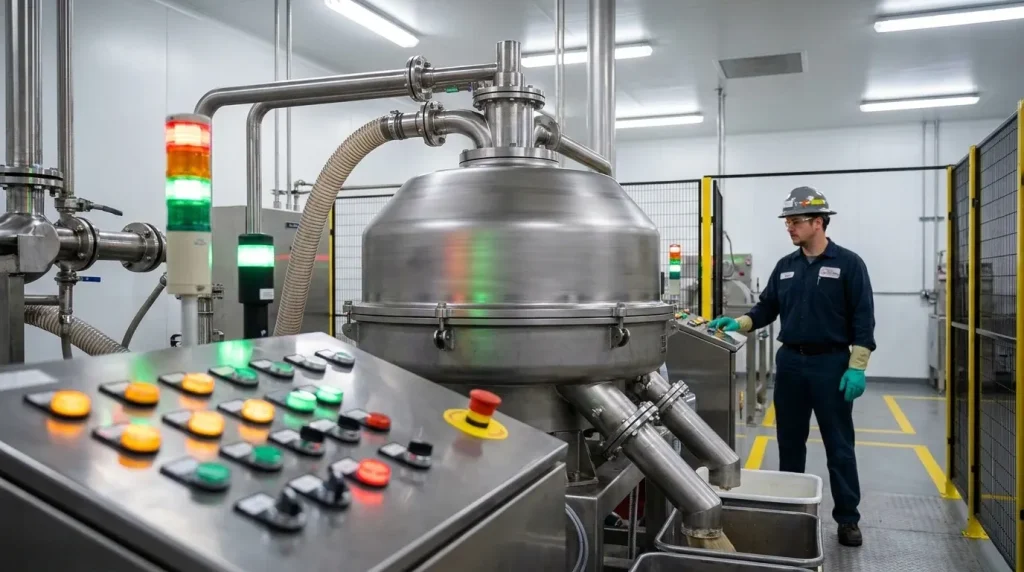
Rotational radius influences both the centrifugal force generated by a centrifuge and its processing capabilities. At a given RPM, a larger rotational radius produces higher relative centrifugal force (RCF), while larger rotating assemblies can often accommodate greater processing volumes. However, operating speed is limited by mechanical design, material stresses, and safety requirements. The following sections explain how centrifuge size and geometry affect throughput and separation performance.
What Is the Relationship Between Centrifuge Size and Processing Capacity?
The relationship between centrifuge size and processing capacity is directly proportional: larger diameters increase both volumetric capacity and settling area. A larger centrifuge size or rotating component diameter provides more internal surface for solids to accumulate during separation, enabling higher throughput per cycle.
Key capacity factors influenced by centrifuge size:
- Volumetric holding capacity: Internal volume scales with the square of the radius, so doubling diameter roughly quadruples capacity
- Settling surface area: Larger rotating assemblies can provide increased separation area, supporting improved clarification performance depending on centrifuge design and operating conditions.
- Solids retention: Larger centrifuge designs may accommodate higher solids loads and longer operating periods before solids removal or discharge is required.
Industrial decanter centrifuges with bowl diameters of 18 in (457 mm) can typically process around 50 to 100 gal/min (190 to 380 L/min), while 36 in (914 mm) units can exceed 500 gal/min (1,900 L/min). For high-volume wastewater or chemical processing, selecting appropriate bowl diameter ensures sufficient residence time for complete separation without frequent interruptions.
How Does Centrifuge Size Affect G-Force at a Given RPM?
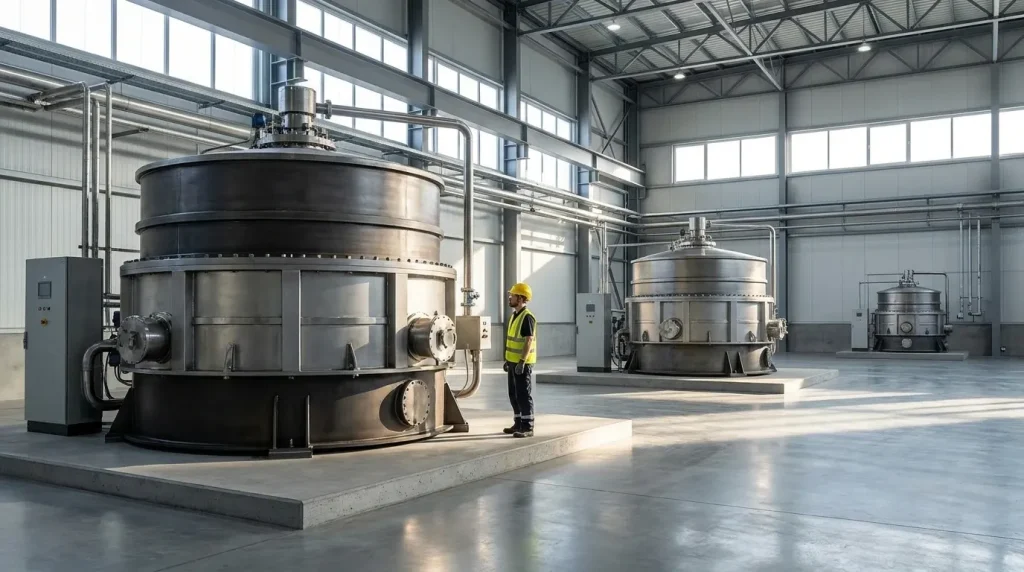
Centrifuge size affects g-force at a given RPM through a direct linear relationship: at identical rotational speeds, larger diameters produce proportionally higher centrifugal forces. The standard formula, RCF = (RPM)² × 1.118 × 10⁻⁵ × r (radius in centimeters) or RCF = 0.0000284 × r × (RPM)² (r in inches), demonstrates that g-force increases directly with radius.
For example, at 3,000 RPM:
| Bowl Diameter | Radius | G-Force (RCF) |
| 8 in (200 mm) | 10 cm | ~1,006 g |
| 12 in (305 mm) | 15.25 cm | ~1,533 g |
| 18 in (457 mm) | 22.9 cm | ~2,300 g |
This relationship creates an engineering trade-off. Centrifuges with larger rotational radii generate higher g-forces but face greater mechanical stress on bearings, seals, and drive components. Manufacturers typically rate maximum RPM inversely to rotational radius, meaning larger units operate at lower speeds to stay within safe structural limits. Understanding this balance helps engineers select equipment that achieves target separation efficiency without exceeding mechanical design parameters.
Why Is Understanding the Interplay of G-Force, RPM, and Centrifuge Size Important for Industrial Applications?
Understanding the interplay of G-force, RPM, and centrifuge size is important for industrial applications because these three parameters determine separation efficiency, throughput capacity, and equipment longevity. Procurement engineers must match centrifuge specifications to specific fluid contaminants and process requirements. The following subsections examine common parameter misapplication mistakes and the benefits of proper selection.
What Mistakes Can Occur When These Parameters Are Misapplied?
Mistakes that can occur when these parameters are misapplied include undersized centrifuge selection, excessive RPM settings, and mismatched G-force targets for the separation task.
Common parameter errors and their consequences:
- Operating beyond the rated speed: Running a bowl, basket, or rotor above its designed RPM increases centrifugal forces beyond intended limits, accelerating component wear and potentially creating serious mechanical safety risks.
- Undersizing capacity for the required throughput: An undersized centrifuge may experience reduced separation efficiency, shorter operating margins, increased wear, and higher maintenance demands as it operates closer to its design limits.
- Ignoring the squared relationship: Because G-force scales with RPM squared, small speed increases create disproportionate mechanical stress
- Mismatching G-force to solids characteristics: Applying 10,000 G to shear-sensitive materials damages product quality, while using 2,000 G on fine particulates yields incomplete separation
Improper rotor balancing or damaged rotors in certain high-speed centrifuge applications can lead to equipment destruction and operator injury. These failures can be contributed to by parameter misapplication during specification or operation.
How Can Process Optimization Benefit from Proper Parameter Selection?
Process optimization can benefit from proper parameter selection through improved separation efficiency, reduced operating costs, and extended equipment service life.
When engineers correctly balance G-force, RPM, and centrifuge size for their specific application, separation efficiency improves measurably. Adjusting differential speed and feed rates based on accurate parameter calculations maximizes solids capture while minimizing energy consumption and helping prevent damage.
Key optimization benefits include:
- Lower disposal costs: Effective parameter matching in wastewater applications reduces sludge volume significantly, cutting hauling and disposal expenses
- Extended bearing life: Operating within calculated G-force limits rather than maximum RPM preserves rotating components
- Consistent product quality: Matching G-force to particle characteristics ensures repeatable separation results batch after batch
- Reduced downtime: Proper specifications prevent the auxiliary switch failures and contact wear identified in root cause failure analyses
For procurement decisions, understanding these relationships enables accurate comparison between centrifuge options. For example, a 24 in (610 mm) bowl in a decanter, disc-stack, or tubular centrifuge at 3,000 RPM may deliver identical G-force to a 36 in (914 mm) bowl at lower speed, but with different throughput and maintenance profiles. This knowledge directly supports capital equipment selection and process scale-up planning.

How Can International Process Plants Help You With Centrifuge Selection or Asset Redeployment?
International Process Plants helps with centrifuge selection and asset redeployment by providing access to quality used and new surplus separation equipment, technical guidance, and global logistics support. The following sections cover our equipment solutions and key parameter takeaways.
What Centrifuge Equipment and Redeployment Solutions Does International Process Plants Offer?
International Process Plants offers centrifuge equipment and redeployment solutions through our global network of warehouses in Eastover, South Carolina (US), Germany, and the United Kingdom. Our inventory includes centrifuges in various materials of construction and configurations, including decanter centrifuges, disc stack separators, and basket centrifuges.
We provide:
- Technical evaluation of centrifuge specifications against your process requirements
- Documentation review including capacity ratings, material certifications, and compliance with regional directives and regulatory requirements
- Global shipping coordination across 15+ countries
- Asset redeployment services for surplus centrifuge equipment
With 46 years in the process equipment industry and over 160,000 satisfied customers worldwide, we understand that matching G-force capability, RPM range, and centrifuge size to your separation application determines operational success.
What Are the Most Important Points to Remember About G-Force, RPM, and Centrifuge Size in Centrifuges?
The most important points to remember about G-force, RPM, and bowl diameter in centrifuges are their mathematical interdependence and practical implications for separation performance.
Key takeaways:
- G-force scales with RPM squared: Doubling RPM produces four times the centrifugal force
- Rotational radius influences G-force at a given RPM: A larger radius produces higher RCF at the same rotational speed, calculated using RCF = RPM² × 1.118 × 10⁻⁵ × r (where r is the rotational radius in centimeters), or RCF = 0.0000284 × r × (RPM)² (where r is the rotational radius in inches).
- Application dictates parameters: Sedimentation centrifuges typically operate at 3,000 to 10,000 G, while filtration types run below 2,000 G
- Capacity and force trade off: Larger rotational radius increases throughput but may require lower RPM to stay within mechanical limits
When evaluating centrifuge equipment, whether purchasing new surplus or redeploying existing assets, verifying these parameters against your specific separation requirements prevents costly mismatches.

 PT
PT  EN
EN  ES
ES  FR
FR  PL
PL  DE
DE  AR
AR  UR
UR  HI
HI  NL
NL  TR
TR  IT
IT  UK
UK  RU
RU  JA
JA  ZH
ZH