 Pular para o conteúdo
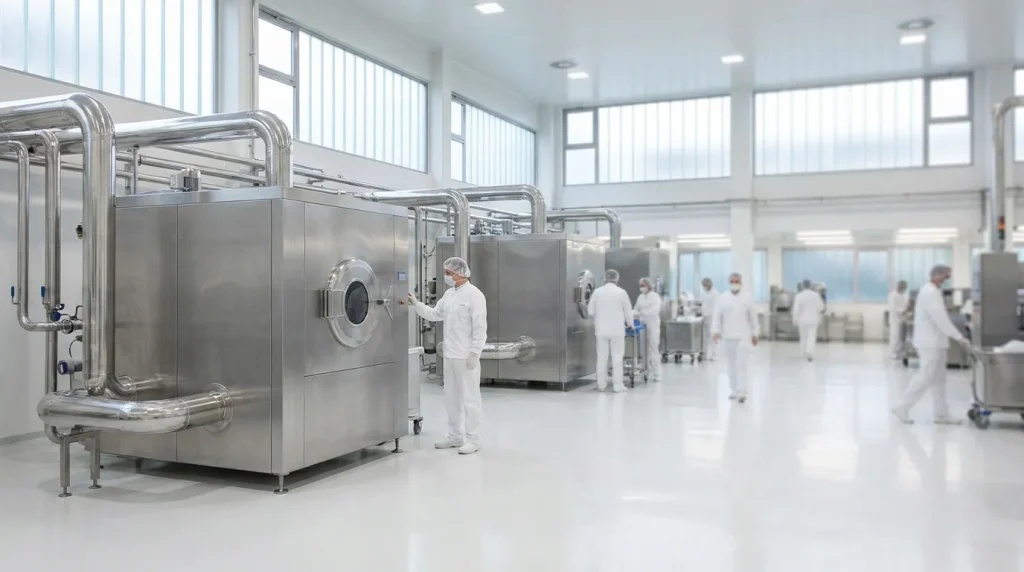
The best dryer types for heat-sensitive products are vacuum dryers, freeze dryers (lyophilizers), fluid bed dryers, and spray dryers, each designed to remove moisture at low temperatures that protect thermolabile materials. These products, common in pharmaceuticals, nutraceuticals, biotechnology, specialty chemicals, and cosmetics, deform structurally or lose potency when exposed to excessive heat.
This guide covers why heat-sensitive materials need specialized drying, which dryer technologies suit them, the factors that drive equipment selection, how dryers compare across product categories, common drying challenges, and how sourcing used equipment supports these needs.
Heat-sensitive products degrade through thermal damage to active compounds, vitamins, and volatile flavor molecules, so matching a dryer’s temperature limit to a product’s degradation threshold becomes the most important specification. Industries handling these materials favor low-temperature drying for high-value outputs.
Vacuum, freeze, fluid bed, and spray dryers each manage low-temperature operation differently. Vacuum dryers lower the boiling point of water to vaporize moisture below 131 F (55 C); freeze dryers sublime ice under deep vacuum to preserve fragile biomolecules; fluid bed dryers suspend particles in heated air for fast, uniform drying; spray dryers convert liquids to powder in seconds. Supercritical CO2 and infrared drying serve specialized applications.
Selecting the right dryer depends on material properties, energy efficiency, operating scale, and maintenance cost. We examine how these factors apply to pharmaceuticals, food, nutraceuticals, and chemical products.
Common challenges include overheating and inconsistent batch quality, both controllable through lower temperatures, shorter cycles, and validated parameters. We also explain how acquiring used dryers from International Process Plants delivers proven drying technology at lower capital cost.
Why Do Heat-Sensitive Products Require Special Drying Methods?
Heat-sensitive products require special drying methods because high temperatures degrade their structural and functional properties. Many functional foods, nutraceuticals, and biopharmaceutical ingredients deform under extreme drying conditions. The sections below explain the risks conventional dryers pose and which industries process these materials.
What Risks Do Conventional Dryers Pose to Heat-Sensitive Materials?
Conventional dryers pose risks to heat-sensitive materials by exposing them to temperatures that trigger thermal degradation, nutrient loss, and structural deformation. Degradation of vitamins A, B1, and C follow first-order kinetics, accelerating as temperature rises. Volatile flavor compounds are particularly vulnerable to heat damage during processing.
The main risks include:
- Thermal degradation of active compounds and drug substances.
- Vitamin loss governed by temperature-dependent reaction rates.
- Heat damage to volatile flavor compounds.
- Changes to polymorphism in pharmaceutical solids.
For procurement engineers, matching dryer temperature limits to a product’s degradation threshold is the single most important specification, not throughput alone.
Which Industries Commonly Process Heat-Sensitive Products?
The industries that commonly process heat-sensitive products are pharmaceuticals, nutraceuticals, biotechnology, specialty chemicals, and cosmetics. Each sector handles thermo-labile compounds requiring controlled drying. According to Grand View Research, the global pharmaceutical manufacturing market was estimated at USD 516.48 billion in 2022, growing at a 7.63% CAGR through 2030.
The primary industries and their market scale are:
| Industry | Market Size | Source Year |
| Produtos farmacêuticos | USD 516.48 billion | 2022 |
| Nutracêuticos | USD 636.2 billion | 2025 |
| Biotecnologia | USD 809.3 billion | 2025 |
| Specialty Chemicals | USD 827.23 billion | 2026 |
| Cosméticos | USD 460.43 billion | 2026 |
These industries favor low-temperature drying for high-value outputs, since freeze-drying costs run four to eight times higher than air drying yet add product value. With these sectors and their risks established, the next section examines which dryer types best protect heat-sensitive products.
Which Dryer Types Are Most Suitable for Heat-Sensitive Products?
The dryer types most suitable for heat-sensitive products are vacuum dryers, freeze dryers, fluid bed dryers, and spray dryers, along with emerging alternatives like supercritical CO₂ drying. Each manages low-temperature operation differently, as the sections below explain.
How Do Vacuum Dryers Protect Heat-Sensitive Materials?
Vacuum dryers protect heat-sensitive materials by lowering the boiling point of water, allowing moisture removal at reduced temperatures. Lower pressure means liquids vaporize without the high heat that triggers thermal degradation. According to a study in the Journal of Food Science, vacuum conditions enable internal vaporization at relatively low product temperatures, typically below 131 F (55 C) in the final drying stage. This gentle profile preserves vitamins, flavor compounds, and active pharmaceutical ingredients that would otherwise break down. For procurement teams handling thermolabile products, vacuum drying offers one of the most reliable low-temperature pathways available across food, nutraceutical, and pharmaceutical applications.
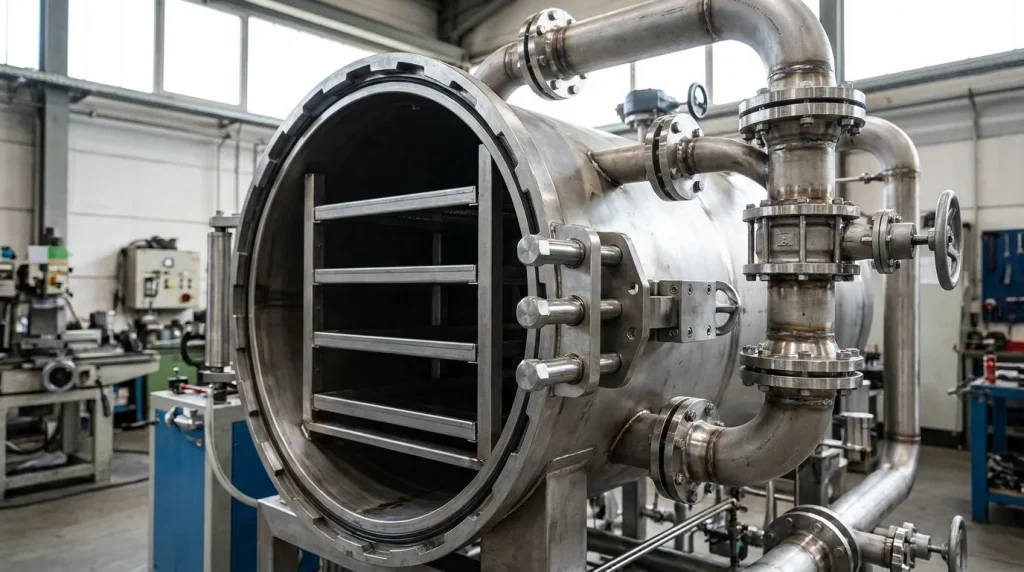
In What Ways Do Freeze Dryers (Lyophilizers) Benefit Sensitive Products?
Freeze dryers benefit sensitive products by removing water through sublimation at very low temperatures, preserving structure, potency, and biological activity. The process freezes the product, then sublimes ice directly to vapor under vacuum, avoiding liquid-phase heat damage. In one lyophilization study published in Pharmaceutics, the freezing temperature and chamber pressure reached -40 C (-40 F) and < 13.3 Pa. This protects fragile biomolecules: research in the Brazilian Journal of Chemical Engineering recorded a 95% enzyme activity recovery for α-amylase dried by freeze-drying. Freeze drying remains the gold standard for high-value enzymes, vaccines, and probiotics, though operating costs run higher than conventional methods.
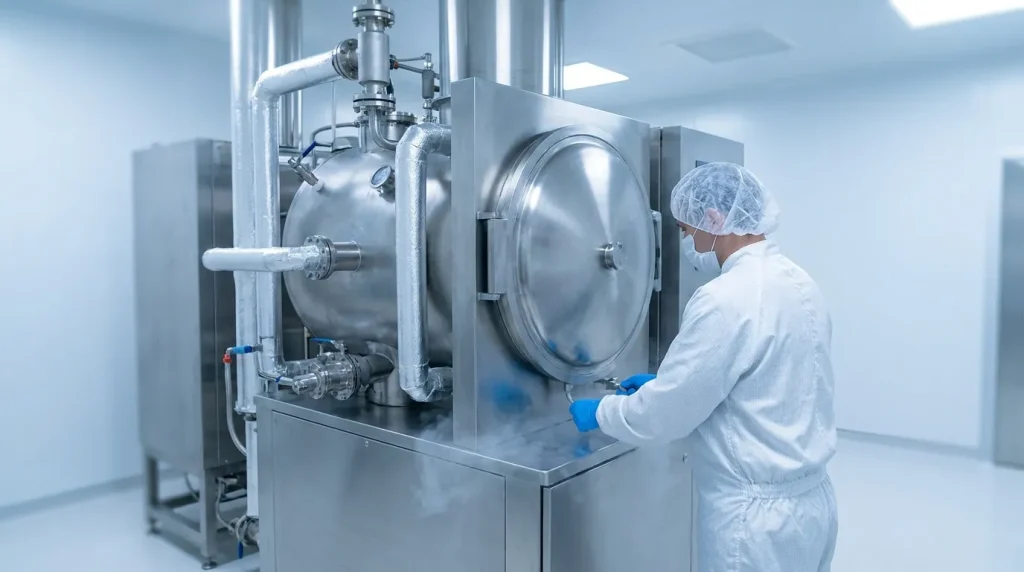
How Do Fluid Bed Dryers Operate With Temperature-Sensitive Items?
Fluid bed dryers operate with temperature-sensitive items by suspending particles in a stream of heated air, creating rapid, uniform heat transfer at moderate temperatures. The fluidized motion shortens drying time and prevents localized overheating, which protects thermolabile materials. Shorter cycles also reduce energy use. According to a study in Sensors, optimizing preheating on a FAMP68 fluid bed dryer cut preheating time by more than 50%, saving about 18.5 kWh per batch and roughly 3,700 kWh annually across 200 batches per year. For granular pharmaceuticals and nutraceuticals, this combination of speed and even thermal distribution makes fluid bed drying a practical choice.
What Is the Role of Spray Dryers in Handling Heat-Sensitive Products?
The role of spray dryers in handling heat-sensitive products is to convert liquid feeds into dry powder through brief exposure to hot air, where rapid evaporation keeps particle temperatures low. Atomized droplets dry in seconds, limiting heat contact time. The food industry uses spray drying extensively, with typical products ranging from 10 to 500 μm. Spray drying also excels at encapsulation. Research in Foods found that spray-drying processes were more suitable than freeze-drying for producing bixin powders with high encapsulation efficiency. For high-throughput powder production of flavors, nutraceuticals, and probiotics, spray drying balances gentle handling with industrial-scale output.
Are There Alternative Dryer Technologies for Delicate Materials?
Yes, there are alternative dryer technologies for delicate materials, including supercritical carbon dioxide drying and infrared drying. Supercritical carbon dioxide drying is an alternative drying method to freeze drying and spray drying for removing water from biomaterials. These methods target applications where standard dryers fall short:
- Supercritical CO₂ drying: removes water from sensitive biomaterials without liquid-phase surface tension, preserving delicate microstructures.
- Infrared drying: delivers energy-efficient, low-temperature drying for select products.
For specialized biomaterials and aerogels, supercritical CO₂ drying often outperforms conventional methods where structural integrity is critical. Selecting among these options depends on product properties, scale, and quality targets, which the next section examines in detail.
What Key Factors Should You Consider When Selecting a Dryer for Sensitive Products?
The key factors for selecting a dryer for sensitive products are material properties, energy efficiency, operating scale, and maintenance costs. The following sub-sections examine how each factor shapes equipment choice for thermally fragile materials.
How Do Material Properties Influence Dryer Selection?
Material properties influence dryer selection by setting the temperature, moisture, and structural limits the equipment must respect. Heat-sensitive materials degrade above defined thresholds, so the dryer must match the product’s thermal tolerance.
Key material properties that guide dryer selection include:
- Thermal degradation threshold, which caps the maximum safe drying temperature.
- Moisture content and bound-water behavior, which determine drying time and method.
- Particle size and target powder dimensions, which favor specific technologies.
- Sensitivity to oxidation, which may require vacuum or inert-gas operation.
For most thermolabile products, prioritizing the degradation threshold over throughput protects quality and yield, a trade-off procurement teams often underestimate.
What Energy Efficiency Considerations Matter for Sensitive Product Drying?
The energy efficiency considerations that matter for sensitive product drying are operating temperature, pressure, and the drying mechanism, because each affects energy use and product integrity. Lower processing temperatures protect heat-sensitive materials while shaping total energy demand.
Vacuum operation reduces the boiling point of water, which enables internal vaporization at relatively low product temperatures, typically below 131 F (55 C) in the final drying stage, according to a study published in the Journal of Food Science. This lets sensitive products dry without thermal damage. Matching the dryer’s mechanism to the product’s thermal limit yields the strongest efficiency gains.
How Does Scale of Operation Affect Equipment Choice?
The scale of operation affects equipment choice by aligning dryer capacity, batch size, and throughput with production volume. Small batches and large continuous runs call for different dryer classes.
Scale considerations that shape equipment choice include:
- Production volume, which separates batch dryers from continuous systems.
- Batch size consistency, which affects validation and repeatability.
- Floor space and utility capacity, which constrain larger units.
- Target output, which determines whether multiple smaller units outperform one large dryer.
Buyers should size for working capacity, not design capacity, because working capacity reflects realistic output for sensitive products.
What Are the Maintenance and Cost Concerns With Specialized Dryers?
The maintenance and cost concerns with specialized dryers are capital expense, energy consumption, cleaning validation, and component upkeep. Specialized dryers for sensitive products carry higher acquisition and operating costs than conventional units.
Primary maintenance and cost concerns include:
- Capital cost, which is highest for freeze dryers and vacuum systems.
- Cleaning and sterilization validation, critical for pharmaceutical and food use.
- Energy demand, which rises with vacuum and refrigeration loads.
- Spare-part availability for seals, pumps, and heating elements.
Sourcing good used dryers controls capital cost while preserving the precise temperature and pressure control sensitive products demand. International Process Plants currently stocks process equipment that helps buyers balance these competing cost and performance factors.
How Do Dryer Types Compare for Specific Heat-Sensitive Product Categories?
Dryer types compare differently across product categories because each material carries distinct thermal degradation thresholds. The sections below cover the best dryers for pharmaceuticals, food and nutraceuticals, and chemical or petrochemical products.
Which Dryers Work Best for Pharmaceuticals?
Freeze dryers (lyophilizers) work best for pharmaceuticals that lose activity at elevated temperatures. Lyophilization removes water through sublimation at low temperatures, preserving fragile molecules. A 2018 study in the Brazilian Journal of Chemical Engineering on enzyme drying found that freeze-drying recovered 95% of α-amylase enzyme activity, outperforming heated alternatives.
Common pharmaceutical drying choices include:
- Freeze dryers (lyophilizers) for biologics, vaccines, and enzymes
- Vacuum dryers for thermolabile active ingredients
- Spray dryers for high-throughput powder production
Tray lyophilization typically runs at a freezing temperature of -40 C (-40 F) and a chamber pressure of < 13.3 Pa. For high-value, low-volume biologics, lyophilization remains the most defensible choice despite its higher cost.
What Are Optimal Dryers for Food and Nutraceuticals?
Optimal dryers for food and nutraceuticals are spray dryers and freeze dryers, selected by throughput and heat sensitivity. Spray drying suits high-volume powders, while freeze drying protects the most fragile compounds.
The food industry extensively uses spray drying, with typical products ranging from 10 to 500 micrometers. A 2022 study in Foods on bixin encapsulation found that spray-drying processes achieved higher encapsulation efficiency than freeze-drying processes for that pigment.
Selection guidance by product type:
- Spray dryers for instant powders, flavors, and encapsulated pigments
- Freeze dryers for probiotics, vitamins, and premium ingredients
- Vacuum dryers for moderate-volume heat-sensitive extracts
For nutraceuticals where structure and functionality degrade under extreme conditions, matching the dryer to the specific compound matters more than throughput alone.
How Are Chemical and Petrochemical Heat-Sensitive Products Dried Safely?
Chemical and petrochemical heat-sensitive products are dried safely using vacuum dryers and quality risk management controls that limit thermal exposure. Vacuum operation lowers the boiling point of solvents and water, enabling drying below degradation thresholds.
Safe drying practices for these products include:
- Vacuum drying to reduce process temperatures and oxidation risk
- Inert atmosphere control for oxygen-sensitive compounds
- Closed-system handling for volatile or hazardous materials
Under vacuum, water vaporizes at relatively low product temperatures, typically below 55 C (131 F) in the final drying stage. According to the European Commission EU GMP Annex 1, processes and equipment should be managed under quality risk management principles to proactively identify and control risks to quality. For reactive chemical intermediates, prioritizing low-temperature vacuum systems over conventional hot-air dryers prevents both degradation and safety hazards. Matching dryer type to each product category sets the stage for addressing the common drying challenges that follow.
What Common Challenges Occur When Drying Heat-Sensitive Products and How Can They Be Overcome?
Common challenges when drying heat-sensitive products include thermal degradation of active compounds and inconsistent quality across batches. The sections below address how to prevent overheating and degradation, then how to secure consistent product quality and yield.
How Can Overheating or Degradation During Drying Be Prevented?
Overheating and degradation during drying can be prevented by lowering product temperature, shortening exposure time, and limiting oxygen contact. Volatile flavor compounds are especially vulnerable to thermal loss.
According to a study in Foods, volatile flavor compounds are highly unstable and prone to thermal degradation, oxidation, and evaporation during processing and storage. Effective prevention strategies include:
- Operating under vacuum to reduce the boiling point and the required product temperature.
- Using freeze drying or low-temperature methods for the most thermo-labile compounds.
- Minimizing dwell time to limit cumulative heat exposure.
- Controlling the drying atmosphere to suppress oxidation.
In our experience, matching the dryer to the compound’s degradation profile matters more than chasing the lowest possible temperature, because excessive cycle times can degrade products as severely as high heat.
What Steps Help Ensure Consistent Product Quality and Yield?
Steps that help ensure consistent product quality and yield include defining target quality attributes, controlling drying parameters tightly, and validating batch repeatability. Quality must be measured against clear, product-specific endpoints.
According to the Journal of Food Engineering, product quality is mainly expressed as taste, color, flavor, nutrient retention, minimal shrinkage, and desired bulk density and rehydration properties in instant powders. To hold these attributes consistent across batches, focus on the following controls:
- Set measurable endpoints for moisture, color, and bulk density before production.
- Stabilize inlet and outlet temperatures to reduce batch-to-batch variation.
- Monitor particle size and rehydration behavior as in-process quality checks.
- Calibrate sensors regularly to keep readings accurate.
For most heat-sensitive lines, defining quality targets before commissioning the dryer prevents costly reprocessing later. With these mitigation strategies defined, sourcing the right equipment becomes the next priority.

How Can Industrial Asset Acquisition Solutions Support Your Heat-Sensitive Drying Needs?
Industrial asset acquisition solutions support heat-sensitive drying needs by giving processors access to good used dryers matched to thermal-protection requirements. The following sections explain how sourcing equipment from International Process Plants supports sensitive product drying and recap the article’s key takeaways.
Can Sourcing Used or Refurbished Dryers From International Process Plants Help With Heat-Sensitive Product Drying?
Yes, sourcing good used dryers from International Process Plants can help with heat-sensitive product drying by matching the right drying technology to thermolabile materials. Most functional foods, nutraceutical ingredients, and biopharmaceutical compounds deform structurally at extreme drying conditions, so selecting the appropriate drying system is essential. We currently stock dryers suited to specific applications, including spray dryers, which the food industry uses extensively for products ranging from 10 to 500 micrometers. According to EU GMP Annex 1, processes and equipment should be managed under Quality Risk Management principles to identify and control quality risks proactively. Acquiring good used equipment lets processors deploy proven drying technology faster and at lower capital cost than new builds, while still meeting demanding thermal-protection standards.
What Are the Key Takeaways About Best Dryer Types for Heat-Sensitive Products We Covered?
The key takeaways are that dryer selection for heat-sensitive products depends on matching thermal limits, energy efficiency, and product quality goals to the right technology. The most actionable conclusions from this article include:
- Vacuum, freeze, fluid bed, spray, and alternative dryers each protect thermolabile materials through different low-temperature mechanisms.
- Material properties, scale, energy use, and maintenance cost should all guide dryer selection.
- Efficiency gains are achievable; optimizing a fluid bed dryer cut preheating time by more than 50%, saving roughly 18.5 kWh per batch.
- Pharmaceuticals, food, nutraceuticals, and sensitive chemicals each require category-specific drying approaches.
Matching verified equipment to these criteria, International Process Plants helps processors acquire dryers built for heat-sensitive production.

 PT
PT  EN
EN  ES
ES  FR
FR  PL
PL  DE
DE  AR
AR  UR
UR  HI
HI  NL
NL  TR
TR  IT
IT  UK
UK  RU
RU  JA
JA  ZH
ZH