 सामग्री पर जाएं
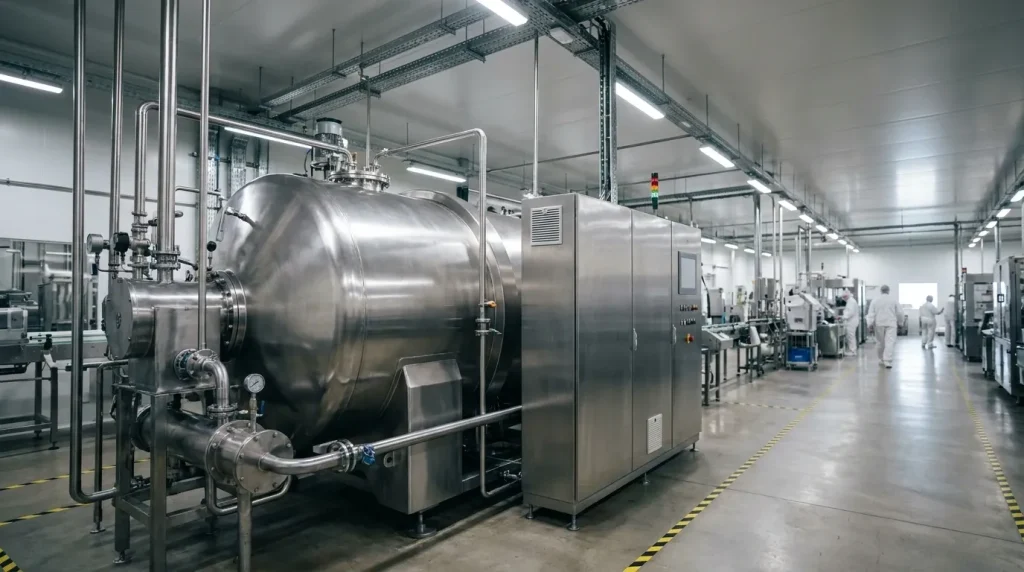
Auto-discharge bottom and manual-discharge top basket centrifuges are two distinct solid-liquid separation systems that differ primarily in how they remove filtered solids from the rotating assembly. Auto-discharge designs use automated scraper mechanisms to cut and expel the cake through the bottom, while manual-discharge units require operators to physically remove solids.
This guide covers operational mechanics, safety and efficiency comparisons, cost analysis, industry applications, and technological advances for both centrifuge types.
Operational mechanics differ fundamentally between these designs. Auto-discharge bottom centrifuges run automated batch cycles including filling, centrifugation, washing, dry-spinning, and automated scraping, with throughput ranging widely depending on basket dimensions, cycle time, product characteristics, and process requirements. Manual-discharge units feature simpler belt-driven assemblies where operators may stop the machine, open the lid, and scoop out the cake by hand.
Safety and efficiency comparisons reveal significant trade-offs. Auto-discharge systems minimize operator exposure to process materials and suit hazardous compound handling, while manual designs increase contact risks but work well for low-volume pilot plants. Labor requirements often differ by around 40 to 60%, with automated units allowing single operators to manage multiple machines simultaneously.
Cost analysis spans initial investment through total lifecycle ownership. Auto-discharge centrifuges can carry around 40 to 60% higher purchase prices but oftentimes recover the premium within 18 to 36 months through labor reduction in high-volume operations.
Industry applications determine which type fits best. Pharmaceutical API crystallization, 24/7 chemical production, and hazardous material processing favor auto-discharge, while pilot-scale development, specialty batches, and R&D flexibility suit manual-discharge units.
Technological advances now bring IoT-enabled monitoring, predictive maintenance, and retrofit options to both centrifuge discharge types, extending equipment life and improving separation consistency.
How Does an Auto-Discharge Bottom Basket Centrifuge Operate?
An auto-discharge bottom basket centrifuge operates by rotating a perforated basket at high speeds, typically around 800 G force at 1,000 rpm, to separate solids from liquids through centrifugal force. The sections below explain its main components, suitable applications, and key advantages and limitations.
What Are the Main Components of an Auto-Discharge Bottom Basket Centrifuge?
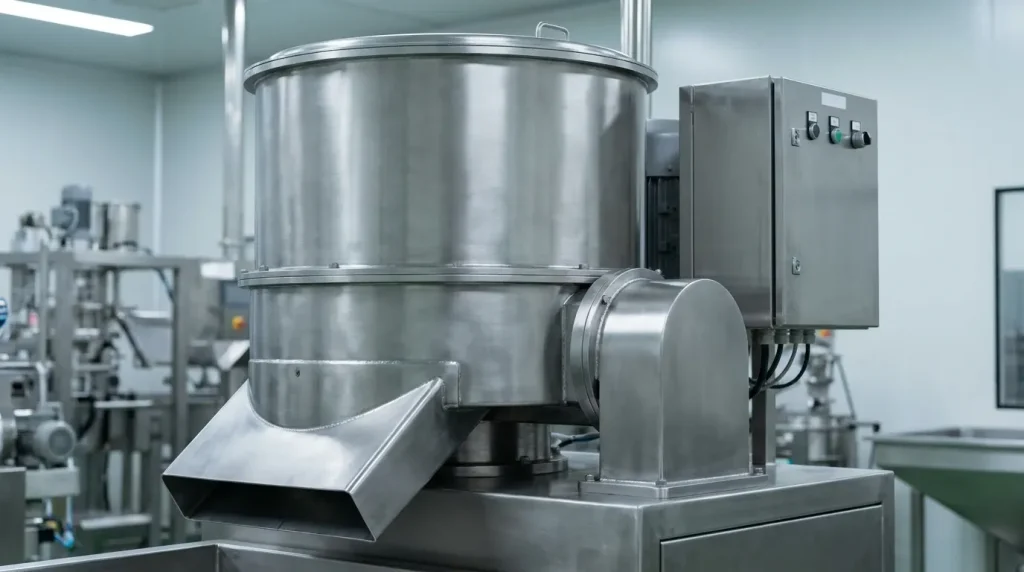
The main components of an auto-discharge bottom basket centrifuge include the perforated basket, drive motor, scraper knife assembly, discharge chute, and control system. The scraper knife moves vertically or radially to cut the filtered cake and direct product through the bottom discharge chute.
Solid-liquid separation occurs through specific automated process steps:
- Filling the basket with slurry
- Intermediate centrifugation to begin separation
- Washing the cake if required
- Dry-centrifugation to remove residual liquid
- Scraping to discharge the solid cake
These machines typically require less staff hours per day for operation and maintenance, depending on plant size. Industrial centrifuge manufacturers recommend major overhauls every 2 to 3 years based on expected wear of critical components such as bearings, seals, and scraper blades.
What Types of Materials and Processes Suit Auto-Discharge Bottom Basket Centrifuges?
The types of materials and processes that suit auto-discharge bottom basket centrifuges are medium to high-volume crystalline solids, chemical intermediates, and products requiring consistent cake washing. These units handle free-draining crystals, salts, and pharmaceutical intermediates where contamination control matters.
अनुप्रयोगों में शामिल हैं:
- Fine chemical and pharmaceutical crystal recovery
- Salt and mineral processing
- Polymer bead dewatering
- Agricultural chemical production
Germany’s chemical industry, the largest in Europe, drives substantial demand for these centrifuges in separation and purification processes. Bottom discharge designs suit processes requiring automated, repeatable batch cycles without manual intervention between cycles.
What Are the Typical Advantages and Limitations of Auto-Discharge Bottom Basket Centrifuges?
The typical advantages of auto-discharge bottom basket centrifuges are reduced labor requirements, reduced operator exposure, consistent product quality, and automation-enabled higher throughput capacity, which varies depending on basket dimensions and raw material characteristics.
Key advantages:
- Automated cake discharge minimizes operator exposure
- Consistent cycle times improve batch-to-batch uniformity
- Bottom discharge allows gravity-assisted product removal
- Enclosed design supports containment requirements
Limitations include higher capital cost compared to manual units, more complex maintenance requirements, and potential challenges with sticky or compressible solids that resist scraping. The automated systems require skilled technicians for troubleshooting and repairs.
For operations processing hazardous materials or running multiple batches daily, these trade-offs often favor auto-discharge designs despite higher upfront investment.
How Does a Manual-Discharge Top Basket Centrifuge Function?
A manual-discharge top basket centrifuge functions by spinning a perforated basket at high speed to separate solids from liquids, with operators removing the filtered cake by hand through the open top. The following subsections cover the distinct components, common applications, and key benefits and drawbacks of this design.
What Are the Distinct Parts of a Manual-Discharge Top Basket Centrifuge?
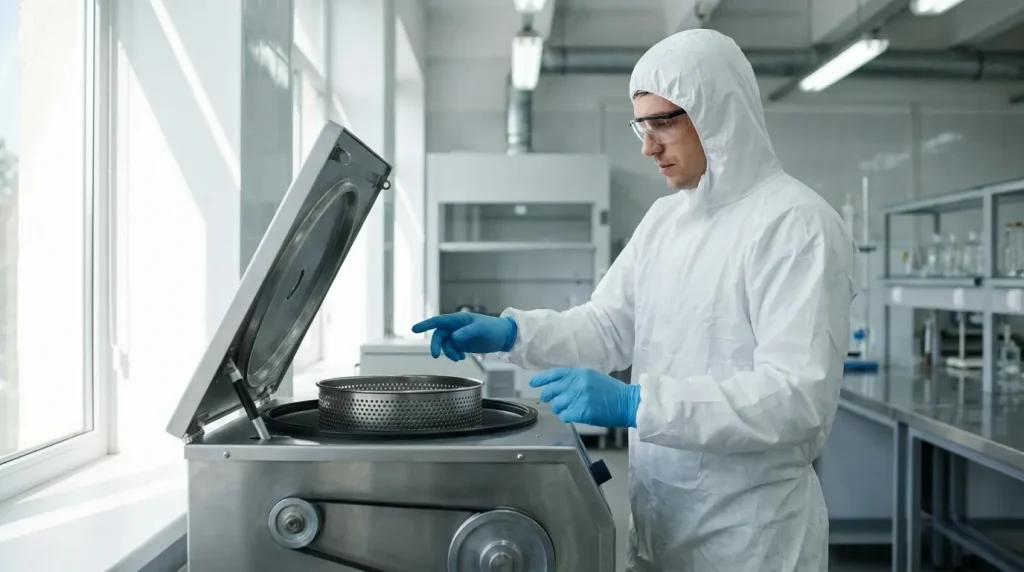
The distinct parts of a manual-discharge top basket centrifuge include the perforated basket, drive system, housing, and filtration media. The basket features a vertical wall parallel to the drive shaft, with the connection between the drive mechanism and basket commonly through a belt. A top-mounted lid provides access for loading slurry and manually removing the solid cake after centrifugation.
Key components include:
- Perforated basket (316L or 304 stainless steel construction typical; varies by process requirements)
- Belt-driven motor assembly
- Filter cloth or screen media lining the basket interior
- Hinged or removable top lid
- Slurry feed inlet
- Filtrate discharge outlet at the housing base
The open-top configuration eliminates the need for automated scraper mechanisms, which simplifies the mechanical design considerably.
In Which Applications Are Manual-Discharge Top Basket Centrifuges Commonly Used?
Manual-discharge top basket centrifuges are commonly used in low-volume operations, pilot plants, and specialty batch processes where product handling flexibility outweighs throughput demands. These units excel when processing high-value materials that require careful inspection between batches or when product characteristics vary significantly between runs.
Typical applications include:
- Pharmaceutical pilot-scale development batches
- Fine chemical and specialty chemical production
- Laboratory and R&D separation trials
- Small-batch crystalline product recovery
- Food-grade ingredient processing
The manual approach suits operations where batch sizes remain small, typically under 100 kg (220 lbs), and where operators need direct visual confirmation of cake quality before discharge.
What Are the Typical Benefits and Drawbacks of Manual-Discharge Top Basket Centrifuges?
The typical benefits of manual-discharge top basket centrifuges include lower capital cost, simpler mechanical design, and greater operational flexibility for varied product types. Drawbacks center on higher labor requirements and limited throughput capacity.
Benefits:
- Lower purchase price than automated systems
- Fewer mechanical components reduce maintenance complexity
- Easy product inspection and quality verification between batches
- Flexibility to handle varying cake characteristics without reprogramming
Drawbacks:
- Requires dedicated operator presence during discharge cycles
- Lower throughput limits high-volume production
- Ergonomic concerns with repeated manual cake removal
- Extended cycle times compared to auto-discharge designs
For procurement engineers evaluating centrifuge options, manual-discharge units make strong economic sense when batch volumes remain modest and labor costs are manageable. High volume or continuous operations typically justify the investment in automated discharge systems.
How Do Operational Efficiency and Safety Compare Between These Centrifuge Types?
Operational efficiency and safety vary significantly between auto-discharge bottom and manual-discharge top basket centrifuges. The sections below examine safety considerations, labor demands, and maintenance factors that influence total productivity.
What Are the Safety Considerations for Each Centrifuge Design?
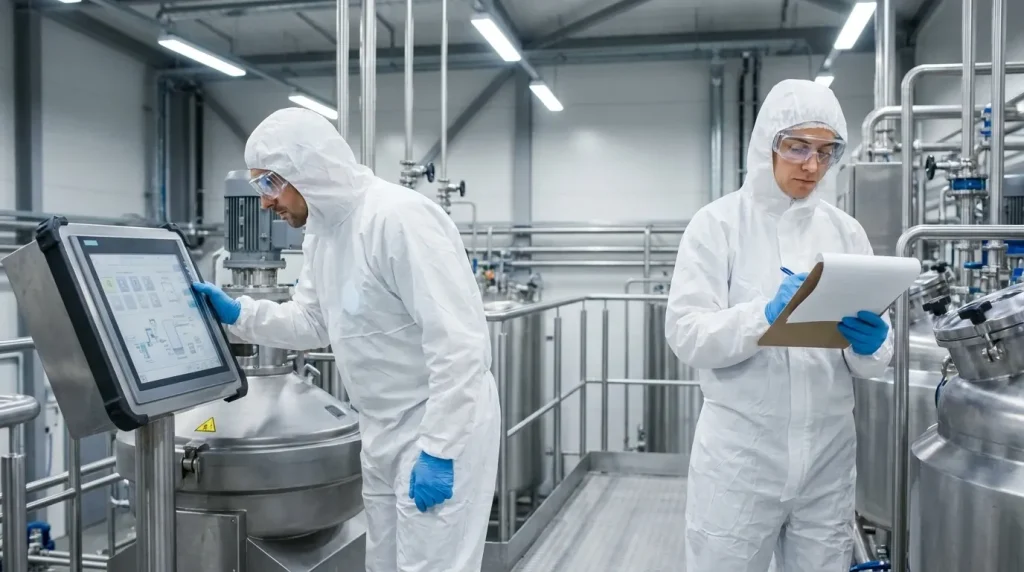
The safety considerations for each centrifuge design center on operator exposure, containment integrity, and compliance with hazardous-atmosphere standards.
Auto-discharge bottom basket centrifuges minimize operator contact with process materials. The automated scraper and bottom discharge chute keep personnel away from rotating components and potentially hazardous solids. This closed-loop operation reduces inhalation and contact risks when handling toxic or irritating compounds.
Manual-discharge top basket centrifuges require operators to physically remove the solid cake through the top opening. According to industry specifications, this design is ideal for low-volume operations or pilot plants where batch sizes are small and operator intervention is acceptable. However, repeated manual discharge increases exposure to airborne particles and ergonomic strain.
Both designs must meet explosion-protection standards when processing flammable materials. ATEX certification (EU), IECEx (international), and Class I Division ratings (North America) govern equipment selection for potentially explosive atmospheres. ISO 5199 provides design, reliability, and safety-related requirements for industrial centrifugal pumps used in process applications worldwide. For pharmaceutical applications, containment systems and validated cleaning protocols add another safety layer regardless of discharge type.
How Do Labor Requirements Differ Between Auto-Discharge and Manual-Discharge Centrifuges?
Labor requirements differ substantially between auto-discharge and manual-discharge centrifuges, with automation reducing operator involvement by often around 40 to 60% in continuous production settings.
Auto-discharge bottom basket centrifuges require minimal manual intervention during normal cycles. Operators load feed material and monitor process parameters, but the scraper mechanism handles solids discharge automatically. This allows a single operator to manage multiple units simultaneously.
Manual-discharge top centrifuges demand hands-on labor for every batch. Operators must:
- Stop the centrifuge and wait for the basket to decelerate
- Manually scoop or scrape the solid cake from the basket interior
- Transfer material to downstream containers
- Clean the basket before the next cycle
A single centrifuge operation typically requires 4 to 8 staff hours per day for operation and maintenance combined, with manual-discharge designs trending toward the higher end of that range. For facilities running multiple shifts, the cumulative labor differential between automated and manual discharge becomes a significant cost factor.
What Maintenance Needs and Downtime Factors Should Be Considered?
The maintenance needs and downtime factors to consider include wear-component replacement schedules, cleaning requirements, and overhaul intervals that differ by discharge mechanism.
Auto-discharge centrifuges have additional mechanical components, including scraper blades, hydraulic or pneumatic actuators, and discharge chutes. These parts experience wear proportional to cycle frequency and material abrasiveness. Scraper blades typically require inspection around every 500 to 1,000 hours (21 to 42 days of continuous operation) though manufacturer guidelines should always be referenced, and replacement when edge wear exceeds manufacturer tolerances.
Manual-discharge centrifuges have fewer moving parts, which simplifies maintenance but does not eliminate it. Basket liners, seals, and bearings still require scheduled attention. Some industrial centrifuge manufacturers recommend major overhauls around every 2 to 3 years based on critical component wear patterns.
Key downtime considerations include:
- Cleaning cycles: Manual units require longer cleaning between batches due to operator access constraints
- Component availability: Auto-discharge actuators and scrapers may have longer lead times than standard basket parts
- Lifecycle planning: Demanding applications such as municipal wastewater dewatering design centrifuges with wear-resistant components to extend maintenance intervals; abrasion protection for conveyor flights may be designed for a minimum of 20,000 operating hours before refurbishment or replacement is required
Facilities processing abrasive or corrosive materials should factor accelerated wear into maintenance budgets regardless of discharge type.
With efficiency and safety factors outlined, cost considerations further clarify which centrifuge type delivers better long-term value for your process.
What Are the Cost Considerations When Choosing Between Auto-Discharge and Manual-Discharge Centrifuges?
The cost considerations when choosing between auto-discharge and manual-discharge centrifuges include initial purchase price, labor expenses, energy consumption, and maintenance requirements. The following sections compare upfront investment against long-term operational costs and examine total cost of ownership across the equipment lifecycle.
How Do Initial Purchase Prices and Long-Term Costs Compare?
Initial purchase prices for auto-discharge bottom basket centrifuges might run slightly higher than manual-discharge top basket units of equivalent capacity, but offer specific benefits. The automated scraper mechanism, discharge chute assembly, and programmable controls add manufacturing complexity that increases capital cost.
Long-term costs tell a different story:
- Labor savings: Auto-discharge units reduce operator intervention, cutting multiple staff hours daily per machine
- Throughput gains: Faster cycle times can increase batch output by around 25–40%
- Consistency: Automated discharge reduces product loss from incomplete cake removal
Manual-discharge centrifuges carry lower upfront costs but accumulate higher labor expenses over time. For facilities running fewer than 8–10 batches daily, manual units often remain cost-effective. High-volume operations typically recover the auto-discharge premium within 18–36 months through labor reduction alone.
What Is the Impact on Total Cost of Ownership Over the Equipment’s Lifecycle?
The impact on total cost of ownership (TCO) over the equipment’s lifecycle depends on five primary factors: initial purchase, installation, energy consumption, maintenance, and labor. According to UniTrak’s Total Cost of Ownership guide, TCO analysis for industrial equipment accounts for the initial purchase, installation, commissioning, energy consumption, maintenance, spare parts consumption, labor, planned and unplanned downtime, and end-of-life related costs across the full life of the equipment.
With cost factors mapped, the next section examines which centrifuge type suits specific industry applications.
Which Basket Centrifuge Discharge Type Aligns Best with Different Industry Applications?
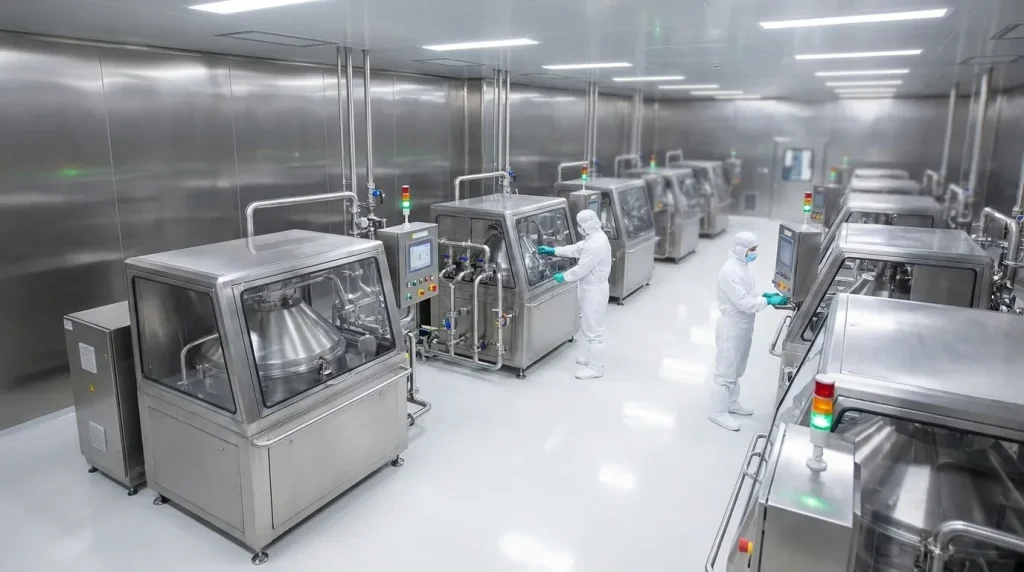
The best basket centrifuge discharge type depends on batch size, product value, and regulatory requirements specific to each industry. Auto-discharge bottom designs suit high-volume chemical and pharmaceutical production, while manual-discharge top units serve pilot plants and specialty applications requiring hands-on product handling.
How Do Industry-Specific Requirements Influence Centrifuge Choice?
Industry-specific requirements influence centrifuge choice by dictating throughput demands, containment standards, and validation protocols that favor either automated or manual discharge systems.
Pharmaceutical manufacturing prioritizes containment and cleanability. Auto-discharge bottom centrifuges with CIP (clean-in-place) systems minimize operator exposure to active pharmaceutical ingredients while meeting FDA and EMA validation requirements. The enclosed discharge path reduces contamination risk during API crystallization and intermediate isolation.
Chemical processing emphasizes throughput, containment, and corrosion resistance. High-volume commodity production benefits from automated systems that cycle continuously without operator intervention. Specialty chemical batches with frequent product changeovers may favor manual-discharge units where simplified cleaning between batches outweighs automation benefits.
Food and beverage applications require hygienic design with smooth surfaces and accessible inspection points. Sugar crystallization and starch separation typically use auto-discharge systems for consistent cake removal, while artisanal or small-batch producers often prefer manual discharge for direct product inspection.
Wastewater treatment relies on polymer bridging formation to create stronger flocs that withstand high dewatering intensity during centrifugation of digested sludge. This application typically uses continuous decanters rather than batch basket centrifuges.
Are There Particular Processes Where One Type Is Clearly Superior?
While both types offer unique benefits, choosing a centrifuge type comes down to your particular process requirements, depending on batch frequency, product characteristics, and labor availability.
Auto-discharge bottom centrifuges are well suited for:
- High-volume crystallization requiring many cycles per day
- Hazardous material handling where operator exposure must be minimized
- 24/7 production schedules with limited staffing
- Products requiring consistent cake thickness for downstream processing
Manual-discharge top centrifuges are well suited for:
- Pilot-scale development and process optimization
- Low-volume specialty products with high per-batch value
- Applications requiring visual inspection of each cake
- Facilities without compressed air or automation infrastructure
- Research and development where flexibility exceeds throughput needs
For processes involving delicate crystals or temperature-sensitive materials, manual discharge allows operators to assess product quality before each unload. Automated systems excel when product consistency is established and maximum throughput drives profitability.
With application requirements defined, recent technological advances continue to expand capabilities for both centrifuge types.
How Do Recent Technological Advances Affect Both Centrifuge Types?
Recent technological advances affect both centrifuge types by introducing automation, predictive maintenance, and retrofit capabilities that can extend equipment life and improve operational efficiency. The following sections examine specific innovations for auto-discharge and manual-discharge systems, plus upgrade pathways for existing equipment.
What Innovations Have Improved Auto-Discharge or Manual-Discharge Systems Recently?
Innovations that have improved auto-discharge and manual-discharge systems recently include IoT-enabled monitoring, automated feed control, and enhanced human-machine interfaces. Modern centrifuge automation continuously monitors operational changes and adjusts flow rates automatically based on feed conditions, reducing operator intervention and improving separation consistency.
Predictive maintenance now leverages IoT technology to gather and analyze real-time data about centrifuge assets, preemptively addressing equipment issues before they result in failures. For auto-discharge systems, this means monitoring scraper knife wear, bearing vibration, and discharge chute conditions. Manual-discharge units benefit from cycle tracking and motor load analysis that signal when maintenance is due.
Advanced control systems offer touchscreen HMIs with recipe storage, allowing operators to program optimal parameters for different products. These interfaces reduce training time and minimize human error during batch changeovers.
How Can International Process Plants Help You Select and Source the Right Centrifuge Equipment?
International Process Plants helps you select and source the right centrifuge equipment by combining 46 years of process equipment expertise with a global inventory of new surplus and quality used separation systems. The following sections explain our acquisition capabilities and summarize the key differences covered in this guide.
Can International Process Plants Assist with Acquiring Used or Refurbished Basket Centrifuges?
Yes, International Process Plants can assist with acquiring used or refurbished basket centrifuges through our extensive global network. We maintain warehouses in Eastover, South Carolina (US), Germany, and the United Kingdom, giving us access to equipment that meets applicable project requirements, including regional compliance requirements and industry standards such as CE marking, PED requirements, or ASME-related requirements where applicable.
Our inventory includes both auto-discharge bottom and manual-discharge top configurations from major manufacturers. For applicable auxiliary equipment, such as centrifugal pumps used within industrial process systems, ISO 5199 provides technical specifications for pump design and construction, and we verify compliance documentation before listing any unit. Each centrifuge undergoes inspection to confirm mechanical condition, basket integrity, and drive system functionality.
For buyers seeking quality used equipment at approximately 50% of new pricing, we provide detailed specifications including basket diameter, g-force ratings, and material of construction documentation.
What Are the Key Takeaways About Auto-Discharge Bottom vs. Manual-Discharge Top Basket Centrifuges We Covered?
The key takeaways about auto-discharge bottom vs. manual-discharge top basket centrifuges are:
- Auto-discharge bottom units suit high-volume, continuous operations requiring minimal operator intervention
- Manual-discharge top units excel in low-volume, pilot-scale, or batch-flexible applications
- Labor requirements differ significantly: auto-discharge reduces manual handling while top-discharge requires operator presence for cake removal
- Safety considerations favor auto-discharge in hazardous environments due to reduced exposure
- Total cost of ownership analysis should weigh higher initial automation costs against long-term labor savings
- Material characteristics, including particle size and cake consistency, strongly influence which design will provide the best separation performance
Selecting between these configurations depends on your specific throughput requirements, labor availability, and process chemistry. International Process Plants can help you evaluate both options against your operational parameters.

 HI
HI  EN
EN  ES
ES  FR
FR  PL
PL  DE
DE  AR
AR  UR
UR  NL
NL  TR
TR  IT
IT  UK
UK  RU
RU  JA
JA  PT
PT  ZH
ZH