
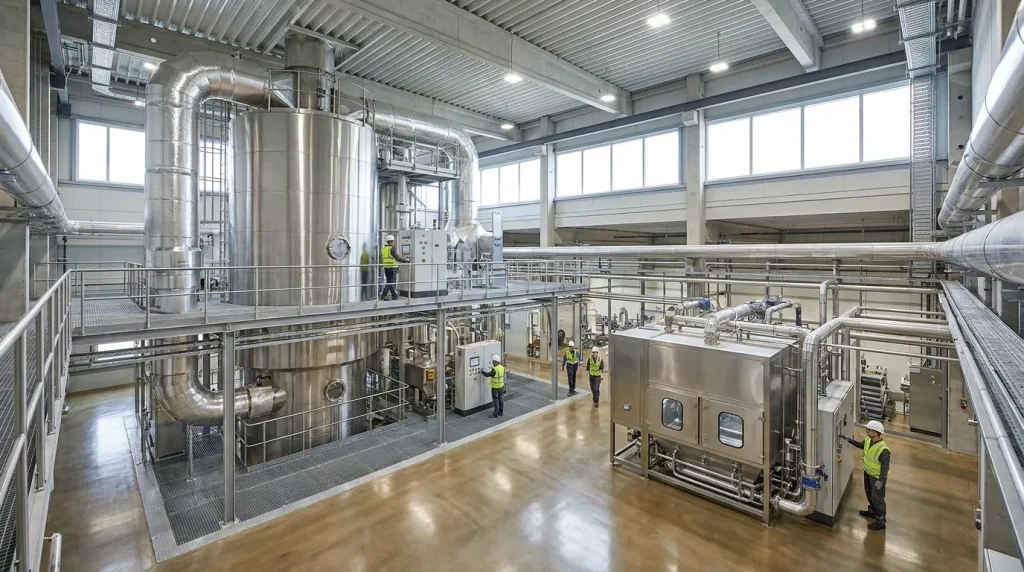
Spray dryers and fluid bed dryers are convective drying systems that differ in feed type, drying mechanism, and product form. Spray dryers atomize liquid feeds into fine droplets and convert them to powder in a single pass of hot air, while fluid bed dryers pass hot gas upward through a bed of free-flowing solid particles to dry them evenly.
This guide covers how each system works and where it applies, the advantages and disadvantages of both, their comparison across energy efficiency and operating costs, their effect on product quality and heat-sensitive materials, the industries and selection factors that point toward one over the other, and how to source the right equipment.
Spray dryers complete powder formation in one continuous step and handle drying gas temperatures from 122 F to 752 F (50 C to 400 C), while fluid bed dryers fluidize solid particles through a distribution plate and support both batch and continuous flow.
Spray dryers offer fast single-step drying and precise particle control but carry high energy demand, nozzle wear, and dust-explosion risk. Fluid bed dryers deliver uniform, efficient drying of free-flowing particles yet struggle with cohesive, fine, or sticky feeds classified in Geldart group C.
Both systems fall under convective drying, where thermal efficiency rarely exceeds 60 percent. Spray drying protects thermally sensitive materials such as biopharmaceuticals and milk powder through short residence times and co-current gas flow.
International Process Plants supplies good used spray dryers and fluid bed dryers from an inventory of 15,000+ pieces of process equipment, lowering capital cost across pharmaceutical, food, and chemical applications.
What Are the Main Differences Between Spray Dryers and Fluid Bed Dryers?
The main differences between spray dryers and fluid bed dryers lie in feed type, drying mechanism, and product form. Spray dryers convert liquid feeds into powder through atomization, while fluid bed dryers dry free-flowing solid particles using upward gas flow. The sections below explain each working principle and typical applications.
How Does a Spray Dryer Work?
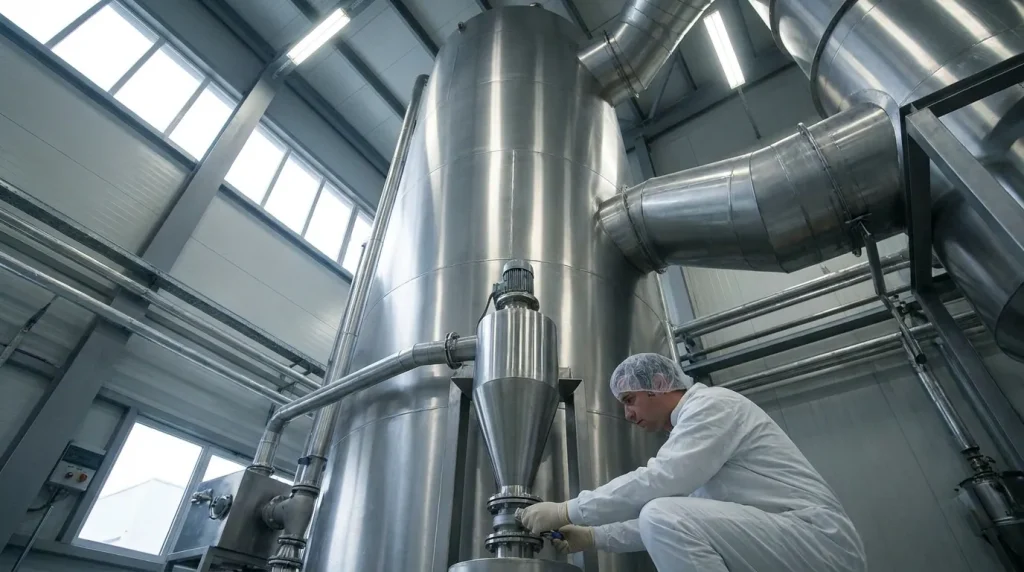
A spray dryer works by atomizing a liquid feed into fine droplets inside a drying chamber, where a stream of hot air converts the droplets into dry powder particles. Atomization occurs through a rotary atomizer or nozzle that breaks the liquid into droplets. The hot gas then evaporates moisture rapidly, producing a free-flowing powder collected at the chamber base.
Drying gas temperatures range from 122 F to 752 F (50 C to 400 C) depending on the material, per Arun S. Mujumdar’s reference work on the classification and selection of industrial dryers from the National University of Singapore. Spray drying completes powder formation in a single step, which makes it efficient for high-volume liquid processing.
How Does a Fluid Bed Dryer Work?
A fluid bed dryer works by passing a hot gas stream upward through a bed of solid particles, which causes the bed to expand and the particles to move freely within it. The hot gas enters at the base of the bed through a dispersion/distribution plate. As gas velocity increases, the particle bed fluidizes, exposing each particle to uniform heat and airflow.
Fluid bed dryers support both batch and continuous flow of materials, according to the Bureau of Energy Efficiency, India. This flexibility makes them effective for drying relatively free-flowing particles with a reasonably narrow particle size distribution.
In Which Applications Is Each Dryer Type Commonly Used?
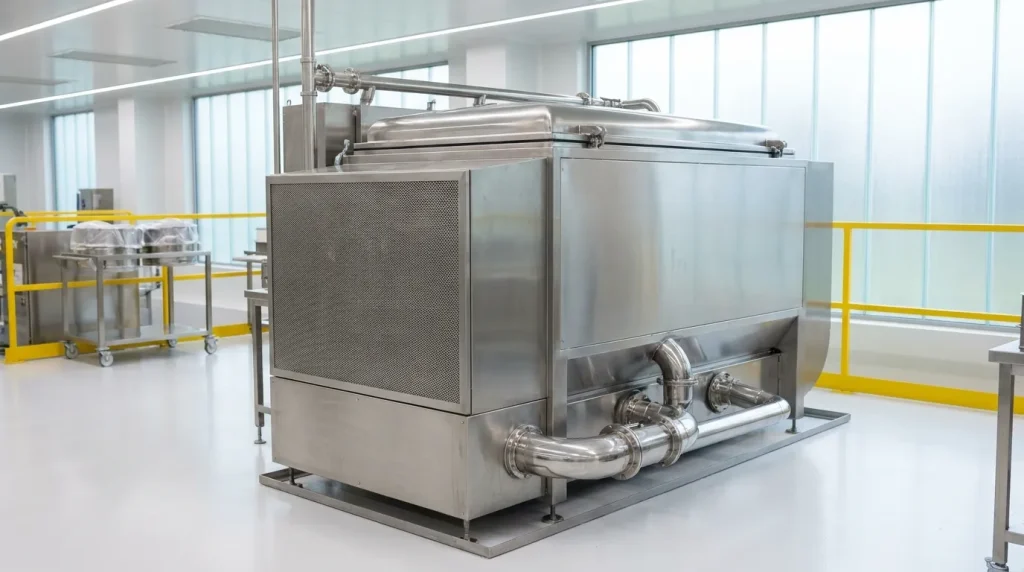
Each dryer type serves distinct applications based on feed form. Spray dryers handle liquid feeds, and fluid bed dryers process solid particles. Common uses for each include:
- Spray dryers: Heat-sensitive materials and detergents dried by co-current and counter-current configurations to achieve specific density, flowability, and particle-size requirements.
- Fluid bed dryers: Free-flowing granules and powders across food, fine chemicals, and pharmaceuticals.
Both belong to the convective dryer category, which accounts for about 85% of all industrial dryers, according to Natural Resources Canada. The global industrial dryers market reached USD 6.0 billion in 2025, reflecting steady demand across these applications. For procurement teams, matching feed state to dryer type abilities is the starting point for dryer type selection. Understanding each system’s strengths sets the stage for weighing their advantages and disadvantages.
What Are the Key Advantages and Disadvantages of Spray Dryers?
Spray dryers offer fast single-step drying and excellent particle control but carry high energy demand, equipment wear, and dust-explosion risk. The following sub-sections detail the main benefits first, then the primary limitations and operational challenges.
What Are the Main Benefits of Using Spray Dryers?
The main benefits of using spray dryers are rapid single-step drying, precise particle control, and gentle handling of heat-sensitive products. Spray drying converts liquid feeds into dry powder in one continuous operation through atomization. The short residence time and rapid evaporation keep particle temperatures low, which suits thermally sensitive materials. According to research published in Pharmaceutics (PubMed Central), the mild processing conditions of spray drying, characterized by short residence times and rapid evaporation, make it suitable for thermally sensitive materials such as biopharmaceuticals.
प्रमुख लाभों में शामिल हैं:
- Single-step conversion of liquids into finished powder.
- Tunable particle size, from 1 to 5 µm respirable particles to larger granules.
- Gentle treatment of proteins, biopharmaceuticals, and food products.
- Continuous high-volume throughput for industrial-scale production.
For heat-sensitive feeds, this combination of speed and low particle temperature is the single most decisive advantage spray drying holds over slower contact-drying methods.
What Are the Primary Limitations or Challenges of Spray Dryers?
The primary limitations of spray dryers are high energy consumption, nozzle wear, minimum-scale constraints, and dust-explosion risk. Drying is an energy-intensive operation, accounting for 10 to 20 percent of total industrial energy use in most developed countries (Wiley-VCH, Modern Drying Technology). Without heat recovery, a typical spray dryer reaches only about 40 percent thermal efficiency.
Key challenges include:
- High thermal energy demand and limited efficiency without heat recovery.
- Nozzle and swirl-chamber wear, requiring frequent inspection and wear-resistant inserts such as tungsten carbide.
- Minimum evaporative capacity around 5 kg/h (11 lbs/h), limiting bench-scale use.
- Large vertical footprint, since a fully developed spray cone is difficult below 5 m (16.4 ft).
- Combustible dust hazards, since fine particles suspended in air can cause flash fires or explosions.
With these trade-offs understood, fluid bed dryers present a different balance of strengths and constraints.
What Are the Key Advantages and Disadvantages of Fluid Bed Dryers?
Fluid bed dryers offer efficient, uniform drying of free-flowing particles but face limits with cohesive or fine materials. The following sub-sections cover their main benefits and their primary limitations.
What Are the Main Benefits of Using Fluid Bed Dryers?
The main benefits of using fluid bed dryers are efficient heat transfer, uniform drying, gentle particle handling, and broad industry suitability. Hot gas enters at the base through a distribution plate, expanding the bed so particles move freely and contact the drying gas evenly. According to the Bureau of Energy Efficiency, India, fluid bed dryers serve industries from heavy mining through food, fine chemicals, and pharmaceuticals, drying relatively free-flowing particles with a reasonably narrow particle size distribution. Key benefits include:
- Uniform, intimate gas-to-particle contact for consistent drying.
- Gentle handling suited to heat-sensitive food and pharmaceutical powders.
- Flexible operation with both batch and continuous material flow.
- Broad applicability across mining, chemical, and pharmaceutical sectors.
For many free-flowing powder applications, this combination of uniformity and gentle processing makes fluid bed drying the most practical convective option.
What Are the Primary Limitations or Challenges of Fluid Bed Dryers?
The primary limitations of fluid bed dryers are their dependence on particle behavior and their narrow material suitability. Fluidization quality varies sharply by particle type. According to Aalto University doctoral research, particles in fluidized beds fall into Geldart groups A, B, C, and D, where group A powders are aeratable, group B are sand-like, group C are cohesive, and group D are spoutable. Cohesive group C powders resist fluidization, while wide size distributions and sticky or wet feeds disrupt stable bed behavior. Key challenges include:
- Poor fluidization of cohesive, fine, or sticky materials.
- Difficulty handling broad particle size distributions evenly.
- Limited suitability for non-free-flowing or paste-like feeds.
These constraints make material characterization essential before specifying a fluid bed system, which directly informs the energy and cost comparison that follows.
How Do Spray Dryers and Fluid Bed Dryers Compare in Terms of Energy Efficiency and Operating Costs?
Spray dryers and fluid bed dryers both fall under convective drying, where thermal efficiency rarely exceeds 60% and energy demand dominates operating costs. The sections below compare energy efficiency between the two systems and explain how maintenance and operating costs differ.
Which Drying System Is More Energy Efficient?
Fluid bed dryers are generally more energy efficient than spray dryers because spray drying spends significant energy on atomization rather than direct evaporation. Drying is a highly energy-intensive operation, accounting for 10 to 20% of total industrial energy use in most developed countries, according to Wiley-VCH’s Modern Drying Technology. In spray drying, the kinetic energy of high-velocity gas breaks the liquid into fine droplets, and this atomization can generate heat that raises the inlet gas temperature and risks degrading heat-sensitive compounds such as proteins.
Operators improve drying efficiency by raising the inlet gas temperature, increasing the ratio of latent to sensible heat. For most heat-tolerant products, fluid bed systems deliver lower energy cost per kilogram of water removed.
How Do Maintenance and Operating Costs Differ Between the Two Systems?
Maintenance and operating costs differ mainly in component wear and capital intensity between the two systems. Spray dryers carry higher maintenance demands because their atomizing nozzles wear over time. According to research published in Pharmaceutics, swirl chamber and orifice wear requires strict maintenance routines, frequent inspections, and wear-resistant inserts such as tungsten carbide to prevent product contamination.
Both systems share a broader cost challenge. The industrial dryers market faces high initial investment and operational costs associated with advanced drying technologies. In our experience, the secondary equipment market lowers this capital barrier significantly, letting buyers acquire proven dryers at a fraction of new-build cost. With these cost factors clear, product quality becomes the next deciding factor.
How Do Spray Dryers and Fluid Bed Dryers Affect Product Quality and Consistency?
Spray dryers and fluid bed dryers affect product quality and consistency through different mechanisms: spray dryers control particle formation during atomization, while fluid bed dryers control it through fluidization dynamics. The sections below compare particle size control and the handling of heat-sensitive materials.
Which System Provides Better Control Over Particle Size and Uniformity?
Spray dryers provide more direct control over particle size and uniformity, because atomization sets droplet size before drying begins. Fluid bed dryers depend on the incoming feed particle size and fluidization behavior, offering less independent control over final dimensions.
Key factors shaping particle size control in spray dryers include:
- Atomizer wear, which affects droplet consistency over time
- Nozzle maintenance routines and frequent inspections
- Wear-resistant coatings or inserts, such as tungsten carbide
According to Pharmaceutics (PubMed Central), nozzle swirl chambers and orifices wear over time, requiring strict maintenance, frequent inspections, and wear-resistant inserts like tungsten carbide to prevent particle contamination in the final product.
How Does Each System Impact Heat-Sensitive Materials or Product Stability?
Spray dryers protect heat-sensitive materials through short residence times and rapid evaporation, while fluid bed dryers expose particles to sustained contact with heated gas. The drying gas flow configuration determines thermal exposure.
According to Drying Technology (Taylor & Francis), co-current flow allows the hottest drying gas to contact the coolest wet droplets, so rapid evaporation keeps particle temperatures low and makes the configuration suitable for heat-sensitive materials such as milk powder.
The main thermal protection mechanisms in spray drying include:
- Short residence times that limit heat exposure
- Rapid evaporative cooling at the droplet surface
- Co-current gas flow that pairs the hottest gas with the wettest feed
For thermally sensitive products like biopharmaceuticals and milk powder, spray drying with co-current flow generally preserves stability better than prolonged fluid bed contact. With quality and stability factors clear, industry-specific selection becomes the next consideration.
Which Industries Commonly Use Spray Dryers Versus Fluid Bed Dryers?
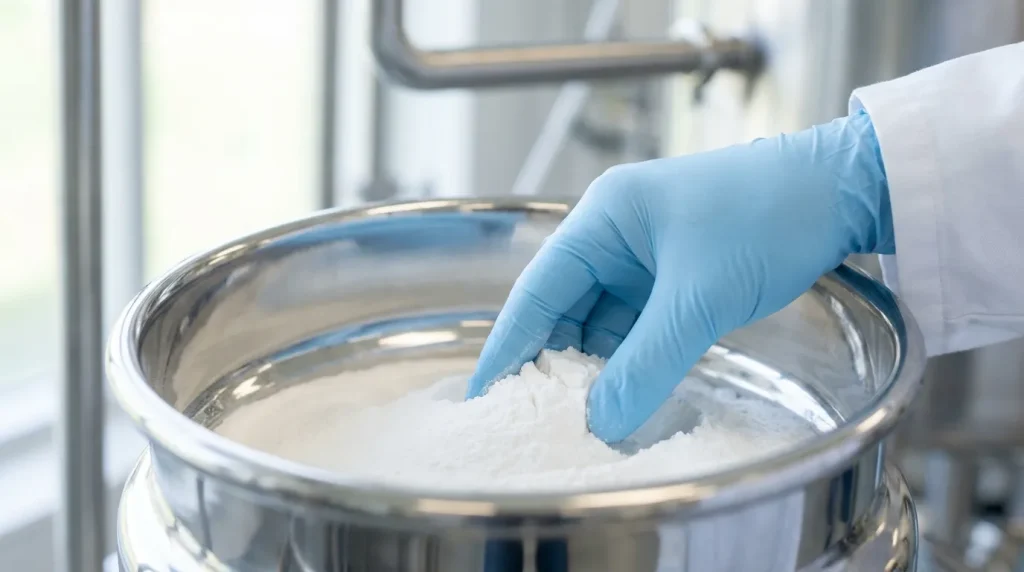
Spray dryers and fluid bed dryers serve overlapping industries, including food, fine chemicals, and pharmaceuticals, but each suits different feed types and product goals. The sections below explain why an industry favors one system and give concrete product examples for each dryer type.
Why Might an Industry Favor One System Over the Other?
An industry favors one system over the other based on feed state, product specifications, and particle characteristics. Spray dryers convert liquid feeds directly into powder, while fluid bed dryers handle relatively free-flowing solid particles with a reasonably narrow particle size distribution. According to the Bureau of Energy Efficiency, India, fluid bed dryers are found throughout all industries, from heavy mining through food, fine chemicals, and pharmaceuticals.
Particle behavior also guides selection. Particles in fluidized beds are classified into Geldart groups A, B, C, and D:
- Group A: aeratable powders
- Group B: sand-like particles
- Group C: cohesive particles
- Group D: spoutable particles
Cohesive group C powders resist fluidization, so industries handling such materials often choose spray drying instead.
Are There Specific Examples of Products Suited to Each Dryer Type?
Yes, specific products suit each dryer type based on whether the feed is liquid or solid. Spray dryers process liquid and slurry feeds into powder, while fluid bed dryers dry and process already-formed wet solid particles.
Products commonly suited to each dryer type include:
- Spray dryers: milk powder, instant coffee, juice powder, detergent slurries, and heat-sensitive pharmaceutical compounds
- Fluid bed dryers: free-flowing granules, mining ore concentrates, food granulates, and coated pharmaceutical particles
For procurement engineers, the feed state is an important factor: liquid feeds typically employ spray drying methods, while wet free-flowing solids typically employ fluid bed drying. Matching the dryer to feed state and particle group prepares you to weigh the practical selection factors that follow.
What Factors Should You Consider When Choosing Between a Spray Dryer and a Fluid Bed Dryer?
The factors to consider when choosing between a spray dryer and a fluid bed dryer are throughput and batch size, space and budget, scalability, and safety, regulatory, and environmental requirements. The following sub-sections examine how each factor shapes the decision.
How Do Throughput Requirements and Batch Size Influence the Choice?
Throughput requirements and batch size directly influence dryer selection by setting capacity and operating mode. Spray dryers suit high continuous output, while fluid bed dryers handle defined batch volumes well.
A reference spray dryer demonstrates the throughput scale these systems reach. According to a Wiley-VCH Modern Drying Technology sample chapter, a spray dryer without heat recovery delivers a production rate of 2,000 kg/h (4,409 lbs/h), an evaporation rate of 2,000 kg/h (4,409 lbs/h), a residence time of 1 minute, and a holdup capacity of 30 to 40 kg (66 to 88 lbs).
For procurement engineers, matching capacity to verified operating conditions while accounting for realistic peak and worst-case scenarios helps prevent oversizing, which wastes energy, and undersizing, which limits output.
How Do Space, Budget, and Scalability Affect Decision-Making?
Space, budget, and scalability affect decision-making by determining footprint, capital cost, and future capacity headroom. Spray dryers require tall chambers and larger floor area, while fluid bed dryers offer more compact, modular layouts.
Heat recovery illustrates the budget trade-off. A spray dryer with heat recovery raises efficiency from 40% to 55%, cutting steam consumption from 5,000 kg/h (11,023 lbs/h) to 3,700 kg/h (8,157 lbs/h) and steam use from 2,800 kW (3,755 HP) to 2,100 kW (2,816 HP), based on the Wiley-VCH Modern Drying Technology sample chapter.
What Role Do Safety, Regulatory, and Environmental Considerations Play?
Safety, regulatory, and environmental considerations play a central role by governing equipment design, certification, and dust-explosion control. Both dryer types must meet applicable standards for the materials they process.
Key compliance and safety frameworks include:
- ATEX and IECEx certification for equipment used in explosive atmospheres.
- EudraLex Volume 4 GMP guidance for medicinal products in the European Union.
- ISO 22000 for food safety management and ISO 14001 for environmental management.
- OSHA combustible dust controls, since fine particles suspended in air can ignite.
Product characteristics also shape safe operation. According to Pharmaceutics (PubMed Central), droplet size, density, and shape alter particle trajectory and the air friction that dissipates energy during atomization, which affects dust behavior and handling.
With these selection factors clear, the right sourcing partner turns specifications into the correct equipment.
How Can International Process Plants Help You Select and Acquire the Right Drying Equipment?
International Process Plants helps you select and acquire the right drying equipment by supplying good used spray dryers and fluid bed dryers from a global inventory of 15,000+ pieces of process equipment. The sections below cover our equipment solutions and the key takeaways from this comparison.
Can IPP’s Used and Refurbished Equipment Solutions Support Your Drying System Needs?
Yes, our good used equipment solutions can support your drying system needs across pharmaceutical, food, and chemical applications. We currently supply spray dryers and fluid bed dryers suited to demanding particle specifications, such as the respirable 1–5 µm particles and 60–90 µm lactose carrier particles used in dry powder inhalers.
Our drying equipment serves common process outputs, including:
- Milk powder, cheese powder, and egg powder
- Juice powder and instant coffee or tea powder
- Color and flavoring ingredients
The global spray drying equipment market is expected to reach USD 11.0 billion (approximately EUR 9.6 billion) by 2033, growing at a 6.8% CAGR from 2026 to 2033, according to Grand View Research. Buying good used equipment lets you enter this market faster and at lower capital cost than new builds.
What Are the Key Takeaways About Spray Dryer vs. Fluid Bed Dryer: Which Drying System Should You Choose? We Covered?
The key takeaways are that spray dryers and fluid bed dryers serve different process goals, and your choice depends on feed type, particle requirements, and thermal sensitivity.
The practical conclusions from this comparison are:
- Spray dryers convert liquid feeds into powder in a single step through atomization and rapid hot-air contact.
- Fluid bed dryers process and granulate solid particles, combining a spraying phase with a drying phase to agglomerate material.
- Spray drying suits thermally sensitive materials, such as biopharmaceuticals, because short residence times and rapid evaporation keep particle temperatures low.
- Fuel type matters: direct dryers transfer nearly 100% of thermal energy into the drying air, while indirect dryers transfer about 70%.
- Safety planning is essential, since suspended powder can cause flash fires or explosions during operation.
Contact International Process Plants to match your specifications with currently available drying equipment.


 HI
HI  EN
EN  ES
ES  FR
FR  PL
PL  DE
DE  AR
AR  UR
UR  NL
NL  TR
TR  IT
IT  UK
UK  RU
RU  JA
JA  PT
PT  ZH
ZH