 Zum Inhalt springen
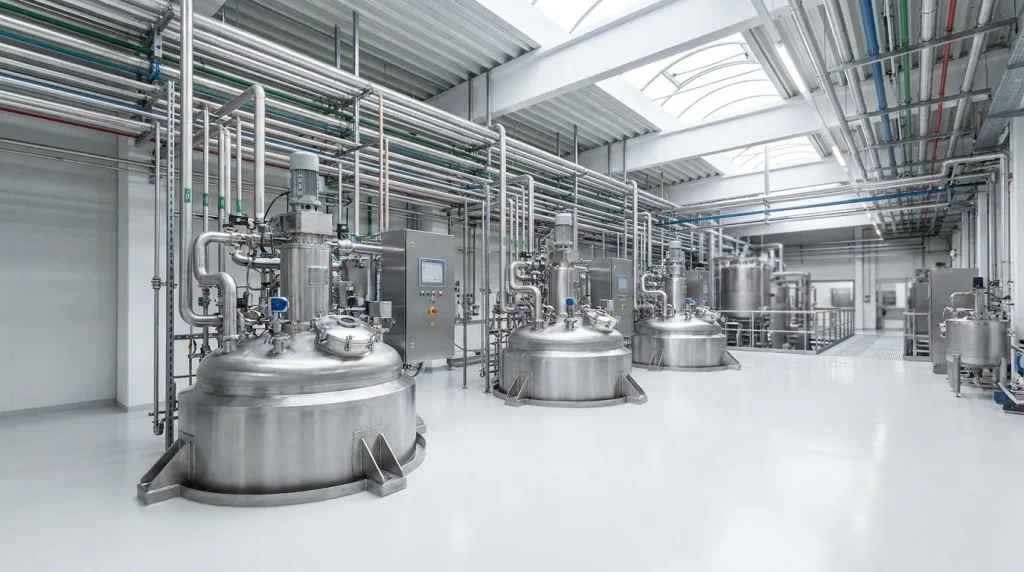
Reactor commissioning and qualification is the structured process of verifying that a reactor is correctly installed, operates within all anticipated ranges, and performs consistently under real production conditions. Installation Qualification (IQ), Operational Qualification (OQ), and Performance Qualification (PQ) form the documented verification sequence that connects equipment setup to validated, compliant operation.
This guide covers the commissioning steps that precede formal qualification, the IQ/OQ/PQ verification sequence itself, governing standards and regulatory frameworks, common challenges with proven efficiency strategies, and how equipment sourcing with complete documentation supports the entire process.
Reactor commissioning begins with site preparation, mechanical installation, utility verification, and safety checks, including pressure testing and interlock validation against codes such as ASME Section VIII and the Pressure Equipment Directive (PED). These steps establish the verified baseline that formal qualification protocols build upon.
IQ then confirms that every component, from vessel dimensions and jacket connections to instrument calibration and materials of construction such as 316L stainless steel or Hastelloy C-276, matches approved engineering drawings. OQ challenges each control loop, alarm threshold, and operational function across the reactor’s full operating range. PQ shifts to actual production conditions, assessing batch-to-batch consistency in yield, temperature uniformity, pressure hold, and cycle time reproducibility.
Regulatory frameworks from the WHO, European Commission Annex 15, PIC/S, ISO 9001, and IEC 61511 define the acceptance criteria and documentation standards each stage must satisfy. Risk-based planning, digital verification workflows, and formal change control programs address the documentation bottlenecks and calibration challenges that commonly delay qualification timelines.
What Are the Main Steps Involved in Reactor Commissioning?
The main steps involved in reactor commissioning include site preparation, mechanical installation, utility connections, safety verification, and regulatory compliance checks. The subsections below cover installation setup and the safety and compliance checks required before qualification begins.
How Do You Prepare for Reactor Installation and Setup?
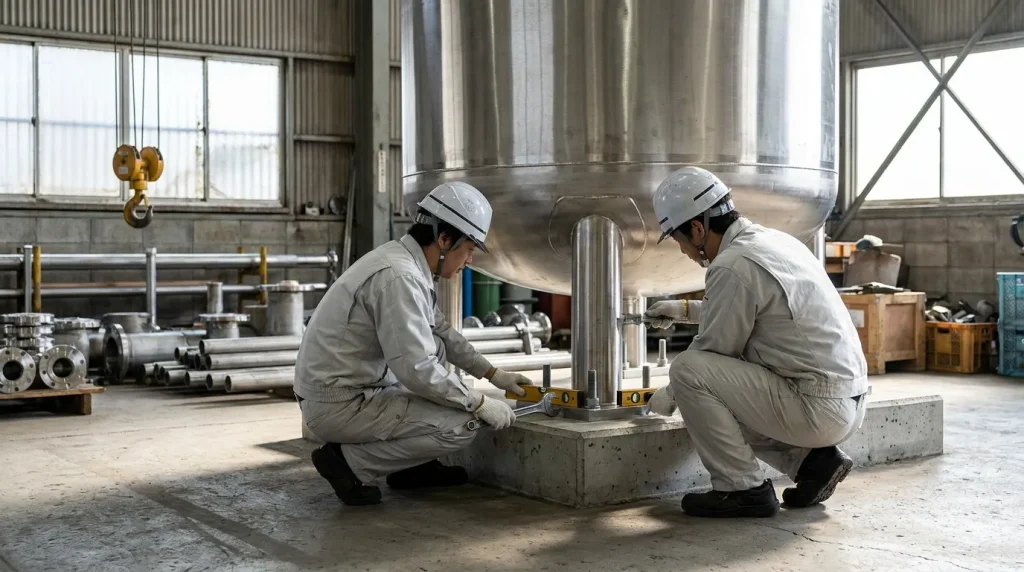
You prepare for reactor installation and setup by completing site readiness assessments, verifying utility connections, and confirming that all equipment matches approved engineering specifications. A structured preparation sequence reduces costly rework during later qualification stages.
Key preparation activities include:
- Confirming that the foundation, structural supports, and anchor points meet the reactor’s weight and dimensional requirements.
- Verifying utility connections for steam, cooling water, electrical supply, and instrument air against piping and instrumentation diagrams (P&IDs).
- Inspecting the reactor vessel, jacket, agitator, seals, and instrumentation against purchase order specifications and manufacturer data sheets.
- Checking materials of construction, such as 316L stainless steel or Hastelloy C-276, against process compatibility requirements.
- Calibrating all instruments, including temperature sensors, pressure transmitters, and flow meters, before mechanical completion.
- Collecting and organizing supplier operating manuals, maintenance schedules, and spare parts lists for use during Installation Qualification (IQ).
What Safety and Compliance Checks Are Required During Commissioning?
The safety and compliance checks required during commissioning include pressure testing, leak detection, electrical safety verification, and confirmation of adherence to applicable codes such as ASME Section VIII, the Pressure Equipment Directive (PED), and CE or UKCA marking requirements.
Essential checks include:
- Hydrostatic or pneumatic pressure testing of the vessel and jacket to their respective design pressures, recorded in both PSI and bar.
- Leak testing on all flanged connections, valve packing, and mechanical seals.
- Verifying safety relief valve set points against design specifications.
- Confirming that electrical installations, grounding, and motor connections comply with IEC 61511 safety instrumented system requirements.
- Reviewing hazard assessments and ensuring emergency shutdown systems function correctly.
According to the UK Health and Safety Executive, special consideration should be given to pressure equipment during commissioning, particularly when verifying that protective devices and interlocks operate within rated parameters. Documentation of every test result forms the evidentiary foundation for subsequent IQ, OQ, and PQ protocols.
With safety and compliance verified, the formal qualification sequence beginning with Installation Qualification can proceed.
What Is Installation Qualification (IQ) and What Does It Include for Reactors?
Installation Qualification (IQ) is the documented verification that a reactor and all associated components are correctly installed according to engineering drawings and manufacturer specifications. The subsections below cover essential IQ documentation and the component verification process.
Which Documentation Is Crucial for Reactor IQ?
The documentation crucial for reactor IQ includes engineering drawings, supplier operating instructions, maintenance requirements, calibration certificates, and materials of construction records. According to the European Commission’s Annex 15 guidelines, IQ requires “collection and collation of supplier operating and working instructions and maintenance requirements” alongside verification against pre-defined acceptance criteria.
A complete IQ documentation package for reactors should contain:
- Engineering drawings and piping and instrumentation diagrams (P&IDs) for the reactor vessel and jacket system.
- Certificates confirming materials of construction, such as 316L stainless steel or Hastelloy C-276, with mill test reports.
- Calibration records for all instrumentation, including temperature sensors, pressure transmitters, and agitator speed indicators.
- Supplier manuals covering operating procedures, spare parts lists, and preventive maintenance schedules.
- Completed IQ protocol checklists with documented pass/fail results for each verification point.
Each pharmaceutical or chemical company must identify which qualification activities prove that critical operational aspects remain controlled, per GMP requirements. Organizing this documentation before IQ execution begins prevents delays during protocol testing and regulatory audits.

How Are Component Verifications Conducted During IQ?
Component verifications during IQ are conducted by systematically comparing each installed element against its engineering specification and recording the results in a qualified protocol. Technicians verify correct installation of the reactor vessel, agitator assembly, jacket connections, instrumentation, pipe work, and utility services against approved drawings.
Key verification steps include:
- Confirming reactor vessel dimensions, design pressure ratings (in both PSI and bar), and temperature ratings (in both °F and °C) match the equipment data sheets.
- Inspecting jacket and pipe work connections for compliance with ASME Section VIII, PED (Pressure Equipment Directive), or CE marking requirements, depending on jurisdiction.
- Calibrating all critical instruments, including thermocouples, pressure gauges, and flow meters, against traceable standards within specified tolerance ranges.
- Verifying materials of construction through visual inspection and cross-referencing mill certificates to confirm alloy grades match specifications.
The European Medicines Agency and PIC/S Committee agreed that Annex 15 will expand to include specific expectations for active substance manufacturers, reinforcing the importance of thorough component verification across reactor types. Completing each verification step with documented evidence before moving to Operational Qualification ensures that no installation deficiency carries forward into functional testing.
What Is Operational Qualification (OQ) and How Does It Validate Reactor Performance?
Operational Qualification (OQ) is the documented verification that a reactor system operates as intended over all anticipated operating ranges. OQ confirms that control systems, instrumentation, and critical functions perform within pre-defined acceptance criteria before production begins. The following subsections cover the specific tests performed during OQ and how control systems are verified.

What Tests and Procedures Are Performed During OQ?
The tests and procedures performed during OQ verify that every reactor function operates correctly across its full anticipated range. As defined by the World Health Organization, OQ is “documented verification that the system or subsystem operates as intended over all anticipated operating ranges.” Key OQ tests for batch reactors include:
- Temperature control verification across the full operating range, measured in both °F and °C at multiple setpoints
- Pressure testing of the vessel and jacket at design limits, recorded in both PSI and bar
- Agitator speed ramp testing to confirm motor performance across low, mid, and high RPM ranges
- Alarm and interlock functionality testing to verify that safety shutdowns trigger at correct thresholds
- Heating and cooling cycle response testing to measure jacket-to-vessel heat transfer rates
Each test requires documented acceptance criteria established before execution. Results that fall outside these criteria trigger formal deviation investigations before the reactor advances to Performance Qualification.
How Are Control Systems and Critical Functions Verified in OQ?
Control systems and critical functions are verified in OQ by challenging each automated loop, sensor input, and safety interlock against documented acceptance criteria. According to the European Medicines Agency and PIC/S, a qualification program must include, at minimum, change control and deviation management protocols, guidance on developing acceptance criteria, and a clear qualification and validation strategy.
Critical functions verified during reactor OQ include:
- Temperature controller response to setpoint changes and disturbance rejection
- Pressure relief valve activation at rated thresholds
- Automated sequence logic for reactor charging, reaction hold, and discharge phases
- Data acquisition system accuracy for batch record integrity
With OQ complete, Performance Qualification then tests the reactor under actual production conditions.
What Is Performance Qualification (PQ) and How Is Real-World Operation Verified?
Performance qualification (PQ) is the documented verification that a reactor performs consistently and reproducibly within defined specifications under actual production conditions. The subsections below cover the specific parameters assessed during PQ and the strategies required to maintain compliance after qualification is complete.
Which Parameters and Results Are Assessed During PQ?
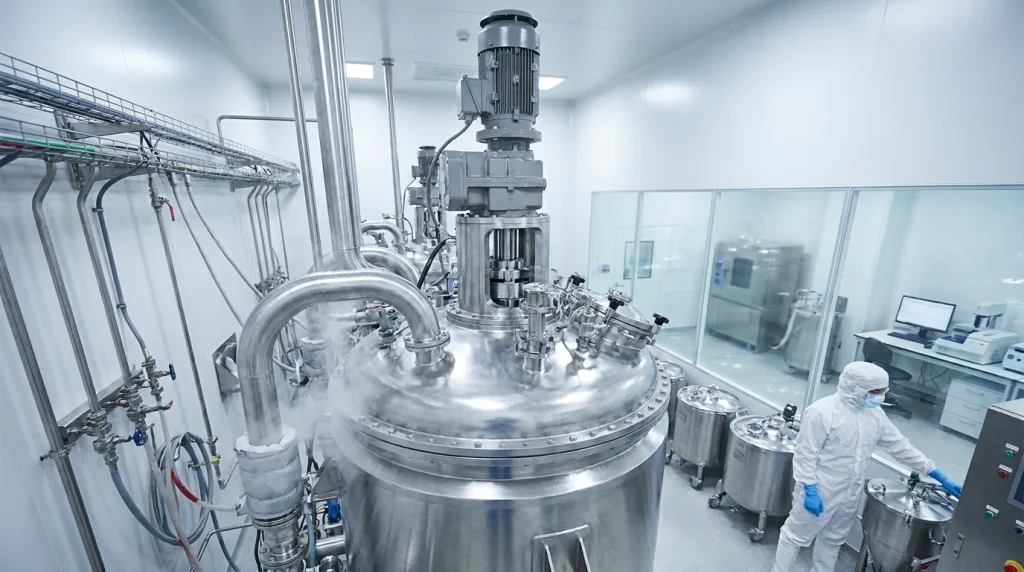
The parameters and results assessed during PQ confirm that the reactor delivers consistent, reproducible output in its normal operating environment. According to the World Health Organization’s GMP validation guidelines, PQ provides “documented verification that the equipment or system performs consistently and reproducibly within defined specifications and parameters in its normal operating environment.”
Key parameters typically assessed include:
- Batch-to-batch consistency of reaction yield and product purity across multiple consecutive runs.
- Temperature uniformity and stability within the vessel during full-scale production cycles, measured in both °F and °C.
- Pressure hold performance under actual process loads, verified against design ratings in both PSI and bar.
- Mixing speed and torque output under real viscosity conditions, confirming agitator performance matches OQ-established ranges.
- Cycle time reproducibility, ensuring each batch completes within acceptable duration windows.
Unlike OQ, which tests functions across anticipated operating ranges, PQ evaluates whether those functions deliver acceptable product quality when raw materials, operators, and environmental variables are introduced simultaneously.
How Do You Ensure Ongoing Compliance After PQ?
You ensure ongoing compliance after PQ by implementing formal change control, periodic requalification, and continuous monitoring programs. The WHO’s GMP guidelines define change control as “a formal system by which qualified representatives of appropriate disciplines review proposed or actual changes that might affect a validated status.”
Essential ongoing compliance practices include:
- Establishing a change control system that evaluates any modification to equipment, materials, or processes for its impact on the qualified state.
- Scheduling periodic requalification at defined intervals, particularly after major maintenance, relocation, or process changes.
- Maintaining continuous process monitoring through calibrated instruments that track critical parameters such as temperature (°F/°C), pressure (PSI/bar), and agitation speed (RPM).
- Conducting regular deviation reviews to identify trends before they compromise product quality.
Requalification does not always require repeating the full IQ/OQ/PQ sequence. A risk-based assessment determines which stages need re-execution based on the scope of the change. With a disciplined compliance program in place, the next consideration is how governing standards and regulatory frameworks shape the entire qualification process.
How Do Industry Standards and Regulatory Requirements Impact IQ, OQ, and PQ?
Industry standards and regulatory requirements impact IQ, OQ, and PQ by defining the acceptance criteria, documentation formats, and testing protocols that each qualification stage must satisfy. The subsections below cover the governing agencies and how recordkeeping supports audits.
Which Agencies and Guidelines Govern Reactor Commissioning?
The agencies and guidelines that govern reactor commissioning span multiple international regulatory bodies and harmonized standards organizations. The World Health Organization (WHO) defines IQ, OQ, and PQ as documented verification activities within its GMP validation guidelines (TRS 1019, Annex 3). The European Commission’s Annex 15 establishes qualification and validation expectations for pharmaceutical manufacturing across EU member states.
Additional governing frameworks include:
- ISO 9001 provides globally recognized quality management requirements applicable to reactor manufacturing and commissioning.
- ASME Bioprocessing Equipment (BPE) Standard covers design requirements for equipment used in pharmaceutical and bioprocessing industries.
- IEC 61511 specifies requirements for design, installation, and maintenance of safety instrumented systems (SIS) that protect reactor operations.
- PIC/S promotes harmonized GMP standards and guidance documents across participating regulatory authorities.
- Pressure Equipment Directive (PED) Und CE marking govern pressure vessel compliance across the European Economic Area.
- ASME Section VIII governs pressure vessel design and fabrication, recognized globally alongside PED and UKCA marking for UK markets.
For reactors operating in cleanroom environments, ISO 14644-1:2015 defines airborne particulate cleanliness classifications that influence qualification parameters. Procurement engineers should verify which combination of these frameworks applies based on the reactor’s geographic installation and intended process.
How Do Documentation and Recordkeeping Support Audits and Inspections?
Documentation and recordkeeping support audits and inspections by providing traceable, verifiable evidence that each qualification stage met predefined acceptance criteria.
Every qualification activity generates specific records:
- IQ records confirm correct installation against engineering drawings and specifications.
- OQ records verify operation across all anticipated operating ranges.
- PQ records demonstrate consistent, reproducible performance under normal production conditions.
Formal change control systems, as defined by WHO GMP guidelines, require qualified representatives to review any proposed changes that might affect a validated status. Incomplete or fragmented documentation creates audit findings that can delay production timelines. Well-structured recordkeeping transforms qualification data into audit-ready evidence that satisfies inspectors across jurisdictions governed by FDA, EMA, PIC/S, and national regulatory authorities.
With regulatory frameworks established, understanding common challenges helps teams execute qualification more efficiently.

What Challenges and Best Practices Exist for Reactor Commissioning and Qualification?
The challenges for reactor commissioning and qualification include calibration difficulties, pressure equipment complexities, and fragmented documentation that delays project timelines. Best practices focus on risk-based planning, standardized protocols, and proactive issue prevention across IQ, OQ, and PQ phases.
What Common Issues Should Be Anticipated and Prevented?
Common issues that should be anticipated and prevented during reactor commissioning include:
- Temperature mapping limitations. Difficulties with equipment operation and the effect of door openings can compromise mapping accuracy, as noted in guidance from Singapore’s Health Sciences Authority.
- Pressure equipment complexities. The UK Health and Safety Executive emphasizes that special consideration should be given to pressure equipment during commissioning, given the safety risks of vessels operating at elevated PSI (bar) ratings.
- Documentation bottlenecks. Manual routing, sequential reviews, and fragmented records often turn commissioning, qualification, and validation (CQV) into the critical path that delays projects and speed to market, according to a 2026 report in ISPE Pharmaceutical Engineering.
- Calibration drift. Instruments verified during IQ may drift before OQ testing begins, producing unreliable operational data if recalibration is not scheduled between phases.
Anticipating these issues early, rather than reacting after deviations occur, is one of the most cost-effective decisions a project team can make.
What Strategies Improve Efficiency and Compliance in IQ, OQ, and PQ?
Strategies that improve efficiency and compliance in IQ, OQ, and PQ include risk-based prioritization, digital workflows, and cross-functional planning. Effective approaches are:
- Adopt a science and risk-based framework. ISPE’s updated approach replaces the traditional V-Model with a methodology focused on critical aspects that directly affect product quality and patient safety.
- Digitize qualification workflows. Digital verification tools (DVTs) replace paper-based processes with streamlined, data-driven workflows that reduce manual errors and accelerate review cycles.
- Integrate commissioning with qualification. Leveraging commissioning test data for qualification protocols eliminates redundant testing and compresses project schedules.
- Standardize acceptance criteria. Pre-defined, measurable criteria for each qualification phase reduce subjective interpretation during execution.
Teams that embed these strategies from project initiation consistently avoid the schedule overruns and compliance gaps that plague reactive approaches. With these practices established, the benefits of commissioning quality used equipment becomes the next discussion.
How Can International Process Plants Support Reactor Commissioning and Qualification Needs?
International Process Plants can support reactor commissioning and qualification needs by supplying new surplus and quality used batch reactors with traceable documentation that aligns with IQ, OQ, and PQ requirements. The subsections below detail how our equipment sourcing facilitates qualification and summarize the guide’s key takeaways.
Can Comprehensive Equipment Sourcing from IPP Facilitate IQ, OQ, and PQ Processes?
Yes, comprehensive equipment sourcing from International Process Plants can facilitate IQ, OQ, and PQ processes. As WHO TRS 1019 Annex 3 clarifies, “qualification” applies specifically to equipment and utilities, while “validation” applies to systems, methods, and processes. This distinction matters because reactor qualification begins with verifiable equipment data.
International Process Plants maintains an inventory of over 15,000 pieces of equipment, including batch reactors constructed from 316L, 316, 304, and 304L stainless steel, as well as Hastelloy C-276. Each currently available reactor ships with materials of construction records, dimensional specifications, and original equipment documentation. These records directly support IQ verification checkpoints such as component traceability, materials confirmation, and calibration baseline data.
Procurement engineers who source from a single supplier with complete documentation spend less time assembling qualification packages from fragmented vendors, reducing the risk of missing records during audits.
What Are the Key Takeaways About Reactor Commissioning and Qualification: IQ, OQ, and PQ Guide?
The key takeaways about reactor commissioning and qualification center on three principles: structured sequencing, complete documentation, and lifecycle compliance.
- IQ confirms correct installation by verifying components, materials of construction, and calibration against engineering specifications.
- OQ validates that the reactor operates as intended across all anticipated operating ranges, including temperature, pressure, and agitation parameters.
- PQ demonstrates consistent, reproducible performance under real production conditions.
- A Validation Master Plan (VMP) provides the organizational framework that connects all three qualification stages.
- Standards from ASME, the Pressure Equipment Directive (PED), CE marking, and PIC/S GMP guidelines govern reactor qualification across global jurisdictions.
- Change control and periodic requalification maintain validated status throughout the reactor’s operational lifecycle.
International Process Plants simplifies the earliest phase of this process by providing batch reactors with traceable construction records, reducing documentation gaps before IQ even begins.


 DE
DE  EN
EN  ES
ES  FR
FR  PL
PL  AR
AR  UR
UR  HI
HI  NL
NL  TR
TR  IT
IT  UK
UK  RU
RU  JA
JA  PT
PT  ZH
ZH