 跳至内容
跳至内容 
A reactor jacket is an external heat exchange surface that controls process temperature by circulating heating or cooling fluids around the vessel wall, transferring thermal energy without direct contact between the process medium and the heat transfer fluid.
This guide covers jacket fundamentals and temperature control principles, the engineering differences between conventional, half-pipe coil, and dimple configurations, heat transfer efficiency factors, selection criteria for specific processes, maintenance and failure prevention, international standards compliance, and equipment sourcing strategies.
Jacket fundamentals establish how outer casings regulate thermal energy flow across vessel walls, where fluid turbulence (measured by Reynolds numbers ranging from 2,000 to 35,000) directly determines convective heat transfer performance and thermal response speed.
Engineering comparisons between jacket types reveal significant pressure and velocity differences. Conventional jackets suit low-pressure service below 50 psig (3.4 bar) in vessels under 100 gal (378.5 L), while half-pipe coil jackets handle up to 750 psi (51.7 bar) and provide 100% drainage capability through their downward spiral pitch.
Heat transfer efficiency depends on vessel material, jacket geometry, fluid velocity, and fouling accumulation. Overall heat transfer coefficients range from 100 W/m²·K (17.6 BTU/hr·ft²·°F) for chilled glass-lined vessels up to 400 W/m²·K (70.4 BTU/hr·ft²·°F) for carbon and stainless steel configurations.
Selection criteria and maintenance protocols address material compatibility (carbon steel, 316L stainless steel, Hastelloy C-276, glass-lined surfaces), preventive inspection schedules, and compliance with ASME Section VIII, PED 2014/68/EU, CE marking, and ATEX directives governing global reactor operations.
What Role Does a Reactor Jacket Play in Heat Transfer Processes?
A reactor jacket plays the role of an external heat exchange surface that controls process temperature by circulating heating or cooling fluids around the vessel wall. The subsections below explain how jackets facilitate temperature control and why uniform heat distribution matters.
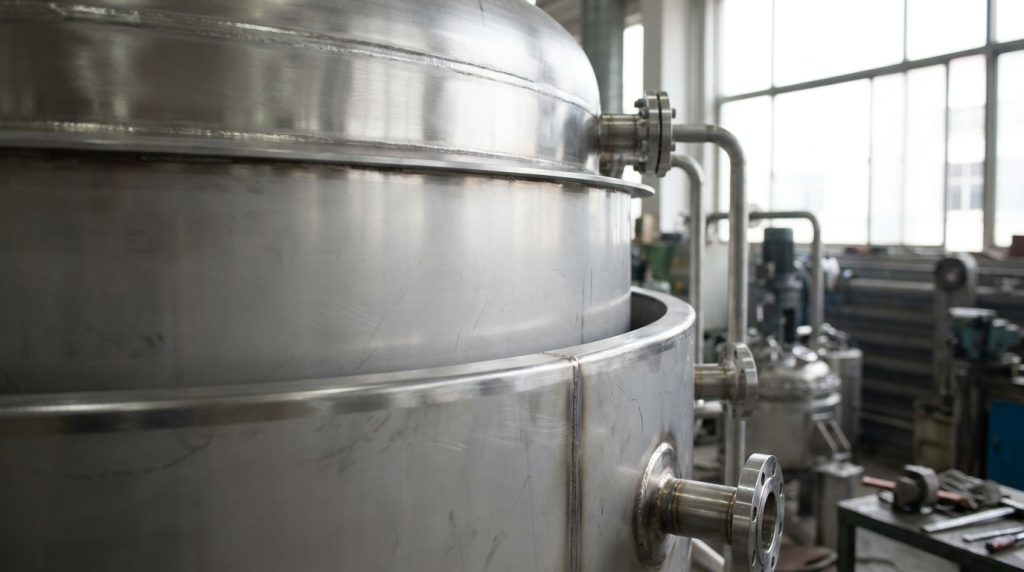
How Does a Reactor Jacket Facilitate Temperature Control?
A reactor jacket facilitates temperature control by enclosing the vessel in an outer casing through which heating or cooling fluids flow at regulated rates. This configuration transfers thermal energy across the vessel wall without direct contact between the process fluid and the heat transfer medium.
According to a Pennsylvania State University study on dimpled jacket hydrodynamics, Reynolds numbers for the working fluid typically range from 2,000 to 35,000, depending on inlet temperature and flow conditions. Higher Reynolds numbers indicate turbulent flow, which increases the convective heat transfer coefficient and accelerates thermal response.
Material selection directly affects jacket performance. Carbon steel reactors operating in aggressive high-temperature, high-pH services are vulnerable to rapid synergistic failure, making alloy upgrades or glass-lined alternatives essential for sustained temperature stability.
Why Is Uniform Heat Transfer Important in Industrial Reactors?
Uniform heat transfer is important in industrial reactors because inconsistent thermal distribution creates localized hot spots or cold zones that degrade product quality, reduce yield, and risk runaway reactions. Even temperature profiles ensure repeatable reaction kinetics across the entire vessel volume.
Pharmaceutical manufacturing illustrates this need clearly. Reactors for active pharmaceutical ingredient (API) synthesis are commonly constructed from 316L stainless steel or glass-lined carbon steel specifically to meet chemical compatibility and heat transfer requirements, according to research published by Taylor & Francis.
Growing global demand for precise thermal management reinforces this priority. The small modular reactor market, driven by decarbonization mandates and industrial heat demand, is projected to grow at a 23.9% CAGR from 2025 to 2030 per Mordor Intelligence. For batch reactor applications, selecting the correct jacket configuration determines whether uniform heat transfer goals are achievable across varying production scales.
With temperature control principles established, the next step is understanding the specific jacket configurations available.
What Are the Main Types of Reactor Jackets Used in Industry?
The main types of reactor jackets used in industry are conventional (plain) jackets, half-pipe coil jackets, and dimple jackets. Each configuration offers distinct pressure ratings, flow characteristics, and heat transfer performance.
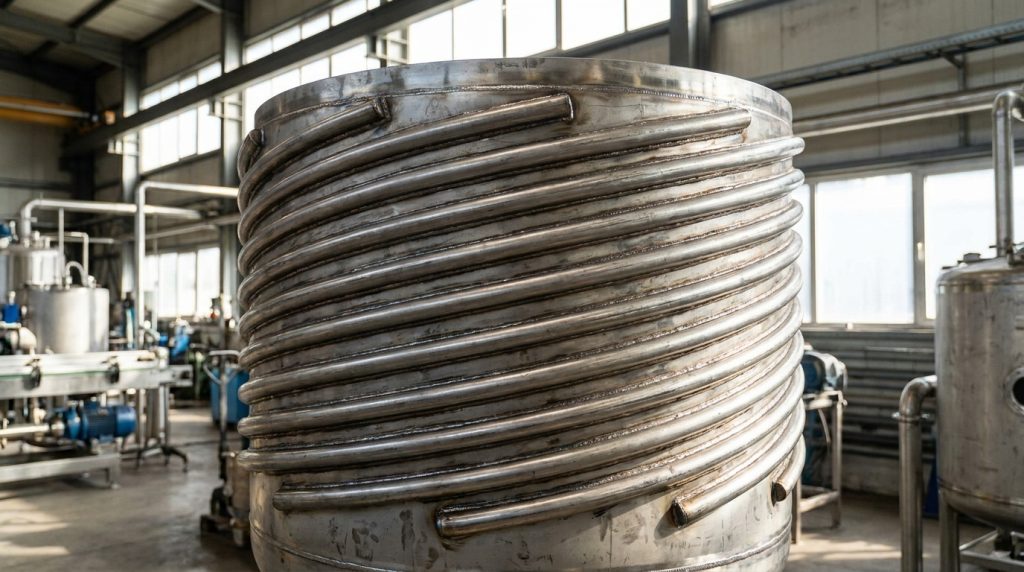
How Do Conventional Jackets Compare to Half-Pipe Coil Jackets?
Conventional jackets compare to half-pipe coil jackets primarily in pressure capacity, flow velocity requirements, and construction complexity. Conventional jackets cover the full vessel wall and base, offering simplicity in fabrication. They are typically best suited for low-pressure applications below 50 psig (3.4 bar) and are often found in small vessels under 100 gal (378.5 L).
Half-pipe coil jackets handle significantly higher pressures, rated up to 750 psi (51.7 bar). According to Thermopedia’s technical velocity guidelines, plain jackets require a target circumferential velocity of 1 to 1.5 m/s (3.3 to 4.9 ft/s), while half-pipe jackets need a minimum of 2.3 m/s (7.5 ft/s) to ensure adequate heat transfer. Half-pipe designs typically use a bottom wall thickness of 4 mm (0.157 in.) to balance structural strength with thermal efficiency.
For engineers selecting between these configurations, the deciding factor is usually jacket-side operating pressure: if that pressure drives vessel wall thickness, half-pipe coils are the more cost-effective choice despite their higher fabrication complexity.
What Are Dimple Jackets and When Are They Preferred?
Dimple jackets are reactor jacket configurations that use a spot-welded pattern of indentations pressed into a thin outer shell, creating channels for heating or cooling fluid between the dimpled sheet and the vessel wall. This construction allows for thinner vessel shell walls compared to conventional jackets while maintaining structural integrity for pressure service.
Dimple jackets are preferred when weight reduction and material cost savings matter more than high fluid velocity. However, the pressure drop inherent in their geometry can limit fluid velocity to approximately 0.6 m/s (2.0 ft/s), which makes them less suitable for aggressive cooling applications requiring rapid heat removal. They perform well in moderate-temperature processes where light gauge metal construction provides adequate thermal performance without the expense of half-pipe fabrication.
How Do the Various Reactor Jacket Types Affect Heat Transfer Efficiency?
The various reactor jacket types affect heat transfer efficiency through differences in fluid velocity, surface contact area, and fouling susceptibility. The subsections below examine specific factors that impact heat transfer rate and how flow patterns and pressure influence jacket performance.
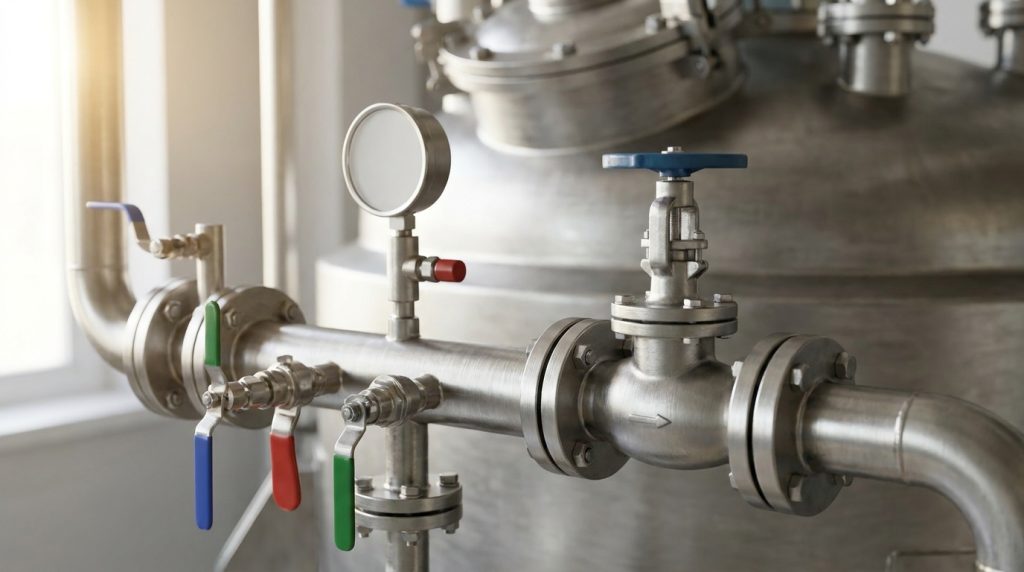
What Factors Impact the Heat Transfer Rate in Each Jacket Type?
The factors that impact the heat transfer rate in each jacket type include vessel material, jacket configuration, fluid velocity, and available surface area. According to Thermopedia, typical overall heat transfer coefficients (U) for jacketed glass-lined steel vessels range from 100 W/m²·K (17.6 BTU/hr·ft²·°F) for chilled cooling to 350 W/m²·K (61.6 BTU/hr·ft²·°F) for distillation duties. Carbon and stainless steel jacketed vessels achieve higher coefficients: 400 W/m²·K (70.4 BTU/hr·ft²·°F) for heating and 350 W/m²·K (61.6 BTU/hr·ft²·°F) for cooling.
Key factors affecting heat transfer rate include:
- Vessel wall material and thickness (glass lining reduces conductivity significantly)
- Jacket surface area relative to reactor volume
- Fluid flow velocity within the jacket annulus
- Fouling deposits that build thermal resistance over time
Expert judgment is often required to balance system design against heat transfer performance, since surface area and jacket geometry directly affect the overall coefficient. For procurement engineers evaluating used equipment, understanding these coefficients helps predict whether a given reactor can meet process heating or cooling demands without costly modifications.
How Do Flow Patterns and Pressure Influence Jacket Performance?
Flow patterns and pressure influence jacket performance by determining fluid turbulence, residence time, and the structural design limits of the vessel wall. Higher turbulence increases the film coefficient on the jacket side, while elevated pressure ratings demand thicker walls that can reduce heat transfer.
ASME Section VIII Division 1 and Division 2 provide the regulatory framework for designing jacketed vessels under external pressure conditions, directly linking allowable pressure to wall thickness requirements. Fouling accumulation further complicates performance by adding insulating layers that reduce effective heat flux, often requiring periodic cleaning or specialized coatings.
For glass-lined carbon steel vessels operating with heat transfer oil, optimization requires calculating heat flux from the jacket, time for heating or cooling cycles, and overall system efficiency. When evaluating batch reactors for purchase, confirming that the jacket design pressure matches your process fluid requirements prevents undersized thermal performance in operation.
What Criteria Should Guide the Selection of a Reactor Jacket for Specific Processes?
The criteria that should guide reactor jacket selection include process temperature and pressure requirements, heat transfer fluid compatibility, and material compliance with international standards. The following subsections address how process demands and material considerations shape this decision.
How Do Process Requirements Impact Jacket Choice?
Process requirements impact jacket choice by defining the thermal load, operating pressure, and fluid dynamics the jacket must accommodate. A process requiring rapid cooling at high pressure demands a half-pipe coil jacket rated up to 750 PSI (51.7 bar), while gentle heating in a small vessel under 100 gal (378.5 L) may only need a conventional jacket below 50 PSIG (3.4 bar).
Key process factors that determine jacket selection include:
- Required heat flux and acceptable heating or cooling time
- Operating pressure of the heat transfer fluid
- Desired flow velocity and turbulence for efficient heat exchange
- Whether the process requires complete jacket drainage between batches
According to PMC (PubMed Central), reactor jacket type selection is critical for enhancing performance metrics such as improved selectivity and yield, which are directly influenced by heat transfer surface efficiency. For processes where product changeover is frequent, prioritizing a jacket design that allows full drainage, such as half-pipe coils with downward spiral pitch, prevents cross-contamination and simplifies cleaning validation.
What Are the Considerations for Material Compatibility and Standards Compliance?
The considerations for material compatibility and standards compliance involve matching vessel and jacket metallurgy to the process chemistry while meeting regulatory requirements across operating jurisdictions.
Material selection depends on thermal conductivity and corrosion resistance:
- Carbon steel offers 45-54 W/m·K (26-31 BTU/hr·ft·°F) but lacks chemical resistance for aggressive media
- 316L stainless steel provides 14-20 W/m·K (8.1-11.6 BTU/hr·ft·°F) with broad corrosion resistance for pharmaceutical and fine chemical processes
- Glass-lined carbon steel delivers superior chemical resistance and cleanability, though its low thermal conductivity requires optimized jacket configurations
Applicable standards include ASME Section VIII for pressure vessel design, PED 2014/68/EU for equipment sold in the European Economic Area, and CE marking for conformity assessment. Preventive maintenance guidelines for jacketed glass reactors recommend inspecting seals and gaskets monthly and cleaning PTFE valve parts after every discharge to prevent coolant leaks. Aligning metallurgy with both process chemistry and certification requirements reduces long-term failure risk and simplifies regulatory audits across global facilities.
What Are the Common Challenges and Maintenance Concerns With Reactor Jackets?
The common challenges with reactor jackets include fouling buildup, corrosion-driven material degradation, and weld-zone leakage. Preventive measures and safety protocols address these failure modes.
How Can Fouling, Corrosion, or Leakage Be Prevented in Reactor Jackets?
Fouling, corrosion, or leakage can be prevented in reactor jackets through scheduled inspections, proper material selection, and proactive maintenance routines. Fouling deposits reduce heat transfer efficiency over time, often requiring periodic cleaning or specialized coatings to maintain thermal performance. Corrosion poses particular risk in aggressive high-temperature, high-pH services, where carbon steel reactors are vulnerable to rapid, synergistic failure without appropriate alloy upgrades.
Key prevention strategies include:
- Inspecting seals and gaskets monthly to catch early degradation.
- Cleaning PTFE valve parts after every discharge to prevent coolant leaks.
- Selecting corrosion-resistant materials such as 316L stainless steel or Hastelloy C-276 for chemically aggressive processes.
- Using helium leak testing in vacuum mode for high-sensitivity detection of weld defects.
According to Enerfab, leading failures in half-pipe reactors include jacket and weld-zone cracks and pinholes, often attributed to corrosion, operational fatigue, or improper joint design. For procurement teams evaluating used equipment, verifying weld integrity and jacket condition before acquisition significantly reduces long-term maintenance costs.
What Safety Measures Should Be Implemented for Reliable Heat Transfer?
The safety measures that should be implemented for reliable heat transfer include pressure monitoring, compliance with international vessel codes, and systematic preventive maintenance schedules. ASME Section VIII Division 1 and Division 2 provide the regulatory framework for jacketed vessels under external pressure conditions, while the Pressure Equipment Directive (PED) 2014/68/EU governs equipment sold in the European Economic Area.
Essential safety protocols include:
- Verifying jacket pressure ratings match operating conditions; conventional jackets suit applications below 50 psig (3.4 bar), while half-pipe designs handle up to 750 psi (51.7 bar).
- Monitoring thermal fluid velocity to ensure adequate heat transfer, targeting 1 to 1.5 m/s (3.3 to 4.9 ft/s) for plain jackets and 2.3 m/s (7.5 ft/s) for half-pipe configurations.
- Documenting inspection intervals per API and ASME requirements, including CE marking or UKCA marking for equipment operating in the UK.
Neglecting flow monitoring is one of the most common oversights in jacketed reactor maintenance; reduced velocity from fouling or pump degradation quietly erodes thermal performance long before visible failure occurs.
With maintenance protocols established, understanding how international standards and certifications shape reactor jacket design ensures compliance across global operations.

How Do International Standards and Certifications Affect Reactor Jacket Design?
International standards and certifications affect reactor jacket design by establishing mandatory requirements for materials, fabrication methods, pressure ratings, and inspection protocols. The following subsections cover specific codes and how global certification frameworks ensure safety.
Why Are ASME, API, PED, and CE Marking Important for Reactor Jackets?
ASME, API, PED, and CE marking are important for reactor jackets because they define the engineering rules that govern safe pressure containment, weld integrity, and material selection. ASME Section VIII Division 1 and Division 2 provide the regulatory framework for pressure vessel design, including specific rules for jacketed vessels under external pressure conditions. PED 2014/68/EU is mandatory for pressure equipment sold in the European Economic Area, covering design, manufacture, and conformity assessment. CE marking confirms PED compliance, while UKCA marking serves the same function for the UK market. API standards address operational specifics; for example, API Standard 660 restricts slip-on flanges above 2,100 kPa (300 psig). Without compliance to these codes, reactor jackets risk weld-zone cracks and pinholes, failures often attributed to corrosion, operational fatigue, or improper joint design.
How Do Global Standards Ensure Reactor Jacket Performance and Safety?
Global standards ensure reactor jacket performance and safety by requiring documented quality systems, environmental controls, and traceable inspection records throughout the production lifecycle. ISO 9001 and ISO 14001 certifications are considered essential for chemical manufacturers to ensure consistent quality management and environmental responsibility across reactor production. Beyond manufacturing, preventive maintenance protocols derived from standards compliance, such as monthly seal and gasket inspections, sustain long-term jacket integrity. For facilities operating in explosive atmospheres, ATEX Directive 2014/34/EU adds requirements for gas and dust zone protection. Together, these frameworks create layered assurance: design codes govern fabrication, quality certifications govern process control, and directive compliance governs operational environment safety.
With standards compliance verified, sourcing certified equipment becomes the next practical step for procurement teams.
How Can Businesses Optimize Reactor Jacket Selection and System Upgrades With Equipment Sourcing Solutions?
Businesses can optimize reactor jacket selection and system upgrades by sourcing new surplus and quality used equipment from established global suppliers. The following subsections cover how International Process Plants supports this process and summarize the key principles of reactor jacket heat transfer.
How Does International Process Plants Support Reactor Jacket and Process Equipment Sourcing?
International Process Plants supports reactor jacket and process equipment sourcing by maintaining an inventory of over 10,000 pieces of new surplus and quality used equipment across warehouses in South Carolina; Germany; and the United Kingdom. With 46+ years of experience, International Process Plants supplies batch reactors, which account for much of our reactor inventory, in materials including 316L stainless steel, 304 stainless steel, and Hastelloy C-276.
Equipment currently available includes jacketed reactor vessels with configurations such as half-pipe coil jackets, the only design that allows 100% drainage due to its downward spiral pitch. All sourced equipment complies with relevant international standards. The Pressure Equipment Directive (PED) 2014/68/EU is a mandatory standard for pressure equipment sold in the European Economic Area, covering the design, manufacture, and conformity assessment of jacketed reactors. International Process Plants also sources equipment meeting ASME, CE marking, and ATEX Directive 2014/34/EU requirements for explosive atmosphere zones.
For procurement engineers evaluating jacket upgrades, sourcing quality used equipment offers significant cost advantages over extended new-build lead times while maintaining full compliance with global pressure vessel codes.
What Are the Key Takeaways About Reactor Jacket Types and Heat Transfer?
The key takeaways about reactor jacket types and heat transfer center on matching jacket configuration to process demands:
- Reactor jackets are fundamental for maintaining uniform heat distribution, which directly affects reaction consistency and final product quality.
- Conventional jackets suit low-pressure applications below 50 psig (3.4 bar) in smaller vessels.
- Half-pipe coil jackets handle pressures up to 750 psi (51.7 bar) and provide complete drainage capability.
- Dimple jackets enable thinner shell walls while maintaining structural integrity.
- Glass-lined reactors offer superior chemical resistance but rely on jacket systems to compensate for low thermal conductivity.
- Material selection between carbon steel, 316L stainless steel, and Hastelloy C-276 significantly influences heat transfer coefficients.
Selecting the right jacket type requires balancing pressure ratings, heat transfer efficiency, drainage needs, and material compatibility. International Process Plants can help procurement teams identify currently available jacketed reactor vessels that meet these specifications across global compliance frameworks.

 ZH
ZH  EN
EN  ES
ES  FR
FR  PL
PL  DE
DE  AR
AR  UR
UR  HI
HI  NL
NL  TR
TR  IT
IT  UK
UK  RU
RU  JA
JA  PT
PT