
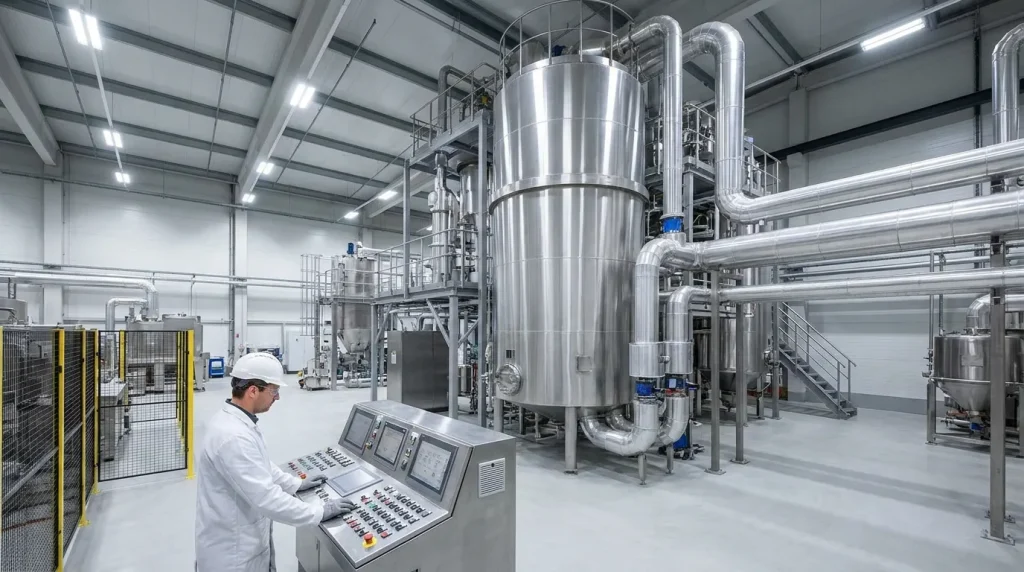
A spray dryer is a continuous drying system that transforms liquid feeds into dry, free-flowing powder by atomizing the liquid into fine droplets and exposing them to heated air for rapid moisture evaporation. This single-step conversion process serves as a cornerstone technology across food processing, pharmaceutical manufacturing, and chemical production.
This guide covers spray drying principles and mechanisms, system components and their functions, the step-by-step drying process, comparative advantages against other drying methods, and industrial applications with emerging technology trends.
Understanding how spray dryers operate begins with two fundamental mechanisms: atomization and heat transfer. Atomization breaks liquid feed into millions of droplets, creating the massive surface area needed for rapid evaporation. Heat and mass transfer then drive moisture from droplet surfaces inward through constant-rate and falling-rate drying periods.
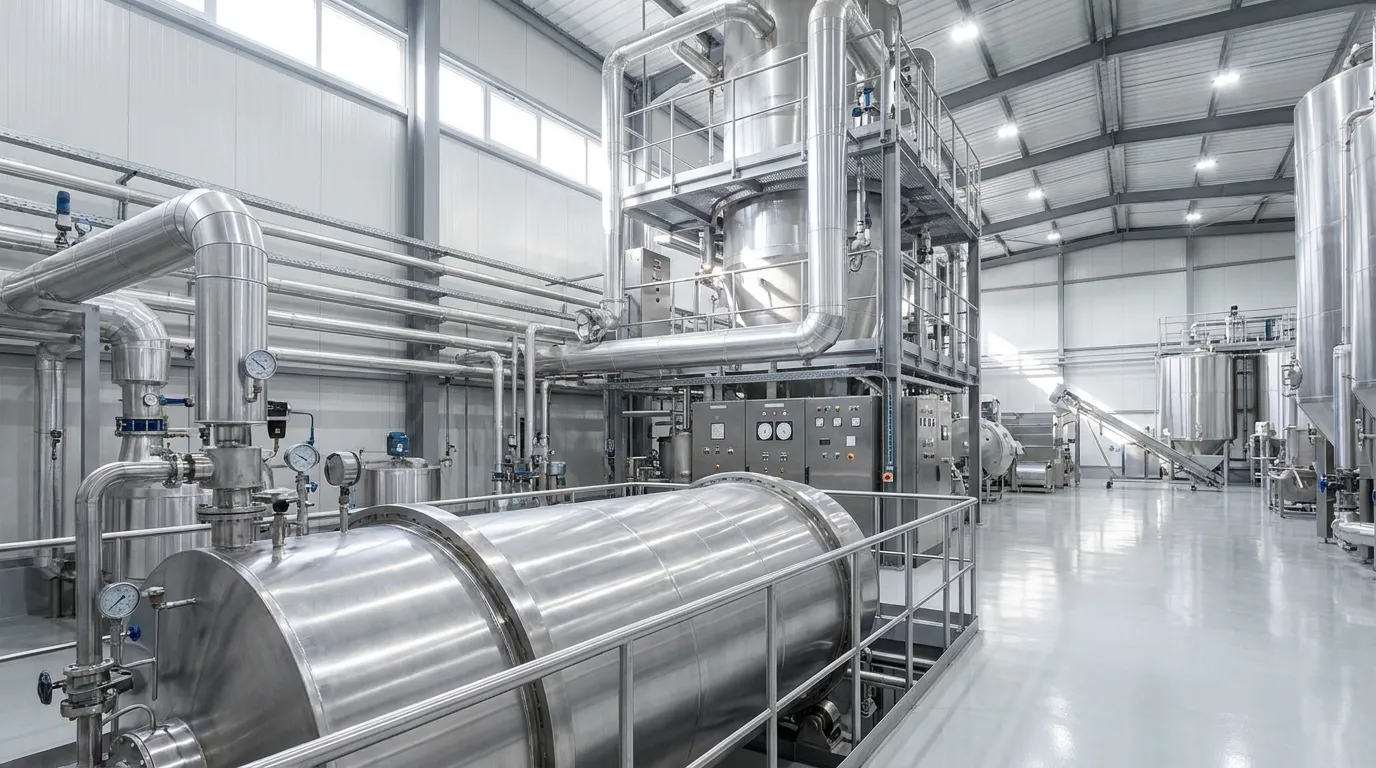
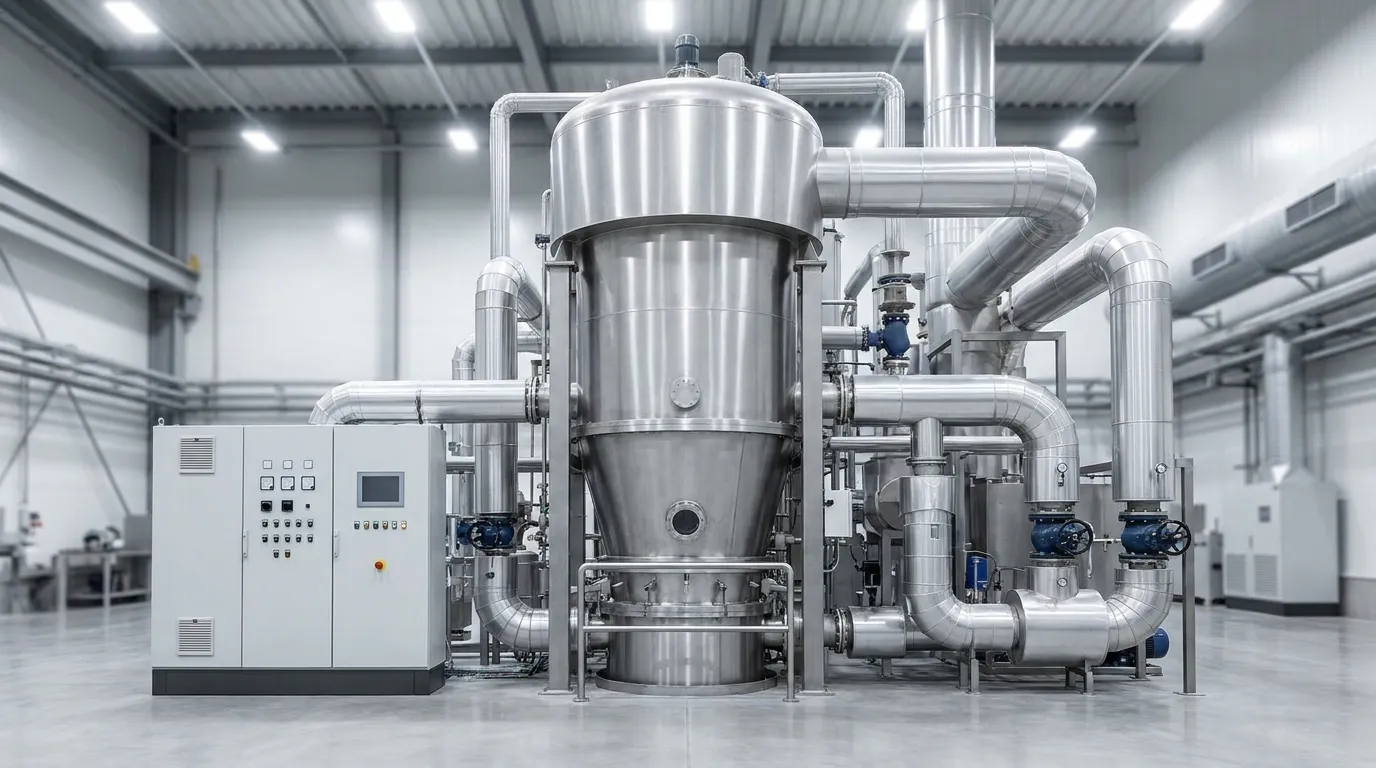
The core components of any spray drying system include atomizers (rotary, pressure, or two-fluid types), air heaters operating at 220°C to 250°C (428°F to 482°F), drying chambers sized for proper residence time, and powder recovery equipment such as cyclones and bag filters.
Comparing spray drying against alternatives reveals clear trade-offs. Energy consumption runs approximately 8.46 kWh/kg (13,094 BTU/lb) for spray drying versus 25.33 kWh/kg (39,204 BTU/lb) for freeze drying, making spray drying roughly three times more efficient. However, inlet temperatures can degrade heat-sensitive compounds, and sticky materials may reduce yield through wall deposition.
Industrial applications range from milk powder and instant coffee to pharmaceutical excipients and ceramic precursors. Recent innovations in heat recovery systems now capture 15% or more of exhaust energy, while automation enables real-time parameter adjustments that reduce batch variability and optimize throughput.
What is a spray dryer and what principles does it operate on?
A spray dryer is a continuous drying system that transforms liquid feeds into dry powder by atomizing the liquid into fine droplets and exposing them to heated air. The process relies on rapid moisture evaporation through controlled thermal and mass transfer. The following sections explain how atomization creates the necessary surface area and how heat and mass transfer mechanisms drive the drying process.
How does the atomization process occur in spray drying?
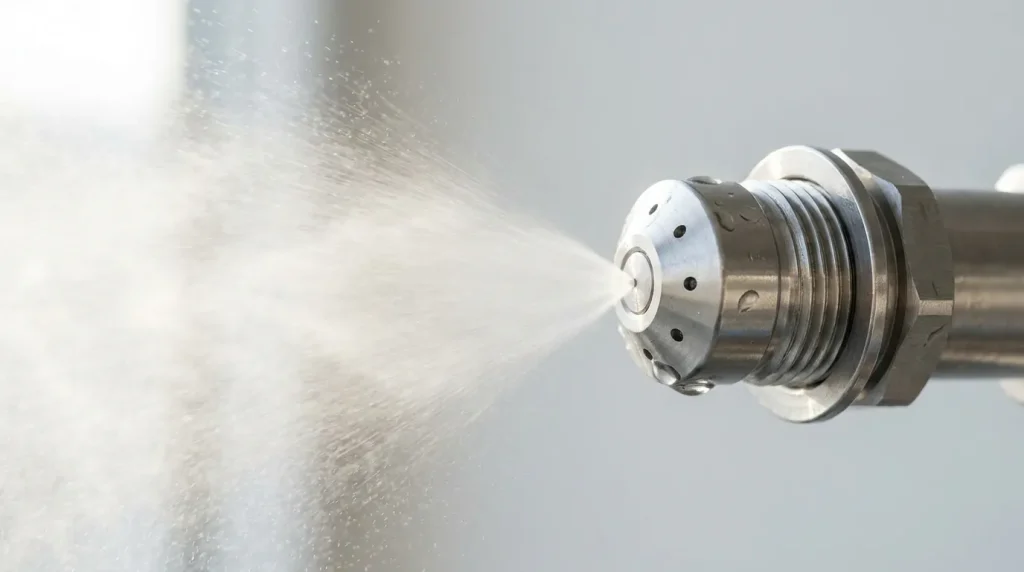
The atomization process occurs by forcing liquid feed through a nozzle or rotary atomizer, breaking it into millions of fine droplets. This dramatic increase in surface area accelerates evaporation rates.
Three primary atomization methods are used:
- Rotary atomizers spin liquid off a wheel at speeds up to 50,000 RPM, producing uniform droplets
- Pressure nozzles force liquid through small orifices
- Two-fluid nozzles use compressed air to shear liquid into droplets
Droplet size directly determines final powder particle size, flowability, and dissolution characteristics. Smaller droplets dry faster but require more energy input.
What are the key thermal and mass transfer mechanisms in spray drying?
The key thermal and mass transfer mechanisms in spray drying involve simultaneous heat transfer from hot air to droplets and moisture migration from droplet interiors to surfaces. According to research published by the International Journal of Pharmaceutics: X, the drying curve comprises two stages: a constant rate period where the droplet temperature adjusts and evaporation begins, followed by a falling rate period where solvent evaporates at constant temperature due to latent heat transfer.
During the constant rate period, surface moisture evaporates rapidly as convective heat transfers from surrounding air to the cooler droplet surface. The falling rate period begins when surface moisture depletes and internal diffusion becomes the limiting factor. This two-stage mechanism enables spray drying to produce stable, free-flowing powders while protecting heat-sensitive compounds through rapid processing times.
What are the main components of a spray dryer system?
The main components of a spray dryer system are the atomizer, air heater, drying chamber, and powder recovery equipment. Each component performs a specific function in transforming liquid feed into dry powder.
What is the purpose of the atomizer or nozzle in spray dryers?
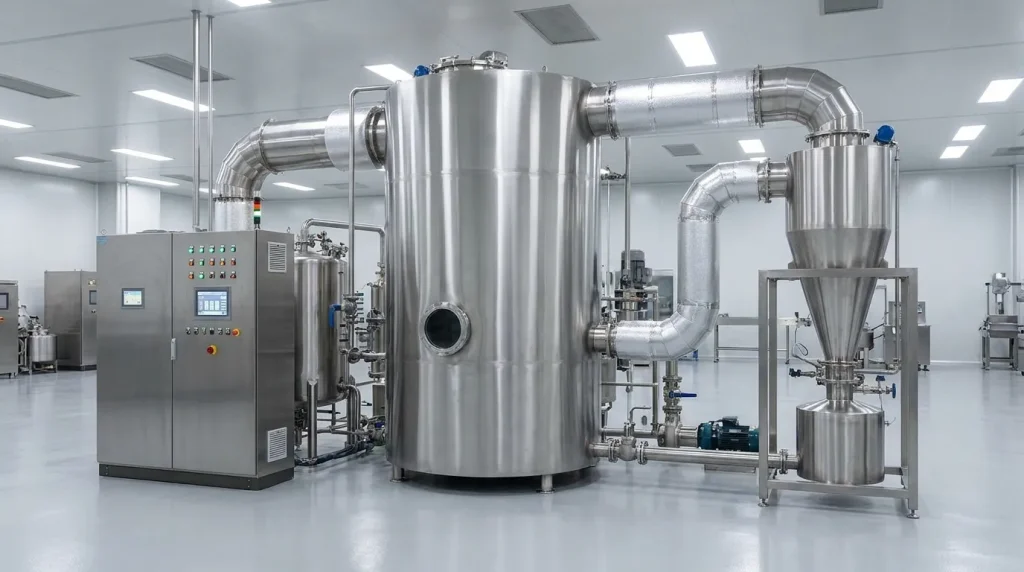
The purpose of the atomizer or nozzle in spray dryers is to break liquid feed into fine droplets that dry rapidly in heated air. Atomizers create high surface area by dispersing liquid into millions of tiny droplets.
Three primary atomizer types serve different applications:
- Rotary atomizers use spinning discs at up to 50,000 RPM to fling liquid outward into fine droplets
- Pressure nozzles force liquid through small orifices to create spray patterns
- Two-fluid nozzles mix compressed air with liquid to achieve atomization at lower pressures
Atomizer selection directly affects particle size distribution, powder density, and final product characteristics.
How are air heaters and drying chambers used in spray drying?
Air heaters and drying chambers work together to provide the thermal energy and residence time needed for moisture evaporation. Air heaters raise inlet temperatures, with some processes reaching 400°C (752°F).
Direct-fired heaters usually cost less than the price of indirect air heaters, though indirect systems prevent combustion byproducts from contacting the product. According to Pharmaceutics research, pharmaceutical spray drying applications are expected to achieve a steady 17% growth rate until 2028, driven by the need to control particle size, crystallinity, and moisture content in active pharmaceutical ingredients.
Drying chambers provide controlled environments where atomized droplets contact heated air. Chamber geometry, whether co-current, counter-current, or mixed flow, determines heat transfer efficiency and particle trajectory.
What roles do cyclones, filters, and powder recovery systems have in spray drying?
Cyclones, filters, and powder recovery systems capture dried particles from the exhaust airstream and prevent product loss. Cyclone separators use centrifugal force to separate particles from air. Bag filters and cartridge filters capture finer particles that cyclones miss. Multi-stage recovery systems combine cyclones with secondary filtration to maximize yield while meeting environmental emission standards.
Proper powder recovery system design balances collection efficiency against pressure drop, since higher resistance increases fan energy consumption throughout the drying operation.
How does the spray drying process work step by step?
The spray drying process works through three sequential stages: feed preparation, atomization with drying, and powder separation with collection. First patented in 1872 by Samuel Percy, spray drying remains a single-step powder-manufacturing process for converting liquid feeds into stable, free-flowing powders, according to NCBI research.
What are the stages of feed preparation and solution handling?
The stages of feed preparation and solution handling include formulation, concentration, filtration, and conditioning. Operators dissolve or suspend the target material in a carrier liquid, typically water or an organic solvent. The feed concentration is adjusted to achieve optimal viscosity for atomization.
Key preparation steps include:
- Dissolving active ingredients in the carrier solvent
- Adjusting solids concentration to target viscosity
- Filtering to remove particulates that could clog nozzles
- Heating or cooling the feed to maintain flowability
- Degassing to prevent air bubble formation during atomization
Proper feed preparation directly affects final powder characteristics, including particle size distribution and moisture content.
How is feed atomized and introduced into the drying chamber?
Feed is atomized and introduced into the drying chamber through high-pressure nozzles or rotary atomizers that break the liquid into fine droplets. The atomized spray meets heated air inside the chamber.
Drying occurs rapidly through two distinct phases. The constant rate period occurs first, where droplets adjust temperature and surface moisture evaporates. The falling rate period follows, where internal moisture migrates outward as particle temperature rises. Total residence time in the chamber depends on chamber dimensions and air flow configuration.
How is the dried powder separated, collected, and packaged?
Dried powder is separated, collected, and packaged through cyclone separators, bag filters, and pneumatic conveying systems. Cyclones use centrifugal force to separate larger particles from the exhaust air stream.
Fine particles pass to secondary bag filters or electrostatic precipitators. Collected powder drops into hoppers, then transfers through rotary valves into packaging lines. Final moisture content is typically low, ensuring shelf stability. Options include bulk bags, drums, or lined containers.
What are the advantages and disadvantages of spray drying compared to other drying methods?
Spray drying offers distinct advantages in speed, scalability, and product consistency, though it carries trade-offs in energy consumption and heat sensitivity. The following sections examine when spray drying outperforms alternatives and where its limitations require careful consideration.
When is spray drying preferred over freeze drying and drum drying?
Spray drying is preferred over freeze drying and drum drying when continuous high-volume production, moderate heat tolerance, and uniform particle characteristics are priorities. Freeze drying preserves heat-sensitive compounds better but consumes significantly more energy. According to a 2024 NCBI study comparing drying methods, energy consumption measured 8.46 kWh/kg for spray drying versus 25.33 kWh/kg for freeze drying, making spray drying roughly three times more energy-efficient.
Drum drying suits high-viscosity pastes but produces flaked or sheet-form products rather than free-flowing powders. Spray drying excels when applications demand:
- Consistent spherical particle morphology
- Rapid drying times measured in seconds
- Scalability from laboratory to production volumes
- Precise control over particle size distribution
For pharmaceutical excipient production, which commanded 42.55% of the pharmaceutical spray drying market share in 2025 according to Mordor Intelligence, spray drying’s ability to engineer specific particle properties makes it the method of choice.
What are common challenges and limitations of spray dryers?
Common challenges and limitations of spray dryers include high initial capital costs, thermal degradation risks for heat-sensitive materials, and wall deposition that reduces yield.
Key limitations to evaluate:
- Energy intensity: While more efficient than freeze drying, spray drying still requires substantial thermal energy for atomization and evaporation
- Heat exposure: High inlet temperatures can degrade thermolabile compounds
- Product loss: Sticky materials adhere to chamber walls, reducing recovery rates
- Particle density: Produces lower bulk density powders compared to drum drying, requiring larger packaging volumes
Process engineers should weigh these factors against production requirements. For materials that tolerate moderate heat and benefit from continuous processing, spray drying remains highly effective despite these constraints.
With advantages and limitations understood, common industrial applications for spray dryers is the next consideration.
What are the typical industrial applications of spray dryers?
The typical industrial applications of spray dryers span food processing, pharmaceuticals, and chemical manufacturing. These industries rely on spray drying to convert liquid feeds into stable, free-flowing powders with precise particle characteristics.
How are spray dryers used in the food, pharmaceutical, and chemical industries?
Spray dryers are used in the food, pharmaceutical, and chemical industries to transform liquid formulations into dry powders with controlled moisture content, particle size, and flowability.
Food industry applications include:
- Milk powder and dairy products
- Instant coffee and tea extracts
- Flavoring agents and encapsulated ingredients
- Egg powder and protein concentrates
- Fruit juice powders and vegetable extracts
Pharmaceutical applications include:
- Active pharmaceutical ingredient (API) processing
- Excipient production for tablet formulations
- Inhalation drug delivery systems
- Bioavailability enhancement of poorly soluble compounds
According to NCBI research, the pharmaceutical industry uses spray drying to alter the size distribution, crystallinity, morphology, and moisture content of APIs and excipients, with the sector expected to achieve 17% growth through 2028. This growth reflects increasing demand for controlled-release formulations and amorphous solid dispersions.
Chemical industry applications include:
- Catalyst preparation and ceramic precursors
- Detergent powders and cleaning agents
- Pigments and specialty coatings
- Agrochemical formulations
What specialty products and powders are commonly produced using spray drying?
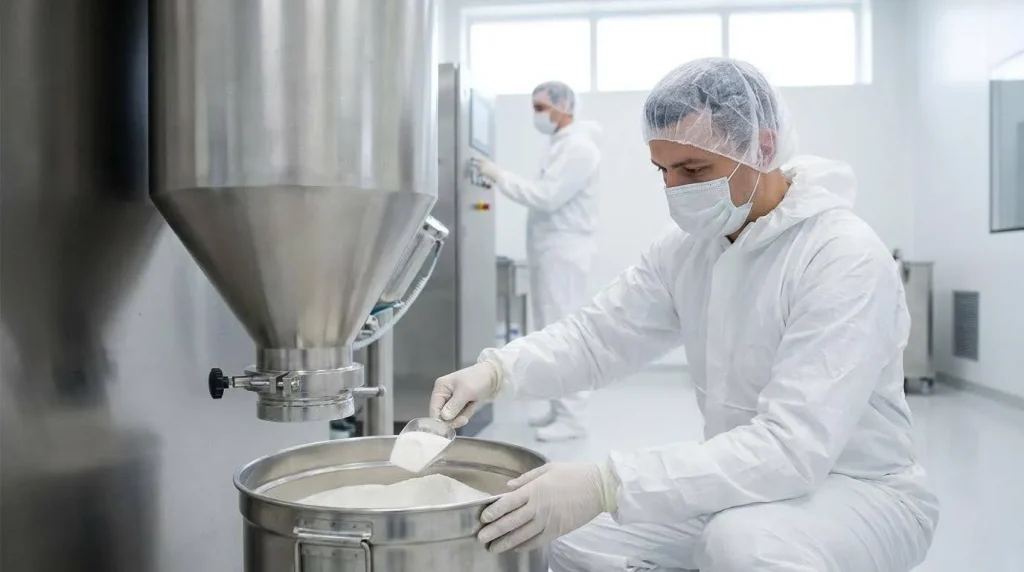
Specialty products and powders commonly produced using spray drying include microencapsulated flavors, pharmaceutical excipients, advanced ceramics, and specialty chemicals requiring precise particle engineering.
High-value specialty applications:
- Microencapsulated probiotics and nutraceuticals
- Spray-dried blood plasma for animal nutrition
- Ceramic powders for electronics manufacturing
- Battery materials and advanced catalyst supports
- Enzyme preparations for industrial processes
Mordor Intelligence reports that excipient production commanded 42.55% of the pharmaceutical spray drying market share in 2025.
The versatility of spray drying makes it valuable wherever consistent powder characteristics, such as bulk density, particle morphology, and dissolution rate, directly impact product performance. With spray dryer applications expanding across industries, equipment sourcing and lifecycle management become critical considerations for plant operations.
How should businesses consider acquiring spray dryers or process plants through asset redeployment solutions?
Businesses should consider acquiring spray dryers through asset redeployment solutions because of the cost, lead time, and equipment verification benefits. The sections below explain how International Process Plants supports these acquisitions and summarize the core principles of spray drying technology.
Can International Process Plants help with sourcing, redeploying, or upgrading spray drying equipment?
Yes, International Process Plants can help with sourcing, redeploying, or upgrading spray drying equipment. With over 46 years of experience and more than 15,000 pieces of equipment currently available across warehouses in the United States, Germany, and the United Kingdom, we specialize in matching process requirements to verified inventory. Our asset redeployment approach delivers spray dryers and complete process plants at approximately 50% of new equipment cost, with lead times measured in weeks rather than the 12 to 18 months typical for new fabrication. We handle equipment from intake through technical verification, ensuring compliance with ASME Section VIII, PED, and CE marking requirements depending on installation jurisdiction. Whether you need a standalone spray dryer or an entire powder processing line, our global network connects buyers with quality used and new surplus equipment sized from pilot scale through full production capacity.
What are the key takeaways about how a spray dryer works, its process, components, and applications?
The key takeaways about how a spray dryer works center on four principles: atomization converts liquid feed into fine droplets, hot air provides rapid moisture removal through heat and mass transfer, particle separation captures the dried powder, and proper component selection determines product quality. Spray dryers operate across inlet temperatures depending on product sensitivity, with energy consumption of approximately 8.46 kWh/kg positioning them between infrared and freeze drying methods. The technology serves food, pharmaceutical, and chemical industries, with the global market projected to reach USD 11.0 billion by 2033 according to Grand View Research. For procurement engineers evaluating equipment options, the combination of continuous processing capability, scalable throughput, and precise particle control makes spray drying essential for converting solutions, suspensions, and emulsions into stable powders.

 ZH
ZH  EN
EN  ES
ES  FR
FR  PL
PL  DE
DE  AR
AR  UR
UR  HI
HI  NL
NL  TR
TR  IT
IT  UK
UK  RU
RU  JA
JA  PT
PT