
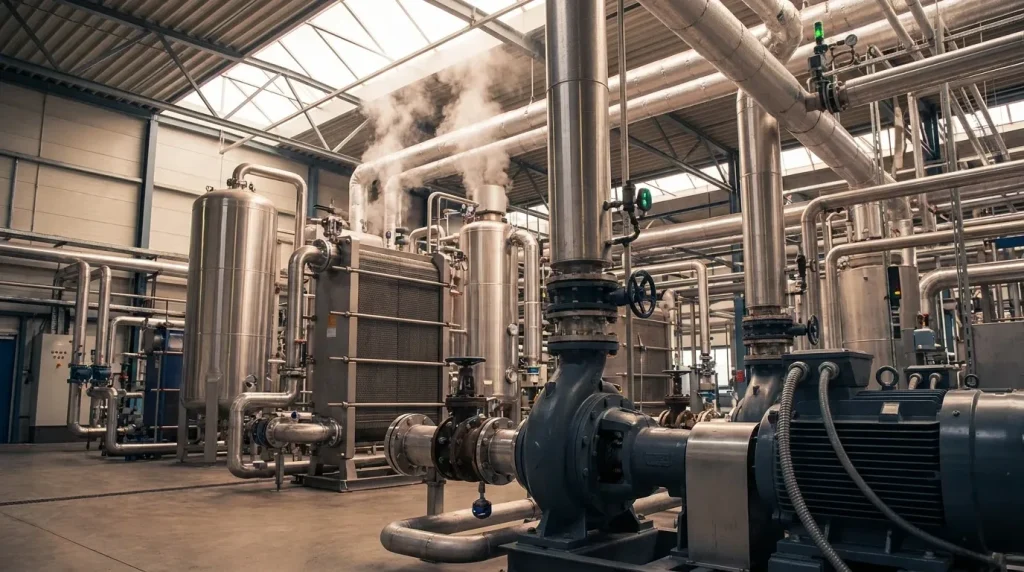
A forced circulation evaporator is a thermal separation system that uses a mechanical pump to drive liquid through a heat exchanger at high velocity, confining boiling to a separate flash chamber rather than inside the tubes. This design prevents fouling and handles difficult feeds that would plug natural circulation systems.
This guide covers the core operating principles, main system components, the step-by-step evaporation process, performance advantages and limitations, and sourcing considerations for used equipment.
We explain how pump-driven circulation achieves velocities of 1.5 to 4.0 m/s (4.9 to 13.1 ft/s) and delivers heat transfer coefficients 2 to 5 times higher than natural circulation systems. You will see why boiling occurs only in the separator vessel, protecting heat-sensitive materials and reducing deposit formation on tube surfaces.
The component breakdown covers the heat exchanger, recirculation pump, and vapor-liquid separator, including how proper sizing against standards such as ISO 16813 maintains efficiency across varying load conditions. We trace the complete process flow from feed input through flash evaporation to product withdrawal.
Our comparison of advantages and disadvantages addresses when forced circulation justifies its higher capital cost, particularly for viscous liquids up to 5,000 mPa·s, crystallizing solutions, and scaling-prone feeds. We also cover the operational challenges of pump energy consumption and maintenance requirements.
The final sections examine how International Process Plants supports procurement teams evaluating used forced circulation evaporators, including inspection priorities, compliance documentation, and integration support from our global inventory.
What is a forced circulation evaporator and when is it used?
A forced circulation evaporator is a thermal separation system that uses a mechanical pump to move liquid through a heat exchanger at high velocity, preventing boiling inside the tubes and enabling evaporation in a separate flash chamber. This design handles difficult feeds that would foul or plug natural circulation systems. The following subsections explain the key differences from natural circulation and the industrial applications where forced circulation excels.
How does a forced circulation evaporator differ from natural circulation systems?
A forced circulation evaporator differs from natural circulation systems by using a centrifugal pump to drive liquid through the heat exchanger at velocities of 1.5 to 4.0 m/s (4.9 to 13.1 ft/s), compared to natural circulation systems that rely on density-driven convection with velocities below 0.3 to 0.5 m/s (1.0 to 1.6 ft/s). According to Vanootech, the heat transfer coefficient in forced circulation evaporators ranges from 1,500 to 4,000 W/m²·K, providing 2 to 5 times higher efficiency than natural circulation systems, which typically achieve only 300 to 800 W/m²·K.
Key operational differences include:
- Boiling location: Forced circulation confines boiling to a low-pressure separator; natural circulation allows boiling inside the tubes
- Scaling resistance: High velocity scours tube walls, reducing deposit formation
- Temperature differential: Forced systems operate at 3 to 8°C (5 to 14°F) differentials versus higher gradients in natural systems
From a procurement standpoint, the higher capital cost of forced circulation units pays back quickly when processing fouling-prone or viscous feeds.
Why is forced circulation preferred for certain industrial applications?
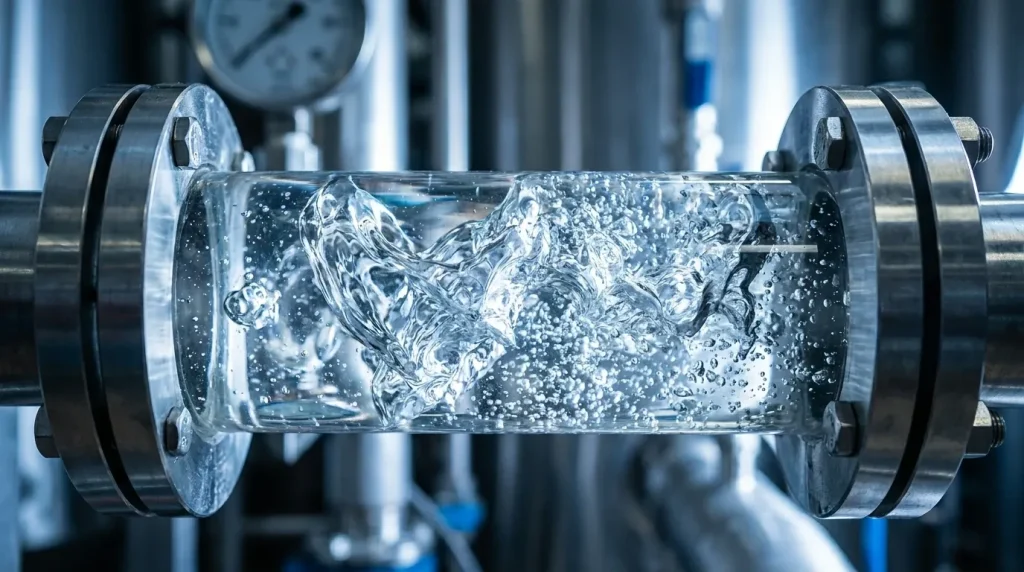
Forced circulation is preferred for certain industrial applications because it handles high-viscosity liquids up to 5,000 mPa·s, resists fouling from scaling compounds, and achieves solids concentrations exceeding 50 to 60% total solids. These capabilities make the technology essential where natural circulation would fail within hours.
Industries that rely on forced circulation evaporators include:
- Pulp and paper: Concentrating black liquor to 75% dry solids at temperatures of 120°C to 140°C (248°F to 284°F)
- Electroplating and metal finishing: Achieving 90% volume reduction in chromium-bearing wastewater
- Chemical manufacturing: Processing crystallizing salts without heat exchanger plugging
- Food processing: Concentrating syrups and gels without thermal degradation
A Vanootech case study documented a forced circulation system that concentrated 15 tonnes per day of electroplating wastewater to 1.5 tonnes per day while removing over 99.9% of hexavalent chromium. For operations processing difficult feeds, forced circulation often represents the only viable evaporation approach.
What are the main components of a forced circulation evaporator?
The main components of a forced circulation evaporator are the heat exchanger, recirculation pump, and vapor-liquid separator. Each component serves a distinct function in the continuous evaporation cycle.
What roles do the heat exchanger, recirculation pump, and separator play?
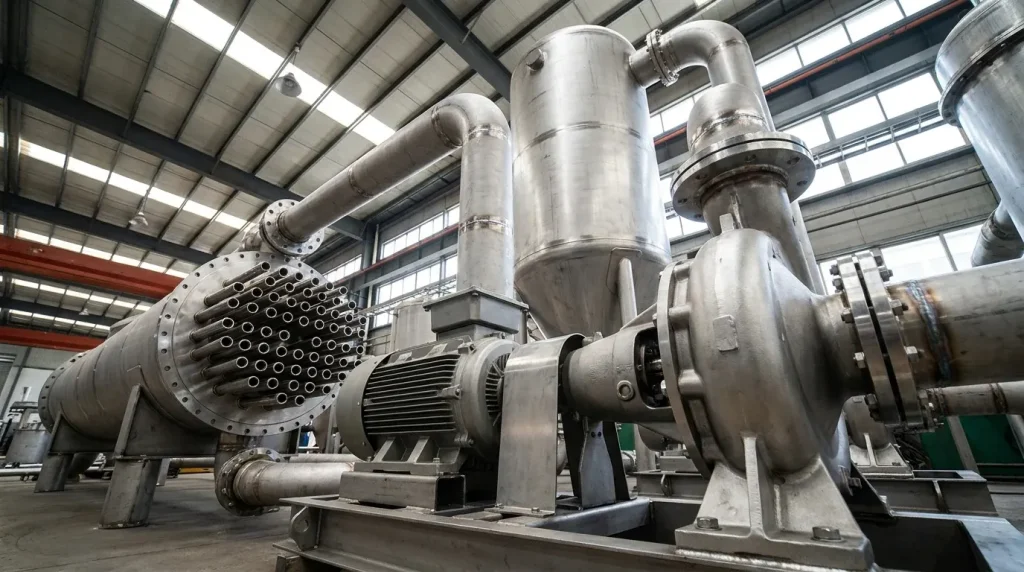
The heat exchanger, recirculation pump, and separator each play essential roles in forced circulation evaporator operation. The heat exchanger (often a shell-and-tube design) transfers thermal energy from steam to the process liquid without allowing boiling inside the tubes. The recirculation pump drives liquid through the system at controlled velocities, maintaining turbulent flow that prevents fouling. The separator receives heated liquid from the exchanger, where pressure reduction causes flash evaporation; vapor exits overhead while concentrated liquid returns to the pump suction.
According to Flow Machinery, ISO 16813:2021 defines performance-based evaporator efficiency metrics requiring the LMTD correction factor to stay within ±3.2% of nameplate across a 40–95% load range. Proper component sizing against such standards ensures each element operates within design parameters, preventing the efficiency losses that occur when components are mismatched.
How is the flow of liquid maintained in the system?
The flow of liquid is maintained by a centrifugal recirculation pump that continuously moves process fluid through a closed loop. This pump circulates liquid at velocities of 1.5–4.0 m/s (4.9–13.1 ft/s), creating turbulent flow conditions that scour heat transfer surfaces and prevent deposit formation.
Key flow characteristics include:
- Circulation rates 3 to 10 times higher than the evaporation rate
- Consistent mass flow regardless of liquid density changes during concentration
- Positive displacement independent of natural convection forces
The pump maintains sufficient head pressure to overcome friction losses through piping, the heat exchanger tube bundle, and the separator inlet. This mechanical circulation allows operators to process liquids up to 5,000 mPa·s viscosity, where natural convection would fail entirely.
With the core components understood, the next section examines how these elements work together during the actual evaporation process.
How does the evaporation process occur in forced circulation systems?
The evaporation process in forced circulation systems occurs through controlled flash evaporation in a separate vessel rather than boiling inside the heat exchanger. This design maintains high heat transfer efficiency while preventing the fouling and scaling problems common in other evaporator types.
How is boiling prevented inside the heat exchanger tubes?
Boiling is prevented inside the heat exchanger tubes by maintaining liquid pressure above the saturation point throughout the heating phase. The recirculation pump pushes liquid through the tubes at velocities of 1.5 to 4.0 m/s (4.9 to 13.1 ft/s), creating sufficient static head to suppress bubble formation even as the liquid absorbs heat.
The liquid experiences only a modest temperature rise, typically 3 to 8°C (5 to 14°F), as it passes through the heat exchanger. This superheated liquid remains in the liquid phase until it enters the separator vessel, where reduced pressure triggers instantaneous flash evaporation. Bulk boiling occurs only in this low-pressure separator and not inside the heat exchanger, meaning the liquid experiences minimal temperature rise and short residence time.
This approach eliminates vapor blanketing on tube surfaces, which would otherwise create insulating pockets that reduce heat transfer coefficients. For viscous or scaling fluids, this principle proves particularly valuable because it keeps the tube walls continuously wetted with fast-moving liquid.
What is the process flow sequence from feed input to product output?
The process flow sequence from feed input to product output follows a continuous loop with strategic product withdrawal:
- Fresh feed enters the circulation loop and mixes with the circulating liquid
- The recirculation pump drives the combined stream through the heat exchanger tubes
- Steam or hot fluid heats the liquid without allowing boiling
- Superheated liquid exits the heat exchanger and enters the separator vessel
- Pressure drop in the separator causes instantaneous evaporation
- Vapor exits through the top for condensation or recompression
- Concentrated liquid collects at the separator bottom
- Most liquid returns to the pump suction; a portion withdraws as product
According to EnerTherm Engineering, maintaining flowability in high-solids applications requires operating the concentrator stage at elevated temperatures, typically between 120°C and 140°C (248°F and 284°F). The circulation rate typically runs 3 to 10 times the evaporation rate, ensuring adequate tube velocity and preventing dry spots.
Understanding process flow mechanics helps when evaluating equipment condition and configuration requirements.
What are the key advantages and disadvantages of forced circulation evaporators?
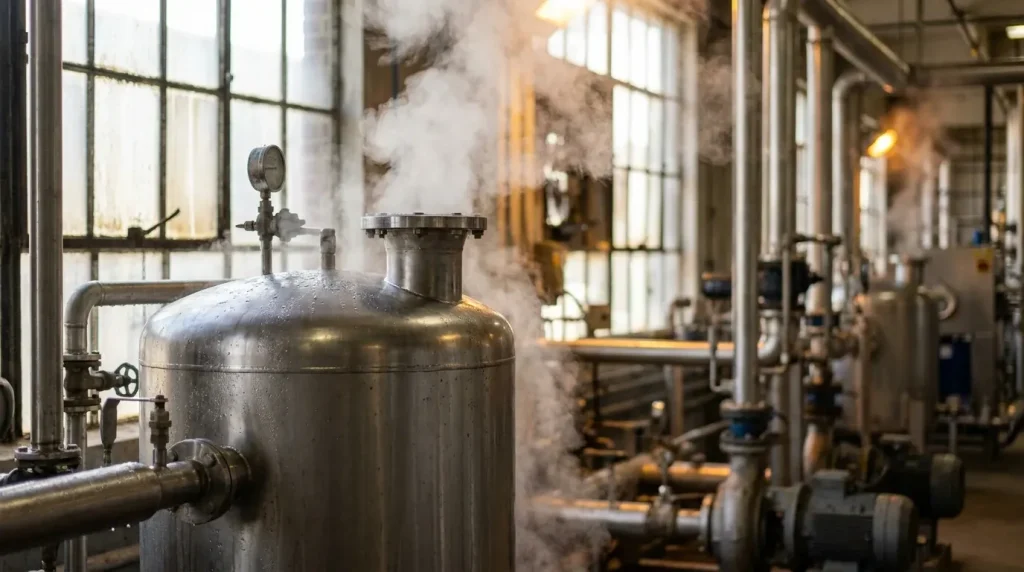
The key advantages of forced circulation evaporators include superior heat transfer, fouling resistance, and the ability to handle viscous or scaling-prone liquids. The key disadvantages include higher capital costs, pump energy consumption, and increased maintenance complexity. The following subsections detail when these systems deliver the greatest value and what operational challenges to expect.
In which scenarios do forced circulation systems offer the biggest benefits?
Forced circulation systems offer the biggest benefits when processing high-viscosity liquids, crystallizing solutions, or scaling-prone feeds. According to Vanootech, forced circulation evaporators handle viscosities up to 5,000 mPa·s, making them suitable for syrups, gels, and concentrates that would stall in natural circulation units.
These scenarios favor forced circulation:
- High-solids concentration exceeding 50–60% total solids
- Crystallization processes requiring controlled evaporation
- Wastewater treatment with heavy metal recovery
- Heat-sensitive products needing short residence times
The combination of high liquid velocities, typically 1.5–4.0 m/s (4.9–13.1 ft/s), and circulation rates 3 to 10 times the evaporation rate prevents dry walls and scaling. For engineers handling difficult feeds, this reliability often justifies the additional equipment cost.
What operational challenges or limitations might users encounter?
Users may encounter higher energy consumption from pump operation, increased capital costs, and more complex maintenance requirements compared to natural circulation systems.
Key operational challenges include:
- Pump energy costs adding to operating expenses
- Cavitation risk if NPSH requirements are not maintained
- More frequent mechanical maintenance on pumps and seals
- Higher initial investment for pumps and controls
According to Vanootech, every 1 mm of scale reduces heat transfer efficiency by roughly 8–10% and increases steam usage by 10–15%. Food industry applications typically require cleaning every 48 hours, while chemical processes may need weekly or monthly cycles.
For plants evaluating used equipment, these challenges are manageable when circulation pumps and heat exchangers are properly sized and maintained. Understanding these trade-offs helps engineers select the right evaporator configuration for their specific feed characteristics.
How does a forced circulation evaporator impact process efficiency and product quality?
Forced circulation evaporators improve process efficiency by delivering heat transfer coefficients of 1,500 to 4,000 W/m²·K, which is 2 to 5 times higher than natural circulation systems. This section examines how these systems handle challenging feed materials.
How does it handle highly viscous or scaling-prone liquids?
Forced circulation evaporators handle highly viscous and scaling-prone liquids through high-velocity circulation and controlled temperature differentials. The pump drives liquid at 1.5 to 4.0 m/s (4.9 to 13.1 ft/s), compared to natural circulation velocities below 0.3 to 0.5 m/s (1.0 to 1.6 ft/s). This aggressive flow rate prevents solids from settling on heat transfer surfaces.
These systems process liquids up to 5,000 mPa·s, including syrups, gels, and concentrated slurries. According to Vanootech, the liquid circulation rate typically runs 3 to 10 times the evaporation rate, which prevents scaling and dry walls even in crystallizing applications.
The low temperature differential of 3 to 8°C (5.4 to 14.4°F) between heating medium and process fluid reduces thermal stress on heat-sensitive products. Bulk boiling occurs only in the separator, not inside the heat exchanger, so the liquid experiences minimal temperature rise and short residence time.
What design features reduce maintenance requirements?
The design features that reduce maintenance requirements include external heat exchangers, high circulation velocities, and separation of boiling from heat transfer surfaces. Because evaporation happens in the separator rather than inside tubes, deposits form more slowly on the heat exchanger walls.
According to EnerTherm Engineering, deposits such as burkeite or calcium carbonate can drop the overall heat transfer coefficient from a design baseline of 1,870 W/m²·K to as low as 720 W/m²·K. This performance degradation underscores why forced circulation’s anti-fouling characteristics matter for long-term operation.
Key design elements that extend cleaning intervals include:
- High fluid velocities that scour surfaces continuously
- Oversized circulation pumps that maintain flow even as viscosity increases
- Smooth internal tube surfaces that resist deposit adhesion
- Accessible tube bundles for inspection and cleaning
Industry data shows routine cleaning extends equipment life by approximately 25% and reduces unplanned downtime by more than 30%. For procurement teams evaluating used forced circulation evaporators, verifying tube condition and pump capacity should be priorities during inspection.
How should you approach forced circulation evaporators when considering used process equipment from International Process Plants?
You should approach forced circulation evaporators from International Process Plants by evaluating unit specifications against your process requirements, verifying compliance documentation, and consulting with our engineering team on integration. The following sections explain how we support sourcing and summarize the core operating principles covered in this article.
Can International Process Plants help with sourcing and integrating forced circulation evaporators for industrial applications?
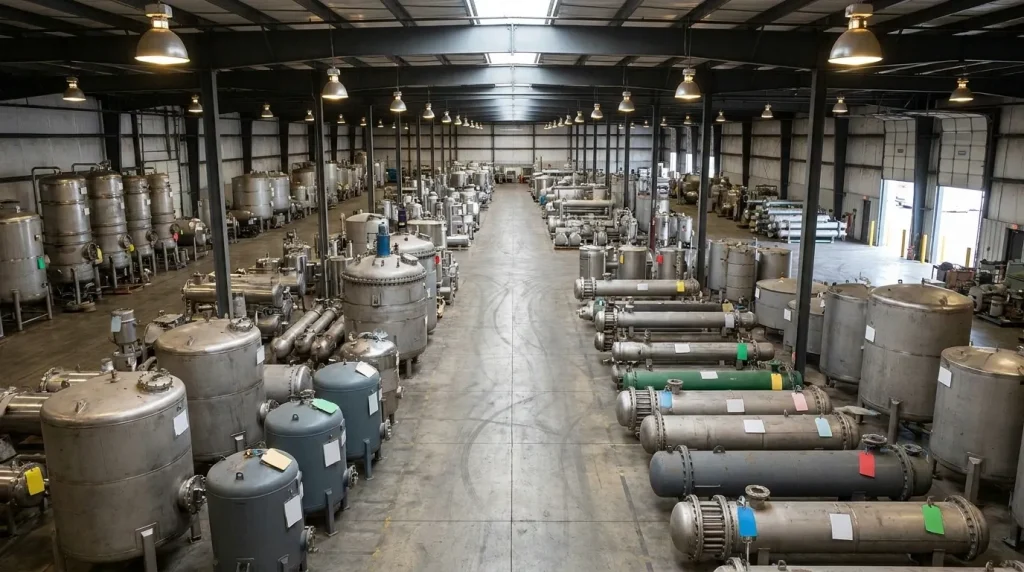
Yes, International Process Plants can help with sourcing and integrating forced circulation evaporators for industrial applications. With over 46 years in the used process equipment market, we maintain an inventory of more than 15,000 pieces of equipment across warehouses in the United States, Germany, and the United Kingdom.
When evaluating a used forced circulation evaporator, key specifications to verify include:
- Heat exchanger surface area and tube metallurgy
- Recirculation pump capacity and materials of construction
- Separator vessel dimensions and pressure ratings
- Documentation for ASME Section VIII, PED, or CE marking compliance
Our team provides technical documentation, inspection reports, and engineering support to help match available units to your viscosity ranges, solids concentrations, and throughput requirements. Purchasing good used equipment typically costs approximately 50% of new, making forced circulation technology accessible for applications ranging from chemical concentration to wastewater treatment.
What are the key takeaways about how a forced circulation evaporator works we covered?
The key takeaways about how a forced circulation evaporator works center on three principles: pump-driven velocity, external boiling, and fouling resistance.
- Pump-driven circulation moves liquid at 1.5 to 4.0 m/s (4.9 to 13.1 ft/s), achieving heat transfer coefficients of 1,500 to 4,000 W/m²·K
- Boiling occurs only in the separator, not inside heat exchanger tubes, protecting heat-sensitive materials
- High circulation rates (3 to 10 times evaporation rate) prevent scaling and enable processing of viscous liquids up to 5,000 mPa·s
- Energy efficiency reaches 30% better than natural circulation, with steam consumption as low as 0.8 to 1.0 ton per ton of evaporated water
These characteristics make forced circulation evaporators the preferred choice for scaling-prone feeds, high-viscosity concentrates, and crystallization applications. For procurement teams evaluating used units, International Process Plants offers the technical expertise and global inventory to match these proven systems to your specific industrial requirements.

 ZH
ZH  EN
EN  ES
ES  FR
FR  PL
PL  DE
DE  AR
AR  UR
UR  HI
HI  NL
NL  TR
TR  IT
IT  UK
UK  RU
RU  JA
JA  PT
PT