
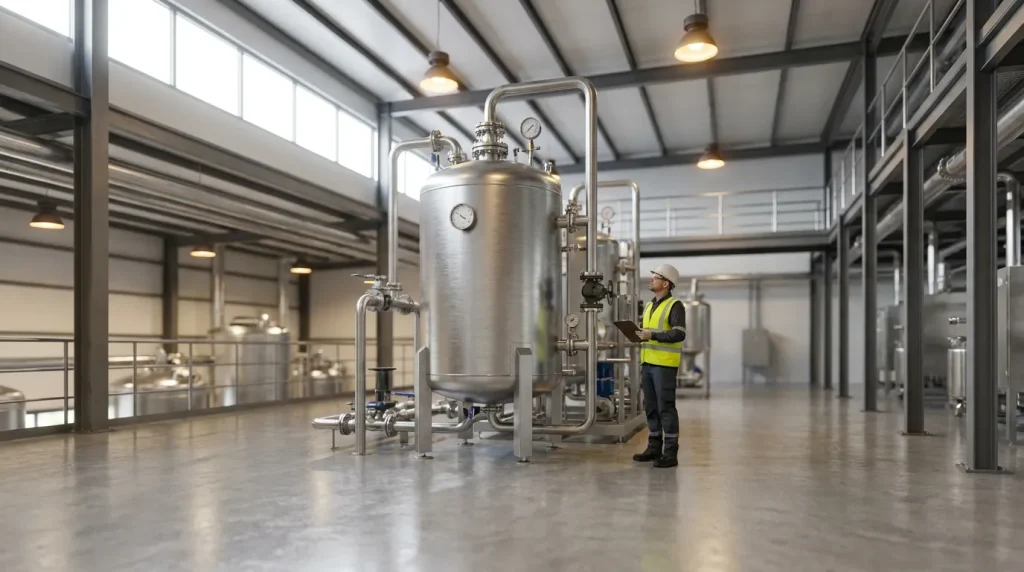
A pressure leaf filter is a liquid filtration system that uses stacked filter elements inside a pressure vessel to separate solids from liquids through cake filtration. These systems contain 10 to 60 filter leaves and handle solid loads between 0.01% and 3%, making them essential equipment for clarification and polishing operations across multiple industrial sectors.
This guide covers pressure leaf filter design and components, the step-by-step filtration process, configuration types and their differences, advantages and limitations, and industrial applications with sourcing considerations.
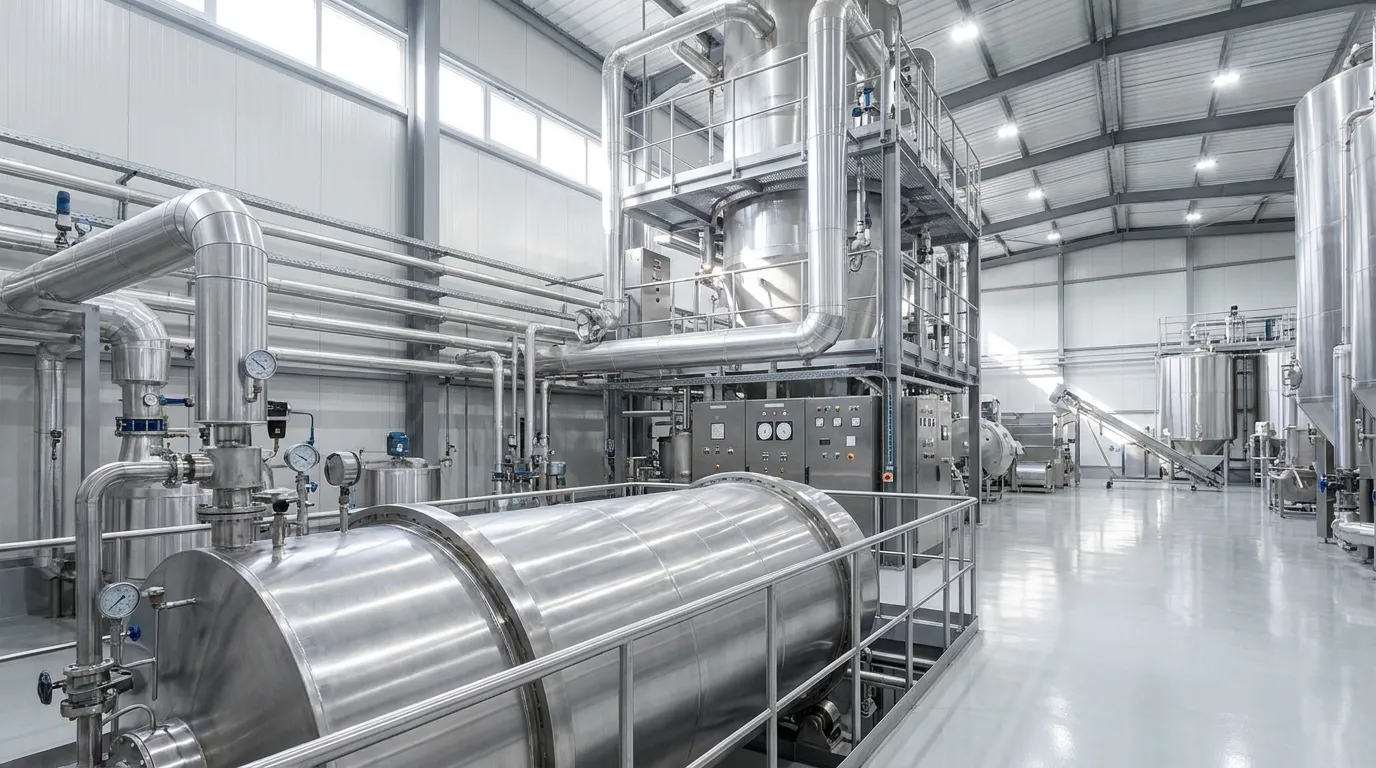
Pressure leaf filter design centers on five key components: the pressure vessel, filter leaves, filter medium, manifolds, and cake discharge mechanism. The filter medium selection directly determines particle retention and filtrate clarity, while system pressure must be carefully matched to slurry characteristics since some solids compact under high pressure.
The filtration process operates through three sequential stages. Pre-coating deposits a uniform layer of filter aid on each leaf surface. The main filtration stage then builds a filter cake as solids accumulate while clear filtrate exits through the manifold. Cake discharge completes the cycle through either wet or dry methods depending on application requirements.
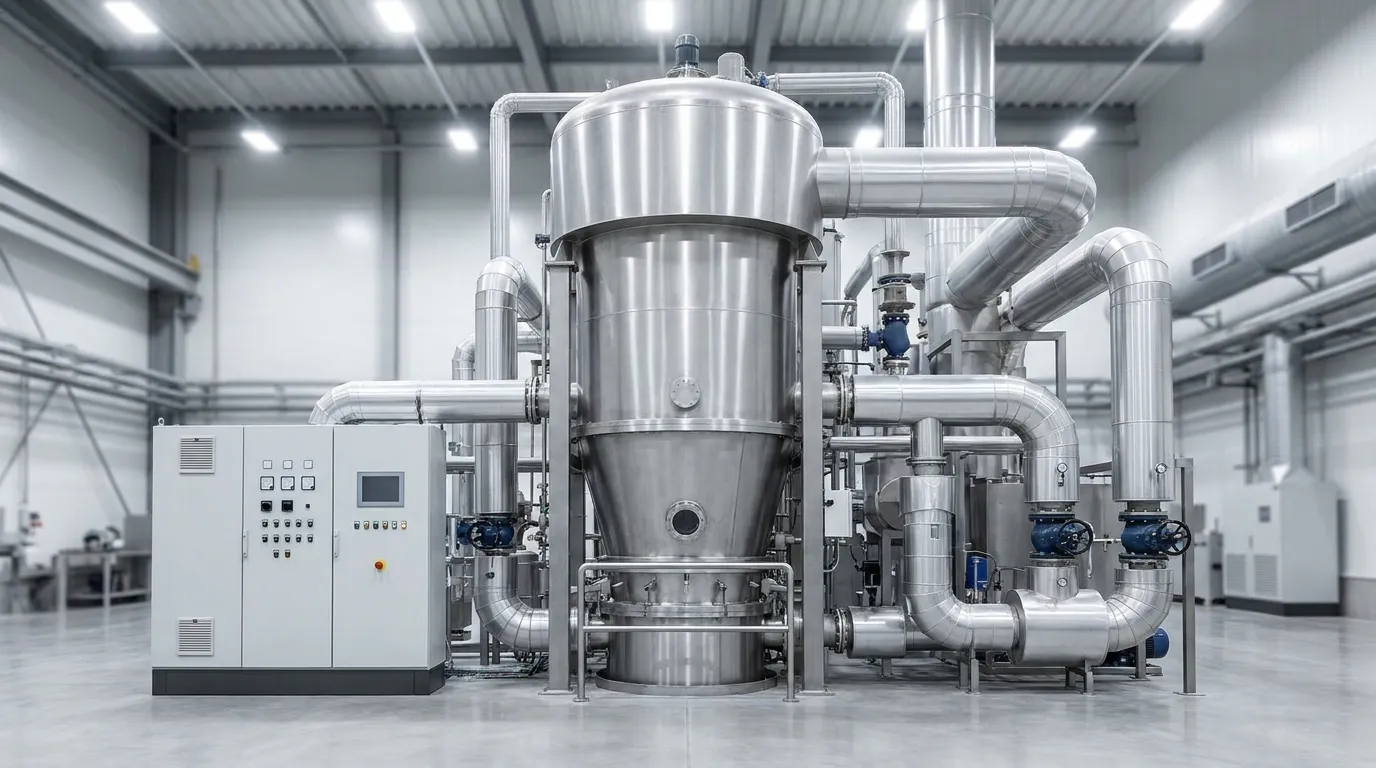
Vertical and horizontal configurations address different operational needs. Vertical units suit space-constrained facilities with moderate filtration volumes, while horizontal units accommodate higher dirt capacity and throughput for heavy-loading applications.
Pressure leaf filters outperform alternative technologies in high-capacity batch processing, enclosed handling of hazardous liquids, and catalyst recovery operations achieving filtrate quality below 1 ppm. These capabilities make them standard equipment in many chemical processing, edible oil refining, pharmaceutical manufacturing, and power generation facilities.
What Is a Pressure Leaf Filter and How Is It Designed?
A pressure leaf filter is a liquid filtration system that uses stacked filter elements inside a pressure vessel to separate solids from liquids through cake filtration. The sections below cover the key components, leaf element structure, and filter medium selection.
What Are the Key Components of a Pressure Leaf Filter?
The key components of a pressure leaf filter include the pressure vessel, filter leaves, filter medium, inlet and outlet manifolds, and cake discharge mechanism. The pressure vessel, constructed to ISO 16528-1:2007 standards for boilers and pressure vessels, can contain around 10 to 60 filter leaves depending on capacity requirements.
Each leaf consists of a rigid frame covered with filter medium, connected to a central manifold that collects clarified filtrate. Inlet ports deliver slurry under pressure, while the outlet manifolds collect and channel the filtrate from the filter leaves, and the retained solids (filter cake) may either be discarded or recovered as the process product, depending on the application.
System pressure significantly impacts solid filterability. According to AIChE guidance, some solids that filter well at low pressures may compact or collapse under high pressures, leading to lower filterability and longer filter times. This makes pressure vessel design and operating pressure selection critical for process engineers evaluating equipment specifications.
How Does the Typical Structure of Pressure Leaf Elements Look?
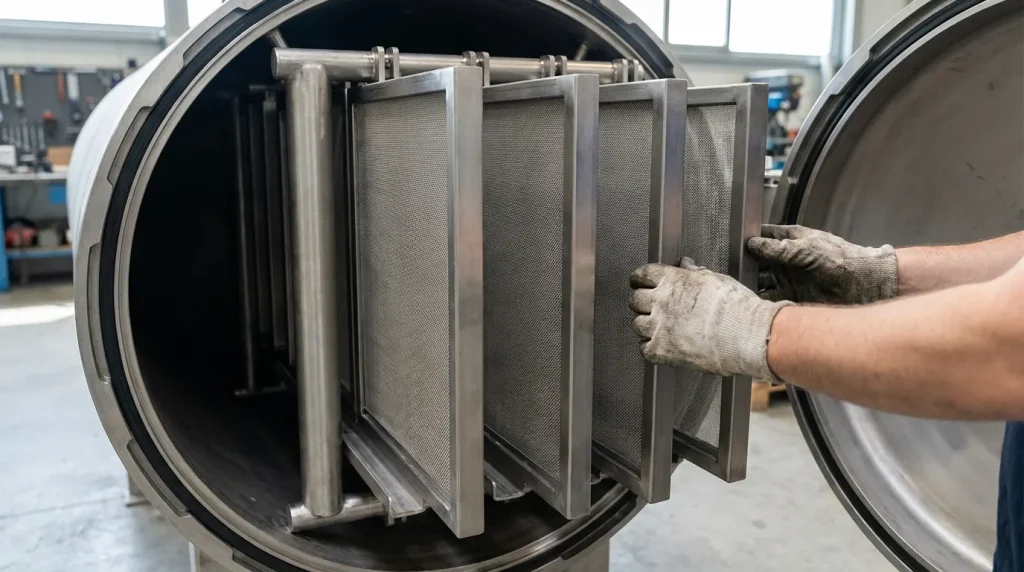
The typical structure of pressure leaf elements consists of a rigid support frame, drainage screen, and outer filter cloth arranged in a flat, rectangular configuration. The support frame provides mechanical strength to withstand differential pressure during filtration cycles.
A drainage screen sits between the frame and filter cloth, creating channels for filtrate to flow toward the central collection manifold. The filter cloth wraps around both sides of the assembly, maximizing available filtration surface area.
Leaf elements mount vertically or horizontally within the vessel:
- Vertical orientation allows gravity-assisted cake discharge
- Horizontal orientation accommodates larger vessels with higher dirt capacity
- Spacing between leaves determines cake thickness capacity
Standard designs maintain differential pressure at around 25 to 30 PSI (1.7 to 2.1 bar) between cleaning cycles to prevent leaf damage, Monitoring differential pressure in the range of approximately 25–30 psi (1.7–2.1 bar) between cleaning cycles may help prevent filter leaf damage and maintain throughput, though specific manufacturer operating and maintenance guidelines should always be referenced.
Why Is the Filter Medium Critical for Filtration Performance?
The filter medium is critical for filtration performance because it determines particle retention, flow rate, and filtrate clarity. Medium selection directly affects whether solids pass through or build into a uniform filter cake.
Filter media options can include woven metal mesh, synthetic fabrics, and sintered metal elements. Industry standards provide standardized methods for evaluating filtration performance, including filtrate quality, solids retention, throughput, and filter media effectiveness under representative operating conditions.
Pressure leaf filter technology has evolved significantly since the Kelly, Sweetland, and Vallez filter presses first accelerated filtration in the US sugar industry in 1922: modern filter aids such as diatomaceous earth and perlite enhance medium performance by creating a porous pre-coat layer. Research into alternative aids, such as eggshell powder for beverage clarification in some niche industries, continues to expand options for processing.
With design fundamentals established, understanding the step-by-step filtration process reveals how these components work together during operation.
How Does the Pressure Leaf Filtration Process Operate Step by Step?
The pressure leaf filtration process operates through three sequential stages: pre-coating, filtration, and cake discharge. Processing steps such as filtration are critical for reducing residues, especially in Active Pharmaceutical Ingredients, and should be managed with different levels of protection based on product components. The following sections detail each operational phase.
What Happens During the Pre-Coating and Filtration Stages?
Pre-coating and filtration stages establish the filter cake that separates solids from liquids. During pre-coating, operators circulate a slurry of filter aid (typically diatomaceous earth or perlite) through the system until a uniform layer deposits on each leaf surface. This pre-coat layer, usually around 3 to 6 mm (0.12 to 0.24 in) thick, protects the filter medium and improves clarity.
Once pre-coating completes, the main filtration stage begins:
- Process fluid enters the pressure vessel under controlled pressure
- Solids accumulate on the pre-coat layer, forming the filter cake
- Clear filtrate passes through the filter medium and exits via the manifold
- Operators monitor differential pressure to track cake buildup
How Is Cake Discharge Managed in Pressure Leaf Filters?
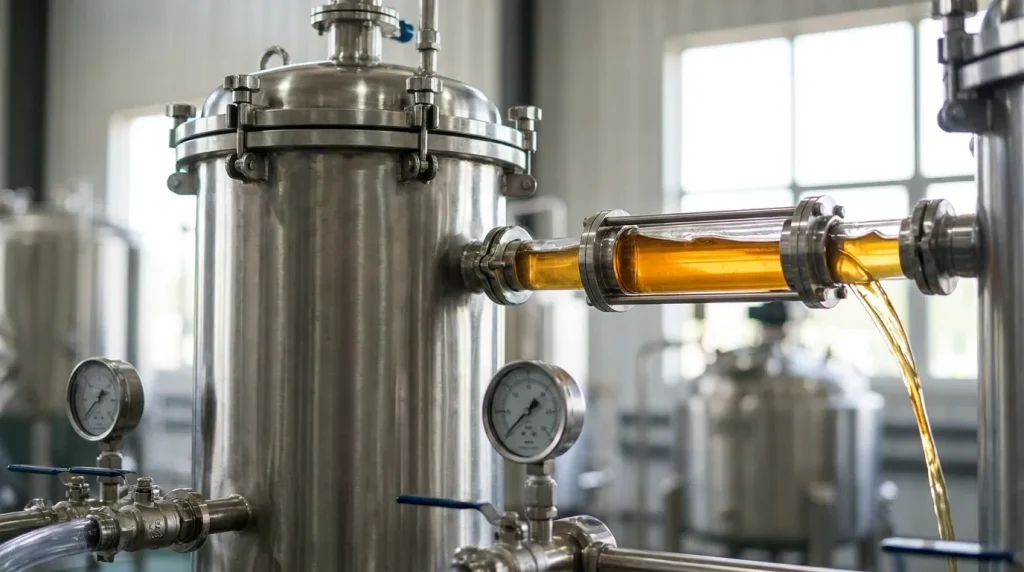
Cake discharge is managed through either wet or dry methods depending on the application and filter configuration. In edible oil filtration, pressure leaf filters with dry cake discharge are widely used for crude vegetable oil processing.
Dry cake discharge methods include:
- Mechanical vibration of filter leaves
- Rotation against stationary scrapers
- Sluicing with compressed air or gas
Wet discharge uses liquid to flush accumulated solids from the leaves, which suits applications where the cake has value or requires further processing. Both horizontal and vertical configurations can facilitate cake release due to gravity-assisted drop off of the vertical filtration plates, while vertical configurations often drop more directly into discharge hoppers. Cycle times between discharges depend on slurry solid content, operating pressure, and target cake thickness.
What Are the Typical Operating Conditions for Pressure Leaf Filtration?
The typical operating conditions for pressure leaf filtration vary by application, but standard parameters govern most industrial installations. Differential pressure between inlet and outlet should remain at around 25 to 30 PSI (1.7 to 2.1 bar) between cleaning cycles to prevent leaf damage, though specific manufacturer operating and maintenance guidelines should always be referenced.
| Parameter | Typical Range (Imperial) | Typical Range (Metric) |
| Operating pressure | Around 15 to 225 PSI | Around 1.0 to 15.5 bar |
| Solid loading | Around 0.01% to 3% | Around 0.01% to 3% |
| Temperature | Up to around 280°F | Up to around 138°C |
| Maximum system pressure | Up to around 363 PSI | Up to around 25 bar |
Ultrafiltration processes for biopharmaceutical protein separation typically operate at around 15 to 100 PSI (1.0 to 6.9 bar), while nanofiltration for organic compound separation requires around 50 to 225 PSI (3.4 to 15.5 bar). Always reference manufacturer guidelines on proper operating pressure. Matching operating conditions to your specific slurry characteristics prevents cake compaction and maintains throughput.
With these operating parameters established, the next section examines how different filter configurations address varying process requirements.
What Types of Pressure Leaf Filters Exist and What Are Their Differences?
The types of pressure leaf filters are vertical and horizontal configurations, each designed for specific operational requirements. The following subsections compare their structural differences and clarify when each configuration delivers optimal performance.
How Do Vertical and Horizontal Pressure Leaf Filters Compare?
Vertical and horizontal pressure leaf filters compare across orientation, capacity, footprint, and cake discharge method. Vertical units stack filter leaves on a central shaft within an upright vessel, while horizontal units suspend leaves from a retractable bundle in a cylindrical shell. According to FLTR engineering documentation, horizontal pressure leaf filter systems are available in larger sizes than vertical systems and offer a higher dirt capacity.
| Feature | Vertical Configuration | Horizontal Configuration |
| Vessel orientation | Upright cylinder | Horizontal cylinder |
| Leaf arrangement | Stacked on central shaft | Suspended from retractable bundle |
| Typical leaf count | Around 10–30 leaves | Around 20–60 leaves |
| Dirt-holding capacity | Moderate | Higher |
| Floor space required | Smaller footprint | Larger footprint |
| Headroom required | Greater vertical clearance | Lower ceiling clearance |
| Cake discharge | Bottom outlet or vibration | Retractable bundle for dry discharge |
| Maximum pressure | Up to around 25 bar (363 PSI) (always reference manufacturer guidelines) | Up to around 25 bar (363 PSI) (always reference manufacturer guidelines) |
Vertical units suit facilities with limited floor space but adequate ceiling height, whereas horizontal units accommodate higher throughput where horizontal clearance exists.
When Is a Specific Configuration Preferred?
A specific configuration may be preferred based on solid load, batch size, discharge requirements, and plant layout constraints. Vertical pressure leaf filters excel in applications requiring compact installation, lower capital cost, and moderate filtration volumes. Horizontal configurations often become the preferred choice when processes demand high dirt capacity, dry cake discharge for product recovery, or continuous high-volume throughput.
Key selection factors include:
- Solid concentration below 1%: vertical units handle lighter loads efficiently
- Solid concentration between 1% and 3%: horizontal units manage heavier cake buildup
- Catalyst recovery applications: horizontal dry discharge preserves valuable solids
- Space-constrained facilities: vertical units minimise floor space consumption
- High-throughput edible oil or chemical processing: horizontal units deliver greater capacity
For most catalyst recovery and high-volume refining operations, horizontal configurations provide the operational flexibility that justifies their larger footprint. With configuration differences clarified, the next section examines the broader advantages and limitations of pressure leaf filter technology.
What Are the Main Advantages and Limitations of Pressure Leaf Filters?
The main advantages of pressure leaf filters include high filtration capacity, enclosed operation, and efficient cake handling. The main limitations involve pressure sensitivity, maintenance complexity, and higher upfront costs. These factors determine where the technology excels and where operators should plan for operational trade-offs.
In Which Situations Do Pressure Leaf Filters Outperform Other Technologies?
Pressure leaf filters outperform other technologies in applications requiring high throughput, enclosed processing, and efficient solids recovery. Their design handles solid loads between 0.01% and 3%, making them ideal for polishing and clarification duties where consistent filtrate quality matters.
Key situations favoring pressure leaf filters:
- Moderate-to-high-capacity batch processing: Systems accommodate 10 to 60 filter leaves, providing large surface area in a compact footprint
- Hazardous or volatile liquids: Fully enclosed vessels contain fumes and prevent contamination or exposure
- Catalyst recovery operations: Effective for recovering valuable catalyst solids from process streams where cake-based separation and reliable discharge are required. Sintered metal systems may be preferred when very fine, absolute retention is required.
- Low product loss: Effective cake formation and drainage help minimize liquid retention in the filter cake, supporting high recovery of filtrate in applications such as edible oil refining and other high-value liquid separations.
- Impurity removal from cake is important: Good cake washing capability, making it useful in applications where impurity removal from cake is important
- Applications requiring pre-coat filtration: Body feed and pre-coat techniques extend cycle times between cleanings
Horizontal configurations offer higher dirt capacity than vertical units, making them preferable for slurries with heavier solid loads. For processes demanding both product purity and material recovery as well as a more compact footprint, pressure leaf filters are often preferred compared to open filter presses or centrifuges.
What Challenges or Drawbacks Should Operators Consider?
The challenges operators should consider include pressure-related performance limits, maintenance requirements, and capital costs. Understanding these factors helps procurement teams plan for realistic operating scenarios.
Critical drawbacks to evaluate:
- Pressure sensitivity: Some solids compact or collapse under high pressure, reducing filterability and extending cycle times
- Differential pressure monitoring: Standard practice requires maintaining around 25 to 30 PSI (1.7 to 2.1 bar) differential between cleaning cycles to prevent leaf damage, though specific manufacturer operating and maintenance guidelines should always be referenced.
- Maintenance complexity: Multi-leaf assemblies require careful inspection and periodic media replacement
- Higher capital investment: Enclosed pressure vessels like pressure leaf filters generally cost more than simple atmospheric filtration systems due to pressure vessel construction, though costs can be comparable to other advanced separation technologies depending on scale and application.
- Space requirements: Horizontal units, while offering greater capacity, demand more floor space than vertical units
For operations processing compressible solids, alternative technologies like vacuum filters may yield better results at lower pressures. However, when product containment and recovery efficiency justify the investment, pressure leaf filters remain a preferable choice across chemical, pharmaceutical, and food processing sectors.
Where Are Pressure Leaf Filters Commonly Used in Industry?
Pressure leaf filters are commonly used in industries requiring efficient solid-liquid separation with high throughput and enclosed operation. The following subsections cover applications in chemical and petrochemical processing, food and beverage production, and pharmaceutical and power generation facilities.
How Are Pressure Leaf Filters Applied in the Chemical and Petrochemical Sectors?
Pressure leaf filters are applied in the chemical and petrochemical sectors for catalyst recovery, solvent purification, and intermediate product clarification. These units handle slurries with solid loads between around 0.01% and 3%, making them suitable for removing fine particulates from process streams.
Key applications include:
- Recovering precious metal catalysts from reaction mixtures
- Purifying solvents and chemical intermediates
- Filtering waxes from lubricating oils
- Clarifying resins and polymer solutions
What Is the Role of Pressure Leaf Filters in Food and Beverage Processing?
The role of pressure leaf filters in food and beverage processing is to remove impurities, activated carbon, and residual solids while maintaining product purity and food safety compliance. These filters operate under enclosed conditions that prevent contamination and oxidation of sensitive products.
Common food industry applications include:
- Sugar refining and syrup clarification
- Edible oil filtration before refining
- Cocoa butter and fat processing
- Beverage clarification and polishing
According to Guard Filter documentation, pressure leaf filters handle activated carbon removal and catalyst recovery in sugar, cocoa, and edible oil production. Vertical units with dry cake discharge are typically used for crude edible oil filtration, as industry experts note their smaller footprint and ability to effectively remove impurities from crude vegetable oil to achieve high quality products, while meeting ISO 22000 food safety requirements.
Why Are Pressure Leaf Filters Important in Pharmaceuticals and Power Generation?
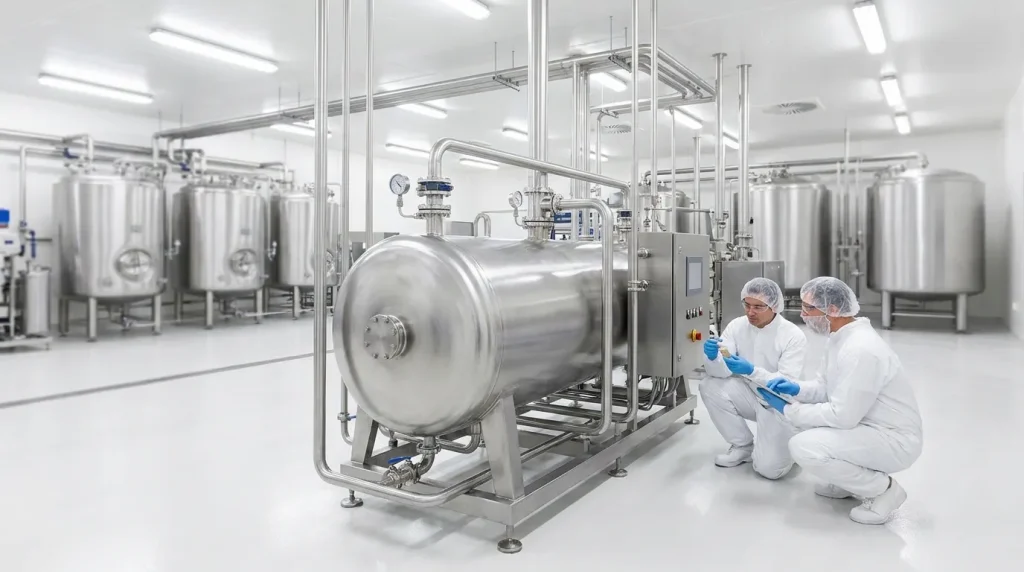
Pressure leaf filters are important in pharmaceuticals and power generation because they deliver the containment, precision, and reliability these regulated industries require. Pharmaceutical applications demand sterile conditions, while power plants need continuous, high-volume filtration.
In pharmaceutical manufacturing, pressure leaf filters support:
- Active pharmaceutical ingredient (API) purification
- Solvent recovery and recycling
- Intermediate product clarification
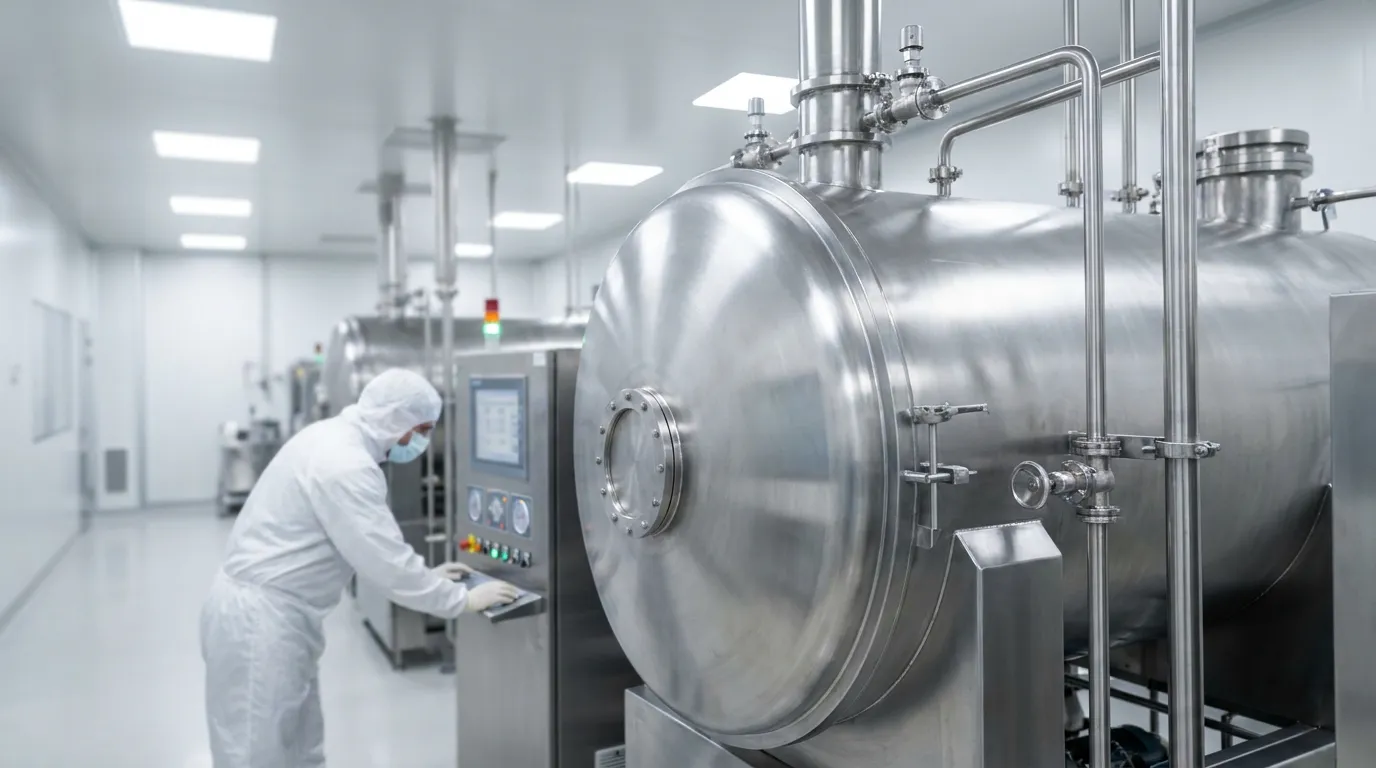
Filtration steps are critical for reducing residues in APIs and should be managed with protection levels appropriate to each process stage. For power generation, turbine oil purification systems are commonly designed to meet machinery safety standards such as EN ISO 12100 and EN 60204-1 in Europe, alongside OEM and site-specific requirements. Pressure leaf filters maintain lubricant cleanliness, extending turbine life and preventing costly unplanned outages. Their enclosed design suits both sterile pharmaceutical environments and the demanding conditions of power plant operations.

How Should You Approach Sourcing or Redeploying Pressure Leaf Filters with International Process Plants?
You should approach sourcing or redeploying pressure leaf filters with International Process Plants by leveraging our global inventory of new surplus and quality used process equipment. The sections below explain how we can help you acquire filtration equipment and summarize the key operational principles covered throughout this guide.
Can International Process Plants Help Acquire or Repurpose Pressure Leaf Filtration Equipment?
Yes, International Process Plants can help acquire or repurpose pressure leaf filtration equipment through our worldwide network of warehouses in the United States, Germany, and the United Kingdom. Our inventory of 15,000+ pieces of process equipment includes filtration systems suitable for chemical, pharmaceutical, food processing, and petrochemical applications.
When evaluating used pressure leaf filters, we verify compliance with applicable standards such as ASME Section VIII for pressure vessels and CE marking for European deployment under the Pressure Equipment Directive (PED). For applications requiring high filtrate purity, sintered metal filtration technology provides a strong alternative, achieving filtrate quality of less than 1 ppm for spent catalyst recovery, according to Mott Corporation technical documentation.
International Process Plants offers several sourcing advantages:
- Access to both vertical and horizontal configurations across multiple capacity ranges
- Global logistics coordination for deployment across 15 countries
- Technical support for repurposing existing units to new applications
For facilities looking to redeploy existing filtration assets, we also purchase complete plants and individual equipment pieces, providing a pathway to recover capital from decommissioned systems.
What Are the Key Takeaways About How a Pressure Leaf Filter Works: Process, Components, and Industrial Use Cases We Covered?
The key takeaways about how a pressure leaf filter works center on three interconnected elements: the filtration mechanism, critical components, and proper application selection.
Pressure leaf filters operate through cake filtration, where slurry enters a pressurized vessel containing stacked filter leaves. Solids accumulate on the filter medium while clarified liquid passes through. Monitoring differential pressure in the range of approximately 25–30 psi (1.7–2.1 bar) between cleaning cycles may help prevent filter leaf damage and maintain throughput, though manufacturer operating and maintenance guidelines should always be referenced.
Critical components include the pressure vessel, filter leaves with supporting frames, the filter medium, and cake discharge mechanisms. Horizontal configurations offer higher dirt capacity for heavy-loading applications, while vertical units minimize floor space. Filter medium selection directly impacts separation efficiency and must match the particle size distribution of your specific process stream.
Industrial applications span edible oil clarification, pharmaceutical intermediate processing, catalyst recovery in petrochemical operations, and turbine oil purification in power generation. Each application demands attention to operating temperature, system pressure, and compliance with sector-specific standards.
With the right equipment matched to your process requirements, pressure leaf filters deliver reliable solid-liquid separation across demanding industrial environments.

 UR
UR  EN
EN  ES
ES  FR
FR  PL
PL  DE
DE  AR
AR  HI
HI  NL
NL  TR
TR  IT
IT  UK
UK  RU
RU  JA
JA  PT
PT  ZH
ZH