

A reactor maintenance schedule is a structured program of preventive tasks, condition-based monitoring, and periodic inspections designed to keep process reactor vessels operating safely within regulatory limits. Inspection intervals define the maximum time between internal examinations, thickness measurements, or proof tests for pressure equipment.
This guide covers the safety and efficiency risks of inadequate maintenance, methods for determining optimal inspection intervals, governing standards and regulations, documentation and digital scheduling practices, downtime minimization strategies, common maintenance challenges, and sourcing solutions that support compliance-ready maintenance cycles.
Skipping or delaying preventive tasks can allow small issues like gasket wear, corrosion, and seal leaks to escalate, potentially causing injuries, unplanned shutdowns, and contamination risks. Maintenance demands also differ significantly across batch reactors, CSTRs, glass-lined vessels, and high-pressure reactor vessels.
Inspection frequency depends on operating severity, vessel metallurgy, process chemistry, and regulatory mandates. Frameworks such as API 510, the Pressure Equipment Directive (PED 2014/68/EU), and ASME Section VIII set hard ceilings on intervals. Condition-based monitoring using vibration analysis, ultrasonic thickness measurement, and thermal imaging allows operators to refine those intervals based on actual equipment health.
Compliance requirements span ICH Q7 for pharmaceutical manufacturing, OSHA PSM and CEFIC guidelines for chemical processes, and IAEA standards for nuclear applications. Regulatory audits demand documented proof at every interval, making centralized CMMS platforms and automated scheduling tools essential.
Redundant equipment configurations, on-stream inspection techniques, and thorough pre-outage planning reduce downtime. Sourcing new surplus and quality used reactor equipment with verified construction standards shortens replacement lead times and keeps inspection cycles on track.
Why Are Regular Maintenance Schedules Critical for Reactor Safety and Efficiency?
Regular maintenance schedules are critical for reactor safety and efficiency because they prevent unplanned failures, reduce costly downtime, and protect personnel. The following subsections cover the risks of inadequate maintenance and how schedules differ by reactor type.
What Are the Typical Risks of Inadequate Reactor Maintenance?
The typical risks of inadequate reactor maintenance include equipment failure, personnel injury, unplanned shutdowns, and accelerated asset degradation. When inspections and preventive tasks are skipped or delayed, small issues such as gasket wear, corrosion, or agitator seal leaks can escalate into failures.
According to the U.S. Chemical Safety and Hazard Investigation Board, maintenance failures led to 4 fatalities and 32 injuries across nine investigated incidents. These consequences extend beyond safety. Unplanned shutdowns disrupt production schedules, damage upstream and downstream equipment, and introduce contamination risks in pharmaceutical or food-grade processes. Neglected reactors can also lose thermal efficiency from buildup on heat transfer surfaces, forcing higher energy consumption to maintain setpoint temperatures.

How Do Maintenance Schedules Vary by Reactor Type?
Maintenance schedules vary by reactor type based on operating conditions, construction materials, and process chemistry. Batch reactors, continuous stirred-tank reactors (CSTRs), and fixed-bed reactors each impose different demands on seals, agitators, linings, and pressure boundaries.
A study published in the Journal of Quality in Maintenance Engineering identified 16 recurring maintenance types with a total planned downtime of 887 hours per year for a single process unit. Key differences across reactor types include:
- Batch reactors require frequent seal and gasket inspections between campaigns, especially when switching between aggressive chemistries.
- CSTRs demand continuous monitoring of agitator bearings and shaft seals because they operate without idle periods.
- Glass-lined reactors need scheduled visual inspections for enamel chip detection
Matching the maintenance interval to the specific reactor type prevents both over-maintenance waste and under-maintenance risk, keeping total cost of ownership predictable across the asset lifecycle.
How Do You Determine the Optimal Inspection Intervals for Different Reactors?
You determine the optimal inspection intervals for different reactors by evaluating operating severity, regulatory requirements, and remaining vessel life. The subsections below cover the key factors that set inspection frequency and how condition-based monitoring refines those intervals.
What Factors Influence Recommended Inspection Frequencies?
The factors that influence recommended inspection frequencies include operating conditions, process chemistry, vessel metallurgy, regulatory mandates, and remaining equipment life. Reactors handling corrosive media at elevated temperatures, such as 400 °F (204 °C) or above, degrade faster than vessels in mild service, so they require shorter intervals between inspections.
Regulatory frameworks set hard ceilings on those intervals:
- API 510 limits the period between internal or on-stream inspections to one half the remaining life of the vessel or 10 years, whichever is less.
- The EU Pressure Equipment Directive (2014/68/EU) requires final assessments, including inspection and proof tests, for certain types of Category III and IV pressure equipment.
- ASME BPV Code Section VIII and CE/UKCA marking requirements apply additional inspection criteria depending on jurisdiction.
How Can Condition-Based Monitoring Impact Inspection Intervals?
Condition-based monitoring can impact inspection intervals by replacing fixed calendar schedules with data-driven assessments that reflect actual equipment health. Rather than inspecting every reactor on the same cycle, operators use real-time sensor data to identify which vessels need attention first and which can safely follow their normal intervals.
Common fault modes that monitoring targets include bearing faults, rotor faults, stator faults, insulation faults and eccentricity faults in agitator drive systems. According to a review published in Sensors (2023), these represent some of the most frequent machine fault categories detectable through vibration and acoustic monitoring.
With inspection intervals established, the next step is understanding which standards and regulations govern reactor maintenance compliance.

What Industry Standards and Regulations Govern Reactor Maintenance and Inspection?
The industry standards and regulations that govern reactor maintenance and inspection include ASME BPV Code, API 510, the Pressure Equipment Directive (PED 2014/68/EU), and ICH Q7. Compliance requirements vary by sector, and regulatory audits directly shape maintenance planning.
Which Compliance Requirements Apply to Pharmaceuticals, Chemicals, or Power Generation?
The compliance requirements that apply to pharmaceuticals, chemicals, and power generation span distinct regulatory frameworks, each with specific maintenance and inspection mandates:
- دواسازی: ICH Q7 requires written procedures for equipment cleaning and subsequent release for use in manufacturing intermediates and active pharmaceutical ingredients (APIs). GMP documentation must trace every maintenance action on reactor vessels.
- Chemicals: OSHA’s Process Safety Management (PSM) standard applies to processes involving flammable liquids or gases in quantities of 10,000 lbs (4,535.9 kg) or more, as noted by OSHA. In Europe, CEFIC guidelines call for comprehensive management systems covering organizational structures, responsibilities, and procedures for major-accident prevention. The ATEX Directive 2014/34/EU governs equipment used in potentially explosive atmospheres.
- Power generation (nuclear): The IAEA requires operating organizations to establish programs for maintenance, testing, surveillance, and inspection of all items important to safety. ASME BPV Code Section XI, Division 1, incorporates the ASME OM Code for in-service testing of components.
Across all sectors, the PED 2014/68/EU mandates final assessments, including inspection and proof tests, for certain Category III and IV pressure equipment. In the UK, the Pressure Systems Safety Regulations 2000 prohibit operating any installed pressure system without a written scheme for periodic examination.
How Do Regulatory Audits Affect Maintenance Planning?
Regulatory audits affect maintenance planning by imposing documented proof of compliance at every inspection interval, which forces maintenance teams to align schedules with regulatory timelines rather than operational convenience alone. Auditors verify that written examination schemes exist, that inspection records are complete, and that corrective actions have been closed before the next operating cycle.
ISO 55000 provides the foundational terminology and principles for developing a proactive asset management system, which auditors increasingly reference when evaluating maintenance program maturity. Facilities without structured programs risk audit findings that can halt production until gaps are resolved. For process engineers managing batch reactors or other reactor vessels, building audit readiness into the maintenance schedule from the start eliminates costly last-minute compliance scrambles.
With regulatory frameworks established, consistent documentation ensures every inspection and maintenance action remains traceable.

What Are the Best Practices for Documenting and Tracking Reactor Maintenance?
The best practices for documenting and tracking reactor maintenance include using centralized recordkeeping systems, standardizing data entry formats, and integrating digital scheduling tools. The following subsections cover recommended technologies for maintenance records and digital solutions for inspection scheduling.
What Tools or Technologies Can Assist With Maintenance Recordkeeping?
The tools and technologies that can assist with maintenance recordkeeping include computerized maintenance management systems (CMMS) and enterprise asset management (EAM) platforms. CMMS platforms centralize work orders, spare parts logs, and inspection reports into a single searchable database. EAM systems extend this capability by linking maintenance records to asset life-cycle data.
Effective recordkeeping tools should capture:
- Inspection dates, findings, and corrective actions for each reactor vessel.
- Pressure test results in both PSI and bar, along with temperature readings in °F and °C.
- Compliance documentation aligned with ASME Section VIII, the Pressure Equipment Directive (PED), CE marking, and UKCA marking.
- Calibration records for condition-based monitoring sensors such as vibration analyzers and ultrasonic thickness gauges.
Standardized templates across these platforms reduce data entry errors and ensure audit readiness across global jurisdictions.
How Can Digital Solutions Streamline Inspection Scheduling?
Digital solutions streamline inspection scheduling by automating interval tracking, generating alerts before deadlines, and consolidating compliance calendars across multiple reactor assets. Scheduling modules within CMMS and EAM platforms allow maintenance teams to set inspection intervals based on regulatory requirements, such as the API 510 maximum of 10 years or half the remaining vessel life, whichever is less.
Automated scheduling eliminates the manual tracking that often leads to missed inspections or redundant downtime. When paired with condition-based monitoring data, digital platforms can adjust intervals dynamically, shifting from fixed calendar schedules to risk-informed timing. This approach reduces unnecessary shutdowns while maintaining full compliance with standards like ASME Section VIII, PED, and UK Pressure Systems Safety Regulations. For operations managing reactor fleets across multiple facilities, centralized digital scheduling provides the visibility needed to coordinate outages efficiently.
How Can You Minimize Downtime During Reactor Maintenance and Inspection?
You can minimize downtime during reactor maintenance and inspection by combining parallel work strategies with thorough pre-outage planning. The following subsections cover production-continuity tactics and outage-duration reduction methods.
What Strategies Allow for Maintenance Without Interrupting Production?
Strategies that allow for maintenance without interrupting production include redundant equipment configurations, on-stream inspection techniques, and staggered scheduling. Facilities that maintain standby or swing reactors can rotate one vessel offline while parallel units continue operating, keeping throughput near capacity.
On-stream inspection methods, such as ultrasonic thickness monitoring and infrared thermography, enable condition assessment while reactors remain in service. API 510 permits on-stream inspections at intervals not exceeding half the vessel’s remaining life or 10 years, whichever is less, allowing operators to extend run lengths between full shutdowns.
Additional approaches that support continuous production include:
- Modular component pre-assembly, so replacement parts install quickly during brief maintenance windows.
- Condition-based monitoring with vibration sensors and corrosion probes, which targets only components showing degradation rather than requiring full-system shutdowns.
- Phased maintenance campaigns that divide work across multiple short interventions instead of one extended outage.
For batch reactor operations, which represent the majority of process reactor installations, scheduling maintenance between campaign changeovers eliminates dedicated downtime entirely.
What Preparations Help Reduce the Duration of Scheduled Outages?
Preparations that help reduce the duration of scheduled outages focus on pre-staging resources, defining scope early, and compressing critical-path tasks. A well-planned turnaround can cut outage length significantly compared to reactive approaches.
Key pre-outage preparations include:
- Completing detailed work packages with task sequencing, labor allocation, and tool lists several months before the shutdown date.
- Pre-staging spare parts, gaskets, and inspection tooling onsite before the outage begins.
- Conducting pre-shutdown inspections using non-destructive examination (NDE) methods to narrow the scope of internal work required.
- Arranging third-party inspection services and regulatory auditors in advance so certification does not become a scheduling bottleneck.
Standardizing isolation, decontamination, and vessel-entry procedures across all reactor types accelerates the transition from operating mode to maintenance-ready status. Facilities that rehearse turnaround sequences through tabletop exercises consistently achieve shorter outage durations.
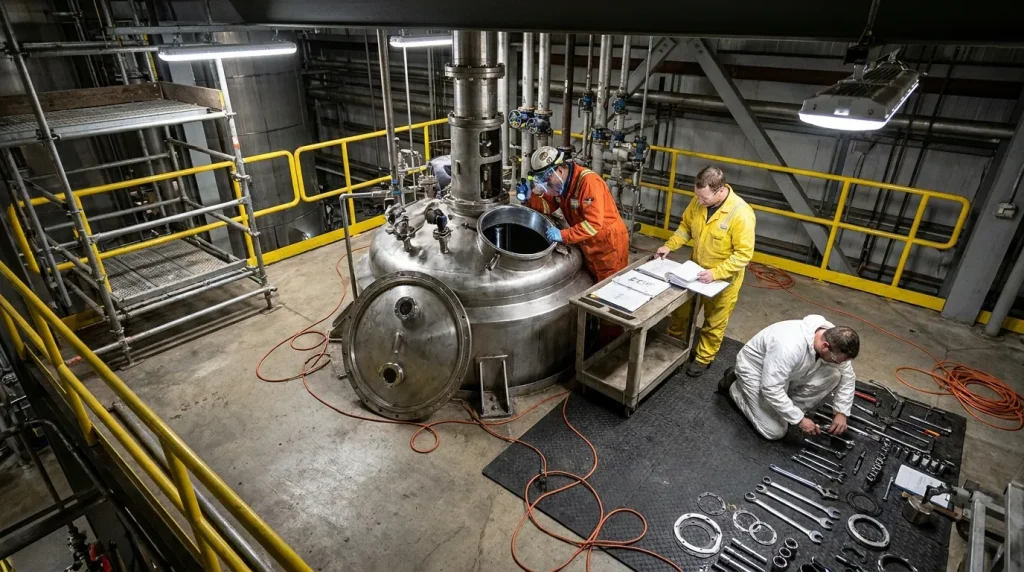
Effective downtime reduction ultimately depends on treating each outage as a project with defined milestones, enabling teams to address common maintenance challenges before they extend the schedule.
What Common Challenges Arise in Reactor Maintenance and How Can You Address Them?
Common challenges in reactor maintenance include undetected failure modes, corrosion in hidden areas, and difficulty accessing internal components for inspection. The following subsections cover failure prevention strategies and solutions for hard-to-reach areas.
How Can You Prevent and Detect Common Reactor Failures?
You can prevent and detect common reactor failures by combining structured preventive maintenance programs with condition-based monitoring technologies.
Effective prevention strategies include:
- Scheduling vibration analysis on agitator assemblies at regular intervals to catch bearing faults early.
- Monitoring wall thickness using ultrasonic testing (UT) to detect corrosion before it compromises vessel integrity.
- Tracking temperature differentials between jacket inlet and outlet to identify fouling or reduced heat transfer.
- Inspecting gasket surfaces and nozzle welds during each planned shutdown for signs of stress cracking.
Pairing time-based inspections with real-time sensor data catches failures that either method alone would miss. For most process engineers, investing in vibration and thermal monitoring on critical reactor drives delivers the fastest return in avoiding unplanned shutdowns.
What Are Effective Solutions for Accessing Hard-to-Inspect Components?
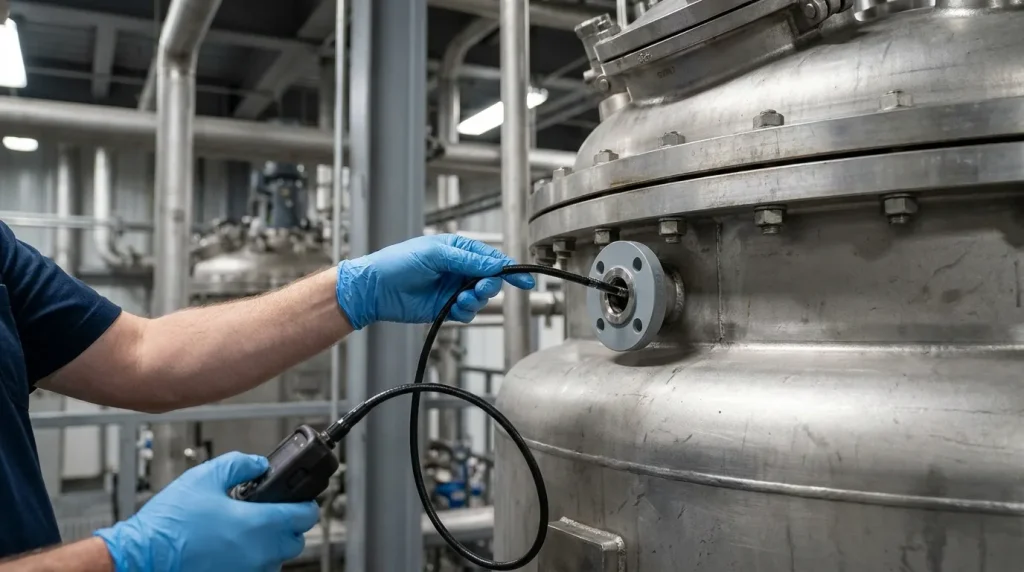
Effective solutions for accessing hard-to-inspect components combine remote inspection technologies with purpose-built entry procedures. Internal surfaces of reactor vessels, particularly baffle plates, bottom outlet valves, and jacket welds, often prove more difficult for conventional visual inspection due to confined geometry or hazardous residue.
Key approaches include:
- Deploying borescopes or robotic inspection systems to inspect internal welds and surface conditions without full vessel entry.
- Using phased-array ultrasonic testing (PAUT) from the exterior shell to evaluate jacket-side corrosion and weld integrity without removing insulation.
- Planning confined-space entry protocols that comply with both OSHA PSM requirements in the United States and ATEX Directive 2014/34/EU requirements in the European Union for explosive atmosphere considerations.
With inspection access planned, maintenance teams can shift focus to sourcing reactor equipment that supports these requirements from the start.
How Should You Approach Reactor Maintenance Schedules and Inspection Intervals with International Process Plants’ Sourcing Solutions?
You should approach reactor maintenance schedules and inspection intervals with International Process Plants’ sourcing solutions by leveraging our inventory of new surplus and quality used reactor equipment to reduce unplanned downtime and maintain compliance-ready inspection cycles.
Can Sourcing Used, Reglassed, or New Reactor Equipment from International Process Plants Improve Maintenance Scheduling?
Yes, sourcing used, reglassed, or new reactor equipment from International Process Plants can improve maintenance scheduling by reducing the lead time between identifying aging components and deploying certified replacements. Procurement delays force facilities to extend inspection intervals or operate degraded equipment, both of which increase risk. According to the National Institute of Standards and Technology, maintenance and repair of machinery and equipment costs manufacturers an estimated $50 billion each year in the United States alone. International Process Plants maintains an inventory of over 15,000 pieces of equipment, including batch reactors built to ASME Section VIII, PED, and CE marking standards. Having currently available replacement vessels and components on hand allows procurement engineers to align equipment swaps with planned outage windows rather than reacting to failures.
What Are the Key Takeaways About Reactor Maintenance Schedule and Inspection Interval Guide We Covered?
The key takeaways about the reactor maintenance schedule and inspection interval guide we covered are:
- Internal inspections of pressure vessels must not exceed 5-year intervals, as required by federal regulations in the Electronic Code of Federal Regulations.
- Preventive, predictive, and condition-based monitoring strategies each reduce unplanned downtime when matched to reactor type and process severity.
- Compliance frameworks including ASME Section VIII, PED (2014/68/EU), UKCA marking, and ICH Q7 govern inspection and maintenance requirements across chemical, pharmaceutical, and power generation sectors.
- Documentation systems and digital scheduling tools improve audit readiness and help teams track inspection histories across multiple reactor vessels.
- Sourcing new surplus and quality used equipment from International Process Plants shortens replacement lead times, helping facilities maintain compliance without extending intervals beyond safe limits.
Structured maintenance programs protect both personnel safety and production continuity. International Process Plants supports these programs by providing currently available reactor equipment that meets global construction and inspection standards.


 UR
UR  EN
EN  ES
ES  FR
FR  PL
PL  DE
DE  AR
AR  HI
HI  NL
NL  TR
TR  IT
IT  UK
UK  RU
RU  JA
JA  PT
PT  ZH
ZH