 İçeriğe geç
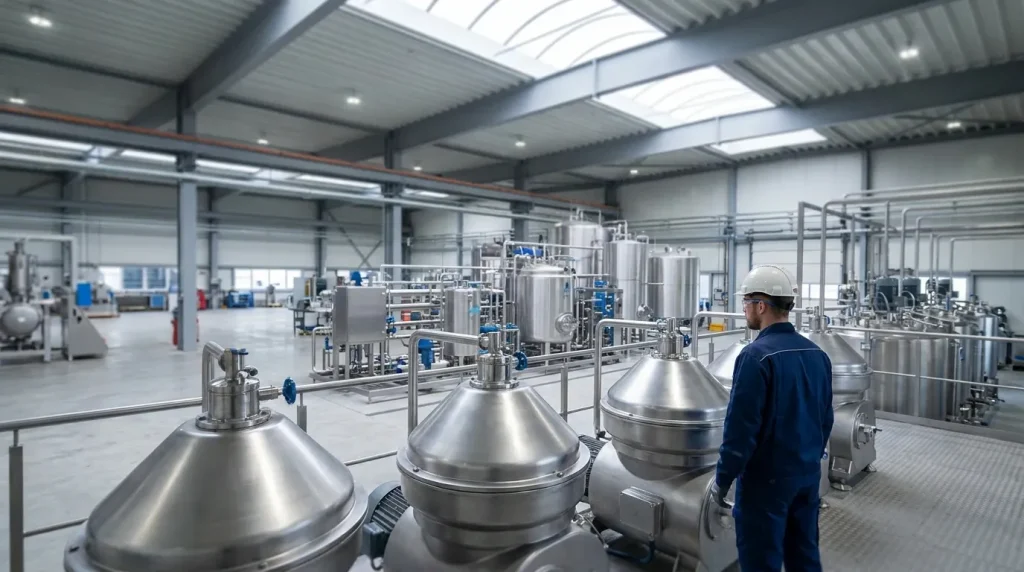
Sizing a centrifuge for your application requires matching separation capacity to your specific feed characteristics, throughput demands, and process requirements. Proper sizing ensures efficient solid-liquid separation without undersized bottlenecks or oversized capital waste.
This guide covers the factors influencing centrifuge selection, equipment types and their sizing implications, capacity calculation methods, feed analysis requirements, and equipment features that affect final specifications.
Before sizing any centrifuge, you must define your process goals, material properties, and regulatory constraints. Particle density differences, liquid viscosity, and solids concentration all determine settling velocity and residence time requirements. Standards such as ISO 13318-1:2024 for particle size analysis and ICH Q7 for pharmaceutical equipment qualification shape both design parameters and documentation needs.
Centrifuge type selection depends heavily on your solids-to-liquid ratio. Disc-stack centrifuges are suitable for feed streams up to around 15% solids concentration, while decanters can manage up to around 50% solids by volume, according to some manufacturer documentations. Tubular bowl units, typically built in sizes from around 4 to 12 inches (102 to 305 mm), suit small particle separation but typically require batch operation for solids removal.
Capacity calculations rely on the Sigma factor and Stokes’ Law principles, with safety margins of around 15% to 25% applied to account for feed variability and peak demand periods. Bowl size, rotor speed, and automation features all influence effective working capacity beyond theoretical calculations.
Feed characteristics analysis and compatibility verification with upstream pumps and downstream handling equipment completes the sizing process before final specification.
What Key Factors Should You Consider Before Sizing a Centrifuge?
The key factors to consider before sizing a centrifuge are process requirements, material properties, throughput needs, and regulatory standards. Each factor directly influences centrifuge size, rotor speed, and operational mode.
Why Does Understanding Your Process Requirements Matter?
Understanding your process requirements matters because separation goals dictate centrifuge type and capacity. Batch processes need different configurations than continuous operations. Solids removal demands different g-forces than liquid-liquid clarification. Defining whether you need dewatering, classification, or purification determines centrifuge geometry and discharge mechanisms. Process temperature ranges, from cryogenic to 400°F (204°C), affect seal materials and bearing selection. Without clear process definition, engineers risk selecting equipment that underperforms or requires costly modifications.
How Do Material Properties Affect Centrifuge Sizing?
Material properties affect centrifuge sizing by determining settling velocity, residence time, and separation efficiency. Particle density difference between solids and carrier liquid controls how quickly separation occurs. High-viscosity feeds require longer residence times or higher g-forces. Abrasive solids demand wear-resistant materials like tungsten carbide or ceramic tiles, increasing cost and weight. Corrosive chemicals require stronger materials such as 316L stainless steel, Hastelloy C-276, or specialized coatings. Particle size distribution, governed by standards such as ISO 13318-1:2024, influences whether disc-stack, decanter, or tubular designs perform best.

What Role Do Desired Throughput and Capacity Play?
Desired throughput and capacity play a central role because they establish minimum volume and feed rate specifications. Key throughput considerations include:
- Design capacity versus working capacity (working capacity typically runs around 80-85% of design)
- Feed rate in gallons per hour (liters per hour)
- Solids loading percentage by volume
- Cycle time for batch units or continuous discharge rate
Matching throughput to actual production schedules prevents both undersizing bottlenecks and oversizing capital waste.
How Do Regulatory or Industry Standards Influence Sizing Choices?
Regulatory and industry standards influence sizing choices by mandating construction codes, validation protocols, and documentation requirements. Pharmaceutical applications follow ICH Q7 GMP guidance, requiring equipment qualification and validation that centrifuges operate within specified ranges. Pressure-containing components must meet ASME Section VIII or the Pressure Equipment Directive (PED) with CE marking for European markets. UKCA marking applies for United Kingdom installations. These requirements influence allowable wall thicknesses, inspection and testing intervals, and material certification processes, which can affect available equipment size choices and extend manufacturing lead times.
What Are the Main Types of Centrifuges and How Do They Impact Sizing?
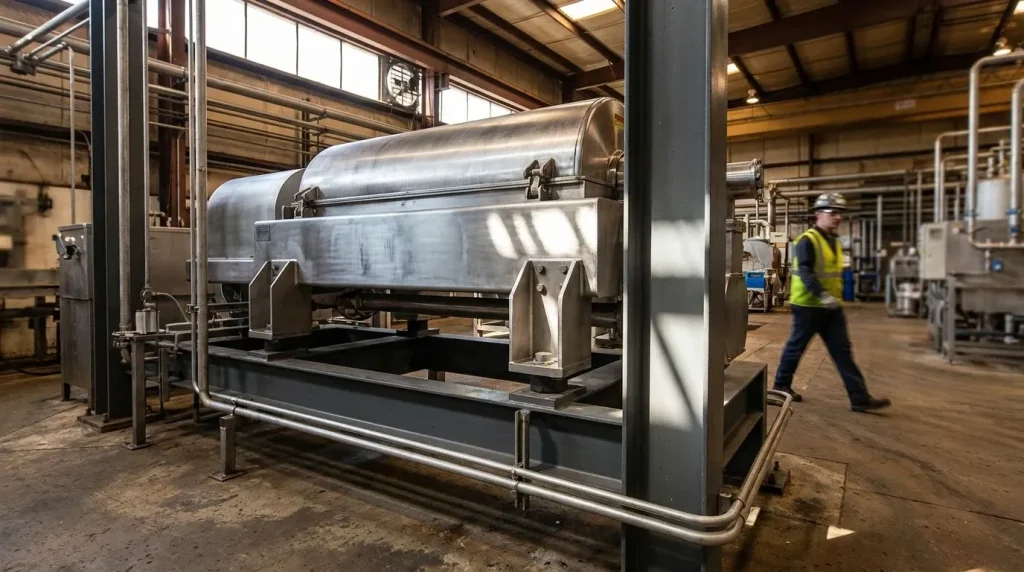
The main types of centrifuges are sedimentation centrifuges (including disc-stack, decanter, and tubular bowl centrifuges), and filtration centrifuges (including peeler, pusher, and basket centrifuges). Each type uses a different mechanism for separation, and handles different solids concentrations, throughput rates, and particle sizes, which directly influence the selection and sizing approach for your application.
When Should You Choose Between Batch and Continuous Centrifuges?
You should choose between batch and continuous centrifuges based on your solids concentration, throughput requirements, and operational preferences. Batch centrifuges suit lower-volume processes with intermittent cleaning cycles, while continuous centrifuges serve high-throughput operations.
Key selection factors include:
- Solids concentration: Disc-stack centrifuges handle feed streams up to around 15% solids and operate continuously with infrequent cleaning. Decanters can manage up to around 50% solids by volume.
- Throughput demands: Continuous decanters are among the highest throughput industrial centrifuges, with applications such as mining treating up to around 100 m³/h (26,400 gal/h) and yielding cake at around 22% solids according to Mordor Intelligence.
- Centrifuge size constraints: Tubular bowl centrifuges, typically built in sizes from around 4 to 12 inches (102 to 305 mm), require batch or semi-batch operation to remove accumulated solids.
According to a Mordor Intelligence 2025 industry report, sedimentation centrifuges held a 56.6% market share, reflecting a continued shift toward enabling continuous processing, especially in high-volume applications.
Which Centrifuge Designs Are Best for Different Solids/Liquids Ratios?
The best centrifuge designs for different solids/liquids ratios depend on the concentration and characteristics of suspended material in your feed stream.
| Solids Concentration | Recommended Design | Typical Application |
| < 1% | Clarifier | Liquid polishing, fine particle removal |
| 1–15% | Disc-stack | Fermentation broths, dairy separation |
| 15–50% | Decanter | Sludge dewatering, mining slurries |
Clarifiers excel at removing suspended solids from relatively clean liquid streams. Decanters separate solids from liquids where significant density differences exist between phases. For processes with variable feed compositions, selecting a design with capacity headroom prevents bottlenecks during concentration spikes.
How Does Separation Efficiency Differ by Centrifuge Type?
Separation efficiency differs by centrifuge type based on the Sigma factor, particle size range, and feed characteristics. The Sigma factor (Σ) quantifies a centrifuge’s separation capacity as the equivalent surface area of a gravity settler performing the same separation.
The types and quantities of influent wet sludge feed are critical factors in determining appropriate centrifuge type and size. This principle remains foundational to modern sizing calculations.
Efficiency considerations by type:
- Tubular bowl: Highest g-force capability, optimal for small particle separation below 1 micron
- Disc-stack: Moderate g-force with high throughput, effective for 1–500 micron particles
- Decanter: Lower g-force but handles high solids loads, suitable for particles above 5 microns
Matching centrifuge type to your specific particle size distribution and solids load ensures you achieve target separation efficiency without oversizing equipment or sacrificing throughput.
How Can You Calculate the Required Centrifuge Capacity?
Calculating the required centrifuge capacity involves applying separation formulas, matching feed volume to cycle time, and building in appropriate safety margins. The following sections explain each calculation step.

What Formulas Are Used to Estimate Centrifuge Capacity?
The formulas used to estimate centrifuge capacity typically rely on Stokes’ law, relative centrifugal force (RCF), and sigma (Σ) theory for sedimentation centrifuges, while filtration centrifuges are sized using filtration, cake resistance, and hydraulic flow models. RCF is calculated as RCF = 1.118 × 10⁻⁵ × r × (RPM)², where r is the radius in centimeters. The equivalent imperial formula is RCF = 2.84 × 10⁻⁵ × r × (RPM)², where r is the radius in inches. The Sigma factor (Σ) represents the equivalent settling area of a gravity settler and determines theoretical throughput for a given separation. Stokes’ Law, modified for centrifugal acceleration, calculates particle settling velocity: v = [Dₚ² × (ρₚ − ρf) × r × ω²] / (18 × μf). Pilot-scale verification often uses measured feed rates, such as 54.5 L/hr (14.4 gal/hr), to validate calculated capacities against actual performance.
How Do You Match Feed Volume and Cycle Time to Capacity?
You match feed volume and cycle time to capacity by calculating residence time based on the feed flow rate and the centrifuge’s solids-holding capacity to determine suitable operating conditions.
Key matching parameters include:
- Feed flow rate: Volume per hour (L/hr or gal/hr)
- Solids accumulation rate: Mass of solids collected per cycle
- Bowl capacity: Maximum solids the centrifuge can hold before discharge
- Cycle time: Duration between solids ejections or batch cleanouts
For batch centrifuges, divide solids capacity by the solids accumulation rate to determine maximum cycle time before discharge is required.
What Safety Margins Should Be Considered in Sizing Calculations?
The safety margins that should be considered in sizing calculations typically range from around 15% to 25% above calculated requirements. According to a World Bank engineering appraisal of industrial projects, most industries apply safety margins to ensure systems meet demand at any time, with a common tendency to overdesign new production units to safeguard against production shortfalls.
Factors requiring safety margins include:
- Feed variability: Fluctuations in solids concentration or particle size
- Peak demand periods: Temporary throughput increases
- Wear allowance: Gradual performance decline between maintenance intervals
- Process upsets: Unexpected changes in feed characteristics
Oversizing by more than 25% might waste capital and increase operating costs, while undersizing risks bottlenecks. For many chemical and pharmaceutical applications, it is recommended to calculate your baseline capacity requirement, then add around 20%.
Why Is Feed Characteristics Analysis Crucial in Centrifuge Sizing?
Feed characteristics analysis is crucial in centrifuge sizing because the physical and chemical properties of your feed stream directly determine which centrifuge type, centrifuge geometry, and operating parameters will achieve the required separation. The subsections below explain how particle size, solid load, viscosity, and proper sampling methods guide accurate sizing decisions.

How Do Particle Size and Distribution Influence Sizing Decisions?
Particle size and distribution influence sizing decisions by determining the centrifugal force and residence time required for effective separation. Finer particles settle more slowly and demand higher g-forces or longer bowl lengths, while coarser particles separate readily at lower speeds.
ISO 13318-1:2024 specifies measurement techniques for particle size distribution using centrifugal liquid sedimentation, providing standardized methods to characterize feed streams accurately.
A wide particle size distribution often requires compromise settings or multi-stage separation. Narrow distributions typically allow tighter optimization and smaller equipment. Characterizing your feed’s particle profile before selection prevents undersized bowls that blind prematurely or oversized units that waste capital.
Why Are Solid Load and Liquid Viscosity Important?
Solid load and liquid viscosity are important because they govern settling velocity and determine whether batch or continuous discharge is more appropriate. Higher solids concentrations require larger bowl volumes or more frequent ejection cycles; viscous liquids slow particle migration and demand longer residence times or higher g-forces.
ScienceDirect’s overview of Stokes’ Law explains that settling velocity is inversely proportional to liquid viscosity. Doubling viscosity halves the settling rate, which means that centrifuges or clarifiers that are undersized for a viscous feed may not provide sufficient residence time or settling capacity to achieve the required clarification.
Decanters handle up to around 50% solids by volume, while disc-stack centrifuges suit feeds below 15% solids. Matching centrifuge type to your feed’s solid load prevents premature wear, excessive maintenance, and poor separation quality.
What Sampling and Testing Methods Are Recommended?
The sampling and testing methods recommended for centrifuge sizing include representative grab samples, composite sampling over production cycles, and laboratory-scale centrifugation trials. These methods capture variability in particle size, solids concentration, and viscosity that single-point measurements may miss.
Key testing protocols for determining your centrifuge size and specification needs include:
- Particle size analysis per ISO 13318-1 standards
- Solids concentration measurement by gravimetric or volumetric methods
- Viscosity testing at operating temperatures using rotational viscometers
- Pilot-scale centrifuge trials to validate theoretical calculations
Testing at actual process temperatures matters because viscosity changes significantly with temperature. Samples collected during startup, steady-state, and upset conditions reveal the full range your centrifuge must handle.
With feed characteristics properly documented, equipment features and accessories become the next consideration in finalizing your centrifuge specification.
How Do Equipment Features and Accessories Affect Sizing?
Equipment features and accessories affect sizing by influencing separation performance, operational flexibility, and integration with existing plant systems. Centrifuge dimensions determine solids-holding capacity, rotor speed controls g-force, automation options impact throughput consistency, and customization can alter footprint and utility requirements. The following sections examine how each factor shapes your sizing decision.
What Impact Do Bowl Size and Rotor Speed Have?
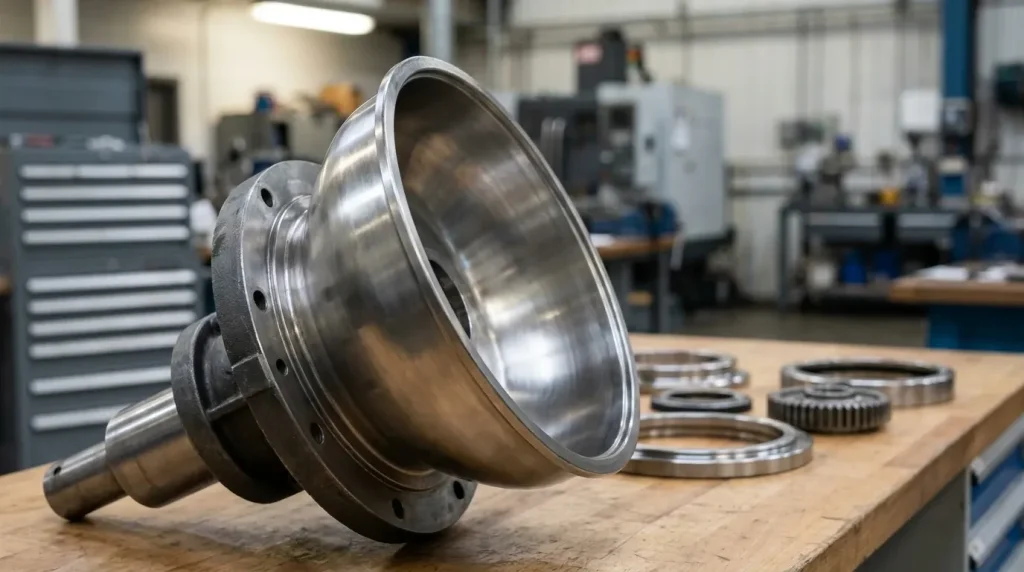
Bowl size and rotor speed have a direct impact on separation capacity and efficiency. Larger bowls hold more solids between discharge cycles, reducing interruption frequency in batch operations. Rotor speed determines the g-force applied to the feed material.
Relative Centrifugal Force (RCF) follows the formula RCF = 1.118 × 10⁻⁵ × r × (RPM)², where RPM is the rotational speed and r is the radius in centimeters, or RCF = 2.84 × 10⁻⁵ × r × (RPM)², where r is the radius in inches.
Key relationships affecting sizing:
- Rotating assembly diameter: Increases radius (r), which raises g-force at constant RPM
- Rotating assembly length: Extends residence time for finer particle capture
- Maximum RPM: Sets the upper g-force limit for difficult separations
- Solids-holding volume: Determines batch cycle duration or continuous discharge frequency
Selecting a bowl that balances radius and speed for your target g-force avoids both undersizing (poor separation) and oversizing (unnecessary capital cost).
How Do Automation and Control Options Matter?
Automation and control options matter because they directly influence throughput consistency, labor requirements, and process integration. Manual centrifuges require operator intervention for discharge cycles, feed adjustments, and monitoring, which limits practical throughput in continuous operations.
Automated features that affect sizing considerations:
- Variable frequency drives (VFDs): Allow speed adjustment for changing feed conditions without mechanical modifications
- Programmable logic controllers (PLCs): Enable consistent cycle timing and integration with upstream/downstream equipment
- Automatic solids discharge: Reduces downtime between cycles, effectively increasing working capacity
- Real-time monitoring sensors: Track vibration, temperature, and torque to optimize performance and predict maintenance
A centrifuge with robust automation may handle variable feed conditions that might otherwise require a larger unit. Conversely, facilities without automation infrastructure may need to size up to accommodate manual cycle inefficiencies.
Can Customization or Retrofitting Change Sizing Requirements?
Yes, customization or retrofitting can change sizing requirements by altering equipment performance parameters or physical footprint. Modifications to centrifuge geometry, drive systems, or materials of construction can expand or constrain the effective operating envelope of existing equipment.
Common modifications affecting sizing:
- Bowl inserts or liners: Reduce effective volume but may improve wear resistance
- Motor upgrades: Increase available torque for higher-viscosity feeds
- Material changes (316L, Hastelloy C-276): Enable corrosive service without capacity reduction
- Explosion-proof enclosures: Add footprint and weight considerations
What Common Mistakes Should You Avoid When Sizing a Centrifuge?
The common mistakes to avoid when sizing a centrifuge include overestimating or underestimating capacity requirements, ignoring lifecycle costs, and failing to verify compatibility with connected process equipment. The sections below cover each pitfall and how to prevent it.
How Can Overestimating or Underestimating Requirements Lead to Problems?
Overestimating or underestimating requirements leads to problems through wasted capital, operational inefficiency, or inability to meet production targets. Oversized centrifuges consume excess energy, require larger footprints, and operate below optimal efficiency at partial loads. Undersized units create bottlenecks, force multiple passes, and accelerate wear from continuous maximum-duty operation.
Common sizing errors include:
- Basing capacity on peak demand without accounting for average throughput
- Ignoring batch-to-batch variability in feed solids concentration
- Failing to apply appropriate safety margins (typically 10–20% above calculated needs)
- Using laboratory-scale data without validated scale-up factors
Process engineers should size for both realistic operating ranges and worst-case extremes.
What Are the Risks of Ignoring Maintenance and Operational Costs?
The risks of ignoring maintenance and operational costs include budget overruns, unplanned downtime, and premature equipment failure. Centrifuge total cost of ownership extends well beyond the purchase price; energy consumption, spare parts, bearing replacements, and component reconditioning can accumulate significantly over a 15–20 year service life.
Key cost categories to evaluate during sizing include:
- Predictable routine maintenance (lubricants, seals, inspections)
- Semi-predictable major repairs (e.g. bowl balancing, drive rebuilds)
- Emergency contingencies for unexpected failures
How Do You Prevent Incompatibility with Upstream or Downstream Equipment?
You prevent incompatibility with upstream or downstream equipment by validating flow rates, pressures, and material specifications across the entire process train before finalizing centrifuge selection. A centrifuge sized in isolation may exceed pump capacity, overwhelm downstream filtration, or create surge conditions in receiving tanks.
ICH 9001 quality management principles emphasize equipment qualification, including validation that equipment operates correctly within specified ranges. These principles apply broadly: ensure that equipment matches your process needs.
Critical compatibility checks include:
- Feed pump delivery rate versus centrifuge inlet requirements
- Discharge consistency matching downstream conveying or drying equipment
- Flange standards (ASME, DIN, JIS) and material compatibility (316L, Hastelloy C-276)
- Control system integration for automated process sequencing
Early coordination between equipment vendors prevents costly retrofits after installation. With process integration verified, selecting the right supplier becomes the final step.
How Can International Process Plants Help You Select and Size a Centrifuge?
International Process Plants helps you select and size a centrifuge by combining 46 years of process equipment expertise with an inventory of 15,000+ pieces spanning decanters, disc-stack separators, and tubular bowl units. The following sections detail our sizing support and summarize the key principles covered in this guide.
What Centrifuge Sizing and Supply Solutions Does International Process Plants Offer?
International Process Plants offers centrifuge sizing and supply solutions that include technical consultation, equipment matching, and access to new surplus and quality used centrifuges across multiple configurations. Our team evaluates your feed characteristics, throughput requirements, and solids loading to recommend appropriately sized units from inventory.
We stock centrifuges with many different capacities,including industrial decanters with handling capabilities over 26,400 gal/hr (100 m³/h). Equipment ships from our three warehouses in Eastover, South Carolina, Germany, and the United Kingdom, supporting global reach.
Key sizing support services include:
- Feed analysis consultation to match centrifuge type to your solids concentration and particle distribution
- Capacity verification against your batch or continuous throughput targets
With the global industrial centrifuge market projected to reach USD 12.32 billion by 2032 according to Zion Market Research, demand for industrial centrifuge equipment is high, especially across chemical processing and water processing sectors.
What Are the Key Takeaways About How to Size a Centrifuge for Your Application We Covered?
The key takeaways about how to size a centrifuge for your application are:
- Define process requirements first: throughput volume, solids concentration, and particle size distribution drive every sizing decision
- Match centrifuge type to feed characteristics: disc-stack units suit feeds up to around 15% solids; decanters handle up to around 50% solids by volume
- Calculate capacity using principles including Sigma factor and Stokes’ Law, then apply 15–25% safety margins
- Verify material compatibility with wetted parts, especially for corrosive or abrasive feeds
- Confirm regulatory compliance with standards including ISO 13318-1:2024 for particle analysis, ICH Q7 for pharmaceutical applications, and regional and industry-specific equipment directives
Proper centrifuge sizing balances separation efficiency against capital and operating costs. Undersizing creates bottlenecks; oversizing wastes energy and floor space. International Process Plants can help you find the right balance with equipment that meets your exact specifications.

 TR
TR  EN
EN  ES
ES  FR
FR  PL
PL  DE
DE  AR
AR  UR
UR  HI
HI  NL
NL  IT
IT  UK
UK  RU
RU  JA
JA  PT
PT  ZH
ZH