 Перейти к содержанию
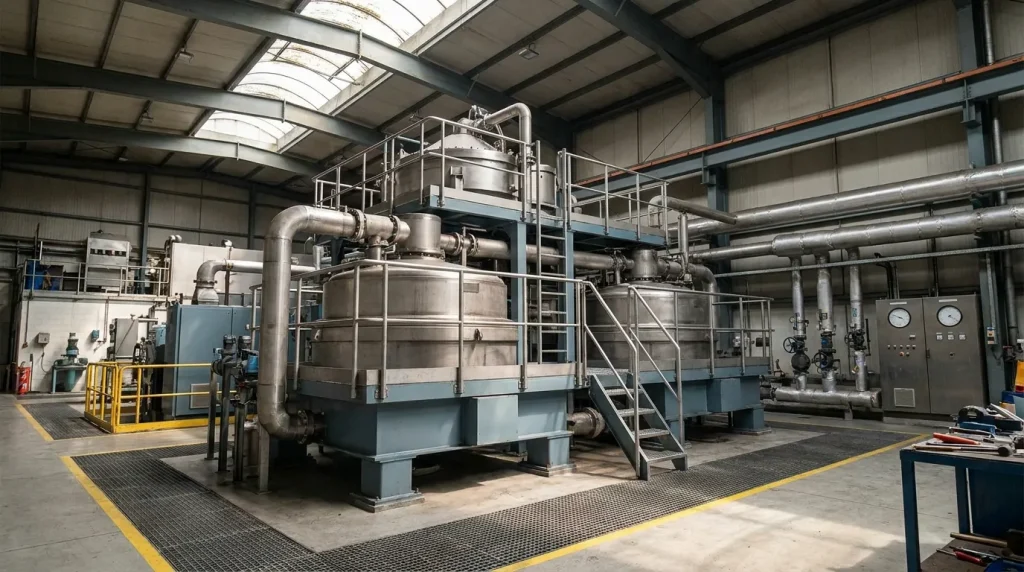
A centrifuge retirement decision hinges on whether repair costs, component availability, and compliance requirements favor continued investment or capital reallocation toward replacement equipment.
This guide covers warning signs of centrifuge failure, total cost of ownership analysis, technical factors affecting rebuild viability, stakeholder roles in the decision process, and industry benchmarks that shape equipment lifecycle choices.
Operational failures such as bearing wear, lid spring mechanism failure, and trunnion seizure often signal systemic degradation rather than isolated issues. When multiple mechanical systems fail within a short window, rebuild costs escalate quickly and production schedules suffer from repeated unplanned shutdowns.
Cost analysis centers on the widely recognized 50% threshold: when repair costs exceed half the replacement value, particularly for units older than 10 years, replacement typically delivers superior long-term value. Energy consumption increases, downtime losses, and emergency repair premiums all factor into accurate total cost calculations.
Technical considerations extend beyond mechanical condition to spare parts availability and obsolescence risk. Control systems incompatible with modern DCS platforms, safety interlocks that no longer meet ATEX or PED requirements, and documentation gaps preventing regulatory revalidation can force retirement regardless of mechanical serviceability.
Effective decision-making requires input from maintenance teams tracking wear patterns, operators observing daily performance changes, plant managers quantifying production impact, and external specialists verifying compliance with directives and jurisdiction-specific requirements such as the Machinery Directive 2006/42/EC.
Industry benchmarks provide objective guidance, with industrial disc centrifuge manufacturers recommending major overhauls every 2 to 3 years, and vibration level increases beyond 2 to 4 mm/s (0.08 to 0.16 in/s) signaling that bowl balancing is necessary.
What Are the Key Signs That a Centrifuge Needs Replacement or Rebuild?
The key signs that a centrifuge needs replacement or rebuild include mechanical failures, declining separation efficiency, and safety or compliance violations. The following subsections examine operational failures, performance degradation, and regulatory factors that signal retirement timing.
How Do Operational Failures Indicate the Need for Centrifuge Retirement?
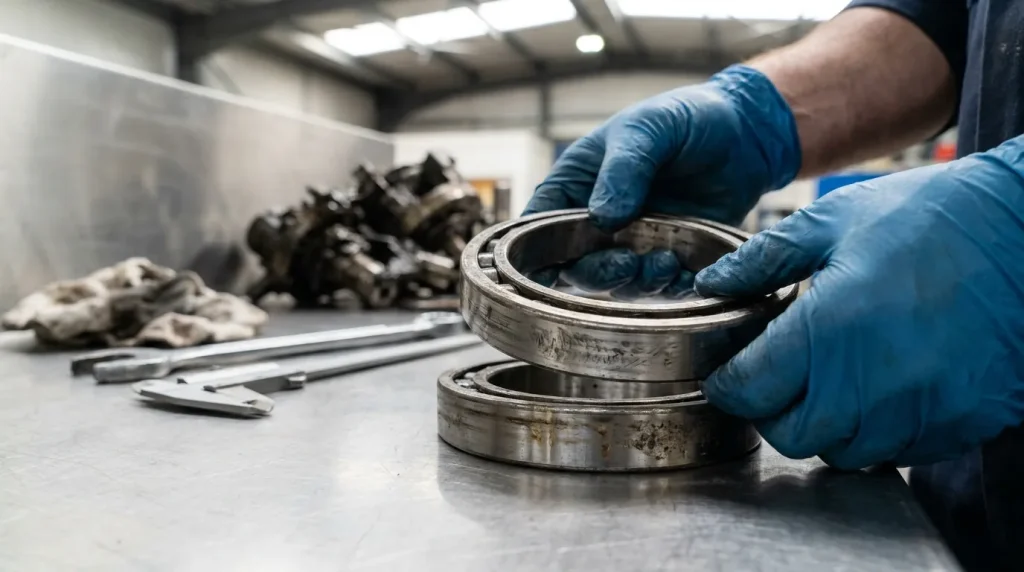
Operational failures indicate the need for centrifuge retirement when critical mechanical components can no longer perform reliably. Warning signs of imminent failure include bearing wear, lid spring mechanism failure, and trunnions that cease operating despite proper lubrication. These failures often occur together in aging units, signaling systemic degradation rather than isolated issues.
When multiple mechanical systems fail within a short window, rebuild costs escalate quickly. Repeated unplanned shutdowns also disrupt production schedules and increase labor costs for emergency repairs. If your maintenance team addresses the same failure modes quarterly, the centrifuge has likely reached its practical service limit.
What Role Does Decreased Performance Play in Making This Decision?
Decreased performance plays a decisive role when separation efficiency drops below process requirements. Gradual throughput decline, inconsistent cake dryness, or rising solids carryover in the centrate all indicate internal wear affecting bowl geometry or scroll tolerances.
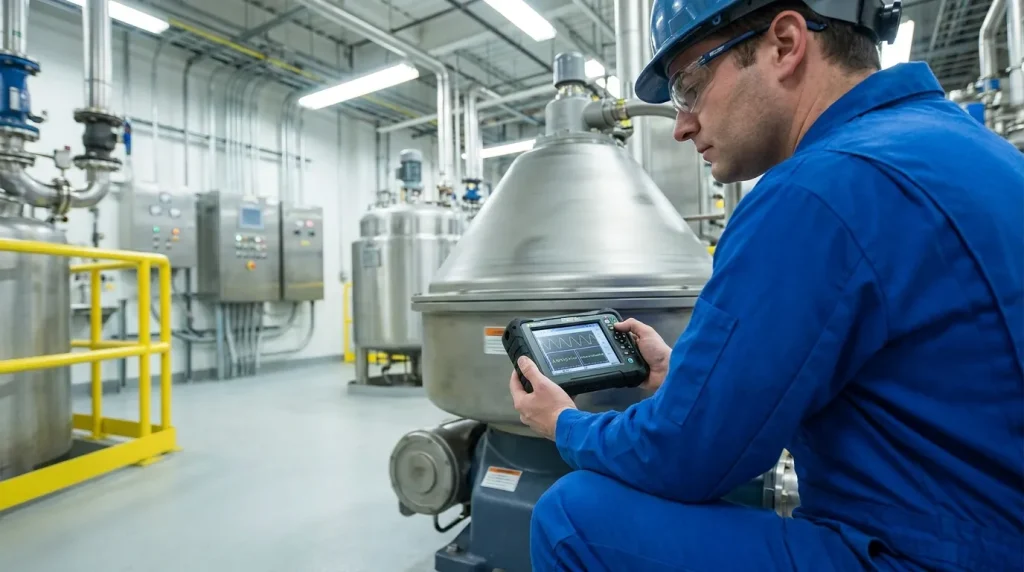
Vibration levels offer a measurable threshold. Bowl balancing becomes necessary when vibration exceeds 2 to 4 mm/s (0.08 to 0.16 in/s), and persistent imbalance after rebalancing can suggest permanent structural damage. Energy consumption also rises as worn components force motors to work harder. If your centrifuge consumes 15 to 20% more power than its baseline while delivering lower output, the efficiency gap can often justify replacement over rebuild.
How Can Safety or Regulatory Compliance Issues Influence Retirement Timing?
Safety or regulatory compliance issues influence retirement timing by creating legal and operational risks that outweigh rebuild economics. In chemical and pharmaceutical plants, centrifuge decisions are heavily influenced by ATEX directives for explosive atmospheres and jurisdiction-specific standards such as the Machinery Directive 2006/42/EC, which governs equipment safety in the European Union.
With safety and regulatory compliance issues identified, the next step is evaluating when replacement offers better total cost of ownership.
How Do You Evaluate the Total Cost of Centrifuge Rebuild Versus Replacement?
You evaluate the total cost of centrifuge rebuild versus replacement by using Total Cost of Ownership (TCO) frameworks to analyze acquisition, installation, energy consumption, maintenance, labor, consumables, downtime, and end-of-life expenses. In many applications, energy, maintenance, and labor represent some of the largest contributors to long-term operating costs, making TCO analysis an important factor in equipment selection and lifecycle planning. The subsections below break down rebuild cost factors, when to replace a centrifuge, and downtime impact calculations.

What Factors Affect the Cost-Effectiveness of Rebuilding a Centrifuge?
The factors that affect the cost-effectiveness of rebuilding a centrifuge include current equipment condition, component availability, and cumulative repair history. Bowl integrity, bearing condition, and drive system wear determine whether rebuilding restores full operational capacity or merely delays inevitable replacement.
Labor costs for skilled technicians often exceed parts costs in complex rebuilds. Specialized balancing, alignment, and seal replacement require expertise that often commands premium rates. Transportation to and from rebuild facilities adds to the total, particularly for units exceeding 2,000 kg (4,400 lb).
Consider energy efficiency losses in older designs. A rebuilt unit may run reliably but consume 15 to 25% more power than current models, eroding savings over time.
When Does Replacing a Centrifuge Offer Better Long-Term Value?
Replacing a centrifuge is a strong choice when:
- Cumulative five-year repair costs approach 40% of new equipment price
- Technology gaps create efficiency or regulatory penalties
- Regulatory changes require modifications
- Spare parts obsolescence forces custom manufacturing
- Manufacturers desire increased efficiency
- Manufacturers want to move from batch to continuous operations
New surplus or quality used centrifuges from secondary markets often reduce replacement costs by around 40 to 60% compared to new OEM purchases, making replacement more affordable economically while delivering comparative performance.
How Should You Assess Downtime and Production Losses in Your Cost Analysis?
You should assess downtime and production losses by calculating hourly lost revenue, including direct output value, contractual penalties, and cascading effects on downstream processes. Identifying discontinued spare parts early and securing successor components is critical for preventing costly production downtime in aging industrial facilities.
Quantify downtime costs with these variables:
| Cost Factor | Calculation Method |
| Lost production | Hourly output value × expected downtime hours |
| Emergency repair premium | Standard labor rate × 1.5 to 2.5 multiplier |
| Expedited shipping | Standard freight cost × 3 to 5 multiplier |
| Quality hold costs | Inventory value × holding period × carrying rate |
For mission-critical separations, maintaining a spare rotor or securing access to rebuilt units shortens recovery time. From a procurement standpoint, the most expensive downtime is unplanned, so factor emergency scenarios into your rebuild-versus-replace calculation alongside routine maintenance windows.
What Are the Technical Considerations for Replacing vs. Rebuilding a Centrifuge?
The technical considerations for replacing vs. rebuilding a centrifuge center on spare parts availability, technology upgrades, and obsolescence risk. The following sections examine how each factor shapes the optimal path forward.
How Does the Availability of Spare Parts Impact the Decision?
The availability of spare parts directly determines whether rebuilding remains viable. When OEMs discontinue components for legacy centrifuge models, securing replacement bearings, seals, and transmission parts becomes increasingly difficult. According to Sparetech’s 2026 analysis, spare parts obsolescence management helps identify the risk of discontinued spare parts early to help prevent costly production downtime in aging facilities.
Critical spare parts that drive this assessment include:
- Bowl and spindle assemblies
- Drive bearings and gears
- Seals and gaskets (material-specific)
- Control system modules and sensors
- Motor components and couplings
If lead times for essential parts exceed your maintenance window, or if aftermarket alternatives compromise performance specifications, replacement often becomes the more reliable path. For facilities running centrifuges older than 15 years, it is crucial to audit parts availability before committing to any rebuild program.
When Is Obsolescence a Critical Factor for Centrifuge Retirement?
Obsolescence becomes a critical factor for centrifuge retirement when component unavailability creates unacceptable operational risk. Part Analytics notes that obsolescence in 2026 is no longer measured solely by part availability but is reflected also in lost production time and increased operational risk for legacy systems.
When obsolescence affects multiple subsystems simultaneously, the cumulative risk often exceeds rebuild economics. Centrifuges become technically obsolete when maintaining them costs more in downtime risk than the capital cost of modern alternatives.
Who Should Be Involved in the Centrifuge Retirement Decision Process?
The centrifuge retirement decision process should involve maintenance teams, operators, plant managers, and external specialists. Each stakeholder contributes distinct technical, operational, and compliance perspectives that shape whether to rebuild or replace.
What Role Do Maintenance Teams Play in the Assessment?
Maintenance teams play a central role in centrifuge retirement assessment by providing direct equipment condition data. They track vibration trends, bearing wear patterns, and repair frequency, offering the clearest picture of mechanical degradation over time.
Their documented maintenance histories reveal whether failures cluster around specific components or indicate systemic decline. Maintenance personnel also understand parts availability firsthand, flagging when lead times extend or successor components become difficult to source. This ground-level insight proves essential for accurate rebuild cost estimates.
How Can Operators and Plant Managers Provide Valuable Input?
Operators and plant managers provide valuable input through daily performance observations and production impact data. Operators notice subtle changes: increased cycle times, unusual sounds, or inconsistent separation quality that maintenance logs may not capture.
Plant managers contribute the broader operational context. They quantify how centrifuge reliability affects production schedules, batch yields, and downstream processes. Their input ensures the retirement decision accounts for actual throughput requirements rather than theoretical specifications alone.
Should OEMs or Third-Party Vendors Be Consulted for Evaluation?
Yes, OEMs or third-party vendors should be consulted for evaluation, particularly for technical assessments and compliance verification. Centrifuge retirement decisions in chemical and pharmaceutical plants are heavily influenced by jurisdiction-specific requirements such as ATEX directives regarding explosive atmospheres and the Machinery Directive 2006/42/EC for equipment placed on the European market.
OEMs provide authoritative guidance on design life, critical tolerances, and rebuild feasibility. Third-party specialists offer independent assessments and often identify cost-effective alternatives the OEM may not present. For facilities operating under PED, CE marking, or UKCA requirements, external consultation ensures replacement equipment meets current regulatory standards.
With stakeholder input consolidated, the next section examines how industry best practices and benchmarks guide the final decision.
How Can Industry Best Practices Help Decide Between Replacement and Rebuild?
Industry best practices help decide between replacement and rebuild by establishing objective benchmarks for equipment life cycles and aligning decisions with regulatory requirements. The following subsections cover manufacturer-recommended overhaul intervals and the standards that shape these decisions.
What Benchmarks Do Leading Companies Use for Centrifuge Life Cycles?
Leading companies use manufacturer-recommended overhaul intervals and component-specific wear thresholds as benchmarks for centrifuge life cycles. Many industrial manufacturers recommend a major overhaul of disc centrifuges around every 2 to 3 years based on the expected lifespan of transmission components like bearings and gears.
Beyond time-based intervals, vibration monitoring provides measurable thresholds. Bowl balancing becomes necessary when vibration levels exceed 2 to 4 mm/second (0.08 to 0.16 in/second). Companies tracking these metrics can predict rebuild timing rather than reacting to failures.
The most disciplined operators combine calendar-based overhauls with condition-based monitoring. This dual approach catches wear patterns that fixed schedules might miss while preventing unnecessary maintenance that can erode ROI.
Are There Industry Regulations or Standards Affecting These Decisions?
Yes, industry regulations and standards can significantly influence centrifuge retirement and upgrade decisions. In regulated sectors such as chemical and pharmaceutical manufacturing, standards and evolving requirements around machinery safety, explosion protection, and compliance can necessitate upgrades or replacement of aging equipment to maintain safe and compliant operation.
Key regulatory frameworks affecting centrifuge decisions include:
-
- ATEX certification for units operating in hazardous environments
- ATEX 2014/34/EU for explosion protection and hazardous area compliance, and IECEx certification (global equivalent framework)
- Machinery Directive 2006/42/EC / Machinery Regulation (EU 2023/1230) for CE-marked equipment in the EU
- CE marking requirements (EU conformity system) and UKCA marking requirements for UK installations (UK market equivalent)
- ISO 55000:2014 (updated 2024), which defines the asset management lifecycle as acquisition, operation, maintenance, modification, and disposal
Equipment failing to meet current regulatory standards often cannot be economically upgraded, making replacement the only compliant path forward. For global operations, maintaining documentation that satisfies multiple jurisdictions adds complexity that favors newer, pre-certified units.
With these benchmarks and regulatory requirements established, sourcing compliant replacement equipment becomes the next consideration.
How Can International Process Plants Support Centrifuge Retirement and Replacement?
International Process Plants supports centrifuge retirement and replacement by supplying new surplus and quality used centrifuge equipment from our global inventory. The following sections detail our equipment solutions and summarize the key decision factors for your centrifuge lifecycle choices.
What Used and Refurbished Centrifuge Solutions Does International Process Plants Offer?
International Process Plants offers a range of used and refurbished centrifuge solutions, including disc stack separators, decanter centrifuges, and basket centrifuges sourced from leading manufacturers. Our inventory of 15,000+ pieces of equipment, housed across warehouses in Eastover, South Carolina (US), Germany, and the United Kingdom with offices in 15 countries, provides procurement engineers with rapid access to quality used units designed in accordance with ASME, CE marking, and PED requirements, along with other applicable jurisdiction-specific standards.
We currently offer:
- Disc stack centrifuges for clarification and separation applications
- Decanter centrifuges for high-solids processing
- Basket centrifuges for batch filtration operations
- Peeler centrifuges for pharmaceutical and chemical applications
Purchasing quality used equipment from International Process Plants typically costs less at approximately 50% of new OEM pricing, allowing facilities to address urgent replacement needs while managing capital expenditure. With 46+ years serving pharmaceutical, chemical, and food processing industries across 15 countries, we understand the technical specifications your applications demand.

What Are the Key Takeaways When Deciding Whether to Retire, Rebuild, or Replace a Centrifuge?
The key takeaways when deciding whether to retire, rebuild, or replace a centrifuge center on three factors: repair cost thresholds, equipment age, and failure indicators.
General industry thresholds for equipment replacement are typically considered to be when repair costs exceed 50% of the replacement value, particularly for units older than 10 years. Warning signs indicating imminent failure can include bearing wear, lid spring mechanism failure, and trunnions ceasing to operate despite proper lubrication.
Decision framework:
- Rebuild when repair costs remain below 50% of replacement value and parts are available
- Replace when cumulative repairs exceed the threshold or obsolescence prevents sourcing components
- Retire and sell when the unit no longer meets process requirements or regulatory standards
For facilities facing tight timelines, quality used centrifuges from International Process Plants offer a middle path: lower capital outlay than new equipment, with faster delivery than extended rebuild schedules.

 RU
RU  EN
EN  ES
ES  FR
FR  PL
PL  DE
DE  AR
AR  UR
UR  HI
HI  NL
NL  TR
TR  IT
IT  UK
UK  JA
JA  PT
PT  ZH
ZH 