
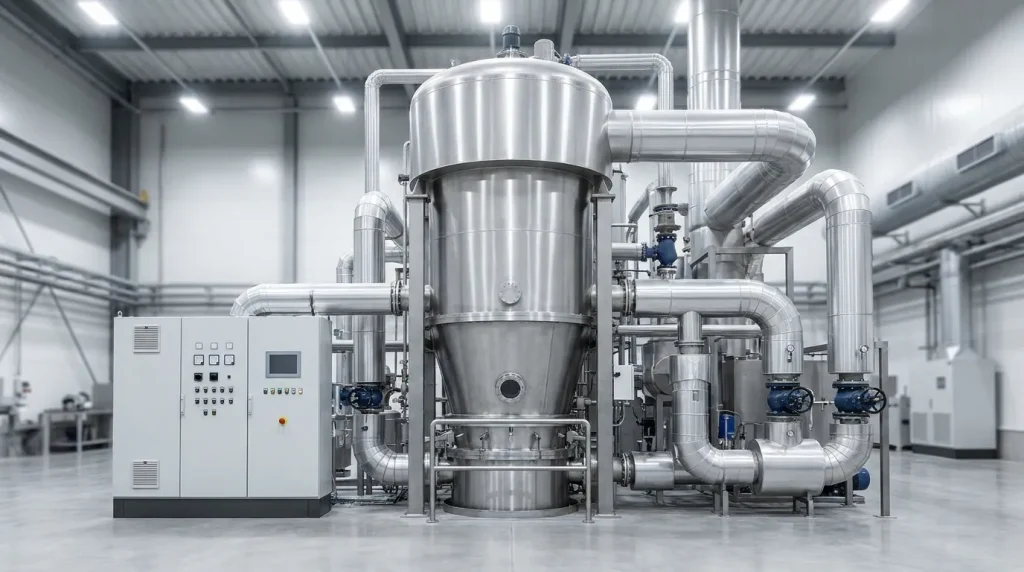
A fluid bed dryer is a drying machine that suspends solid particles in a stream of heated gas to remove moisture through convective evaporation. The equipment lifts wet solids until they behave like a fluid, exposing every particle to direct contact with hot gas for fast, uniform drying.
This guide covers dryer design and components, the fluidization and drying mechanics that govern performance, industry applications, the operational trade-offs, maintenance and safety practices, and equipment selection.
Dryer design and components establish the foundation. We explain the air handling unit, gas distributor plate, product container, expansion chamber, and filtration system, then compare top spray, bottom spray, and tangential spray configurations and the duties each one suits.
The process mechanics show how the dryer actually works. We detail how upward airflow suspends particles, how operators load and prepare materials, and the airflow distribution and gas temperature factors that control drying uniformity.
Industry applications connect the technology to real production. We outline pharmaceutical use under GMP and quality risk management standards, food processing under HACCP и ISO 22000 frameworks, and chemical and petrochemical drying where combustible dust and ATEX compliance shape design.
Operational trade-offs, maintenance, and selection close the picture. We weigh uniform drying and gentle handling against dust explosion risk and energy demand, outline inspection and life-cycle safety practices, and conclude with how International Process Plants sources fluid bed dryers from a global inventory of new surplus and quality used equipment.
What is a fluid bed dryer and how is it designed?
A fluid bed dryer is a drying machine that suspends solid particles in a stream of heated gas to remove moisture through evaporation. Its design combines an air handling unit, a product container, and a filtration system. The sections below detail the primary components and how the main dryer types compare.
What are the primary components of a fluid bed dryer?
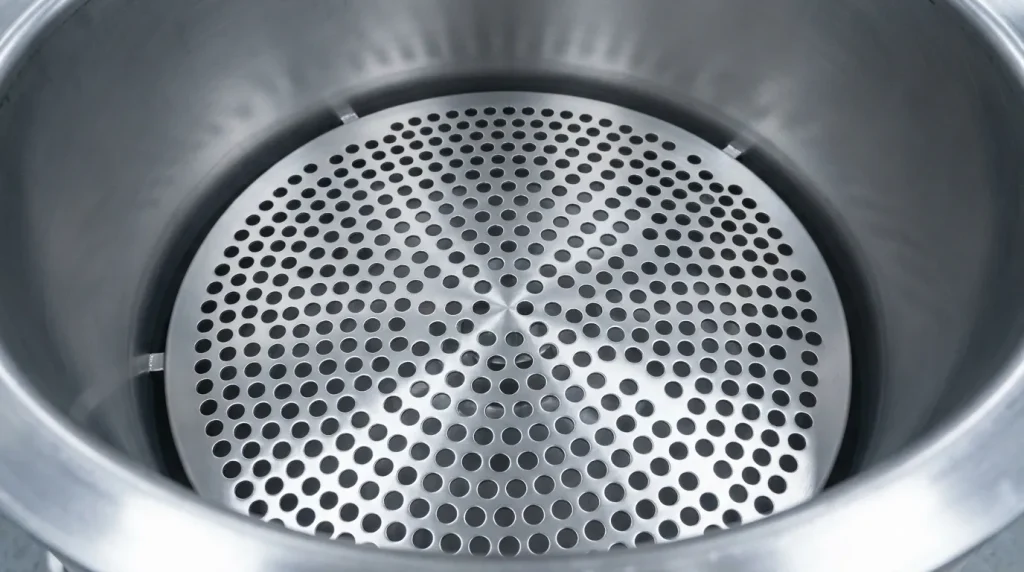
The primary components of a fluid bed dryer are the air handling unit, the gas distributor plate, the product container (bowl), the expansion chamber, and the filtration system. Each part controls a distinct stage of the drying cycle.
- Air handling unit: heats and supplies the inlet gas at a controlled temperature and flow rate.
- Gas distributor plate: spreads incoming gas evenly across the bed to start fluidization.
- Product container (bowl): holds the wet solids during drying.
- Expansion chamber: slows the gas above the bed so particles fall back instead of escaping.
- Filtration system: bag filters or cyclones capture fine particles from the exhaust gas.
The gas distributor governs bubble behavior, which directly shapes drying quality.
How do different types of fluid bed dryers compare?
Different types of fluid bed dryers compare across spray nozzle position, particle handling, and intended application. Because particulate solids are kept in suspension by the gas flow, they move very freely, which lets these dryers process materials that resist drying in other equipment.
The main configurations differ as follows:
| Type | Nozzle position | Primary use |
| Top spray | Above the bed | Granulation and drying |
| Bottom spray | Below the bed | Coating and layering |
| Tangential spray | Rotating | Pelletization |
For most granulation and drying duties, top spray units offer the broadest flexibility, while bottom spray designs suit precise coating work. Selection depends on the particle behavior and finished product specification your process demands.
How does the fluidization process occur in a fluid bed dryer?
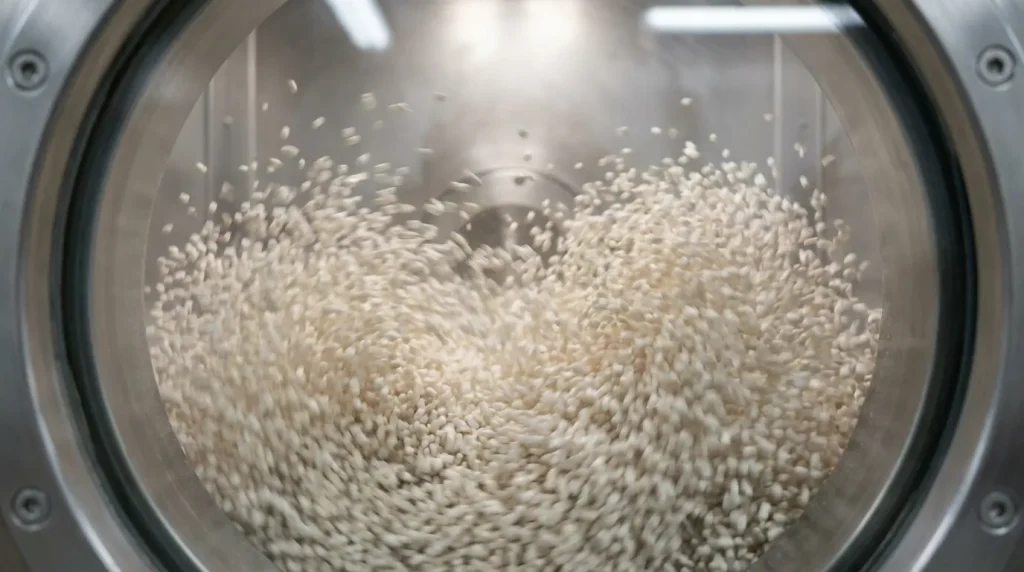
The fluidization process occurs in a fluid bed dryer when upward gas flow lifts and suspends solid particles, making them behave like a fluid. Two factors control this process: airflow velocity and proper material loading. The sections below explain each.
What role does airflow play in fluidization?
Airflow plays the central role in fluidization by lifting particles into suspension once the upward gas velocity overcomes their weight. Three variables govern bubble behavior and overall effectiveness:
- Gas distributor design, which spreads airflow evenly across the bed
- Particle properties, including size, shape, and density
- Fluidizing velocity, which determines suspension and mixing intensity
Matching velocity to material type is the single most important adjustment operators make, because too little airflow leaves particles static and too much causes entrainment and product loss.
How are materials loaded and prepared for drying?
Materials are loaded and prepared for drying by placing wet solids into the product container or bowl above the gas distributor plate, then introducing heated air from below. Free movement of particles depends on correct loading, since the gas flow keeps solids in suspension and allows even drying.
Proper preparation involves several steps:
- Charging the bowl to the recommended fill level, avoiding overloading
- Checking particle size and moisture content for uniform fluidization
- Confirming the distributor plate and filter bags are clean and seated
Because suspended particles move very freely, fluid bed dryers handle materials that resist drying in other equipment types. Consistent particle sizing before loading prevents channeling and dead zones, which directly improves drying uniformity. With airflow and loading set correctly, the dryer is ready for the heat transfer stage that removes moisture.
What are the key steps in the drying process inside a fluid bed dryer?
The key steps in the drying process are heat transfer to wet particles, moisture evaporation into the gas stream, and exhaust of the moisture-laden air. The sections below explain how heat moves during drying and which factors control drying efficiency and uniformity.
How is heat transferred during fluid bed drying?
Heat is transferred during fluid bed drying through convection, as heated air contacts and surrounds each suspended particle. Fluidization is a convective drying technique that reduces or eliminates moisture in wet particles and converts that moisture into gas through evaporation, according to a 2020 study published in Cogent Engineering. Each suspended particle gains direct, uniform contact with the hot gas stream, which raises particle surface temperature and drives moisture out as vapor.
The convective drying process follows three stages:
- Hot air transfers thermal energy to each fluidized particle surface.
- Surface moisture evaporates into the surrounding gas stream.
- Moisture-laden air exits the chamber as exhaust.
This direct particle-to-gas contact is what makes convective heat transfer faster and more even than static drying methods.
What factors influence drying efficiency and uniformity?
The factors that influence drying efficiency and uniformity are airflow distribution, gas temperature, particle properties, and moisture recovery. Even fluidization keeps every particle in suspension, which produces consistent moisture removal across the batch. Heat pump systems can also improve efficiency. The International Energy Agency notes that a heat pump system recovers waste heat from the drying chamber by removing moisture from the air, lowering total energy demand.
Key factors include:
- Airflow distribution, which determines whether all particles fluidize evenly.
- Inlet gas temperature, which controls the rate of moisture evaporation.
- Particle size and density, which affect fluidization behavior.
- Waste heat recovery, which reduces overall energy consumption.
For most operations, uniform airflow is the single most decisive factor, since uneven fluidization creates wet pockets that no amount of added heat can fully correct. With drying mechanics established, equipment selection by industry follows next.
What industries commonly use fluid bed dryers and why?
Fluid bed dryers serve pharmaceutical, food processing, and chemical industries because they dry heat-sensitive particles quickly and uniformly. The sections below cover pharmaceutical applications, food processing uses, and chemical and petrochemical operations.
What applications exist in the pharmaceutical industry?
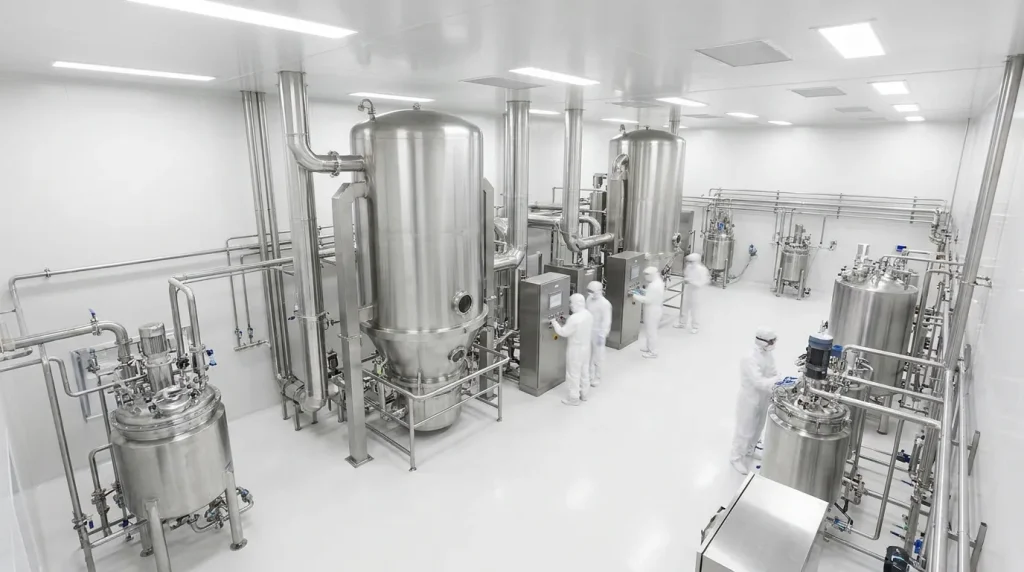
Applications in the pharmaceutical industry include drying granules, coating particles, and preparing powders for tablet and capsule production. Fluid bed dryers support consistent moisture control, which protects active ingredient stability and dosage uniformity. These processes operate under current good manufacturing practice (GMP) and quality risk management standards. According to the 2023 ICH Q9(R1) Quality Risk Management guidance revision, formal risk-based decision-making reduces product availability risks tied to manufacturing quality issues. For pharmaceutical manufacturers, fluid bed drying remains one of the most reliable methods for achieving repeatable particle quality at scale.
How are fluid bed dryers used in food processing?
Fluid bed dryers are used in food processing to dry granular products, instantize powders, and stabilize moisture content in ingredients such as coffee, milk powder, spices, and cereals. Uniform drying preserves flavor, color, and nutritional value while extending shelf life. Operations follow food safety frameworks, including Hazard Analysis and Critical Control Points (HACCP) and ISO 22000 management systems. According to the Food and Agriculture Organization of the United Nations, the HACCP system identifies specific hazards and control measures to ensure food safety. Modern systems also recover waste heat from the drying chamber, improving energy efficiency for high-volume production lines.
What are common uses in chemical and petrochemical industries?
Common uses in chemical and petrochemical industries include drying catalysts, polymers, resins, and fine chemical powders with precise moisture targets. Fluid bed dryers handle large volumes while maintaining temperature control across heat-sensitive batches. Combustible dust safety is critical in these operations. According to the U.S. Occupational Safety and Health Administration, common categories of combustible dusts include food, agricultural products, metal, wood, plastics, chemicals, coal, and other carbonaceous material. Equipment serving European markets must meet ATEX requirements for potentially explosive atmospheres. For chemical processors, integrating explosion prevention into dryer design is not optional; it directly protects personnel and continuous production. These industry demands shape the design trade-offs covered next.
What are the advantages and disadvantages of using a fluid bed dryer?
The advantages and disadvantages of using a fluid bed dryer balance high drying efficiency against operational risks. Advantages include uniform drying, fast moisture removal, and gentle particle handling. Disadvantages include dust explosion risk and sensitivity to particle properties. The sections below cover quality benefits and process limitations.
How do fluid bed dryers improve product quality?
Fluid bed dryers improve product quality by suspending particles in a gas stream, which produces uniform moisture removal and gentle handling. Because the particulate solids are kept in suspension by the gas flow, they move very freely; this makes the dryers suitable for materials that are difficult to dry in other equipment.
Fluid bed dryers improve product quality through several mechanisms:
- Uniform drying across the entire batch from even gas distribution.
- Rapid moisture removal through convective evaporation.
- Reduced thermal damage from lower contact temperatures.
- Consistent particle size and free-flowing texture.
This uniformity is the decisive advantage for pharmaceutical granules and fine chemicals, where batch-to-batch consistency directly affects downstream processing and product approval.
What are potential limitations or challenges with fluid bed drying?
The potential limitations of fluid bed drying include combustible dust hazards, sensitivity to particle properties, and elevated energy demand. Dust explosions have occurred across many industries, including chemical manufacturing, food production, and metal processing, according to the Canadian Centre for Occupational Health and Safety.
The main challenges of fluid bed drying are:
- Dust explosion risk, requiring ATEX or equivalent explosion protection.
- Particle sensitivity, since cohesive or very fine solids fluidize poorly.
- High airflow demand, which raises energy consumption.
- Attrition, where friable particles break under turbulent motion.
For most operations, the explosion hazard is the limitation that drives equipment specification more than any other; selecting vessels rated for the dust class and jurisdiction (ATEX in the European Union, equivalent standards elsewhere) is an important design step. When sourcing a fluid bed dryer, matching the equipment to your material properties and safety classification protects both product quality and personnel.
How does maintenance and cleaning impact fluid bed dryer operation?
Maintenance and cleaning directly affect fluid bed dryer reliability, drying efficiency, and operator safety. Regular upkeep preserves airflow consistency and prevents contamination. The sections below cover lifespan best practices and how equipment safety is managed during operation and maintenance.
What best practices can extend the lifespan of fluid bed dryers?
Best practices that extend fluid bed dryer lifespan center on systematic inspection, cleaning, and component care. Fluidized bed technology has matured since commercial fluidized beds began operating in the 1920s in Germany for coal gasification, according to AIChE Chemical Engineering Progress, and proven maintenance routines now sustain modern units. Apply these practices:
- Inspect the gas distributor plate regularly to maintain even airflow.
- Clean filter bags to prevent pressure buildup and blockages.
- Verify seals and gaskets to avoid air leaks.
- Monitor pressure drop across the bed to detect performance loss early.
- Replace worn components before failure.
Consistent preventive maintenance protects drying uniformity far more effectively than reactive repairs.
How is equipment safety managed during operation and maintenance?
Equipment safety during operation and maintenance is managed through risk-based planning, scheduled servicing, and cost-aware asset management. Life-cycle costing (LCC) supports this by assessing all costs across an asset’s life cycle, including acquisition, operation, maintenance, and end-of-life, according to the OECD. Safety management practices include:
- Following lockout procedures before maintenance access.
- Verifying ground bonding to control static and dust ignition risks.
- Inspecting explosion relief and pressure systems on schedule.
- Documenting maintenance under a structured asset management program.
Treating safety and cost together over the full life cycle yields more reliable, lower-risk operation than addressing either in isolation.
What should you consider when choosing a fluid bed dryer for your application?
The key considerations when choosing a fluid bed dryer are your process requirements and supplier qualifications. Process factors determine the equipment specifications, while supplier questions verify quality, compliance, and serviceability. The sub-sections below cover both.
How do process requirements affect equipment selection?
Process requirements directly determine fluid bed dryer specifications, including material type, fluidization velocity, and construction standards. Particle properties and target moisture levels set the airflow design, because fluidization effectiveness depends on the gas distributor, particle behavior, and fluidising velocity. Optimal superficial gas velocities vary by material.
Match these process variables to equipment selection:
- Material handling difficulty: Free-flowing suspension suits materials hard to dry in other dryer types.
- Construction standards: ASME Section VIII, the Pressure Equipment Directive (PED), and CE marking govern pressurized designs across global jurisdictions.
- Working capacity: Buyers should weigh working capacity alongside design capacity, ensuring sufficient margin to accommodate expected peak loads.
How can International Process Plants support your fluid bed dryer needs?
International Process Plants supports your fluid bed dryer needs by sourcing process equipment from a global inventory and managing complete plant transitions. The sections below cover IPP’s equipment sourcing and plant transition services, then recap how a fluid bed dryer works across industrial applications.
What equipment sourcing and plant transition services does IPP offer for fluid bed dryers?
International Process Plants offers equipment sourcing from new surplus and quality used inventory, along with full plant transition services such as asset acquisition, redeployment, and resale. We maintain more than 15,000 pieces of process equipment across warehouses in the United States, Germany, and the United Kingdom.
Fluid bed dryers and related granulation equipment vary by spray nozzle position. Fluidized bed granulators are classified as top spray, bottom spray, or tangential spray, so choosing a configuration compatible with your process is essential. Our team helps procurement and process engineers identify equipment that fits the required drying and granulation method. For most buyers, sourcing quality used equipment shortens lead times significantly compared with new fabrication.
What should you remember about how a fluid bed dryer works and its role in industrial applications?
A fluid bed dryer works by passing heated gas upward through a bed of wet particles, suspending the solids and evaporating moisture through convective drying. Fluid bed dryers serve pharmaceutical, food processing, and chemical applications where uniform drying and gentle particle handling matter. The key practical takeaways are:
- Airflow and gas velocity control fluidization quality and drying uniformity.
- Equipment configuration must match the material and target moisture level.
When you are ready to source a fluid bed dryer, International Process Plants can match the right equipment to your application.

 RU
RU  EN
EN  ES
ES  FR
FR  PL
PL  DE
DE  AR
AR  UR
UR  HI
HI  NL
NL  TR
TR  IT
IT  UK
UK  JA
JA  PT
PT  ZH
ZH