 Pular para o conteúdo
Glass-lined reactor reglassing is a refurbishment process that strips damaged enamel from a vessel’s steel substrate and applies new borosilicate glass through multiple high-temperature firings, restoring corrosion protection at 70% of new vessel cost. Whether reglassing proves worthwhile depends on steel shell integrity, process compatibility, and regulatory compliance.
This guide covers damage mechanisms and failure modes, the reglassing process and its decision framework, cost and ROI comparisons, regulatory and safety triggers for replacement, and provider selection criteria.
Glass lining damage originates from corrosion, thermal shock, and mechanical impact. Each failure mode produces distinct degradation patterns; some remain repairable with spot fixes while others necessitate full reglassing or vessel replacement based on extent and substrate condition.
The decision between reglassing and replacement hinges on Non-Destructive Examination (NDE) results for the steel shell. A sound substrate qualifies for reglassing regardless of vessel age, while wall thinning, fatigue cracking, or deformation typically mandates replacement because compromised steel cannot reliably bond with new enamel.
Reglassing costs 70% of new fabrication, and reconditioned vessels cost 65% to 70%; yet cumulative reglassing cycles progressively stress the substrate. Risk-adjusted ROI favors reglassing when NDE confirms integrity, and favors replacement when inspection results introduce long-term uncertainty.
Vessels that predate current ASME Section VIII, PED 2014/68/EU, or ATEX 2014/34/EU requirements may not qualify for recertification after reglassing. When compliance gaps exist in pressure boundary design or pharmaceutical cGMP surface validation, replacement becomes the only viable path.
What Are the Common Causes of Glass-Lined Reactor Damage?
The common causes of glass-lined reactor damage include corrosion from aggressive chemicals, thermal shock from rapid temperature changes, and mechanical stress from impacts or abrasion. Internal impact damage can occur from dropping objects heavier than 450 grams (0.99 lb) from a height greater than 20 cm (7.87 in) onto the interior lining surface, according to De Dietrich Process Systems.
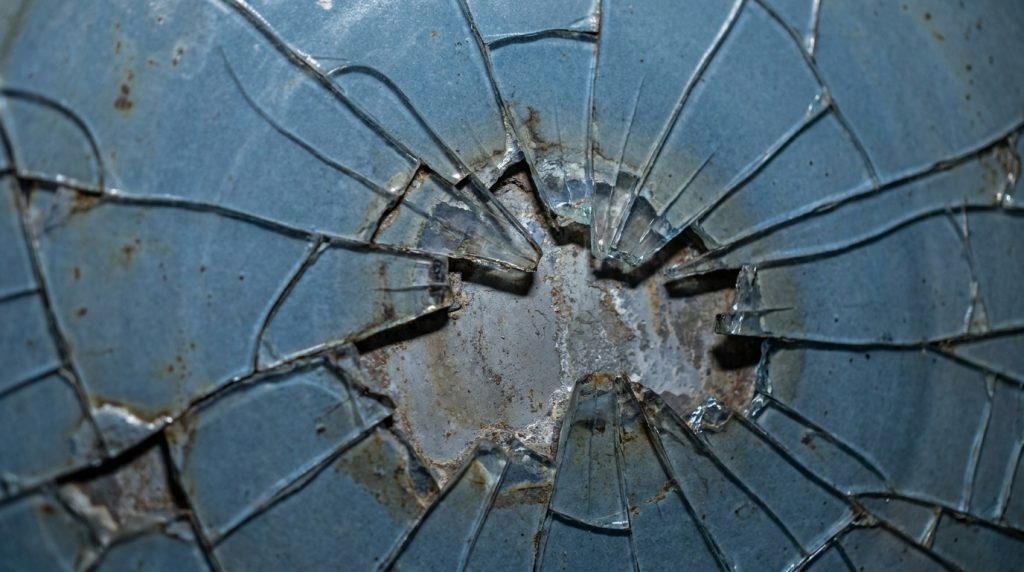
How Do Corrosion, Thermal Shock, and Mechanical Stress Affect Glass Linings?
Corrosion, thermal shock, and mechanical stress affect glass linings by degrading the enamel layer that protects the steel substrate from chemical attack. Glass-lined steel construction fuses enamel to steel at temperatures between approximately 750°C and 900°C (1,382°F and 1,652°F), combining the chemical resistance of glass with the mechanical strength of steel. When any of these three forces exceeds the lining’s tolerance, exposed steel corrodes rapidly.
Corrosion erodes the glass surface gradually. DD 3009 glass exhibits corrosion rates of approximately 0.2 mm/year in 20% HCl at 140°C (284°F) and 0.1 mm/year in 30% H₂SO₄ at 128°C (262°F). Water vapor resistance is excellent at approximately 0.017 mm/year per DIN 51165/ISO 2744 at 100°C (212°F).
Thermal shock creates tensile stress when temperature changes exceed recommended limits. For DD 3009 glass at a wall temperature of 180°C (356°F), jacket fluid must stay between 30°C and 270°C (86°F and 518°F), maintaining a maximum differential of 150°C (270°F). Welding near glass-lined equipment, whether interior or exterior, almost invariably causes glass damage. ISO 28721-3 governs thermal shock resistance testing for vitreous enamels in process plants. General thermal shock often necessitates complete reglassing.
Mechanical stress fractures the brittle glass layer on impact. According to De Dietrich, DD 3009 glass demonstrates mechanical shock resistance approximately 80% greater than older glass types, tested with a 1 kg (2.2 lb) mass dropped onto a 1.5 mm (0.06 in) thick glass-lined plate. Despite this improvement, even modern linings remain vulnerable to dropped tools, aggressive hydroblasting, and abrasion from hard particles at nozzle edges and agitator zones.
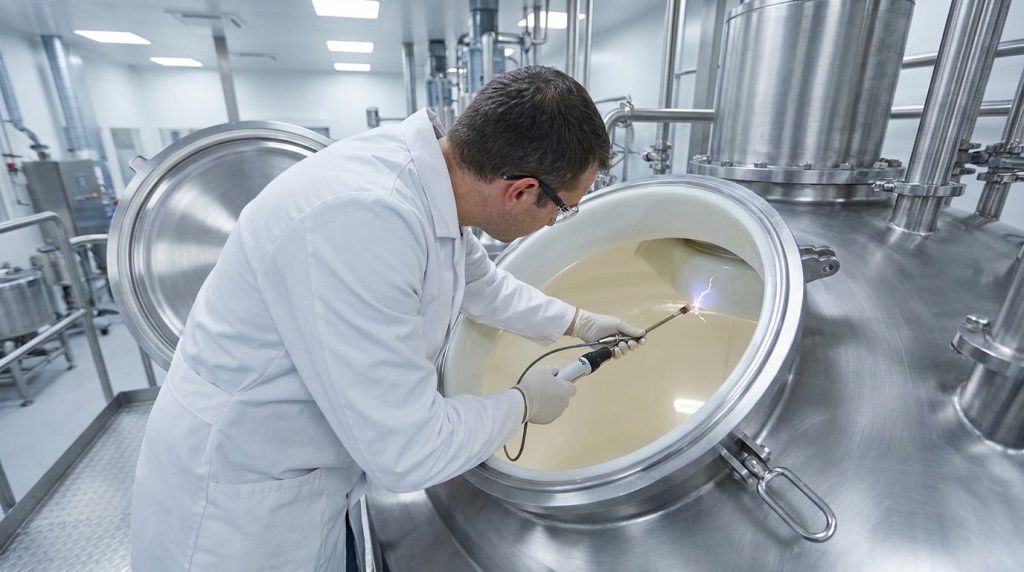
StatiFlux testing, which sprays electrically charged talc-based powder onto the lining, can reveal cracks not detectable by visual inspection or standard spark testing after mechanical or thermal stress events. This makes it essential for post-incident assessment.
What Types of Damage Can Be Repaired Versus Require Replacement?
The types of damage that can be repaired versus those requiring replacement depend on damage extent, location, and whether the steel substrate remains structurally sound. Localized chips, small cracks, and minor pinholes confined to accessible areas such as nozzle edges or baffle zones are typically repairable using tantalum plugs, epoxy patches, or PTFE-based repair systems. These spot repairs restore corrosion protection without removing the vessel from service.
Damage requiring full reglassing or replacement includes:
- Widespread thermal shock cracking across large surface areas
- Corrosion that has penetrated through the glass to compromise the steel substrate
- Star-shaped spall patterns from external impacts, where subsurface damage extends beyond visible fractures
- Repeated damage in the same zones, indicating systemic process incompatibility
When the steel shell shows wall thinning, pitting, or deformation confirmed by Non-Destructive Examination (NDE), reglassing alone cannot restore pressure-vessel integrity. In these cases, replacement becomes the safer path, particularly for vessels operating under ASME Section VIII or PED 2014/68/EU certification requirements.
Understanding which failure mode caused the damage directly shapes the repair-or-replace decision, a factor explored in the next section on decision criteria.
What Factors Influence the Decision Between Reglassing and Replacement?
The factors that influence the decision between reglassing and replacement include reactor age, steel shell condition, operating environment severity, and process demands. The sections below address how equipment condition and operational requirements shape this choice.
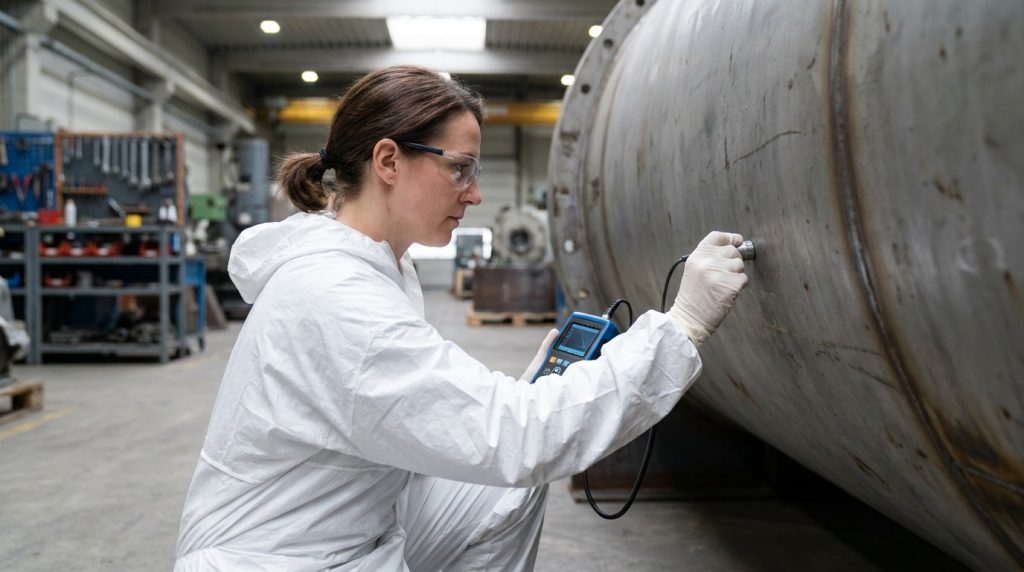
How Does Reactor Age or Condition Affect This Choice?
Reactor age or condition affects this choice by determining whether the steel substrate can safely accept a new glass lining. During reglassing, the steel shell undergoes Non-Destructive Examination (NDE) to assess wall thickness, corrosion pitting, and structural integrity. If the shell passes inspection, reglassing remains viable regardless of the vessel’s chronological age.
A vessel that has experienced localized lining damage from mechanical impact or abrasion, while retaining a sound steel body, is an ideal reglassing candidate. Conversely, vessels with widespread wall thinning, stress cracking, or deformation from repeated thermal cycling typically require full replacement because the substrate cannot reliably support new enamel.
According to De Dietrich Process Systems, a successful reglassing project can extend the service life of a glass-lined vessel by multiple decades, often matching the lifespan of a new vessel. For most procurement decisions, the steel shell condition matters far more than the calendar age of the reactor.
What Role Do Operating Conditions and Process Demands Play?
Operating conditions and process demands play a decisive role because they determine how quickly a new lining will degrade and whether the existing vessel geometry meets current requirements. Factors to evaluate include:
- Acid concentration and temperature exposure (higher values accelerate glass corrosion)
- Thermal cycling frequency and severity relative to the 150°C (270°F) maximum differential threshold
- Abrasive solids content in the process stream
- Alkaline pH levels, since a 10°C (18°F) temperature increase can double the rate of alkali attack on glass lining
If operating conditions have intensified since the original installation, reglassing alone may not suffice. New fabrication allows complete design customization, including nozzle placement, jacket configuration, and upgraded agitator mounting. Reglassing preserves the existing vessel geometry, which works well when process requirements remain unchanged but becomes a limitation when throughput or mixing specifications have evolved.
Understanding both current and projected process demands ensures the chosen path delivers long-term value, not just short-term savings.
How Does the Reglassing Process for Glass-Lined Reactors Work?
The reglassing process for glass-lined reactors works by stripping the damaged enamel, inspecting the steel substrate, and applying new glass through multiple high-temperature firings. The steps and downtime considerations are outlined below.
What Are the Steps Involved in Professional Reglassing?
The steps involved in professional reglassing follow a structured sequence designed to restore the vessel to original specifications. According to De Dietrich Process Systems, the process includes:
- Removal and transport of the vessel to a qualified reglassing facility.
- Full abrasive blasting and cleaning to strip the existing glass lining.
- Inspection and Non-Destructive Examination (NDE) of the steel shell to confirm structural integrity.
- Repair of any substrate defects identified during NDE.
- Application of new glass enamel through multiple firings at approximately 750°C to 900°C (1,382°F to 1,652°F).
- Reassembly of components and return shipment.
Each firing fuses a new layer of borosilicate glass to the steel, building corrosion resistance incrementally. For procurement engineers evaluating this path, the NDE step is critical: if the steel shell shows fatigue cracking or excessive wall thinning, the vessel may not qualify for reglassing at all.
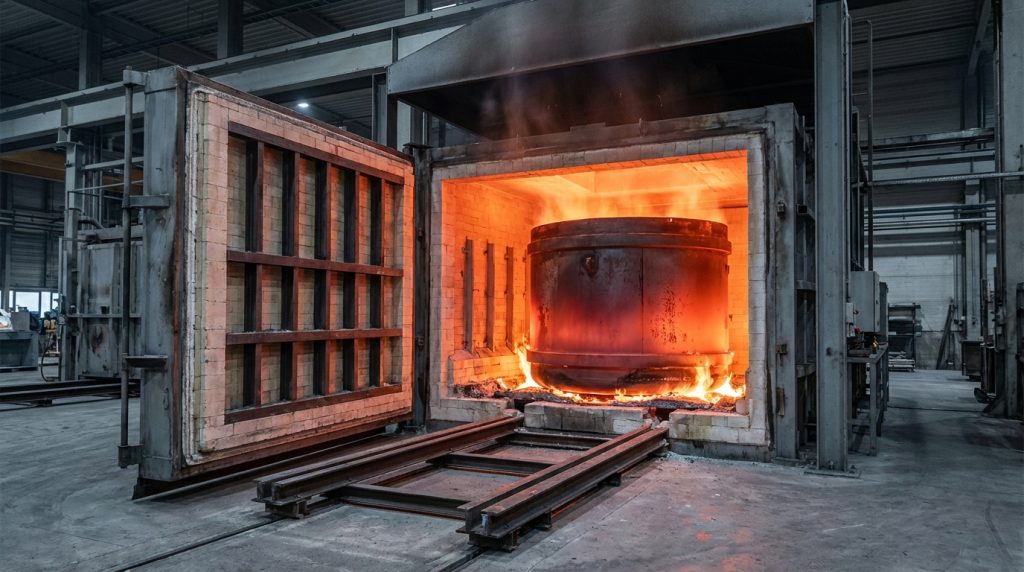
How Long Does Reglassing Typically Take, and What Are the Downtime Considerations?
Reglassing typically takes several weeks to months depending on vessel size, facility backlog, and extent of steel repairs required. Turnaround time specifics vary between independent reglassing providers and major OEMs, with limited published benchmarks available industry-wide.
The primary downtime concern is that the vessel must leave service entirely during the process. However, a reconditioned glass-lined vessel, which typically costs 65% to 70% of a new unit according to De Dietrich Process Systems, offers the advantage of zero sequential downtime by allowing immediate unit swapping while the original vessel undergoes reglassing.
For facilities that cannot tolerate extended outages, procuring a reconditioned spare in advance and scheduling the reglassing during a planned turnaround remains the most practical strategy.
With the process mechanics established, the next section examines the performance outcomes and limitations of reglassing.
What Are the Key Benefits and Limitations of Reglassing a Glass-Lined Reactor?
The key benefits of reglassing a glass-lined reactor include cost savings, extended vessel life, and environmental sustainability. The key limitations involve risks to older steel substrates and potential compliance gaps. The following sections detail performance restoration and drawbacks.
Can Reglassing Restore Original Performance and Compliance?
Yes, reglassing can restore original performance and compliance when the steel substrate remains structurally sound. A successful reglassing project extends service life by multiple decades, often matching the lifespan of a new vessel. The renewed glass lining delivers the same corrosion resistance, anti-adhesive surface properties, and thermal shock tolerance as original factory coatings.
According to De Dietrich Process Systems, the high surface smoothness of glass lining (Ra < 0.4 µm) is essential for validated cleaning procedures in pharmaceutical applications, meeting cGMP requirements. This means a properly reglassed reactor can satisfy ASME Section VIII, PED 2014/68/EU, and ATEX 2014/34/EU certifications after post-firing inspection confirms lining integrity through spark testing and visual examination.
For pharmaceutical plants especially, reglassing preserves GMP-compliant geometry without the lead time of new fabrication.
Are There Risks or Drawbacks to Reglassing Older Equipment?
There are several risks and drawbacks to reglassing older equipment:
- Steel substrate degradation from years of thermal cycling may cause warping or thinning that prevents proper glass adhesion during firing at 750 °C to 900 °C (1,382 °F to 1,652 °F).
- Hidden corrosion beneath the original lining, detectable only after full blasting and Non-Destructive Examination (NDE), can disqualify a vessel mid-process.
- Design constraints remain locked in; nozzle placement, jacket configuration, and vessel geometry cannot be modified during reglassing.
- Older metallurgy may not meet current pressure vessel code requirements, limiting recertification options.
According to De Dietrich Process Systems, reglassing saves embodied energy from virgin steel production, yet this benefit disappears if the substrate fails NDE and the project must pivot to full replacement after disassembly costs are already incurred.
When substrate integrity is uncertain, evaluating replacement or sourcing a reconditioned vessel can reduce overall project risk.
When Is Full Reactor Replacement Recommended Instead of Reglassing?
Full reactor replacement is recommended instead of reglassing when the steel substrate has degraded beyond repair, when process requirements have changed significantly, or when regulatory compliance demands current design standards. The following subsections address cost-lifecycle comparisons and safety-driven replacement triggers.
How Do Cost and Lifecycle Considerations Compare?
Cost and lifecycle considerations compare favorably for replacement when cumulative reglassing expenses approach or exceed 70% of a new vessel’s price. According to De Dietrich Process Systems, reglassing typically costs 70% of new vessel price, while a good used vessel costs 50%. If a reactor has undergone multiple reglassing cycles, additional firings at 750°C to 900°C (1,382°F to 1,652°F) progressively stress the steel substrate.
Replacement becomes the better lifecycle investment when:
- The vessel requires design changes such as new nozzle placement or jacket reconfiguration.
- Cumulative repair costs over 10 years exceed 70% of new fabrication cost.
- The steel shell shows thinning or fatigue cracking detected during NDE inspection.
- Process demands have shifted to higher pressures or temperatures beyond original specifications.
For vessels already past their second reglassing, the diminishing returns on steel integrity make full replacement the more predictable long-term investment.
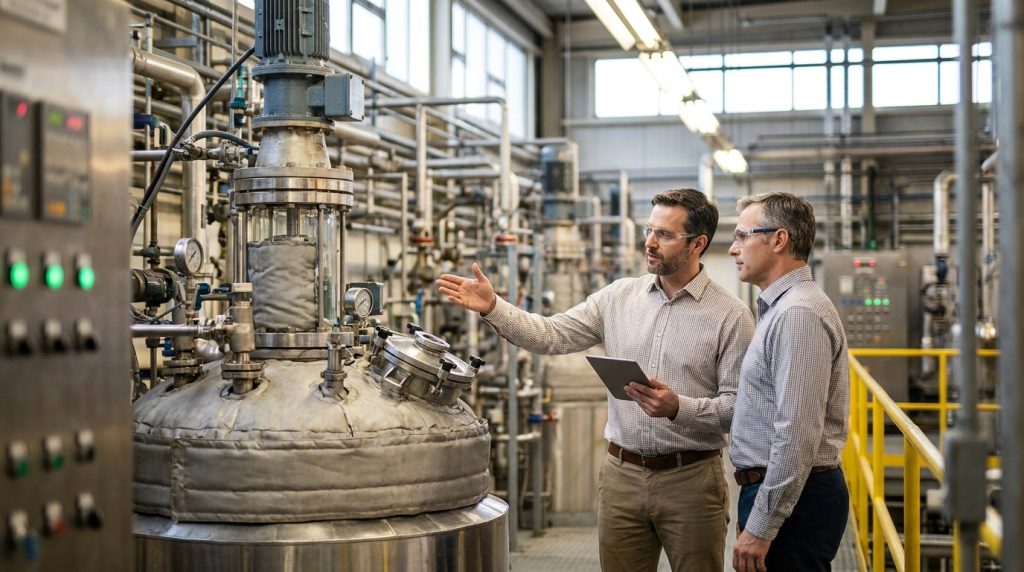
What Regulatory or Safety Factors May Require Replacement?
Regulatory or safety factors may require replacement when an existing vessel cannot meet current pressure codes or hazardous-atmosphere standards. In the United States, glass-lined equipment must comply with ASME Boiler and Pressure Vessel Code (Section VIII, Div. 1). In the EU, the Pressure Equipment Directive (PED 2014/68/EU) requires Notified Body certification for vessels with maximum allowable pressure above 0.5 bar (7.25 PSI). Additionally, the ATEX Directive (2014/34/EU) mandates compliance for reactors handling flammable solvents in potentially explosive atmospheres.
Replacement is required when:
- The original vessel predates current ASME, PED, or CE marking requirements and cannot be recertified.
- Pharmaceutical cGMP design standards demand validated surface smoothness (Ra < 0.4 µm) that worn substrates cannot achieve after reglassing.
- ATEX-rated zone classification changes require equipment redesign.
- National registration numbers (such as CRN in Canada) are invalid for the modified vessel geometry.
When compliance gaps exist, no amount of reglassing resolves the underlying design deficiency, making replacement the only viable path forward.
How Do Costs and ROI Compare Between Reglassing and Replacement?
Costs and ROI between reglassing and replacement depend on upfront capital outlay, production downtime, and long-term risk exposure. The subsections below address short- and long-term financial impacts alongside warranty and risk management considerations.
What Are the Short- and Long-Term Financial Impacts?
The short- and long-term financial impacts differ significantly between reglassing, purchasing a reconditioned vessel, and ordering new fabrication. Reglassing typically costs 70% of a new vessel’s price, according to De Dietrich Process Systems, making it the lowest capital option when the steel substrate remains sound. A reconditioned glass-lined vessel costs 70% of new and eliminates sequential downtime through immediate unit swapping. New fabrication requires 100% capital expenditure but delivers full design customization.
Over the long term, a successful reglassing can extend service life by multiple decades, often matching a new vessel’s lifespan. This means the per-year cost of ownership drops substantially when reglassing is viable. For facilities that do not require nozzle relocation or jacket redesign, reglassing delivers the strongest ROI per dollar spent.
How Do Risk Management and Warranty Factors Influence ROI?
Risk management and warranty factors influence ROI by determining the total cost of failure scenarios and ongoing compliance obligations. Reglassed vessels typically carry warranties on the new glass lining itself, but the underlying steel shell remains the owner’s responsibility. If non-destructive examination (NDE) during the reglassing process reveals hidden fatigue or corrosion in the substrate, unplanned repair costs can erode the projected savings.
New vessels, by contrast, carry comprehensive warranties covering both shell and lining, reducing exposure to unexpected failure costs. Compliance risk also plays a role: equipment operating under ASME Section VIII, PED 2014/68/EU, or ATEX 2014/34/EU must maintain documented pressure boundary integrity. Reglassing preserves the original nameplate rating only if the steel passes NDE; otherwise, re-certification costs must factor into the ROI calculation.
For most procurement decisions, the risk-adjusted ROI favors reglassing when thorough NDE confirms substrate integrity, and favors replacement when inspection findings introduce uncertainty about long-term pressure boundary performance.
What Should Plant Managers Consider When Selecting a Reglassing or Replacement Provider?
Plant managers should consider provider certifications, relevant experience with glass-lined equipment, and aftermarket support capabilities. The following subsections cover qualification criteria and ongoing service factors.
What Certifications and Experience Should Providers Have?
Providers should have certifications that confirm compliance with the pressure vessel and glass-lining standards applicable in your operating jurisdiction. Key certifications and standards to verify include:
- ASME Boiler and Pressure Vessel Code (Section VIII, Div. 1) for equipment in the United States
- Pressure Equipment Directive (PED 2014/68/EU) with Notified Body certification for EU operations
- CE marking for European market conformity
- UKCA marking for United Kingdom installations
- ISO 28721-1, which specifies quality requirements for glass-lined steel apparatus in process plants
- ATEX Directive (2014/34/EU) compliance for reactors handling flammable solvents
Beyond certifications, evaluate demonstrated experience with your specific reactor size, glass formulation, and process chemistry. A provider experienced in pharmaceutical cGMP environments differs significantly from one focused on commodity chemical applications. Providers who perform Non-Destructive Examination (NDE) of the steel shell before committing to reglassing demonstrate the technical rigor that protects your investment.
How Important Is Aftermarket Support and Spare Parts Availability?
Aftermarket support and spare parts availability are critical factors that directly affect long-term uptime and total cost of ownership. A reglassed or replacement reactor requires ongoing access to components such as agitator seals, baffles, nozzle covers, and gaskets specific to the vessel geometry.
Providers with broad aftermarket networks reduce lead times for replacement parts. This matters because glass-lined equipment operates in corrosive environments where component degradation is predictable. Choosing a provider locked to a single parts source creates supply chain vulnerability. Providers that stock or source parts from multiple manufacturers offer procurement flexibility that keeps your reactor operational regardless of OEM availability.
For plant managers evaluating long-term partnerships, the provider’s ability to supply inspection services, spare glass-lined components, and technical guidance after project completion often determines whether the initial investment delivers its projected return.
With provider selection criteria established, the next step is evaluating how specific suppliers address your lifecycle needs.
How Can International Process Plants and Universal Glasteel Equipment Assist With Glass-Lined Reactor Lifecycle Decisions?
International Process Plants (IPP) and its Universal Glasteel Equipment (UGE) division can assist with glass-lined reactor lifecycle decisions by providing expert reglassing services, sourcing new surplus and quality used vessels, and guiding the reglass-versus-replace evaluation.
Can Universal Glasteel Equipment Provide Expert Reglassing and Equipment Sourcing Solutions?
Yes, Universal Glasteel Equipment can provide expert reglassing and equipment sourcing solutions for glass-lined reactors across chemical and pharmaceutical applications. UGE specializes in glass and glass-lined equipment, offering both professional reglassing services and access to IPP’s global inventory of new surplus and quality used vessels.
This dual capability matters in a market experiencing significant growth. According to a 2024 Grand View Research report, the global glass-lined equipment market was estimated at USD 2,229.3 million in 2024 and is projected to reach USD 4,571.5 million by 2033, growing at a CAGR of 8.3%.
UGE supports equipment that meets international compliance requirements, including ASME Section VIII (Div. 1) classification in the United States, the Pressure Equipment Directive (PED 2014/68/EU) for European markets, and the ATEX Directive (2014/34/EU) for explosive atmosphere applications. All inspection work follows established protocols such as DC spark testing and StatiFlux analysis to verify lining integrity before and after reglassing.
What Are the Key Takeaways for Deciding Between Reglassing and Replacement of Glass-Lined Reactors?
The key takeaways for deciding between reglassing and replacement of glass-lined reactors center on three factors: steel shell integrity, process compatibility, and regulatory compliance.
- Reglass when the steel substrate passes Non-Destructive Examination (NDE), the vessel geometry still meets process needs, and operating conditions remain within standard limits (minimum -29°C / -20°F for standard glass-lined steel).
- Replace when the shell shows significant corrosion or fatigue, process requirements demand new nozzle configurations or jacket designs, or pharmaceutical cGMP design standards require validated cleanability that the original vessel cannot achieve.
- Source a reconditioned vessel from inventory when production cannot tolerate extended downtime, since a pre-reglassed unit allows immediate installation.
Every decision should account for applicable standards: ISO 28721-1 (and its German equivalent DIN EN ISO 28721-1) for quality requirements, ASME Section VIII for pressure classification, PED for EU compliance, and CE or UKCA marking depending on jurisdiction. For buyers navigating these choices globally, IPP and Universal Glasteel Equipment offer technical assessment, compliance guidance, and access to 10,000+ pieces of currently available equipment across warehouses in the United States, Germany, and the United Kingdom.

 PT
PT  EN
EN  ES
ES  FR
FR  PL
PL  DE
DE  AR
AR  UR
UR  HI
HI  NL
NL  TR
TR  IT
IT  UK
UK  RU
RU  JA
JA  ZH
ZH