 Skip to content
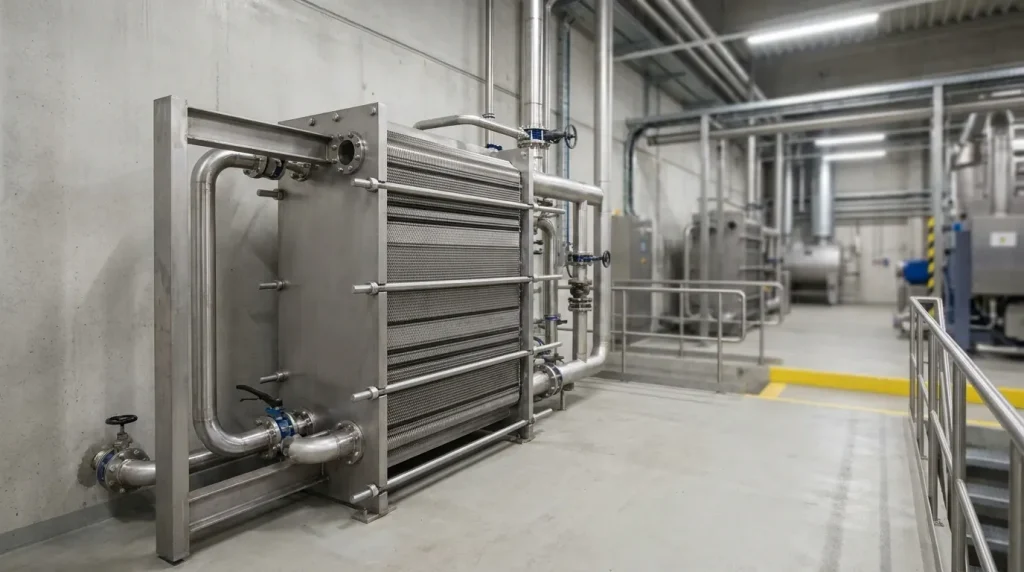
A plate and frame heat exchanger is a thermal transfer device that uses stacked corrugated metal plates to move heat between two fluids without mixing them. Elastomeric gaskets seal the channels and direct each fluid into alternate passages, enabling efficient conduction through thin plate walls while preventing cross-contamination.
This guide covers plate and frame heat exchanger components, heat transfer mechanics, performance advantages and limitations, comparisons with shell and tube designs, and maintenance best practices.
The core components include corrugated plates stamped from stainless steel, titanium, or Hastelloy, plus a frame assembly with carrying bars, guide bars, and tightening bolts that compress the plate pack. Gasket materials such as EPDM, NBR, and FKM determine temperature and chemical compatibility limits.
Heat transfer occurs through countercurrent flow, where hot and cold fluids move in opposite directions through adjacent channels. This arrangement maximizes temperature differential along the entire plate length, achieving heat transfer coefficients of 3,000 to 7,000 W/m²K for water applications.
Advantages include compact footprint, high thermal efficiency, and easy serviceability through removable plate packs. Limitations involve pressure constraints from gasket materials and regulatory complexity under standards like PED 2014/68/EU for equipment exceeding 0.5 bar gauge.
Proper maintenance requires cleaning one to three times annually using chemical agents, with gasket inspection after each cycle. Common failure indicators include port leakage, reduced flow rates, and widening approach temperatures that signal declining thermal performance.
What are the main components of a plate and frame heat exchanger?
The main components of a plate and frame heat exchanger are corrugated metal plates, a frame assembly, and elastomeric gaskets. These elements work together to create alternating flow channels that transfer heat between two fluids without mixing them.
How do the plates function within the heat exchanger?
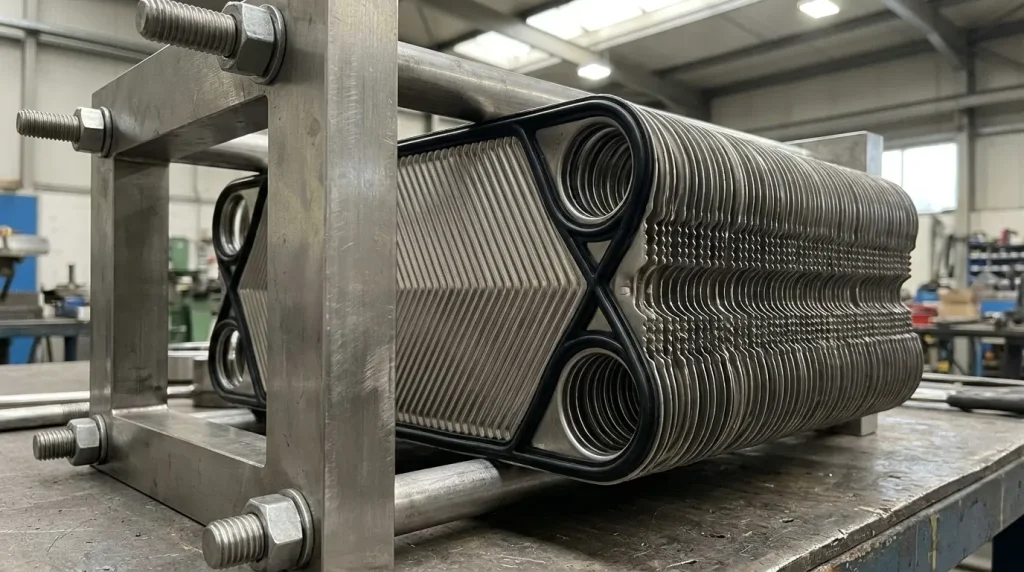
The plates function within the heat exchanger by creating thin channels where hot and cold fluids flow on opposite sides of each plate, enabling efficient heat transfer through the metal surface. According to the Xylem Buffalo GPX Manual, the corrugation pattern on thermal plates induces highly turbulent flow, which gives strong resistance to the formation of deposits on the plate surface.
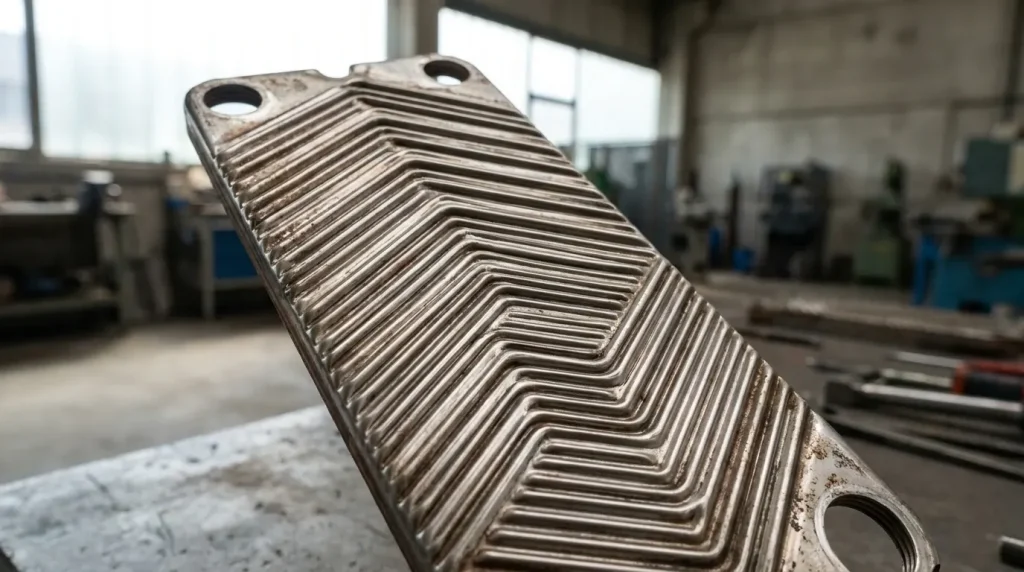
Plates are typically stamped from thin stainless steel, titanium, or Hastelloy sheets, with thicknesses ranging from 0.5 mm to 1.2 mm (0.02 in to 0.05 in). The corrugated chevron or herringbone pattern serves two purposes: it maximizes surface area and creates turbulence that enhances heat transfer coefficients.
Each plate contains corner ports that align when stacked, forming inlet and outlet manifolds for both fluid streams. This design allows the plate pack to be expanded or reduced by adding or removing plates, giving operators flexibility to match changing process demands.
What role do frames and gaskets play in the process?
Frames and gaskets play critical roles in the process by providing structural support, maintaining alignment, and sealing the plate channels to prevent fluid leakage or cross-contamination. According to the Alfa Laval GPHE Instruction Manual, the carrying bar carries the plate pack and pressure plate, the guide bar keeps channel plates aligned at their lower end, and tightening bolts compress the plate pack between the frame plate and pressure plate.
The frame assembly consists of a fixed frame plate, a movable pressure plate, upper and lower guide bars, and threaded tightening bolts. Operators adjust bolt tension to achieve the specified compressed dimension, known as the “A dimension,” which ensures proper gasket compression.
Elastomeric gaskets fit into grooves around each plate’s perimeter and ports. Gasket materials are selected based on temperature and chemical compatibility:
- NBR (nitrile rubber): continuous service from -10°C to 110°C (14°F to 230°F) for oil applications
- EPDM: continuous service from -50°C to 150°C (-58°F to 302°F) for water, steam, and chemicals
- FKM/Viton: continuous service from -5°C to 180°C (23°F to 356°F) for aggressive media
With component functions established, the next section explains how heat actually transfers between the two fluid streams.
How does heat transfer occur in a plate and frame heat exchanger?
Heat transfer in a plate and frame heat exchanger occurs through conduction across thin metal plates while two fluids flow in adjacent channels without mixing. The corrugated plate surfaces and countercurrent flow arrangement maximize thermal efficiency. Below, we examine the step-by-step process and compatible fluid types.
What is the step-by-step process for heat exchange between fluids?
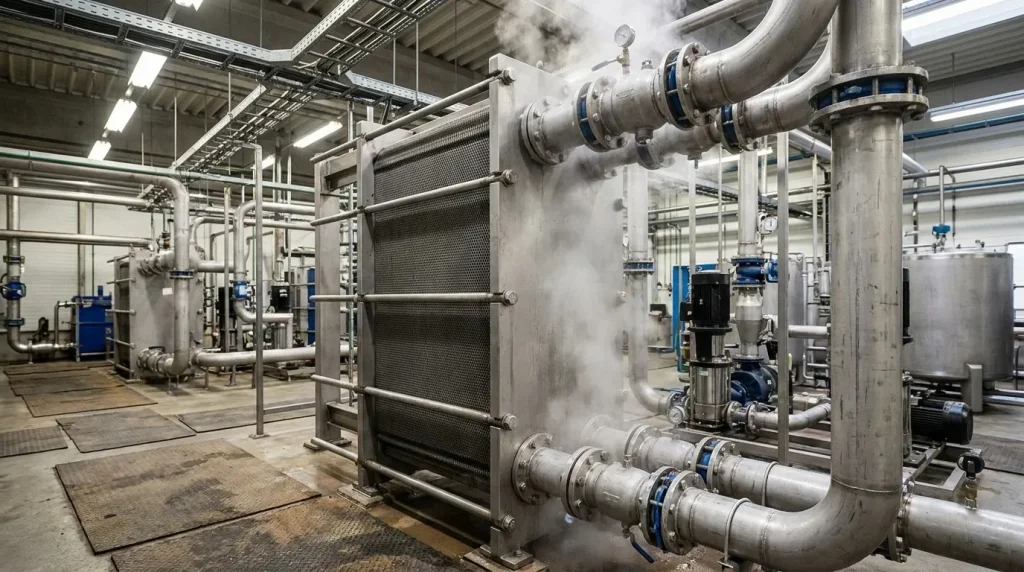
The step-by-step process for heat exchange between fluids follows a specific sequence through the plate pack:
- Hot fluid enters through the inlet port and flows into channels between plates
- Cold fluid enters through a separate port and flows into other channels
- Elastomeric gaskets seal each channel and direct fluids into alternate passages, preventing cross-contamination
- Heat conducts through the thin plate walls (typically 0.5 mm to 1.2 mm (0.02 in to 0.05 in) thick) from the hotter fluid to the cooler fluid
- Countercurrent flow (fluids moving in opposite directions) delivers the highest temperature change between streams
- Both fluids exit through separate discharge ports at their new temperatures
According to the Xylem Buffalo GPX Manual, countercurrent flow enhances heat transfer efficiency by maintaining the maximum temperature difference along the entire plate length.
Which types of fluids can be used in plate and frame heat exchangers?
The types of fluids that can be used in plate and frame heat exchangers include water, glycol solutions, oils, and various process chemicals, with compatibility determined by plate and gasket materials.
Common compatible fluid and material pairings include:
- Water and glycol solutions: stainless steel plates with copper brazing
- Deionized water and corrosive fluids: stainless steel plates for improved corrosion resistance
- Dielectric fluids and oils: aluminum plates
- Sulfuric acid and aggressive chemicals: Hastelloy plates
Gasket selection also governs fluid compatibility. EPDM gaskets handle water, steam, and chemicals from -50 to 150°C (-58 to 302°F), while FKM/Viton gaskets suit aggressive media up to 180°C (356°F) continuous operation. The corrugated plate pattern induces turbulent flow, which resists deposit formation.
Understanding these heat transfer principles helps engineers specify the right configuration for their thermal duties.
What are the advantages and disadvantages of plate and frame heat exchangers?
The advantages of plate and frame heat exchangers include high thermal efficiency, compact footprint, and easy maintenance. The disadvantages include pressure limitations, gasket compatibility concerns, and regulatory complexity for high-risk applications.
Why are plate and frame heat exchangers commonly used in various industries?
Plate and frame heat exchangers are commonly used in various industries because they deliver superior heat transfer in a compact design. According to IMARC Group’s 2025 market analysis, the chemical sector leads heat exchanger demand with approximately 22.7% market share, using these units for temperature control during reactions and separation processes.
Key advantages driving adoption include:
- High heat transfer coefficients reaching 3,000 to 7,000 W/m²K for water applications
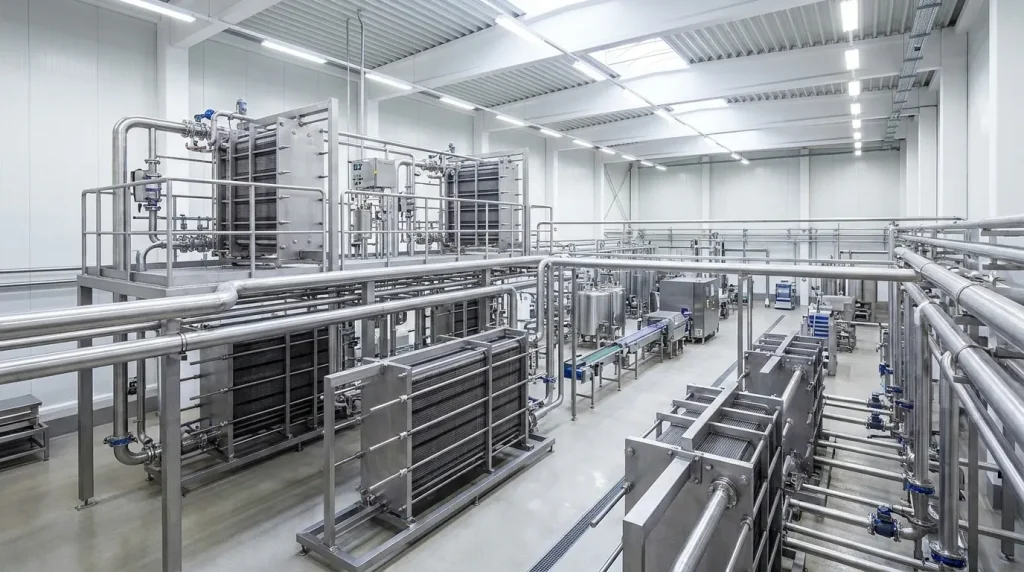
- Compact footprint requiring less floor space than shell and tube alternatives
- Easy maintenance through accessible plate packs that technicians can disassemble for cleaning
- Scalable capacity by adding or removing plates to match process requirements
- Energy efficiency from countercurrent flow configurations that maximize temperature differentials
HVAC, refrigeration, food processing, and pharmaceutical manufacturing all rely on these exchangers for precise thermal management. The combination of efficiency, versatility, and serviceability makes this design practical for applications where space constraints and frequent cleaning cycles are operational realities.
What limitations or challenges can users encounter with this equipment?
The limitations users encounter with this equipment fall into three categories: pressure constraints, gasket compatibility, and regulatory compliance burden.
Pressure and temperature boundaries restrict application scope. Gaskets limit operating conditions based on material selection. NBR handles temperatures from 14°F to 230°F (minus 10°C to 110°C), while FKM/Viton extends to 356°F (180°C) continuous. Higher pressures and temperatures often require welded or brazed designs instead.
Gasket degradation represents one of the most common failure modes. Chemical incompatibility, thermal cycling, and aggressive clean-in-place chemistry accelerate wear. The Pressure Equipment Directive (PED 2014/68/EU) applies to equipment exceeding 0.5 bar gauge, establishing four risk categories with Category IV requiring Notified Body involvement at every stage.
Additional challenges include:
- Narrow channel gaps that limit solids handling
- Gasket replacement costs during routine maintenance cycles
Understanding these boundaries during specification prevents operational problems after installation.
How do plate and frame heat exchangers compare to other types of heat exchangers?
Plate and frame heat exchangers compare favorably to other heat exchanger types in terms of heat transfer efficiency, footprint, and serviceability. The following subsection examines why engineers often select plate and frame designs over shell and tube alternatives.
Why might someone choose a plate and frame heat exchanger over a shell and tube model?
Someone might choose a plate and frame heat exchanger over a shell and tube model because of superior heat transfer performance and compact size. According to Engineers Edge, shell and tube heat exchangers typically achieve heat transfer coefficients of 800 to 2,500 W/m²K for liquid-to-liquid applications, while plate designs reach 3,000 to 7,000 W/m²K in comparable water-water service.
Key reasons engineers select plate and frame designs include:
- Higher heat transfer coefficients in a smaller footprint
- Easier maintenance through removable plate packs
- Better handling of low-to-medium-viscosity fluids at higher flow rates
- Modular expansion by adding or removing plates
Shell and tube units remain preferable for high-pressure applications exceeding 30 bar (435 PSI), high-temperature duties above 200°C (392°F), or services involving highly viscous or particulate-laden fluids. For most HVAC, food processing, and pharmaceutical operations requiring precise temperature control in moderate conditions, plate and frame exchangers deliver better thermal performance per unit of installed space.
How can you ensure efficient operation and maintenance of a plate and frame heat exchanger?
You can ensure efficient operation and maintenance of a plate and frame heat exchanger through regular cleaning schedules, proper gasket care, and systematic inspection for early wear indicators. The following sections cover best practices for cleaning and the most common signs of failure.
What are best practices for cleaning and maintaining these heat exchangers?
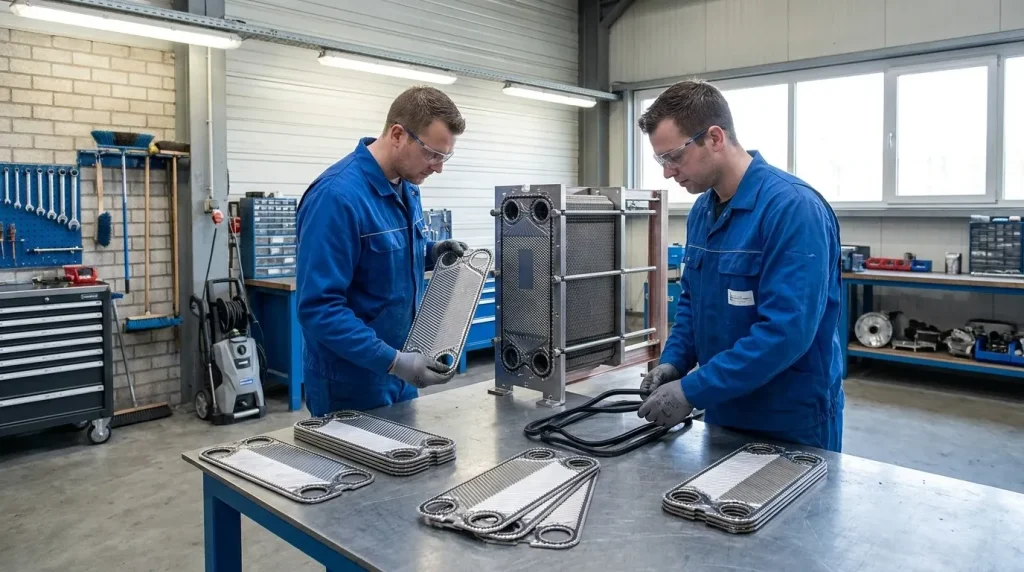
Best practices for cleaning and maintaining plate and frame heat exchangers include scheduling cleaning cycles one to three times per year, using appropriate chemical agents, and following proper tightening procedures during reassembly.
Effective cleaning protocols involve these key steps:
- Circulate chemical cleaning agents such as nitric acid, phosphoric acid, or potassium hydroxide based on fouling type
- Follow manufacturer specifications for the “A dimension” when compressing the plate pack
- Use a star-pattern bolt sequence to prevent frame distortion
- Inspect gaskets after each cleaning cycle for swelling, brittleness, or deformation
At a large Scandinavian dairy using Alfa Laval Extend technology, optimized cleaning protocols delivered 7,000 m³ (1.85 million gal) of water savings, 100,000 kWh (341.2 million BTU) in pumping and heating reduction, and 35 tonnes (77,161.8 lb) of chemical savings annually, resulting in 50% increased uptime.
What are the common signs of wear or failure in plate and frame heat exchangers?
The common signs of wear or failure in plate and frame heat exchangers include gasket degradation, plate surface damage, and frame misalignment. According to Central States Industrial Equipment, the most frequent failures in hygienic service are gasket blowouts, plate fatigue and cracking, frame distortion from uneven tightening, and CIP-related damage from incorrect chemistry or temperature.
Gasket failure warning signs:
- Weeping or leakage at ports or plate edges
- Bulging elastomer visible outside the plate pack
- Softened, swollen, or brittle material after cleaning
- Repeated need for re-tightening
Plate failure indicators include corrosion pitting, crevice attack, and surface staining. Cracking often remains invisible until severe, making scheduled dye-penetrant inspections valuable for early detection.
Understanding these maintenance fundamentals helps buyers evaluate equipment condition when sourcing plate and frame heat exchangers for their operations.
How does International Process Plants provide solutions for plate and frame heat exchanger needs?
International Process Plants provides solutions for plate and frame heat exchanger needs through our inventory of new surplus and quality used process equipment. The following subsections cover cost and reliability benefits, plus key operational takeaways.
Can sourcing used plate and frame heat exchangers from IPP improve project cost and reliability?
Yes, sourcing used plate and frame heat exchangers from International Process Plants can improve both project cost and reliability. Good used equipment typically costs approximately 50% of new OEM pricing, allowing procurement teams to allocate capital toward other critical process needs. According to MarketsandMarkets, the global plate and frame heat exchanger market is projected to reach USD 10.50 billion by 2030, growing at a 7.8% CAGR. This demand growth means new equipment lead times often extend 12 to 20 weeks, while International Process Plants maintains ready-to-ship inventory from our warehouses in the United States, Germany, and the United Kingdom.
Reliability comes from thorough inspection protocols. Each unit undergoes verification of plate condition, gasket integrity, and frame alignment before sale. For facilities running pasteurization, product heating, cooling loops, or cleaning-in-place systems, immediate availability reduces production downtime risk.
What are the key takeaways about how a plate and frame heat exchanger works?
The key takeaways about how a plate and frame heat exchanger works center on three principles:
- Corrugated plates create turbulent flow that maximizes heat transfer coefficients, reaching 3,000 to 7,000 W/m²K for water applications
- Countercurrent flow between alternating channels delivers the highest temperature differential
- Gasket selection determines operating limits, with EPDM handling -58°F to 302°F (-50°C to 150°C) and FKM reaching 392°F (200°C)
Maintenance requires cleaning one to three times annually using chemical agents such as nitric acid, sulfamic acid, or phosphoric acid. International Process Plants offers plate and frame heat exchangers with documented service histories, giving buyers confidence in remaining service life. Contact our team to discuss currently available inventory matched to your process specifications.

 EN
EN  ES
ES  FR
FR  PL
PL  DE
DE  AR
AR  UR
UR  HI
HI  NL
NL  TR
TR  IT
IT  UK
UK  RU
RU  JA
JA  PT
PT  ZH
ZH