 Ga naar inhoud
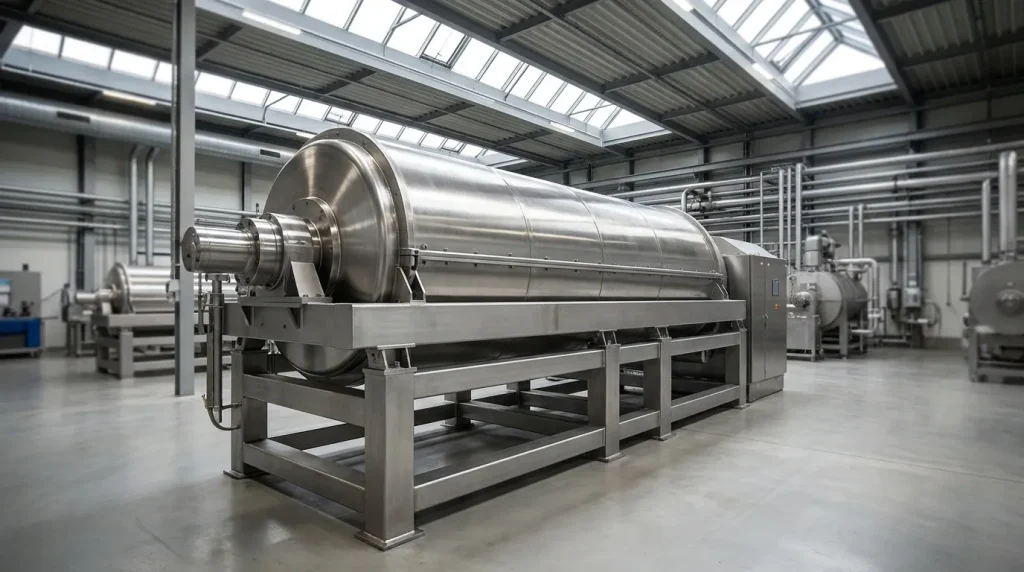
A decanter centrifuge is a machine that separates solid material from liquids through continuous high-speed rotation. Also called a horizontal bowl centrifuge or scroll centrifuge, this equipment can generate centrifugal forces between 500 and 4,000 × g to accelerate sedimentation far beyond what gravity alone achieves.
This guide covers decanter centrifuge construction and operating principles, the separation process stages, industry applications, operational benefits and limitations, and equipment maintenance practices.
Understanding construction starts with the core components: a rotating bowl, scroll conveyor, gearbox, feed zone, and discharge ports. Bowl diameters can range from 150 mm to 1,400 mm (6 to 55 in.) to match throughput requirements, while the differential speed between bowl and scroll determines how quickly separation of liquids and solids can be achieved.
The separation process follows four continuous stages. Feed enters and accelerates to match bowl rotation, solids settle outward under centrifugal force during clarification, the conical beach section compacts settled material, and separated phases discharge through dedicated ports for solids and liquids.
Industry applications span chemical processing, pharmaceutical manufacturing, food production, wastewater treatment, and power generation among others. Specific uses include PVC waste processing, whey protein manufacturing, starch dewatering, oil extraction, and sludge treatment.
Operational benefits include continuous throughput, high automation levels, and reduced labor requirements compared to batch-based systems. Limitations involve higher capital costs, maintenance complexity, and sensitivity to feed variability.
Selection criteria focus on matching particle size, solids concentration, throughput requirements, and chemical compatibility to equipment specifications, while maintenance protocols based on operating hours and predictive systems help extend service life and prevent unplanned downtime.
What is a decanter centrifuge and how is it constructed?
A decanter centrifuge is a machine used to separate solid material from a liquid or liquids in a continuous process. Also known as a horizontal bowl centrifuge, solid bowl centrifuge, or scroll centrifuge, this equipment uses centrifugal force to achieve efficient separation. The following sections cover the main components and the working principle that drive this process.
What are the main components of a decanter centrifuge?
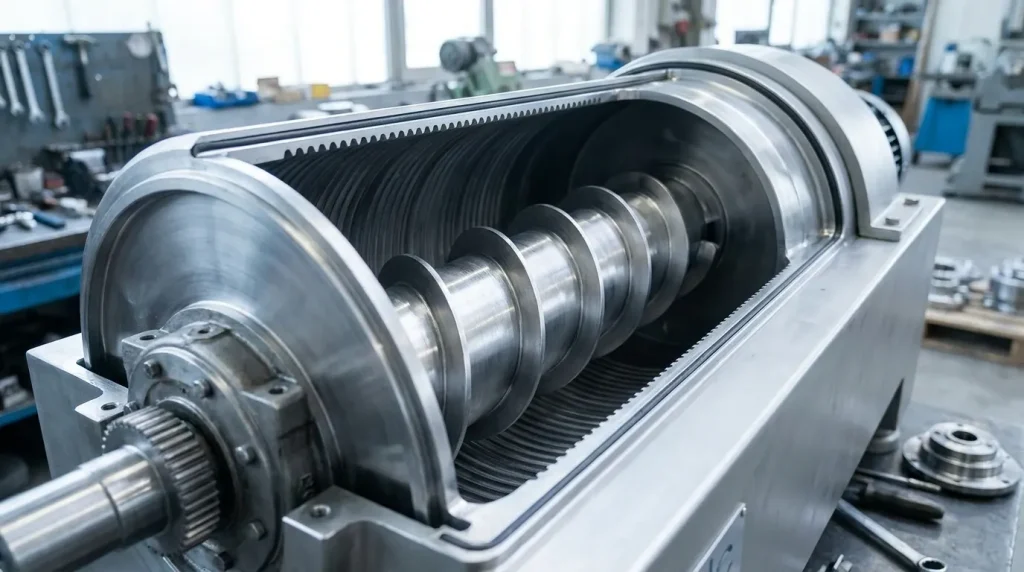
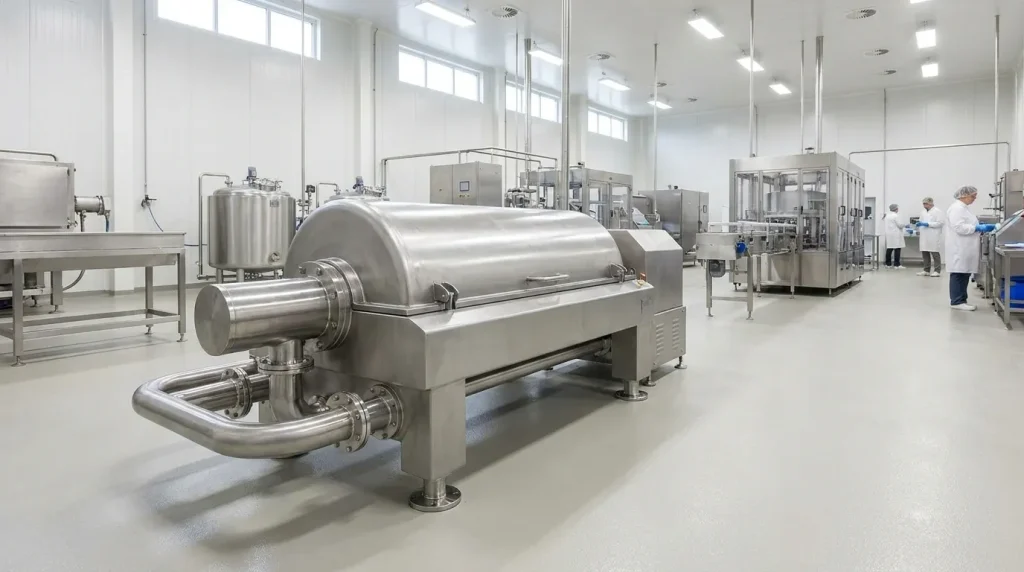
The main components of a decanter centrifuge are the rotating bowl (drum), scroll conveyor (auger), gearbox, feed zone, discharge ports, and drive system. Each component serves a specific function in the continuous separation process.
- Rotating bowl (drum): The cylindrical outer shell that spins at high speed to generate centrifugal force. Bowl diameters can range from around 150 mm to 1,400 mm plus (approximately 6 in to 55 in) depending on throughput requirements.
- Scroll conveyor (auger): A helical screw that rotates inside the bowl at a slightly different speed, conveying settled solids toward the discharge end.
- Gearbox: Creates the differential speed between the bowl and scroll, controlling how quickly solids move through the system.
- Feed zone: The central area where slurry enters the centrifuge and accelerates to match bowl rotation speed.
- Discharge ports: Separate outlets for clarified liquid (centrate) and dewatered solids (cake).
- Drive system: Motors and belts that power bowl and scroll rotation.
As explained in an AIChE Best of Equipment Series, decanter centrifuges can handle a wide range of products with different particle sizes, shapes, porosities, and densities, making them versatile for slurries where concentrations and particle sizes vary significantly. Large-scale industrial units can process volumes up to around 500 m³/hr (approximately 2,200 GPM).
How does the working principle of a decanter centrifuge operate?
The working principle of a decanter centrifuge operates by applying high centrifugal forces to accelerate the natural settling of solids from liquids. The bowl rotates at speeds typically between around 2,000 and 4,000 RPM, generating g-forces from around 500 to 4,000 × g, according to the centrifuge manufacturer guides.
When slurry enters the feed zone, it accelerates to match the bowl’s rotation speed. Denser solid particles migrate outward to the bowl wall under centrifugal force, while lighter liquid phases remain closer to the center. The scroll conveyor, rotating slightly slower than the bowl, continuously moves accumulated solids along the bowl toward the conical “beach” section. As solids travel up this incline, they compact and dewater before discharging through cake ports. Clarified liquid flows in the opposite direction, exiting through separate centrate ports.
This differential speed between bowl and scroll is critical. Too fast, and solids may discharge wet; too slow, and throughput can suffer.
Understanding the separation mechanism provides the foundation for examining specific processes decanter centrifuges perform across different industries.
What processes are typically performed using a decanter centrifuge?
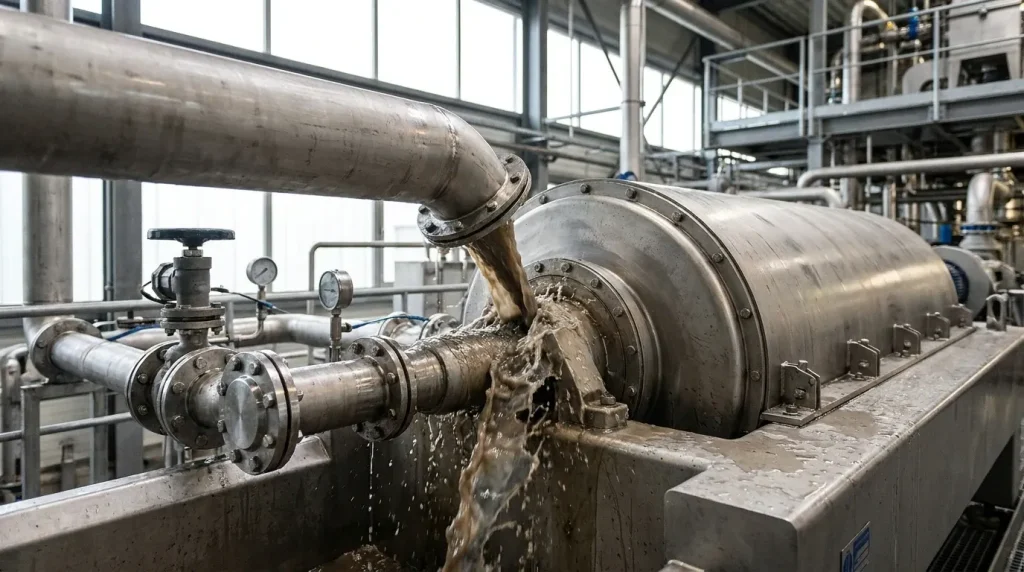
Decanter centrifuges perform continuous solid-liquid separation across chemical, pharmaceutical, food processing, and wastewater treatment applications. The following sections explain how separation occurs and the stages involved.
How does a decanter centrifuge facilitate solid-liquid separation?
A decanter centrifuge facilitates solid-liquid separation by generating intense centrifugal forces that accelerate sedimentation far beyond the rate achievable under normal gravity. The rotating bowl spins the incoming slurry at high velocity, forcing denser solid particles outward against the bowl wall while lighter liquid phases remain closer to the center.
According to some decanter centrifuge manufacturer guides, the bowl rotates at speeds typically between around 2,000 and 4,000 RPM, generating g-forces from around 500 to 4,000 × g. This acceleration compresses the settling time from hours to minutes. The scroll conveyor, rotating at a slightly different speed than the bowl, continuously moves accumulated solids toward the discharge end. This differential speed is critical: too slow, and solids build up; too fast, and separation efficiency drops.
What are the key stages involved in the separation process?
The key stages involved in the separation process are feed introduction, clarification, compaction, and discharge. Each stage occurs simultaneously within the rotating assembly, enabling continuous throughput rather than batch processing.
- Feed introduction and acceleration: Slurry enters through a central feed tube and accelerates to match bowl rotation speed
- Clarification zone: Solids settle radially outward under centrifugal force while clarified liquid moves toward the weir plates
- Beach section compaction: The conical “beach” section compresses settled solids, squeezing out residual liquid before discharge
- Separated phase discharge: Dewatered solids exit through cake ports at the narrow end while clarified liquid overflows weirs at the opposite end
The continuous nature of this process makes decanter centrifuges particularly valuable for high-volume operations where batch-based centrifuge models would create bottlenecks.
In which industries are decanter centrifuges most commonly used?
Decanter centrifuges are most commonly used in applications such as chemical processing, pharmaceutical manufacturing, food production, wastewater treatment, and power generation. The following sections examine how these industries apply decanter technology to solve specific separation challenges.
How are decanter centrifuges applied in the chemical and pharmaceutical industries?
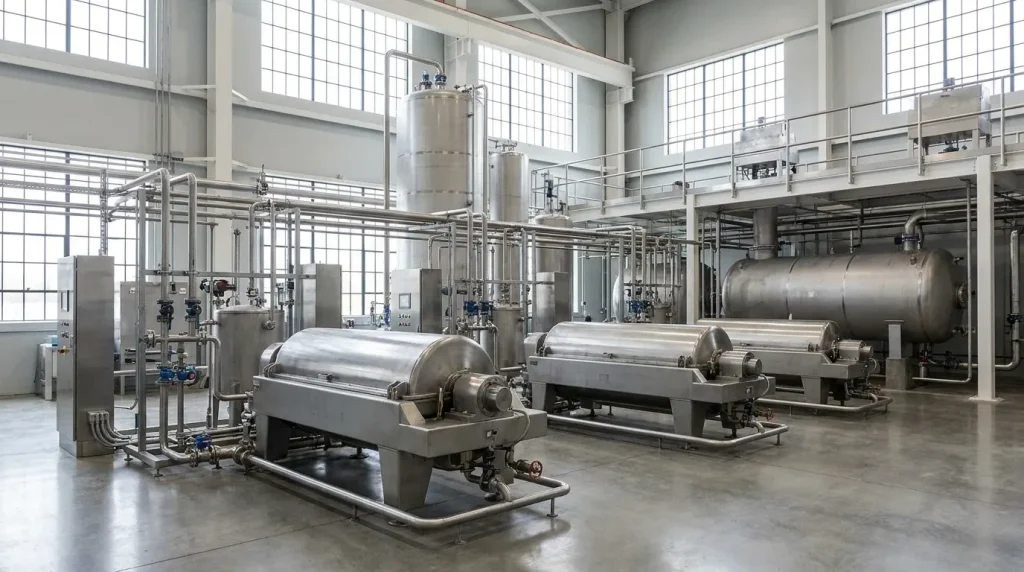
Decanter centrifuges are applied in the chemical and pharmaceutical industries for continuous solid-liquid separation of process intermediates, product recovery, and waste stream treatment. Chemical plants use these machines to separate catalyst fines from reaction mixtures, recover valuable solvents, and process polymer slurries. In pharmaceutical operations, decanters can handle solid-liquid separation of fermentation broths, and dewatering of filter cakes.
Volgens de Vinyl 2010 Progress Report 2009 published by Cefic (the European Chemical Industry Council), the installation of a modified Vinyloop® decanter centrifuge represented a technical breakthrough that significantly reduced contamination and filler content in recycled PVC from cable waste, improving product quality. The report notes that the Ferrara plant processed 8,000+ tonnes (8,819+ short tons) of PVC waste annually during this period. This demonstrates how specialized decanter configurations can address challenging chemical waste streams.
The ability to operate continuously under closed conditions makes decanters particularly valuable for processing hazardous or solvent-based materials where containment is essential.
What roles do decanter centrifuges play in food processing and power generation?
Decanter centrifuges play critical roles in food processing for oil extraction, starch production, dairy processing, and protein recovery. In power generation, they handle coal fines recovery, cooling water treatment, and ash pond dewatering.
Key food processing applications include:
- Olive and avocado oil extraction, separating oil from water and pulp
- Starch production, reducing moisture content to approximately 40% before drying
- Whey protein manufacturing, removing curd fines and suspended solids
- Fruit juice clarification and wine production
Power generation facilities rely on decanters for:
- Fly ash slurry dewatering from scrubber systems
- Cooling tower blowdown treatment
- Coal washing fines recovery
- Flue gas desulfurization sludge processing
Food processors benefit most from decanters when handling high-volume streams with variable solids concentrations, while power plants value the continuous operation that keeps waste handling synchronized with generation schedules.
What are the main benefits of using decanter centrifuges?
The main benefits of decanter centrifuges are continuous operation, high automation, and reduced labor requirements. The main limitations are high capital costs and maintenance complexity. The sections below detail efficiency gains and operational challenges.
How do decanter centrifuges improve operational efficiency and cost-effectiveness?
Decanter centrifuges improve operational efficiency and cost-effectiveness through continuous processing, automation, and labor reduction. Unlike batch centrifuges requiring manual loading and unloading, decanters can often process feed material around the clock without needing to stop for manual discharge cycles.
Key operational benefits of decanter centrifuges include continuous operation, high automation levels, and reduced labor requirements. Automated controls adjust differential speed, pond depth, and feed rate in real time, minimizing operator intervention.
Cost-effectiveness compounds over time:
- Continuous throughput eliminates batch changeover losses
- Automated systems reduce staffing needs per shift
- Consistent separation quality lowers rework and product loss
- Single-unit operation replaces multi-stage gravity settling systems
For high-volume applications, decanters can provide a lower cost per unit of material processed than alternative separation methods, despite higher initial capital investment, due to their high throughput, continuous operation, and reduced operating requirements.
How do you select and maintain the right decanter centrifuge for your process needs?
Selecting the right decanter centrifuge requires matching equipment specifications to your feed material characteristics and throughput requirements. The following subsections cover selection criteria and maintenance practices that maximize equipment performance and service life.
What criteria should guide the selection of a decanter centrifuge?
The criteria that should guide decanter centrifuge selection include feed material properties, required throughput capacity, separation efficiency targets, and operational environment factors.
Key process parameters to evaluate:
- Particle size and density: Slurries with fine particles usually require higher g-forces, while coarser materials can separate effectively at lower speeds
- Solids concentration: Feed streams with variable concentrations need units with adjustable differential speed and pond depth
- Throughput requirements: Bowl diameter determines capacity; units can range from around 150 mm to 1,400 mm or more (6 to 55 in.) to match production volumes
- Chemical compatibility: Materials of construction must resist corrosion from process fluids; 316L stainless steel can suit many applications, while Hastelloy can handle more aggressive chemistries
- Discharge consistency: Target dry solids percentage dictates beach angle and conveyor pitch selection
Matching these parameters to your specific slurry characteristics ensures optimal separation performance and prevents premature wear.
How can regular maintenance optimize decanter centrifuge performance?
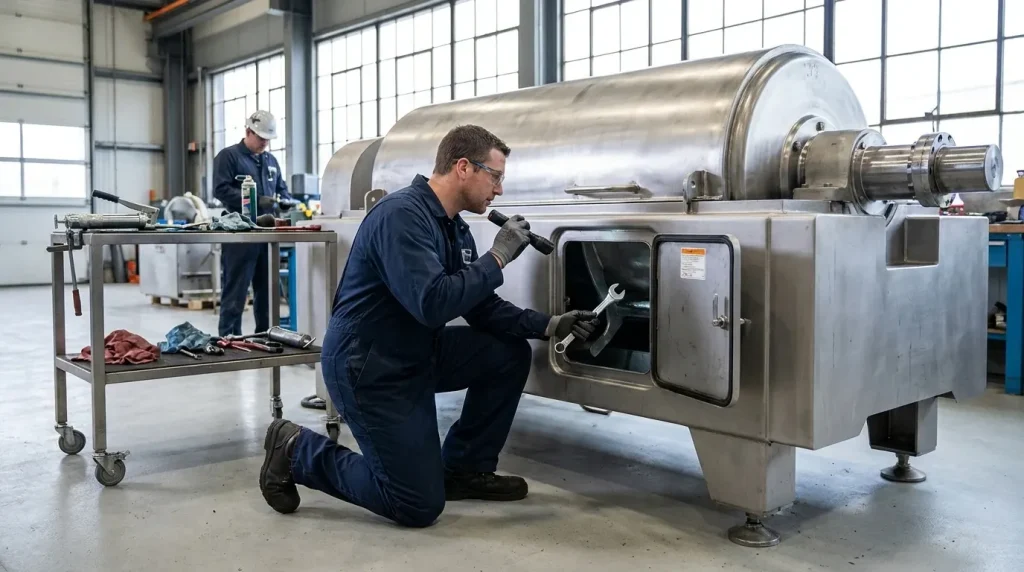
Regular maintenance optimizes decanter centrifuge performance by preventing unplanned downtime, extending component life, and maintaining separation efficiency within design specifications.
Common maintenance intervals might include:
- Every 3–5 days (continuous 24/7 operation): Grease bowl bearings
- Every 7,000 hours: Lubricate main drive motor bearings on the drive end
- Every 13,000 hours: Lubricate non-drive end motor bearings
- Weekly: Inspect feed tubes, discharge ports, and wear tiles for erosion
- Monthly: Check gearbox oil levels and vibration readings
- Annually: Complete internal inspection of scroll conveyor flights and bowl surfaces
Manufacturer guidelines and technical documentation should always be referenced for precise maintenance interval timelines. Facilities adhering to ISO 9001:2015 quality management system standards should follow structured protocols and document maintenance procedures, ensuring consistency and helping extend equipment reliability. Proactive scheduling based on operating hours and predictive analytics where enabled rather than solely on calendar time prevents the costly consequences of component failure or scroll wear.
With decanter benefits and maintenance protocols in place, partnering with an experienced equipment supplier streamlines both acquisition and long-term support.
How can International Process Plants help you source and integrate decanter centrifuges into your operations?
International Process Plants offers new surplus and quality used decanter centrifuges for chemical, pharmaceutical, food processing, and industrial applications. The following sections explain our equipment solutions and summarize the essential takeaways from decanter centrifuge technology.
What solutions does International Process Plants offer for acquiring used, new, or refurbished decanter centrifuges?
International Process Plants offers solutions for acquiring new surplus and quality used decanter centrifuges through our global inventory of over 15,000 pieces of process equipment. Our decanter centrifuges support continuous solid-liquid separation across industries including chemical processing, food production, and wastewater treatment.
We maintain inventory at warehouses in Eastover, South Carolina (US), Germany, and the United Kingdom, enabling efficient shipping to facilities worldwide. Equipment currently available includes horizontal bowl centrifuges with various bowl diameters and throughput capacities to match your specific process requirements.
Our procurement team can source decanter centrifuges for applications ranging from oil recovery and starch dewatering to pharmaceutical separation. When you acquire equipment through International Process Plants, you benefit from 46+ years of process equipment expertise and technical support to ensure proper integration into your existing operations.
What are the key takeaways about how decanter centrifuges work, their process, applications, and benefits?
The key takeaways about decanter centrifuges cover their operating principle, process stages, applications, and benefits:
- Working principle: High-speed bowl rotation can generate g-forces around 500 to 4,000 × g that separate solids from liquids based on density differences
- Main components: Rotating bowl, scroll conveyor, gearbox, feed zone, and discharge ports work together for continuous separation
- Process stages: Feed introduction, clarification, sediment compaction at the beach section, and final discharge of separated phases
- Size range: Bowl diameters from around 150 mm to upwards of 1,400 mm (6 to 55 in.) accommodate throughput requirements from pilot-scale to large industrial operations
- Some key applications: Wastewater sludge dewatering, oil extraction, starch production, whey protein processing, and chemical manufacturing
- Primary benefits: Continuous operation, high automation, reduced labor requirements, and versatility across varying particle sizes and slurry concentrations
For procurement engineers evaluating separation equipment, the combination of continuous throughput and adaptability to different feed characteristics makes decanter centrifuges a practical choice for many solid-liquid separation challenges. Contact International Process Plants to discuss your specific throughput and separation requirements.

 NL
NL  EN
EN  ES
ES  FR
FR  PL
PL  DE
DE  AR
AR  UR
UR  HI
HI  TR
TR  IT
IT  UK
UK  RU
RU  JA
JA  PT
PT  ZH
ZH