 Ga naar inhoud
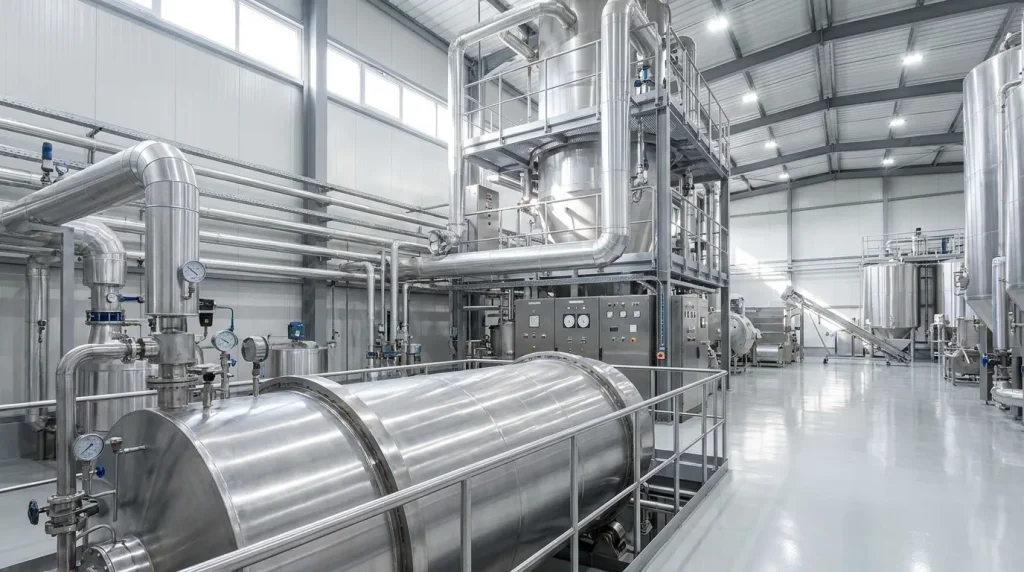
Conduction, convection, and radiation drying are three industrial heat transfer mechanisms that differ in how thermal energy reaches wet material: direct surface contact, moving hot air or gas, or electromagnetic waves. Each mechanism suits different materials, throughput targets, and energy profiles.
This guide covers how each drying method works and its core equipment, the materials and applications best suited to each, the safety and compliance requirements that apply, and how to compare cost, energy efficiency, and product quality when selecting a method.
Conduction drying transfers heat through direct contact between a heated surface and the product, using drum dryers and contact dryers for viscous foods, slurries, pastes, and heat-stable thin-film materials. Steam-heated drums operate at 2 to 6 bar (29 to 87 PSI), with product residence times as short as 2 to 30 seconds, delivering fast heat transfer at the risk of surface scorching.
Convection drying passes heated air or gas over the material, carrying moisture away in the exhaust stream. Spray dryers, fluidized bed dryers, rotary dryers, and tray dryers handle a broad range of powders, granules, and particulate solids across pharmaceutical, chemical, food, and mineral sectors, though heated airflow makes the method energy-intensive.
Radiation drying uses infrared, microwave, or radio-frequency energy to heat moisture directly within materials such as coatings, textiles, films, and moisture-selective products. This method requires shielding, interlocks, and worker exposure controls because radio-frequency and microwave systems emit electromagnetic fields.
Method selection depends on material form, target moisture content, batch capacity, energy consumption, and validated process control.
How Does Conduction Drying Work and What Are Its Main Features?
Conduction drying works by transferring heat through direct contact between a heated surface and the wet material. This section covers the equipment that uses conduction drying, the materials best suited to it, and its main advantages and disadvantages.
What Types of Industrial Equipment Use Conduction Drying?
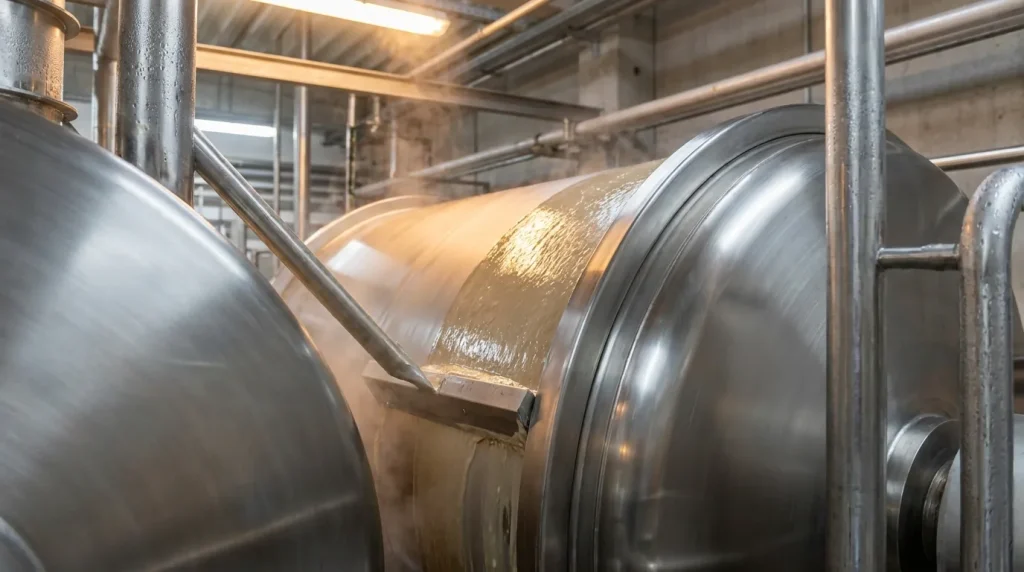
The types of industrial equipment that use conduction drying are drum dryers and contact dryers, which apply heat through direct surface contact. Drum dryers press a thin product film onto steam-heated rotating cylinders, then scrape the dried material off after a short residence time. Industrial dryers process large quantities of bulk materials that need reduced moisture levels.
Common conduction drying equipment includes:
- Drum dryers for viscous foods, purees, and slurries.
- Contact dryers for viscous materials, starches, and sticky materials.
Drum and contact dryers transfer heat efficiently, but operators must control surface temperature to prevent product scorching. For most high-moisture viscous feeds, conduction equipment delivers faster heat transfer than air-based systems.
What Materials and Processes Are Best Suited for Conduction Drying?
The materials best suited for conduction drying are viscous foods, slurries, pastes, purees, starches, chemicals, and heat-stable thin-film products. Conduction occurs when heat moves through materials in direct contact with each other, so these feeds must tolerate direct contact with a heated surface.
Conduction drying suits materials such as:
- Viscous liquids and slurries
- Pastes, purees, and starches
- Heat-stable chemical and thin-film products
Materials that scorch easily or carry contamination risk are poor candidates, since direct surface contact concentrates heat at the product interface.
What Are the Advantages and Disadvantages of Conduction Drying?
The advantages of conduction drying are direct contact heat transfer, short residence times, and strong suitability for viscous liquids and slurries. The main disadvantages are product scorching risk, demanding cleaning requirements, and limited material compatibility.
The key advantages and disadvantages are:
| Aspect | Voordeel | Disadvantage |
| Heat transfer | Direct, efficient contact | Scorching at the surface |
| Residence time | Short processing cycles | Limited to heat-stable feeds |
| Product type | Ideal for viscous slurries | Difficult cleaning between batches |
For viscous, heat-stable feeds, conduction drying remains one of the most efficient choices despite its cleaning demands. With conduction drying established, convection methods offer a contrasting air-based approach.
How Does Convection Drying Work and Why Is It Commonly Used?
Convection drying works by passing heated air or gas over wet material, transferring heat to the surface and carrying moisture away in the exhaust stream. It is commonly used because it suits a wide range of materials and scales. The sections below cover convection drying equipment, suitable materials and applications, and the method’s pros and cons.
What Types of Systems or Equipment Are Used for Convection Drying?
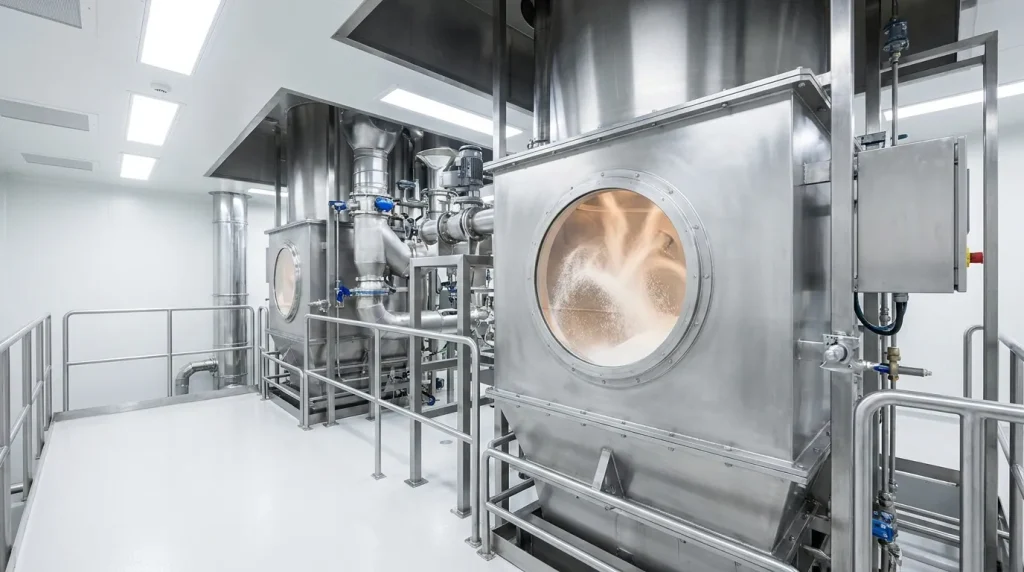
The types of systems used for convection drying are spray dryers, fluidized bed dryers, rotary dryers, and tray dryers. Drying is a common unit operation in pharmaceutical manufacturing, often used to remove solvent or water from wet granules, which makes convection equipment central to many production lines. Each system controls airflow, inlet and outlet temperature, residence time, and humidity to manage drying rate. The main convection drying systems are:
- Spray dryers: atomize liquid feed into hot gas for rapid powder formation.
- Fluidized bed dryers: suspend granular solids in an upward air stream for uniform drying.
- Rotary dryers: tumble bulk solids through a heated, rotating drum.
- Tray dryers: circulate hot air across stacked product trays in batches.
When convection dryers process flammable dusts or solvents, the ATEX Directive 2014/34/EU covers equipment and protective systems intended for use in potentially explosive atmospheres.
What Materials and Industrial Applications Favor Convection Drying?
The materials and applications that favor convection drying are particulate solids and powders processed across many industries. Convection drying is most applicable to pharmaceuticals, chemicals, food powders, fertilizer, cement, minerals, paper and pulp, ceramics, textiles, granules, crystals, droplets, and particulate solids. This broad compatibility comes from convection’s reliance on airflow rather than direct surface contact, which lets the method handle free-flowing and loosely bound materials. The core controllable parameters are:
- Airflow rate and distribution
- Inlet and outlet temperature
- Residence time
- Humidity and drying-rate control
- Exhaust handling
For procurement engineers, this flexibility is what makes convection the default choice when a single line must run multiple products with varying moisture loads.
What Are the Pros and Cons of Convection Drying?
The pros and cons of convection drying center on its flexibility against its energy demand. Convection handles diverse materials and scales well, but heated airflow makes it energy-intensive. A 2024 study in Research in Agricultural Engineering on rotary paddy drying found that higher temperature significantly shortened drying time, reduced total energy and fuel consumption even at higher capacity, and achieved the lowest carbon dioxide emissions at the highest temperature and capacity.
The main trade-offs are:
- Advantages: broad material compatibility, scalable equipment options, and adjustable drying-rate control.
- Disadvantages: high energy use, exhaust handling requirements, and longer residence times for some materials.
Raising inlet temperature within product-safe limits is the most direct lever for cutting both drying time and operating cost. With convection trade-offs clear, radiation drying offers a contrasting approach for specialized materials.
What Is Radiation Drying and How Does It Differ from Other Methods?
Radiation drying is a method that uses electromagnetic energy, such as infrared, microwave, or radio-frequency waves, to heat and evaporate moisture directly within a material. Radiant heat travels in a straight line and heats any solid that absorbs its energy, unlike conduction or convection. The sections below cover equipment, use cases, limitations, and safety.
What Industrial Equipment Uses Radiation Drying?
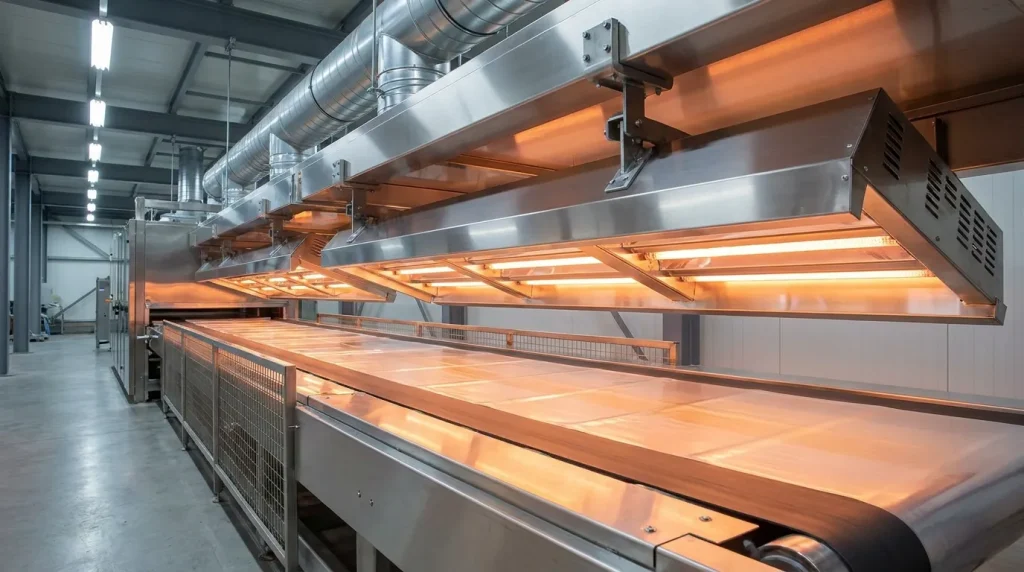
Radiation drying equipment includes infrared dryers, microwave drying systems, and radio-frequency (RF) dielectric dryers that transfer energy through electromagnetic waves. Radiofrequency and microwave radiation operate in distinct frequency ranges: RF spans 3 kilohertz (kHz) to 300 megahertz (MHz), and microwave spans 300 MHz to 300 gigahertz (GHz). According to the Occupational Safety and Health Administration (OSHA), microwave drying equipment, heat sealers, vinyl welders, and glue curing all use RF/MW radiation.
Common radiation drying equipment includes:
- Infrared dryers for coatings, textiles, and thin films
- Microwave dryers for food products
- RF dielectric dryers for ceramics and polymers
- Glue curing and heat sealing systems
What Are Typical Use Cases and Limitations of Radiation Drying?
Radiation drying use cases include coatings, textiles, thin films, food products, ceramics, polymers, glue curing, and moisture-selective dielectric-responsive materials. The method excels at selective, rapid surface and volumetric heating where penetration depth and absorption behavior suit the product.
Key limitations of radiation drying are:
- Limited penetration depth in dense or thick materials
- Required shielding and interlocks to contain electromagnetic fields
- Worker exposure assessment and leakage checks
- Higher operator-safety overhead than hot-air systems
For most production lines, hybrid integration with hot air or vacuum drying overcomes single-mechanism penetration limits while preserving the speed advantage of radiant energy.
What Safety or Efficiency Considerations Apply to Radiation Drying?
Safety considerations for radiation drying include shielding, interlocks, warning signage, leakage checks, lockout/tagout, and worker training, because RF and microwave systems emit electromagnetic fields. A complete framework should emphasize wavelength or frequency, absorption behavior, penetration depth, and worker exposure controls.
Efficiency gains depend on matching the radiation frequency to the material’s absorption behavior and integrating heat recovery. Procurement engineers should always address operator-safety controls early in specification. With radiation drying defined, the next section compares all three methods side by side.
How Do You Compare Conduction, Convection, and Radiation Drying in Industrial Settings?
Comparing conduction, convection, and radiation drying in industrial settings means matching each heat transfer mechanism to material properties, throughput, energy targets, and product quality goals. The following sections cover selection criteria and how cost, energy efficiency, and product quality differ among the three methods.

What Criteria Should Be Used to Select the Right Drying Method?
The criteria used to select the right drying method are material form, target moisture content, batch capacity, residence time, operating temperature, energy consumption, uniformity, and validated process control. Material form drives the first decision: drum drying, a convective-conductive method, suits viscous or liquid foods, while fluidized bed drying suits granular materials.
Key selection criteria include:
- Material form and heat tolerance: viscous liquids, slurries, granules, or thin films.
- Target moisture endpoint and uniformity: consistent final moisture across the batch.
- Batch capacity and residence time: throughput needs versus product exposure.
- Operating temperature and energy use: balancing speed against fuel and electricity cost.
- Validated control strategy: documented, repeatable process control for regulated sectors.
How Do Cost, Energy Efficiency, and Product Quality Differ Among Methods?
Cost, energy efficiency, and product quality differ among methods according to capital outlay, energy per kilogram of moisture removed, drying time, and final product condition. Drying is one of the most energy-intensive unit operations in the process industries, so control strategy directly affects both cost and throughput. A 2023 study in MDPI Electronics on pharmaceutical fluidized-bed drying found a control strategy that reduced drying time by 29.4% and achieved 9.45% energy savings versus conventional control.
With selection criteria and trade-offs defined, sourcing the right dryer becomes the next step.
How Can International Process Plants Support Your Drying Equipment Needs?
International Process Plants supplies new surplus and quality used drying equipment for chemical, pharmaceutical, and industrial processing. The sections below cover the dryer types we currently stock and a summary of the conduction, convection, and radiation drying differences explained throughout this article.
Can International Process Plants Help Source Used Conduction, Convection, or Radiation Dryers?
Yes, International Process Plants can help source conduction, convection, and radiation dryers from our inventory of 15,000+ pieces of process equipment. We stock dryers covering all three heat transfer mechanisms, which lets buyers match equipment to a specific process need rather than a single drying method.
The dryer categories we currently support include:
- Conduction dryers, such as drum and contact units that transfer heat through direct surface contact for slurries, pastes, and viscous materials.
- Convection dryers, such as spray dryers, fluidized bed dryers, rotary dryers, and tray dryers that move heated air across powders, granules, and particulate solids.
- Radiation dryers, such as infrared, microwave, and radio-frequency units used for coatings, films, and moisture-selective materials.
Drying ranks among the most energy-intensive unit operations in the process industries. Buying quality used equipment lowers capital outlay while still delivering proven thermal performance. Matching the dryer mechanism to product behavior matters more than chasing the newest model, since a well-specified used dryer often outperforms a poorly matched new one. We stock equipment in stainless steel grades including 316L, 316, 304, and 304L, with quality units held across our warehouses in the United States, Germany, and the United Kingdom.
What Are the Key Takeaways About Conduction vs. Convection vs. Radiation Drying We Covered?
The key takeaways are that conduction, convection, and radiation drying differ in how heat reaches the product and which materials each method suits best.
- Conduction drying transfers heat through direct contact with a heated surface, making it suitable for viscous foods, slurries, pastes, and heat-stable materials.
- Convection drying transfers heat through moving hot air or gas, making it the most versatile method for powders, granules, droplets, and particulate solids.
- Radiation drying transfers heat through infrared, microwave, or radio-frequency energy, making it suitable for coatings, films, and moisture-selective products, though it requires shielding and exposure controls.
The practical lesson for buyers is to start with the product characteristics first. Match the heat transfer mechanism to your material’s moisture behavior, target throughput, and energy budget first. International Process Plants can help you identify and source the right used dryer once those requirements are clear.

 NL
NL  EN
EN  ES
ES  FR
FR  PL
PL  DE
DE  AR
AR  UR
UR  HI
HI  TR
TR  IT
IT  UK
UK  RU
RU  JA
JA  PT
PT  ZH
ZH