 コンテンツにスキップ
Sizing a chemical reactor for industrial processes is the engineering discipline of determining the optimal vessel volume, geometry, and operating envelope needed to achieve a target conversion at a specified production rate while maintaining safety and regulatory compliance.
This guide covers reaction kinetics and design variables, reactor type comparisons, sizing equations and dimensionless parameters, practical design workflow, common sizing errors, and equipment sourcing strategies.
Reaction kinetics and design variables form the foundation of every sizing calculation. Rate constants governed by the Arrhenius equation, production throughput expressed as space-time, and operating conditions in temperature and pressure collectively define minimum vessel volume and wall thickness requirements.
Reactor type comparisons address how batch, continuous, and semi-batch systems each use fundamentally different sizing parameters; batch reactors size by charge volume and cycle time, while continuous systems size by volumetric flow rate and residence time. Plug flow reactors achieve higher conversion per unit volume than stirred tanks for positive-order reactions, making geometry selection inseparable from sizing.
Sizing equations and dimensionless parameters provide the quantitative tools for final calculations. The Damkohler number identifies whether a system is kinetics-limited or mass-transfer-limited, directly determining whether additional volume will improve conversion or whether enhanced mixing is required instead.
Practical design workflow covers project objective definition, data gathering per ISO 10628 flow diagram standards, and compliance with ASME, PED, CE marking, UKCA, and ATEX requirements depending on installation jurisdiction.
Common sizing errors and equipment sourcing address the consequences of under-sizing (failed conversion targets, safety risks) and over-sizing (excess capital expenditure, reduced mixing efficiency), along with how International Process Plants matches verified reactor specifications from over 10,000 pieces of inventory to documented process requirements.
What key factors influence the sizing of a chemical reactor?
The key factors influencing the sizing of a chemical reactor are reaction kinetics, desired production rates, and operating temperature and pressure. Each factor determines a different dimension of the final vessel specification.
How does reaction kinetics affect reactor size?
Reaction kinetics affects reactor size by dictating how long reactants must remain in the vessel to achieve the target conversion. Faster reactions require smaller volumes; slower reactions demand larger vessels or longer residence times.
The Arrhenius equation, k = Ae^(-Ea/RT), quantifies how temperature influences the rate constant. Higher activation energies mean the reaction is more sensitive to temperature changes, which directly impacts whether a smaller, high-temperature vessel can replace a larger, low-temperature one.
The Damköhler number (Da) relates reaction rate to transport rate. When Da is much greater than 1, mass transfer limits performance, and additional volume alone will not improve conversion. Engineers must evaluate whether the system is kinetics-limited or transport-limited before committing to a reactor volume.

How do desired production rates determine reactor volume?
Desired production rates determine reactor volume through the relationship between volumetric flow and required residence time. According to the University of Michigan, space time (τ) is obtained by dividing reactor volume by the volumetric flow rate entering the reactor, representing the time necessary to process one reactor volume of fluid at entrance conditions.
For batch reactors, volume links directly to batch size and cycle time. For continuous systems, volume equals the product of volumetric flow rate and required residence time:
- V = Q × τ (continuous flow reactors)
- V = working volume + headspace allowance (batch reactors)
Distinguishing between design capacity and working capacity is critical. Working capacity, typically 80% of total vessel volume, often matters more to buyers because it reflects usable processing space after accounting for vapor disengagement and mixing zones.
What role do temperature and pressure play in reactor sizing?
Temperature and pressure play a central role in reactor sizing because they govern reaction rate, equilibrium conversion, and vessel wall thickness. Higher operating temperatures accelerate kinetics but require thicker walls or higher-grade alloys like 316L stainless steel or Hastelloy C-276.
Operating pressure similarly affects both reaction equilibrium and mechanical design. Vessels operating at 150 PSI (10.3 bar) require heavier construction than atmospheric-pressure designs. According to ScienceDirect, in petrochemical industries, most accidents related to valve failure are linked to overpressure events and malfunctioning or under-sizing of safety valves.
Pressure equipment must comply with relevant standards across jurisdictions:
- ASME Section VIII (global recognition)
- Pressure Equipment Directive (PED) and CE marking (EU markets)
- UKCA marking (United Kingdom)
Properly accounting for maximum allowable pressure and temperature during sizing prevents costly over-engineering while maintaining regulatory compliance and operational safety.
With these sizing factors established, the next step is understanding how different reactor types require distinct approaches.
Which types of chemical reactors require different sizing approaches?
Chemical reactors require different sizing approaches because batch, continuous, and semi-batch systems each use distinct design variables. The following sections compare sizing methods across reactor types and address plug flow versus stirred tank considerations.
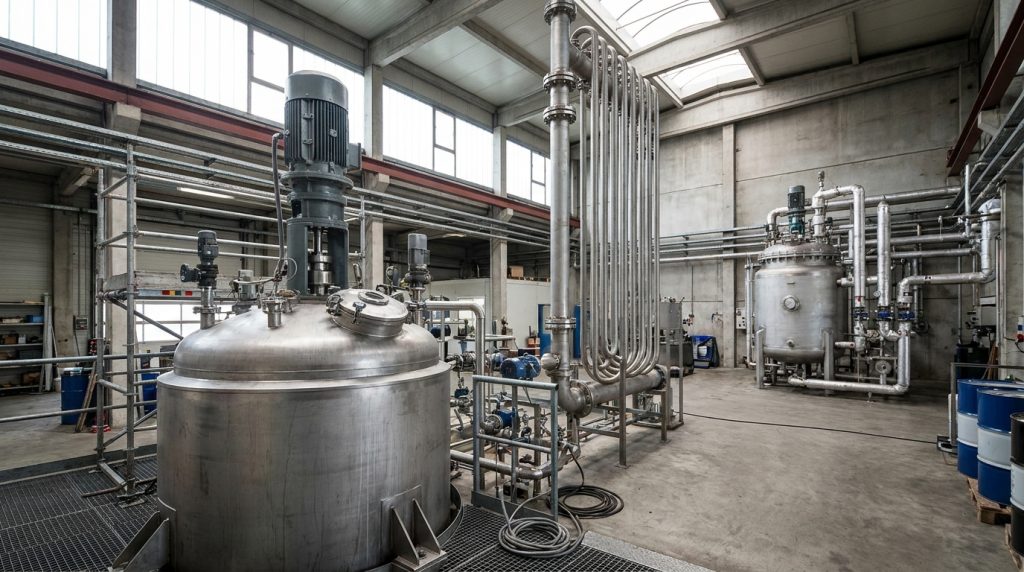
How is reactor sizing different for batch, continuous, and semi-batch reactors?
Reactor sizing is different for batch, continuous, and semi-batch reactors because each type defines volume requirements through fundamentally different parameters.
- Batch reactors are closed vessels where all reactants are added initially, and the reaction proceeds over time. Volume depends on total charge size and required residence time per cycle.
- Continuous reactors (such as CSTRs and tubular designs) size based on volumetric flow rate and space time, requiring steady-state throughput calculations rather than cycle-based estimates.
- Semi-batch reactors combine both approaches: an initial charge determines base volume, while controlled feed addition over time dictates headspace and thermal management capacity.
According to Dataintelo, the chemical reactors market was valued at $12.4 billion in 2025 and is projected to reach $21.8 billion by 2034, growing at a 6.5% CAGR. This growth reflects increasing demand across all three reactor categories, making correct sizing methodology essential for capital efficiency.
What special considerations apply for sizing plug flow versus stirred tank reactors?
Special considerations for sizing plug flow reactors (PFRs) versus stirred tank reactors (CSTRs) center on residence time distribution and mixing behavior.
- PFRs assume no axial mixing; fluid moves as a uniform “plug” through the tube. Sizing depends on tube length, diameter, and flow velocity to achieve target conversion at a given reaction rate.
- CSTRs assume perfect back-mixing; the exit composition equals the composition inside the vessel. For the same target conversion, CSTRs typically require larger volumes than PFRs for positive-order reactions.
- For reactions requiring high conversion (above 90%), PFRs are inherently more volume-efficient, while CSTRs may need multiple stages in series to approach equivalent performance.
Equipment destined for European or UK markets must comply with the Pressure Equipment Directive (PED) for CE marking or meet UKCA requirements, which differ in scope and detailed requirements. These compliance factors directly influence vessel geometry and wall thickness calculations during sizing.
With reactor types clarified, the next step involves the specific equations and calculations used to determine final dimensions.
What calculations and equations are used in chemical reactor sizing?
The calculations used in chemical reactor sizing include material balance equations, energy balances, and dimensionless numbers that relate reaction rates to transport phenomena. The subsections below cover fundamental design equations, conversion and space-time parameters, and heat and mass transfer limitations.

What fundamental design equations are involved in reactor sizing?
The fundamental design equations involved in reactor sizing are the material balance (mole balance) equations specific to each reactor type. For a batch reactor, the design equation relates volume to the integral of molar flow over reaction rate. For a CSTR, reactor volume equals the product of volumetric flow rate and the change in concentration divided by reaction rate. For a plug flow reactor (PFR), volume is determined by integrating the molar flow rate over conversion divided by the rate expression.
These equations assume ideal conditions. According to an AIChE publication, expert expertise is crucial to avoiding common pitfalls, which often result from sizing based on theoretical design without accounting for real-world operation. Applying safety factors and validating kinetics data against pilot-scale results prevents costly mismatches between calculated and actual performance.
How are conversion, space-time, and space-velocity used in calculations?
Conversion, space-time, and space-velocity are used in calculations to link reactor volume with throughput and reaction progress. Conversion (X) represents the fraction of limiting reactant consumed, directly determining required residence time. Space-time (τ) equals reactor volume divided by the inlet volumetric flow rate, representing the time necessary to process one reactor volume of fluid at entrance conditions. Space-velocity (SV) is the inverse of space-time, expressed in reciprocal hours (h⁻¹).
Engineers use these parameters to size reactors as follows:
- Higher target conversion requires larger reactor volume or longer residence time.
- Space-time sets the minimum vessel size for a given production rate.
- Space-velocity benchmarks allow quick comparisons between reactor configurations.
How do you account for heat and mass transfer limitations?
You account for heat and mass transfer limitations by evaluating dimensionless numbers that identify whether the reaction is kinetics-controlled or transport-controlled. According to ScienceDirect, the Damkohler number (Da) is defined as the dimensionless ratio of the reaction rate to the rate of mass transfer; Da >> 1 indicates a mass-transfer limited system, while Da << 1 indicates a kinetic-limited system.
When Da >> 1, increasing reactor volume alone will not improve conversion. Instead, engineers must enhance mixing intensity, increase heat transfer area, or reduce particle size. When Da << 1, the reaction itself is the bottleneck, and standard kinetic sizing equations apply directly. Evaluating this ratio early in design prevents oversizing vessels that cannot overcome transport resistances regardless of volume.
With these equations and dimensionless parameters established, the next step involves applying them within a structured design process.
What practical steps are involved in the reactor sizing process?
The practical steps involved in the reactor sizing process include defining project objectives, gathering design data, addressing safety and regulatory requirements, and planning for scalability. The following subsections detail each step.
How do you define project objectives and gather necessary design data?
You define project objectives and gather necessary design data by establishing target production rates, conversion requirements, and operating conditions before any calculations begin. Key data to collect includes:
- Reaction kinetics parameters (rate constants, activation energy, reaction order)
- Feed composition, volumetric flow rates, and desired product specifications
- Operating temperature range in both °F and °C, and pressure range in PSI and bar
- Physical properties of reactants and products (density, viscosity, heat capacity)
- Batch cycle time or continuous throughput targets
Process flow diagrams prepared according to ISO 10628, which specifies classification, content, and representation of flow diagrams for chemical and petrochemical processes, provide the foundation for capturing these inputs systematically. Without complete design data, sizing calculations produce unreliable results that lead to costly corrections during commissioning.
Which safety and regulatory factors must be considered during sizing?
The safety and regulatory factors that must be considered during sizing include pressure relief capacity, material compatibility, hazardous atmosphere classification, and compliance with jurisdiction-specific codes. Critical considerations are:
- ASME Section VIII (Division 1 or 2) for pressure vessel design in North America
- The Pressure Equipment Directive (PED) and CE marking for European markets
- UKCA marking for equipment operating in the United Kingdom
- ATEX Directive certification when reactors operate in explosive atmospheres
- Adequate safety valve sizing to prevent overpressure events
According to a ScienceDirect study on petrochemical industry safety, most accidents related to valve failure are linked to overpressure events and malfunctioning or under-sizing of safety valves. For process engineers, this underscores that regulatory compliance is not merely administrative; it directly determines whether a reactor can operate safely at design conditions.

How should scalability and future expansion be factored into reactor sizing?
Scalability and future expansion should be factored into reactor sizing by incorporating design margins that accommodate projected production increases without requiring full equipment replacement. Practical approaches include:
- Selecting vessel volumes with 10–15% additional working capacity beyond current requirements
- Specifying nozzle sizes and agitator drives that support higher throughput
- Choosing materials of construction (316L stainless steel, Hastelloy C-276) rated for broader process envelopes
- Designing support structures and piping layouts that permit future parallel reactor installation
Oversizing carries its own risks, including higher capital costs and reduced mixing efficiency at low fill levels. The most effective strategy balances near-term operating needs against realistic growth projections, typically aligned with production forecasts. Modular approaches, where capacity increases through additional identical units rather than a single oversized vessel, often reduce financial risk while preserving operational flexibility.
With practical sizing steps established, awareness of common mistakes helps avoid costly errors during execution.
What are common mistakes and troubleshooting tips in reactor sizing?
Common mistakes in reactor sizing include using inaccurate kinetics data, selecting improper safety margins, and failing to account for real-world operating conditions. The sections below cover kinetics errors, the consequences of incorrect sizing, and post-installation validation methods.
How can improper kinetics data lead to sizing errors?
Improper kinetics data can lead to sizing errors by producing incorrect predictions of reaction rates, residence times, and required reactor volumes. When rate constants derived from the Arrhenius equation are measured at laboratory scale without accounting for temperature gradients or mixing limitations present at full scale, the calculated volume will not match actual process needs. Inaccurate activation energy values cause exponential errors in rate predictions across operating temperature ranges. Similarly, using kinetics measured under ideal conditions ignores mass transfer resistances that slow reactions in larger vessels. For most batch reactor applications, validating kinetics at pilot scale before committing to a final vessel size remains the single most effective way to prevent costly rework.
What are the impacts of under- or oversizing a chemical reactor?
The impacts of under- or oversizing a chemical reactor span operational efficiency, safety, and project economics. According to research from King Fahd University of Petroleum and Minerals, under-sizing of process components minimizes waste heat recovery efficiency, while over-sizing impacts Net Present Value (NPV) due to excessive capital expenditure.
Key consequences of under-sizing include:
- Failure to achieve target conversion or yield at design throughput.
- Forced reduction in production rates to maintain product quality.
- Elevated pressures and temperatures from pushing reactions beyond safe limits.
- Increased risk of overpressure events requiring emergency relief.
Key consequences of over-sizing include:
- Higher capital expenditure on vessel fabrication, structural supports, and ancillary equipment.
- Reduced mixing efficiency in stirred vessels operating below design fill levels.
- Longer heat-up and cool-down cycles, increasing batch cycle time.
- Lower return on investment from underutilized capacity.
In practice, engineers often over-size reactors driven by fear of under-sizing, yet a 10-15% design margin typically provides adequate buffer without the penalties of gross over-sizing.
How can you validate and optimize reactor size after installation?
You can validate and optimize reactor size after installation by comparing measured performance against original design parameters and adjusting operating conditions accordingly. Start by collecting actual data on conversion, yield, temperature profiles, and cycle times during commissioning runs. Compare these measurements against the design basis to identify deviations.
Practical validation steps include:
- Running test batches at varying fill levels to determine true working capacity versus design capacity.
- Measuring actual residence time distributions to confirm mixing assumptions.
- Monitoring heat transfer coefficients to verify jacket or coil performance matches rated specifications.
- Tracking pressure drop across inlet and outlet connections under real flow conditions.
If the reactor is oversized, reducing batch volumes or shortening cycle times can recover efficiency. If undersized, process intensification strategies, such as improved catalysts or optimized temperature profiles, can increase effective throughput without replacing the vessel.
With sizing validated, partnering with an experienced equipment supplier simplifies future capacity adjustments.
How can International Process Plants assist with chemical reactor sizing and equipment selection?
International Process Plants assists with chemical reactor sizing and equipment selection by providing access to over 10,000 pieces of new surplus and quality used process equipment, supported by 46+ years of sourcing expertise across global markets.

What services does International Process Plants offer for sourcing the right-sized reactors?
International Process Plants offers inventory matching, technical specification review, and global sourcing services for finding the right-sized reactors. With much of our reactor inventory consisting of batch reactors, we maintain one of the largest selections of process-ready vessels in materials including 316L, 316, 304, and 304L stainless steel, as well as Hastelloy C-276.
Our sourcing process accounts for critical sizing parameters:
- Design capacity and working capacity verification for your specific process requirements.
- Pressure ratings validated against ASME Section VIII, CE marking, and PED compliance for European installations.
- Temperature compatibility confirmed in both vessel operating range and jacket rating specifications.
- Material of construction matched to your chemical compatibility needs.
Over-sizing of chemical equipment is often driven by perceived risk of under-sizing, yet it leads to higher capital costs and operational efficiency losses. We help buyers avoid both extremes by matching actual process data, documented per ISO 10628 flow diagram standards, to currently available equipment with verified specifications from our warehouses in South Carolina (US), Germany, and the United Kingdom.
What are the key takeaways about how to size a chemical reactor?
The key takeaways about how to size a chemical reactor center on matching reaction kinetics, production targets, and safety margins to a vessel’s verified design specifications. Proper sizing requires balancing conversion requirements, space-time calculations, heat and mass transfer limitations, and regulatory compliance across jurisdictions.
Critical principles to remember:
- Define reaction kinetics data accurately before selecting reactor volume.
- Calculate required space-time based on volumetric flow rate and desired conversion.
- Account for both design capacity and working capacity when evaluating equipment.
- Verify compliance with PED, ATEX, CE marking, or UKCA marking depending on installation region.
- Factor in scalability so the reactor supports future production increases without requiring immediate replacement.
According to Verified Market Reports, the global chemical reactors market was valued at USD 6.8 billion in 2024 and is forecasted to reach USD 9.9 billion by 2033 at a 4.8% CAGR. This sustained growth makes selecting correctly sized equipment a strategic investment decision, not merely a technical exercise. For procurement engineers evaluating reactor options, International Process Plants provides the global inventory depth and technical documentation needed to match sizing calculations to real, currently available equipment.

 JA
JA  EN
EN  ES
ES  FR
FR  PL
PL  DE
DE  AR
AR  UR
UR  HI
HI  NL
NL  TR
TR  IT
IT  UK
UK  RU
RU  PT
PT  ZH
ZH