 Vai al contenuto
A rotary dryer is a continuous industrial drying system that removes moisture from bulk solids by tumbling them through a heated air stream inside a rotating cylindrical drum. The drum’s slight incline and internal flights cascade material through hot gas, driving evaporation as the product moves from the feed end to the discharge end.
This guide covers rotary dryer components and construction materials, the step-by-step drying process, industry applications, performance and maintenance factors, comparisons with alternative drying technologies, and equipment sourcing.
Core components include the drum shell, internal flights (lifters), riding rings, trunnion wheels, and the girth gear drive system. Each performs a specific mechanical or thermal function; drums range from 1 feet to 14 feet (0.3 meters to 4.3 meters) in diameter, and construction materials span carbon steel, stainless steel, Hastelloy, and Inconel depending on process chemistry.
The drying process follows a clear sequence: wet material enters through a feed chute, flights lift and shower it through heated air, and moisture evaporates into the exhaust stream. Co-current airflow suits heat-sensitive materials, while counter-current configurations achieve higher thermal efficiency and lower final moisture content.
Rotary dryers serve chemical processing, mining, agriculture, food production, pharmaceuticals, and biomass energy sectors, handling everything from ore concentrates to pharmaceutical granules at throughputs from 10 pounds/hour (4.5 kilograms/hour) to over 100 tons/hour (90.7 metric tons/hour).
Temperature, airflow volume, and rotation speed are the primary variables governing performance. Regular alignment checks on trunnion wheels and riding rings prevent accelerated wear and unplanned downtime.
Compared to fluid bed dryers, rotary dryers trade some energy efficiency for superior material versatility and high-volume continuous operation. International Process Plants helps businesses source used, refurbished, or new rotary dryers by maintaining a global inventory of process equipment across warehouses in the United States, Germany, and the United Kingdom..
What are the main parts and components of a rotary dryer?
The main parts and components of a rotary dryer include the rotating drum (shell), flights, riding rings, trunnion wheels, the girth gear and pinion drive system, seals, and the feed and discharge housings. Each component serves a specific function in material transport, heat transfer, and structural support.

How does each component of a rotary dryer contribute to the drying process?
Each component of a rotary dryer contributes to the drying process by performing a dedicated mechanical or thermal function that keeps material moving, the drum rotating, and heat transfer maximized.
- Drum (shell): The cylindrical vessel that contains the material and rotates to promote tumbling and exposure to heated air. Drums typically range from 1 ft to 14 ft (0.3 m to 4.3 m) in diameter.
- Flights (lifters): Internal fins that pick up material and shower it through the air stream as the drum rotates, maximizing heat transfer between the material and drying air.
- Riding rings (tires): Circular bands that provide the surface on which the drum rotates, supported by the trunnion rollers beneath.
- Trunnion wheels (rollers): These serve as the cradle for the rotating drum, ensuring smooth, concentric rotation.
- Girth gear and pinion: The girth gear encircles the drum and is driven by a smaller pinion gear to rotate the entire assembly at controlled speed.
- Sigilli: Prevent air leakage at the feed and discharge ends, maintaining thermal efficiency inside the drum.
- Feed and discharge housings: Enclose the entry and exit points, directing material flow and containing the drying gas.
According to the AIChE Equipment Testing Procedure for Continuous Direct-Heat Rotary Dryers, standardized methods exist for evaluating how these components perform together in chemical process applications. When any single part degrades, the entire system’s throughput and energy consumption suffer, making component-level understanding essential for procurement decisions.
What materials are commonly used to construct rotary dryers?
The materials commonly used to construct rotary dryers include carbon steel, stainless steel (such as 304 and 316 grades), Hastelloy, Inconel, and various specialty alloys. Material selection depends on the chemical properties of the product being dried, operating temperature, and corrosion resistance requirements.
- acciaio al carbonio suits non-corrosive bulk materials at moderate temperatures.
- Stainless steel (304, 316L) handles corrosive chemicals and food-grade applications.
- Hastelloy and Inconel resist extreme chemical attack and high-temperature oxidation.
For biomass applications, where rotary drum dryers commonly reduce moisture content from approximately 50% down to 5% to 7%, corrosion-resistant alloys extend service life under acidic condensate conditions. Matching metallurgy to process chemistry is one of the most overlooked factors in used equipment procurement, yet it directly determines long-term reliability and maintenance costs. International Process Plants maintains expertise in material compatibility assessment for used and new surplus rotary dryers, helping procurement teams match equipment metallurgy to specific process chemistry requirements across pharmaceutical, chemical, and food processing applications.
What is the step-by-step process of drying material in a rotary dryer?
The step-by-step process of drying material in a rotary dryer involves feeding wet material into a rotating drum, applying heat to evaporate moisture, and discharging the dried product. The sub-sections below cover material introduction, heat transfer, and moisture removal.
How is wet material introduced and moved through a rotary dryer?
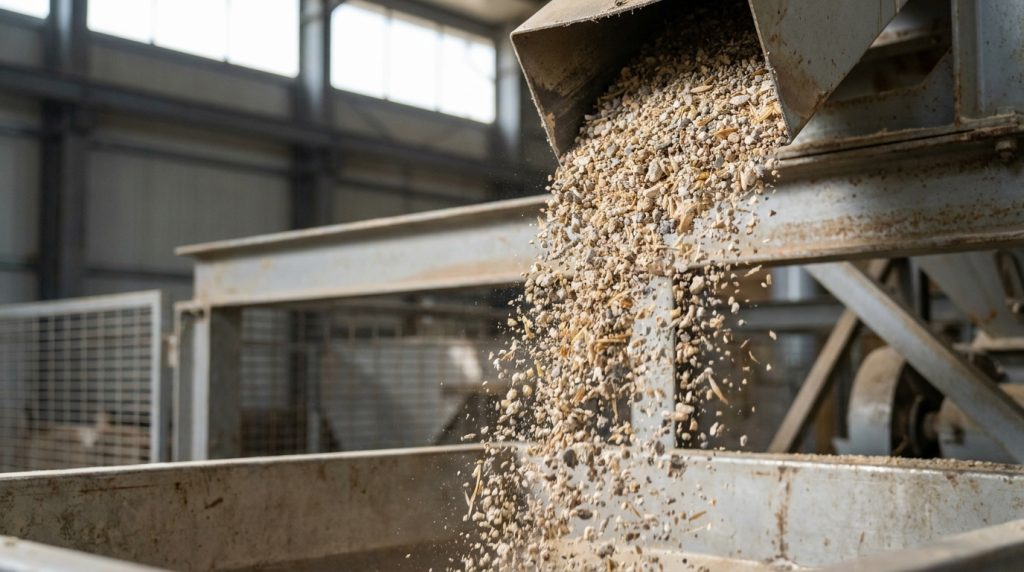
Wet material is introduced into a rotary dryer through a feed chute or screw conveyor at the elevated end of the drum. Gravity and the drum’s slight incline (typically 1 to 5 degrees) advance the material toward the discharge end. As the drum rotates, internal flights (lifters) pick up the material and shower it through the air stream, maximizing heat transfer between the material and drying air.
Retention time, or residence time, is the duration the material stays inside the dryer drum to achieve the target moisture reduction. According to FEECO International, the dryer shell can be constructed from carbon steel, stainless steel, Hastelloy, Inconel, and other alloys, each selected based on the material’s corrosiveness and operating temperature. Engineers adjust drum speed, angle, and flight configuration to control how long solids remain in the drying zone.
How is heat generated and transferred within a rotary dryer?
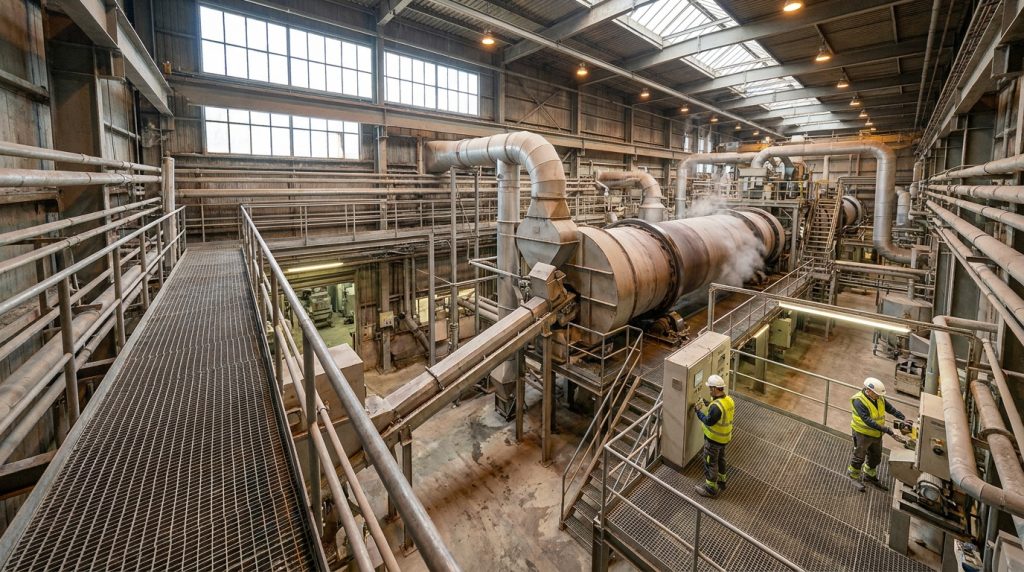
Heat is generated within a rotary dryer by a combustion burner (fired on natural gas, oil, or biomass) or through indirect steam tubes, depending on the application. In direct-heat designs, hot gas flows through the drum and contacts the material directly, transferring thermal energy through convection. Indirect designs heat the drum shell or internal tubes, transferring energy through conduction without exposing the product to combustion gases.
The choice between direct and indirect heating depends on whether the material tolerates contact with flue gases. While rotary dryers handle high throughput efficiently, fluidized bed dryers are generally more energy-efficient due to their superior heat transfer performance and precise moisture control. For processes requiring large-scale continuous operation, however, the rotary configuration remains the practical standard.
How is moisture removed from materials during rotary drying?
Moisture is removed from materials during rotary drying through evaporation driven by the temperature differential between the heated air and the wet material surface. As flights cascade solids through the hot gas stream, water molecules transition from liquid to vapor and are carried out of the drum by the exhaust air.
Two primary airflow configurations govern this process:
- In co-current drying, the material and drying gas move in the same direction, which is ideal for heat-sensitive materials because the hottest gas contacts the wettest material first.
- In counter-current drying, the material and gas move in opposite directions, allowing for higher thermal efficiency and lower final moisture content.
Selecting the correct airflow configuration directly influences product quality, energy consumption, and throughput capacity.
With the drying process established, several operational factors determine how efficiently a rotary dryer performs.
What types of materials and industries use rotary dryers?
Rotary dryers serve a wide range of industrial sectors and process a diverse array of bulk materials. The subsections below cover which industries benefit most and which specific products these dryers commonly handle.
Which industrial sectors benefit most from rotary dryer technology?
The industrial sectors that benefit most from rotary dryer technology include chemical processing, mining and minerals, agriculture, food production, pharmaceuticals, and biomass energy. These sectors share a common need for high-volume, continuous moisture removal from bulk solids.
According to a 2025 Grand View Research report on the global industrial dryer market, the rotary dryer segment held a 28.4% share of the total market due to its high volume capacity and continuous operation capability. That dominance reflects the technology’s scalability: drum diameters range from 1 ft to 14 ft (0.3 m to 4.3 m), with throughput capacities from 10 lb/hr (4.5 kg/hr) to over 100 tons/hr (90.7 tonnes/hr).
Key sectors include:
- Elaborazione chimica: fertilizers, catalysts, and polymer pellets requiring precise moisture targets.
- Mining and minerals: ore concentrates, calcium carbonate, and silica sand.
- Food production: steam tube dryers support large-scale facilities at 10 to 60 tons (9 to 54 metric tons) per hour.
- Biomass and energy: wood chips, bagasse, and municipal sludge for fuel preparation.
- Prodotti farmaceutici: granulated intermediates and excipients dried under controlled conditions.
While fluid bed dryers achieve higher thermal efficiency in certain applications, rotary dryers remain the preferred choice when feed materials vary in size, density, or stickiness. For procurement teams evaluating drying equipment, this versatility often outweighs marginal efficiency differences.
What are common products dried using rotary dryers?
Common products dried using rotary dryers span minerals, agricultural commodities, industrial chemicals, and organic materials. The technology handles feedstocks ranging from fine powders to coarse, irregular solids.
Frequently processed products include:
- Minerals: sand, limestone, phosphate rock, iron ore fines, and clay.
- Agricultural products: grain, corn, rice, soybean meal, and animal feed pellets.
- Chemical compounds: ammonium nitrate, potassium chloride, sodium sulfate, and activated carbon.
- Biomass materials: wood chips, sawdust, peat, and sugarcane bagasse.
- Waste and recycled materials: sewage sludge, compost, and recycled aggregates.
- Food ingredients: spent brewers grain, fish meal, and starch byproducts.
This breadth of application exists because rotary dryers tolerate wide variation in particle size, moisture content, and feed consistency. Few other drying technologies can process materials as coarse as ore chunks and as fine as chemical powders within the same basic equipment configuration.
Understanding the sectors and products that rotary dryers serve helps clarify the performance factors that determine optimal operation.
What factors affect the efficiency and performance of a rotary dryer?
The efficiency and performance of a rotary dryer depend on operating parameters like temperature, airflow, and rotation speed, as well as consistent preventive maintenance practices.
How do temperature, airflow, and rotation speed impact rotary dryer operation?
Temperature, airflow, and rotation speed impact rotary dryer operation by directly controlling heat transfer rates, material residence time, and moisture removal capacity. Higher inlet temperatures accelerate evaporation but risk degrading heat-sensitive materials. Airflow volume determines how quickly moisture-laden air is replaced with dry air inside the drum.
Rotation speed governs how frequently flights lift and cascade material through the gas stream. According to a study published in Heliyon (Cell Press), increasing the rotational speed of a flighted rotary dryer from 2.5 to 4.5 rpm significantly affects the solids’ discharge rate and airborne phase distribution. Faster rotation reduces residence time but increases material exposure to the air stream per revolution.
Trunnion wheels serve as the cradle for the rotating drum, ensuring concentric rotation that maintains consistent material contact with heated airflow. For most applications, balancing these three variables against target moisture content produces optimal throughput without excessive energy consumption.
What maintenance is required to keep rotary dryers running efficiently?
The maintenance required to keep rotary dryers running efficiently includes regular alignment checks, component inspections, and lubrication schedules. Key tasks include:
- Inspecting trunnion wheels and riding rings for wear patterns caused by misalignment.
- Verifying girth gear and pinion gear mesh for proper tooth contact.
- Checking seals at feed and discharge ends for air infiltration that reduces thermal efficiency.
- Lubricating bearings and drive components on manufacturer-recommended intervals.
- Monitoring shell straightness and drum runout to detect structural distortion.
Proper alignment of a rotary dryer prevents excessive wear on the trunnion wheels and riding rings, extending the equipment’s operational lifespan, according to FEECO International. Neglecting alignment leads to accelerated component degradation, unplanned downtime, and higher energy consumption as the drive system compensates for mechanical resistance.
With performance variables and maintenance protocols established, understanding how rotary dryers compare to alternative drying technologies helps inform equipment selection.

How do rotary dryers compare to other industrial drying technologies?
Rotary dryers compare favorably in throughput and material versatility, though they consume more energy than some alternatives. The following subsections examine specific advantages, disadvantages, and scenarios where other dryer types may be preferable.
What are the advantages and disadvantages of rotary dryers versus alternatives?
The advantages and disadvantages of rotary dryers versus alternatives center on capacity, energy use, and material flexibility.
Advantages of rotary dryers:
- High-capacity modern industrial dryers achieve a drying load of at least 20 metric tons of evaporated water per hour, according to a ScienceDirect publication.
- Rotary dryers handle a wide particle size range, from fine powders to large aggregates.
- Continuous operation suits high-volume production with minimal downtime.
Disadvantages of rotary dryers:
- Energy consumption is higher than fluid bed dryers, which achieve superior heat transfer performance and more precise moisture control.
- Large physical footprint requires significant floor space.
- Mechanical complexity increases maintenance demands for riding rings, trunnion wheels, and girth gears.
For operations prioritizing throughput above 10 metric tons per hour, rotary dryers remain difficult to replace despite their energy penalty. With over 46 years of experience serving chemical processing and minerals industries, International Process Plants helps facilities source rotary dryers suited to high-throughput applications, offering access to used, refurbished, and new surplus equipment worldwide..
In what situations might a different dryer type be preferable?
A different dryer type might be preferable when energy efficiency, precise moisture control, or space constraints outweigh throughput requirements. The IEA notes that peaking fossil fuel demand is driving a shift toward more efficient clean energy drying technologies, making thermal efficiency a growing selection criterion.
Situations favoring alternatives include:
- Heat-sensitive pharmaceuticals or fine chemicals requiring narrow temperature bands (fluid bed dryers offer tighter control).
- Space-limited facilities where vertical flash dryers occupy a smaller footprint.
- Applications demanding final moisture below 1%, where fluid bed or vacuum dryers achieve lower residual moisture more efficiently.
- Low-throughput specialty batches where tray or conveyor dryers reduce operating cost.
When throughput exceeds 20 metric tons per hour and the material tolerates direct-heat contact, rotary dryers typically remain the most practical choice despite higher energy input.
With drying technology selection clarified, International Process Plants can help match these requirements to currently available equipment.
How can businesses acquire, upgrade, or replace rotary dryers through International Process Plants?
Businesses can acquire, upgrade, or replace rotary dryers through International Process Plants by leveraging our global inventory of new surplus and quality used process equipment. The following sections explain our sourcing capabilities and summarize the key principles of rotary dryer operation.
How does International Process Plants help businesses source used, refurbished, or new rotary dryers?
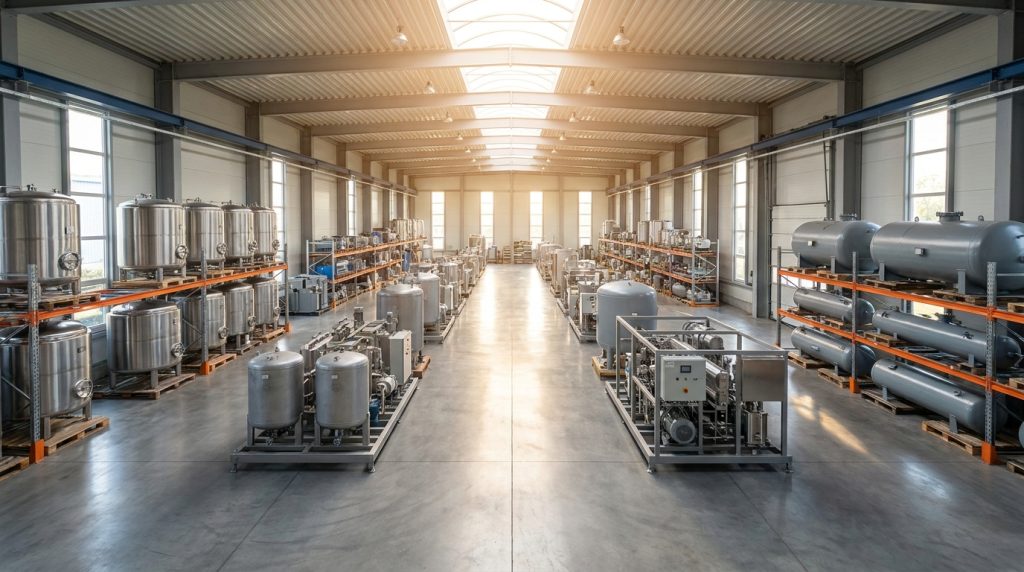
International Process Plants helps businesses source used, refurbished, or new rotary dryers by maintaining a global inventory of process equipment across warehouses in the United States, Germany, and the United Kingdom.. With 46+ years of experience, we specialize in matching procurement engineers and plant managers with equipment suited to their specific process requirements.
Rotary dryers handle chemical processing applications with high-capacity output ranging from 1 to over 200 tons (0.9 to 181 tonnes) per hour, according to H&P Process Equipment. Because these units represent significant capital investments, sourcing quality used or new surplus equipment through International Process Plants reduces lead times and procurement costs compared to ordering from new manufacturers.
Our sourcing process addresses key buyer considerations:
- Material of construction compatibility, including carbon steel, stainless steel, and specialty alloys
- Drum diameter and throughput capacity matched to production targets
- Airflow configuration, whether co-current for heat-sensitive materials or counter-current for higher thermal efficiency
- Compliance with international standards such as ASME, CE marking, and PED
International Process Plants serves industries spanning pharmaceutical, chemical, food processing, and fertilizer production across it’s 15 locations worldwide. Contact our team to discuss currently available rotary dryer inventory or to request a specific configuration.
What are the key takeaways about how rotary dryers work?
The key takeaways about how rotary dryers work center on three principles: mechanical material transport, controlled heat transfer, and efficient moisture removal.
- A rotating cylindrical drum uses internal flights to lift and shower material through a heated air stream, maximizing contact between wet solids and drying gas.
- Co-current airflow protects heat-sensitive materials by directing the hottest gas toward the wettest feed, while counter-current airflow achieves lower final moisture content and higher thermal efficiency.
- Drum diameter, rotation speed, retention time, and airflow volume are the primary variables that determine drying performance and throughput.
- Regular alignment and component maintenance, particularly of trunnion wheels and riding rings, extend equipment lifespan and prevent costly unplanned downtime.
For procurement teams evaluating rotary dryer acquisition, these operational fundamentals directly inform equipment selection. International Process Plants can help match these technical requirements to currently available new surplus and quality used rotary dryers in our global inventory.

 IT
IT  EN
EN  ES
ES  FR
FR  PL
PL  DE
DE  AR
AR  UR
UR  HI
HI  NL
NL  TR
TR  UK
UK  RU
RU  JA
JA  PT
PT  ZH
ZH