
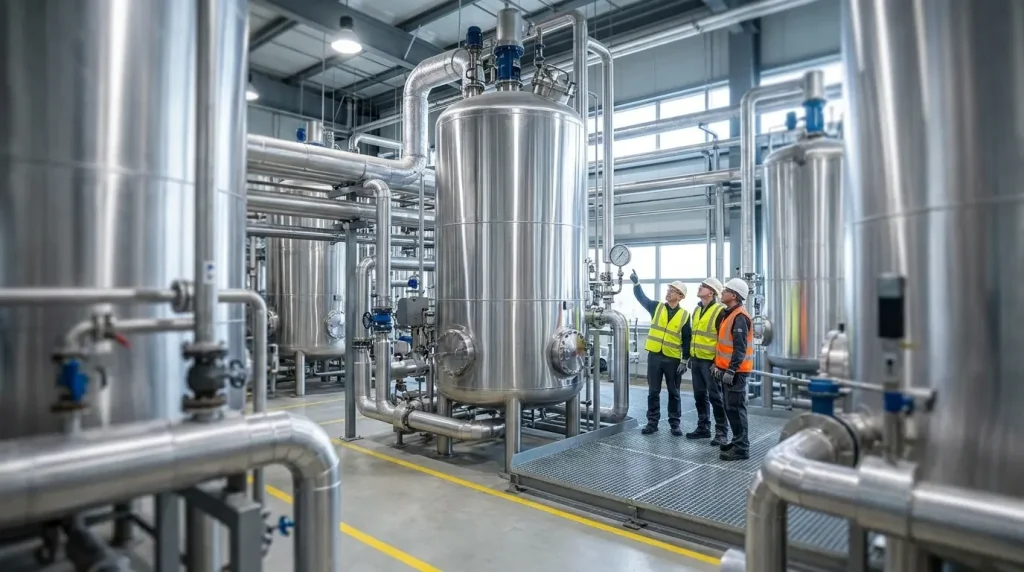
An industrial evaporator is a heat transfer system that concentrates liquid solutions by vaporizing solvents, typically water, while retaining dissolved solids or solutes. These systems apply thermal energy through heat exchangers, separate vapor from liquid droplets, and condense the vapor for recovery or disposal.
This guide covers evaporator operating principles and components, the major evaporator types and their applications, industry-specific uses, selection criteria, and sourcing options for used equipment.
Evaporator operation relies on heat transfer, vapor-liquid equilibrium, and boiling point elevation. Core components include heat exchangers, vapor separators, condensers, and vacuum systems that work together to achieve efficient concentration while protecting product quality.
The primary evaporator types each serve distinct process needs. Falling film evaporators operate under vacuum at reduced temperatures for heat-sensitive products. Forced circulation evaporators handle crystalline, viscous, or corrosive materials with extended residence times. Rising film, plate, rotary, and flash evaporators address specific applications from laboratory scale to high-volume continuous operations.
Chemical, pharmaceutical, food and beverage, and power generation industries rely on evaporators for concentration, purification, and energy recovery. Material selection, capacity sizing, and maintenance requirements vary significantly across these sectors.
Selecting the right evaporator depends on throughput demands, feed chemistry, corrosion resistance needs, and compliance with pressure vessel codes such as ASME Section VIII and the Pressure Equipment Directive. Used and good used evaporators offer capital savings up to 50% with lead time reductions up to 90% compared to new equipment, making the secondary market a practical option for many procurement teams.
How does an industrial evaporator work?
An industrial evaporator works by applying heat to a liquid solution, causing the solvent (typically water) to vaporize while leaving behind concentrated solids or solutes. The sections below explain the physical principles, core components, and design factors that determine evaporator performance.
What physical principles govern industrial evaporation?
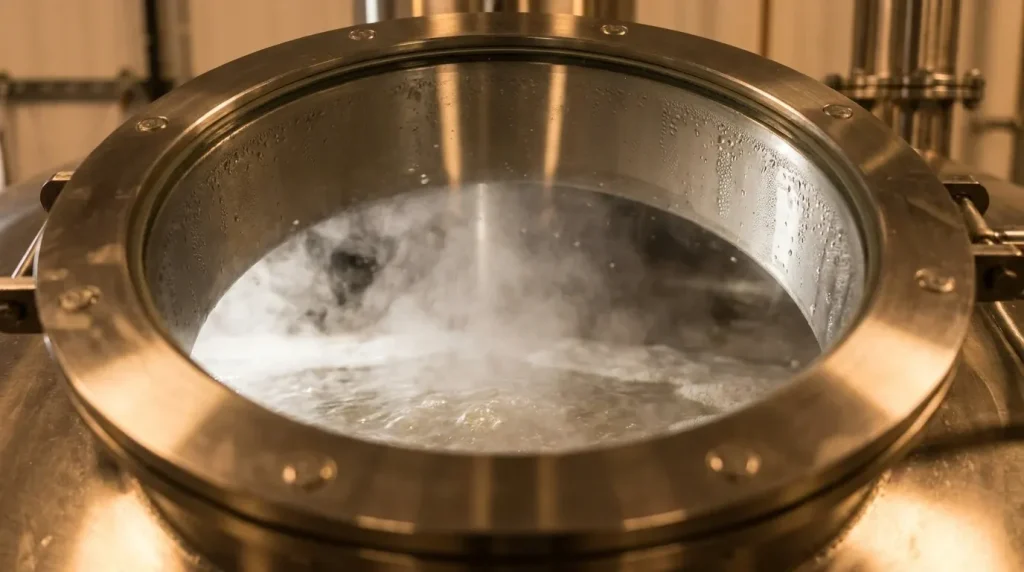
The physical principles that govern industrial evaporation are heat transfer, vapor-liquid equilibrium, and boiling point elevation. Heat energy transfers from a steam source through a metal surface into the liquid, raising its temperature until vaporization occurs. Vapor-liquid equilibrium describes the balance point where vapor pressure equals saturation pressure, determining when and how quickly molecules escape the liquid phase.
Boiling point elevation affects efficiency directly. According to ScienceDirect, boiling point elevation is the increase in boiling temperature caused by dissolved salts, calculated as the difference between pure water’s boiling point and the solution’s boiling point at a given concentration. Process engineers must account for this effect when designing systems for concentrated solutions, as higher solute levels require more energy input to achieve vaporization.
What are the main components of an industrial evaporator?
The main components of an industrial evaporator are:
- Heat exchanger: Transfers thermal energy from steam or another heat source into the liquid feed
- Vapor separator: Removes liquid droplets from the vapor stream to prevent product carryover
- Condenser: Converts the generated vapor back into liquid for recovery or disposal
- Feed system: Controls liquid inlet flow rate and distribution
- Vacuum system: Reduces operating pressure to lower boiling points when processing heat-sensitive materials
According to ANDRITZ, these basic components work together to transfer heat, separate vapor from remaining liquid droplets, and condense the vapor produced. Material selection for each component depends on the corrosiveness of the feed solution and operating temperatures.
How does the design of an evaporator affect its efficiency?
The design of an evaporator affects its efficiency through heat transfer surface area, flow configuration, and residence time. Larger heat transfer surfaces increase evaporation rates, while tube orientation (vertical or horizontal) influences how liquid contacts heated surfaces. Overall heat transfer coefficients for steam-to-water systems typically range from 350 to 750 BTU/hr-ft²-°F (1,990 to 4,260 W/m²-K), though actual values depend heavily on design choices.
Residence time is particularly critical. Shorter residence times suit heat-sensitive products by minimizing thermal degradation, while longer times benefit viscous or crystallizing solutions that need sustained contact. The choice between single-effect and multiple-effect configurations also impacts steam economy, with multi-stage systems recovering latent heat from generated vapor to preheat subsequent stages.
What are the different types of industrial evaporators?
The different types of industrial evaporators are falling film, forced circulation, rising film, plate, rotary, and flash evaporators. Each design optimizes specific process variables such as residence time, heat sensitivity, and viscosity handling.
What is a falling film evaporator and how is it used?
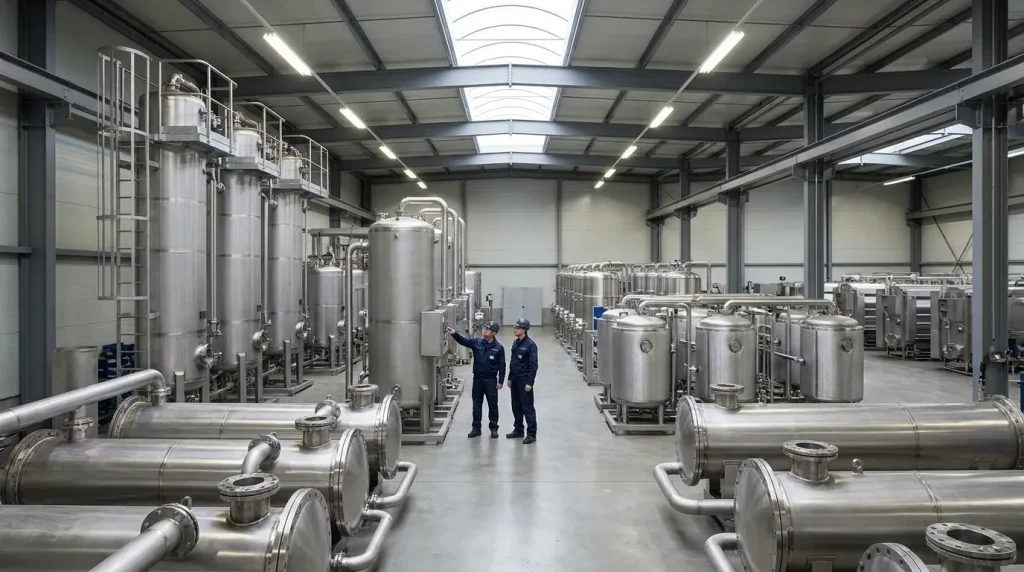
A falling film evaporator is a vertical tube design where liquid flows downward as a thin film along heated tube walls, enabling rapid evaporation with minimal thermal degradation. The liquid enters at the top, spreads across the tube surfaces, and evaporates as it descends.
Falling film evaporators operate under vacuum at 5–20 kPa (0.7–2.9 psia) absolute pressure, reducing water’s boiling point to approximately 40–60°C (104–140°F), according to Zhejiang Zhongbo’s technical documentation. This low-temperature operation protects heat-sensitive products such as fruit juices, dairy concentrates, and pharmaceutical intermediates. Steam economy for single-effect units typically reaches 60–80%.
How does a forced circulation evaporator operate?
A forced circulation evaporator operates by using an external pump to move liquid through heat exchanger tubes at high velocity, enabling crystallization control. The pumped flow keeps solids suspended and maintains turbulent conditions across heating surfaces.
According to a technical document comparing evaporator types, forced circulation evaporators handle crystalline products, corrosive solutions, and viscous fluids with residence times ranging from 2 to 25 minutes. This extended contact time suits applications where complete dissolution or controlled crystal growth matters more than thermal sensitivity. Common uses include salt crystallization, caustic soda concentration, and sugar processing.
What distinguishes a rising film evaporator from other types?
A rising film evaporator is distinguished by its upward vapor flow that carries liquid as a thin film along vertical tube walls, creating turbulence without mechanical pumps. Steam surrounds the tubes externally while the feed enters at the bottom.
The main advantage of rising film evaporators is their low residence time compared to other designs. This brief thermal contact allows operation at higher temperatures while preserving product quality for heat-sensitive materials. Rising film units work well for dilute feeds with low viscosity, such as black liquor in pulp mills or certain chemical intermediates.
When is a plate evaporator the preferred choice?
A plate evaporator is the preferred choice when processing low-viscosity liquids that require compact equipment footprints and easy cleaning access. The corrugated plate design creates turbulent flow patterns that enhance heat transfer coefficients.
Plate evaporators excel in food and beverage applications where sanitary requirements demand frequent disassembly and inspection. Their modular construction allows capacity adjustments by adding or removing plates. Dairy processors use plate evaporators because the design minimizes hold-up volume and supports clean-in-place protocols.
How do rotary and flash evaporators differ in industrial applications?
Rotary and flash evaporators differ in their evaporation mechanisms: rotary units use mechanical rotation to create thin films under controlled vacuum, while flash evaporators rely on sudden pressure drops to achieve instantaneous vaporization.
Rotary evaporators operate with water bath temperatures of 40–60°C (104–140°F), adjusting pressure rather than temperature to control evaporation rate, according to Northwest Scientific documentation. Flash evaporators suit high-volume continuous processes where feed liquids experience rapid pressure reduction. Rotary units serve laboratory and pilot-scale operations; flash systems handle industrial-scale desalination and chemical recovery.
With evaporator types established, the next consideration is matching these designs to specific industry requirements.
What industries commonly use industrial evaporators?
Industrial evaporators serve chemical, pharmaceutical, food and beverage, and power generation sectors. Each industry relies on evaporation for concentration, purification, or energy recovery processes tailored to specific operational demands.
Why are evaporators essential in the chemical and pharmaceutical sectors?
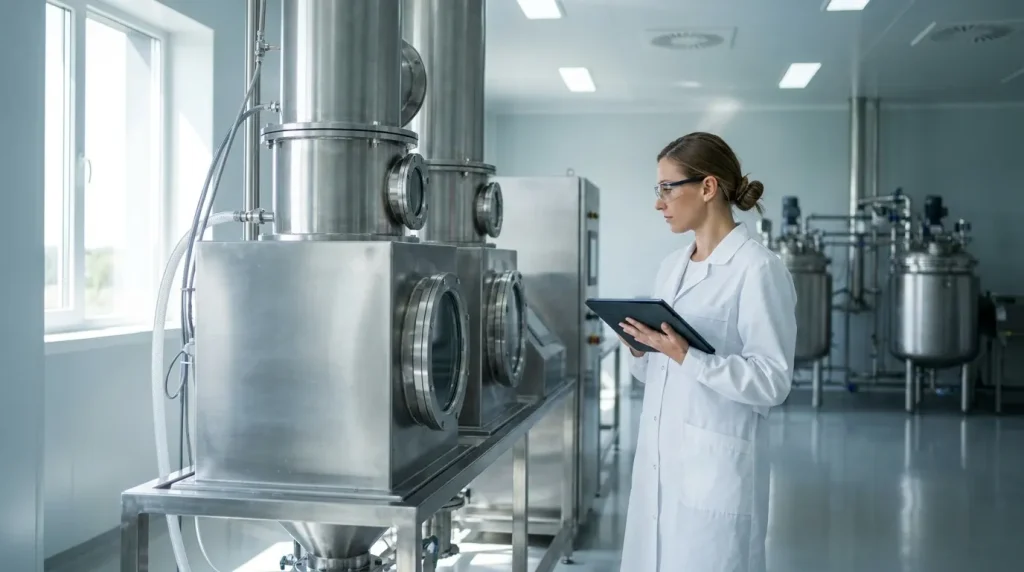
Evaporators are essential in the chemical and pharmaceutical sectors because they enable precise concentration of active compounds while maintaining product integrity. Chemical manufacturers use evaporators to recover solvents, concentrate acids, and process corrosive materials that require specialized alloy construction such as 316L stainless steel or Hastelloy C-276.
Pharmaceutical operations demand evaporators for:
- Concentrating active pharmaceutical ingredients (APIs) under controlled temperatures
- Removing solvents from drug formulations without thermal degradation
- Purifying water for injection-grade applications
- Recovering expensive solvents for reuse
Both sectors benefit from falling film and forced circulation designs that handle heat-sensitive products while meeting stringent purity standards. Compliance with PED (Pressure Equipment Directive) and ASME Section VIII ensures equipment meets global regulatory requirements for these highly regulated industries.
How do food and beverage producers benefit from industrial evaporators?
Food and beverage producers benefit from industrial evaporators through efficient concentration of liquids while preserving flavor, color, and nutritional value. According to Grand View Research, the global industrial evaporators market was valued at USD 21.7 billion in 2025 and is projected to reach USD 33.2 billion by 2033, reflecting strong demand across food processing applications.
Common food and beverage evaporator applications include:
- Concentrating fruit juices, dairy products, and sugar solutions
- Producing tomato paste, coffee extracts, and condensed milk
- Reducing shipping and storage costs through volume reduction
Heat transfer coefficients ranging from 350 to 750 BTU/hr-ft²-°F (1,990 to 4,260 W/m²-K) enable efficient processing at temperatures low enough to protect delicate flavor compounds.
What role do evaporators play in power generation and energy processes?
Evaporators play a critical role in power generation and energy processes by managing water treatment, recovering waste heat, and concentrating process streams. Power plants use evaporators to treat boiler feedwater, removing dissolved solids that cause scaling and corrosion in high-pressure steam systems.
Key power generation applications include:
- Zero-liquid discharge (ZLD) systems for wastewater concentration
- Flue gas desulfurization effluent treatment
- Cooling tower blowdown processing
- Brine concentration in geothermal operations
Energy facilities also deploy mechanical vapor recompression (MVR) evaporators to recover thermal energy, reducing overall steam consumption. This makes evaporators valuable for meeting environmental discharge limits while improving plant efficiency.
With evaporator applications spanning multiple sectors, selecting the right configuration depends on several key factors specific to your process requirements.
What are the key considerations when selecting an industrial evaporator?
The key considerations when selecting an industrial evaporator include capacity requirements, maintenance demands, and material compatibility. The following subsections address how each factor shapes equipment decisions.
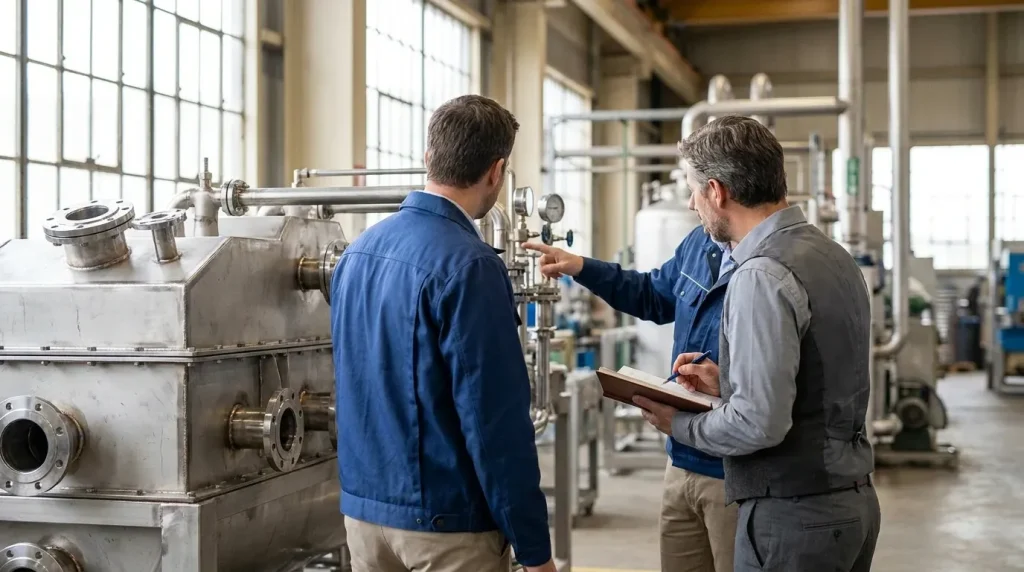
How do capacity and throughput requirements influence evaporator selection?
Capacity and throughput requirements influence evaporator selection by determining the unit size, configuration, and operational flexibility needed for consistent production. Undersized equipment forces continuous maximum operation, accelerating wear and limiting response to demand spikes. According to Günay Soğutma’s technical guidance on evaporator sizing, selecting a unit with 10–15% capacity margin handles peak loads without forcing continuous maximum operation.
Key capacity factors to evaluate:
- Feed rate in gallons per hour (L/hr) and target concentrate output
- Peak versus average throughput demands across production cycles
- Batch versus continuous operation mode
- Available steam supply in lb/hr (kg/hr) relative to evaporation load
Matching evaporator capacity to actual throughput patterns, rather than theoretical maximums, prevents both equipment strain and wasted capital on oversized units.
What maintenance and operational factors should be considered?
Maintenance and operational factors to consider include cleaning frequency, inspection access, and component replacement intervals. Evaporators processing fouling-prone feeds require designs with easy tube access or clean-in-place (CIP) capability. Residence time affects both product quality and scaling rates; forced circulation units with 2–25 minute residence times demand more frequent descaling than falling film designs.
Critical operational considerations:
- Accessibility for tube inspection and mechanical cleaning
- Availability of replacement parts across global markets
- Automation compatibility for temperature and vacuum control
- Compliance with PED (Directive 2014/68/EU), ASME Section VIII, or local pressure vessel codes
Specifying equipment that aligns with your maintenance capabilities reduces unplanned downtime and extends service life.
How do material compatibility and corrosion resistance impact choice?
Material compatibility and corrosion resistance impact choice by determining equipment lifespan and product purity when processing aggressive or reactive feeds. Standard 304/304L stainless steel suits many aqueous applications, while 316/316L handles chloride-bearing streams. For highly corrosive environments such as MSF desalination plants, duplex stainless steel grade S32304 offers high strength with pitting resistance comparable to 316, according to research published in ScienceDirect.
Material selection factors:
- Feed chemistry: pH range, chloride content, organic solvents
- Operating temperature in °F (°C) and pressure in PSI (bar)
- Product purity requirements and leachate tolerance
- Cost tradeoff between standard alloys and specialty materials like Hastelloy C-276
Selecting materials matched to process conditions prevents premature failure and contamination. With selection criteria defined, the next section examines how used or refurbished evaporators deliver value.
How can used or refurbished industrial evaporators provide value?
Used and good used industrial evaporators provide value through significant capital savings, faster deployment timelines, and proven operational histories. The following subsections examine sourcing advantages, quality assurance methods, and critical inspection points for buyers.
What are the advantages of sourcing pre-owned evaporators?
The advantages of sourcing pre-owned evaporators include substantial cost reductions, compressed lead times, and access to proven equipment designs. Buying good used evaporators can save up to 50% of capital costs and reduce lead times by 90% compared to purchasing new equipment, according to International Process Plants. These savings allow procurement teams to allocate budgets toward installation, commissioning, or capacity expansion rather than equipment acquisition alone.
Good used units often come with documented operating histories, providing insight into actual performance under real process conditions. This track record reduces the uncertainty inherent in specifying new equipment for established applications.
How is the quality and reliability of refurbished equipment ensured?
The quality and reliability of good used equipment is ensured through systematic inspection, testing, and documentation protocols aligned with international standards. Reputable suppliers conduct thorough assessments against ASME Section VIII, the Pressure Equipment Directive (PED 2014/68/EU), and applicable CE or UKCA marking requirements before offering units for sale.
Inspection protocols typically include:
- Dimensional verification of heat transfer surfaces
- Non-destructive examination (NDE) of welds and pressure boundaries
- Hydrostatic pressure testing per original design specifications
- Review of original material test reports and fabrication records
Equipment that meets these standards performs comparably to new units while delivering the cost advantages of the secondary market.
How should you approach industrial evaporator needs with International Process Plants?
International Process Plants can help you source, redeploy, or sell industrial evaporators across global markets. The following sections explain our sourcing capabilities and summarize the key points covered in this guide.
Can International Process Plants help with sourcing or redeploying industrial evaporators?
Yes, International Process Plants can help with sourcing or redeploying industrial evaporators. With over 46 years of experience and warehouses in the United States, Germany, and the United Kingdom, we connect buyers and sellers across global markets. Our inventory includes falling film, forced circulation, rising film, and plate evaporators in materials such as 316L stainless steel and Hastelloy C-22.
According to Grand View Research, Asia Pacific held 35.5% of the global industrial evaporators market in 2025, with China leading regionally. Whether you need to acquire equipment for expansion or redeploy surplus units from a facility closure, we provide documentation review, logistics coordination, and technical evaluation to streamline the process.
What are the key takeaways about what is an industrial evaporator and its types we covered?
The key takeaways about industrial evaporators and their types are:
- Industrial evaporators concentrate solutions by transferring heat to vaporize solvents, with core components including heat exchangers, separators, and condensers
- Falling film evaporators suit heat-sensitive applications with low residence times
- Forced circulation evaporators handle crystalline, viscous, or corrosive products
- Rising film evaporators offer minimal thermal exposure for quality-critical processes
- Selection depends on capacity requirements, material compatibility, and maintenance considerations
- Used evaporators can reduce capital costs by up to 50% and lead times by up to 90%
For procurement engineers evaluating options, matching evaporator type to your specific feed properties and throughput requirements remains the most critical decision. Contact International Process Plants to discuss your evaporator sourcing or redeployment needs.

 HI
HI  EN
EN  ES
ES  FR
FR  PL
PL  DE
DE  AR
AR  UR
UR  NL
NL  TR
TR  IT
IT  UK
UK  RU
RU  JA
JA  PT
PT  ZH
ZH