 Saltar al contenido
A glass-lined reactor is a chemical processing vessel that combines the mechanical strength of a carbon steel outer shell with the chemical inertness of a fused borosilicate glass lining, creating a non-reactive barrier that prevents product contamination in corrosive environments.
This guide covers construction and materials, industry applications, performance comparisons with stainless steel, selection and compliance criteria, and sourcing support from International Process Plants (IPP).
Glass-lined reactors are built by fusing multiple layers of glass frit onto substrates like ASTM A516 Grade 70 or EN 10028-2 P265GH steel through repeated high-temperature firings, achieving a minimum lining thickness of 10 mils (0.25 mm) that resists acids, solvents, and oxidizing agents.
Pharmaceutical manufacturers, chemical processors, agrochemical producers, and food companies rely on these reactors because the glass surface eliminates extractable metal contamination from chromium and nickel that can leach from unlined stainless steel vessels into sensitive products.
Compared to stainless steel alternatives, glass-lined reactors offer superior corrosion resistance to acidic media at lower cost per equivalent volume, though they operate within tighter constraints for alkaline exposure (pH below 12), thermal cycling rates, and mechanical impact tolerance.
Selecting the right vessel requires matching pressure ratings, agitator configurations, and thermal envelopes to your process conditions while ensuring compliance with ASME Section VIII, PED, ISO 28721, and cGMP standards depending on your market and application.
IPP supports glass-lined reactor procurement through over 46 years of experience, a large inventory of pieces of equipment across warehouses in the US, Germany, and the United Kingdom, and specialized expertise through our Universal Glasteel Equipment (UGE) subsidiary.
Why Are Glass-Lined Reactors Used in Industrial Processes?
Glass-lined reactors are used in industrial processes because they combine the mechanical strength of steel with the chemical inertness of glass, preventing product contamination in corrosive environments. The following sections cover the industries that rely on them, their core benefits, and their limitations.
What Types of Industries Commonly Utilize Glass-Lined Reactors?
The types of industries that commonly utilize glass-lined reactors include:
- Fabricación farmacéutica, where non-reactive surfaces prevent contamination of Active Pharmaceutical Ingredients (APIs) and drug formulations requiring high purity.
- Procesamiento químico, where aggressive acids and solvents would corrode unlined steel vessels.
- Producción de agroquímicos, where synthesis of pesticides, herbicides, and fertilizers demands protection from severe chemical corrosion.
- Food processing, where product purity and absence of metallic leaching are essential.
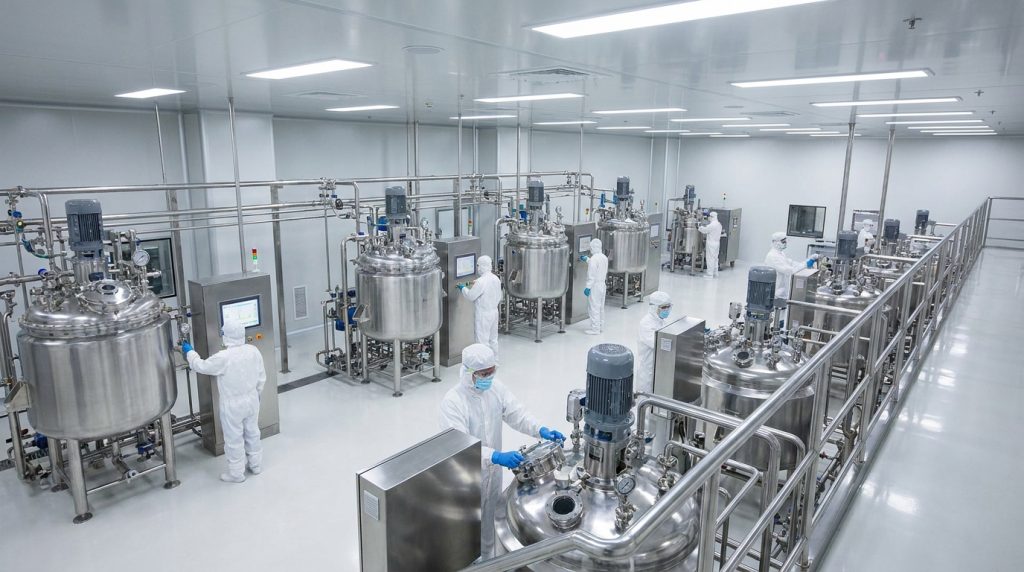
According to ZMIX Tech, the agrochemical industry relies on the glass lining’s ability to protect the steel body from severe chemical corrosion during aggressive processing. For procurement teams sourcing reactor vessels, understanding which industry application drives your specification requirements will determine the correct pressure rating, volume, and lining grade.
What Are the Main Benefits of Using Glass-Lined Reactors?
The main benefits of using glass-lined reactors are superior corrosion resistance, product purity, and cost-effectiveness relative to solid alloy alternatives. Key advantages include:
- Chemical inertness: the glass surface is impervious to most acids, solvents, and reactive intermediates.
- Contamination prevention: unlike unlined stainless steel (SS 316L), glass-lined steel eliminates the risk of extractable metals such as chromium and nickel leaching into the product.
- Ahorro de costes: glass-lined reactors are generally cheaper for equivalent volumes compared to solid alloy reactors while delivering comparable corrosion protection.
- Cumplimiento normativo: glass-lined steel meets stringent FDA, EMA, and cGMP requirements for pharmaceutical batch processing.
These characteristics make glass-lined reactors a practical choice when process chemistry involves corrosive media at moderate pressures and temperatures.
What Are the Potential Drawbacks of Glass-Lined Reactors?
The potential drawbacks of glass-lined reactors are vulnerability to mechanical impact, thermal shock sensitivity, and limited alkaline resistance. Specific limitations include:
- Thermal shock susceptibility: rapid temperature changes exceeding the glass’s tolerance limits can cause spalling or cracking. According to the Association for Materials Protection and Performance (AMPP), thermal shock is a primary cause of failure in glass-lined equipment.
- Alkaline limitation: if the pH exceeds 12 and temperature rises above 80°C (176°F), the glass lining loses corrosion resistance.
- Mechanical fragility: dropped tools or metal objects can chip or fracture the lining, requiring costly repair or relining.
- Pressure constraints: glass-lined reactors typically operate at lower pressures than solid stainless steel or Hastelloy alternatives.
These drawbacks require careful process control and handling protocols, considerations that directly influence how these reactors are constructed and maintained.
How Is a Glass-Lined Reactor Constructed and What Materials Are Used?
A glass-lined reactor is constructed by fusing a specialized borosilicate glass coating onto a carbon steel pressure vessel substrate. The sections below cover the glass lining’s unique properties, the application process, and maintenance requirements.
What Makes the Glass Lining in These Reactors Unique?
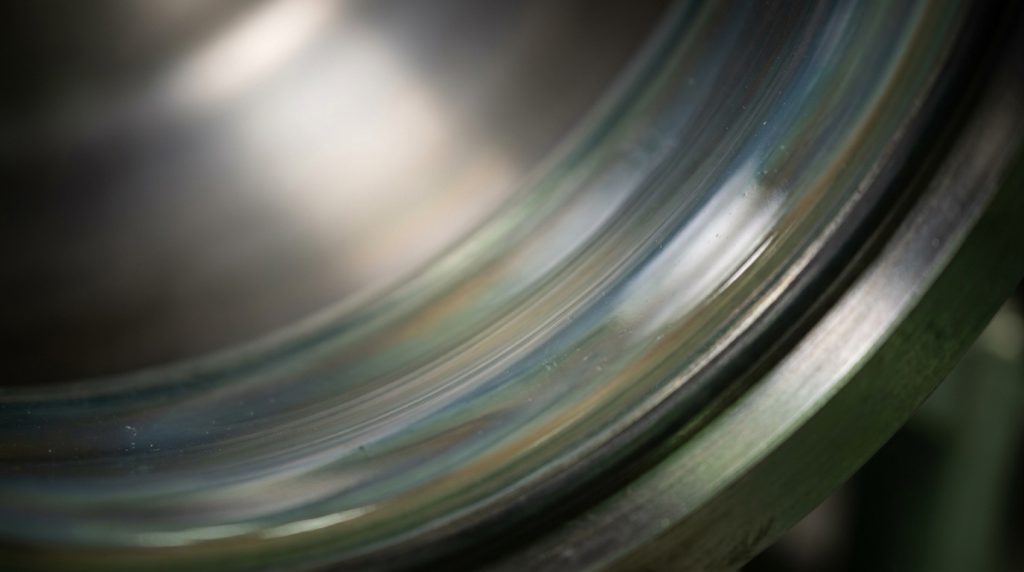
The glass lining in these reactors is unique because it creates a chemically inert, non-porous barrier that prevents contamination while leveraging the mechanical strength of the steel shell beneath it. Standard glass lining specifications require an average minimum thickness of 10 mils (0.25 mm), tested with a dry film thickness gage according to ASTM D7091.
This borosilicate glass composition resists acids, solvents, and oxidizing agents that would rapidly degrade unlined metallic surfaces. The IChemE INSET Toolkit emphasizes that inherent safety, health, and environmental management improves when materials like glass lining offer superior resistance to hazardous chemical reactions.
Where stainless steel handles alkalis and higher pressures effectively, glass lining excels at processing corrosive media that would attack metallic surfaces. For procurement engineers evaluating reactor materials, this distinction determines which vessel chemistry dictates.
How Is the Glass Lining Applied to the Reactor Vessel?
The glass lining is applied to the reactor vessel through multiple firing cycles. Each layer is fused individually onto the steel substrate, building up the required thickness incrementally.
The substrate is typically carbon steel. ASTM A516 Grade 70 (ASME SA516 Grade 70) is the standard grade for pressure vessel plates intended for moderate and lower temperature service. In European markets, P265GH, a non-alloy carbon-manganese steel within EN 10028-2, is widely used for glass-lined equipment due to its cost-effectiveness at elevated temperatures.
Before each firing, ground glass frit is applied as a slurry or powder. According to Business Research Insights, the global glass reactor market (worth USD 1.17 billion in 2026) is expected to reach USD 2.1 billion by 2035, reflecting growing demand for this construction method.
What Maintenance Does a Glass-Lined Reactor Require?
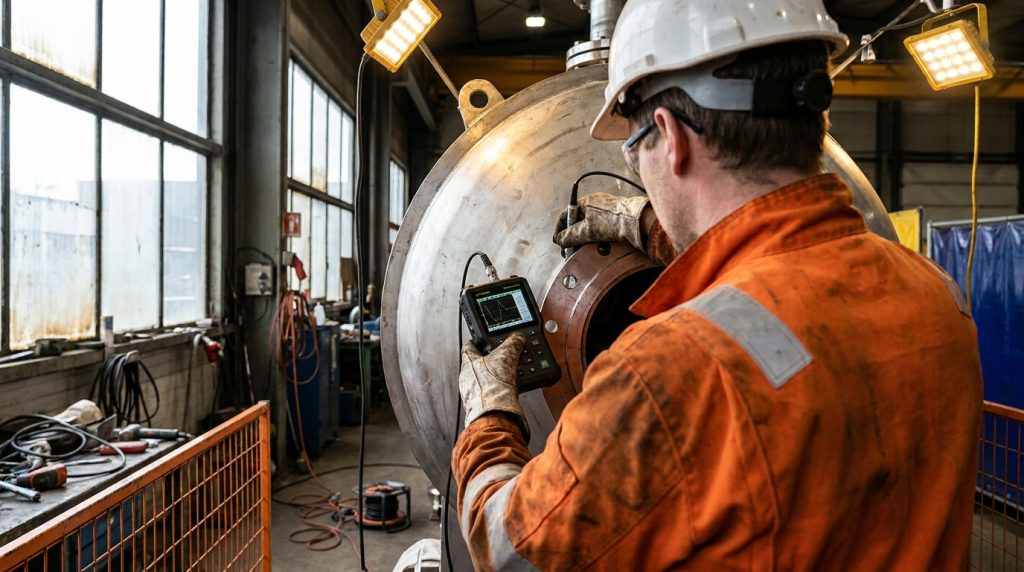
A glass-lined reactor requires regular inspection, careful operational practices, and periodic spark testing to detect micro-cracks before they compromise the lining. With proper routine maintenance, these vessels provide approximately 15 to 20 years of service, though actual lifespan depends on process chemistry and operating conditions.
Key maintenance practices include:
- Conducting high-voltage spark tests (5,000 V to 20,000 V) at scheduled intervals to identify pinholes or hairline fractures in the glass.
- Avoiding thermal shock by controlling heating and cooling rates within manufacturer-specified limits.
- Preventing mechanical impact from dropped tools or metal objects during charging operations.
- Monitoring pH levels, since alkaline media above pH 12 at temperatures exceeding 176 F (80 C) can damage the lining.
For pharmaceutical applications, glass or glass-lined steel remains the most common pilot plant material choice, meeting FDA and EMA requirements for process safety and contamination control. Proactive maintenance programs protect this investment far more effectively than reactive repairs after lining failure.
With construction fundamentals established, the next section explores specific industry applications.
What Are the Key Applications of Glass-Lined Reactors?
The key applications of glass-lined reactors span pharmaceutical manufacturing, chemical processing, and food production. Each industry relies on the glass lining’s chemical inertness and contamination-free surface for different reasons.
How Are Glass-Lined Reactors Used in the Pharmaceutical Industry?
Glass-lined reactors are used in the pharmaceutical industry primarily for producing Active Pharmaceutical Ingredients (APIs) and drug formulations where high purity and non-catalytic surfaces prevent product degradation. The inert glass surface eliminates extractable metal contamination, which is critical when synthesizing compounds that must meet strict regulatory standards from agencies such as the FDA and EMA.
Pharmaceutical manufacturers rely on these reactors for:
- Synthesis of APIs requiring contamination-free environments
- Intermediate reactions involving corrosive solvents and acids
- Crystallization and distillation steps demanding high-purity conditions
- Batch processing where product changeover requires thorough cleaning
According to Strategic Market Research, the global glass-lined equipment market was estimated at USD 1.83 billion in 2024, with growth driven by expanding pharmaceutical manufacturing hubs worldwide. For procurement teams sourcing reactors for cGMP-compliant facilities, glass-lined steel remains the most practical balance between corrosion resistance and mechanical durability.
Why Do Chemical Processing Plants Rely on Glass-Lined Reactors?
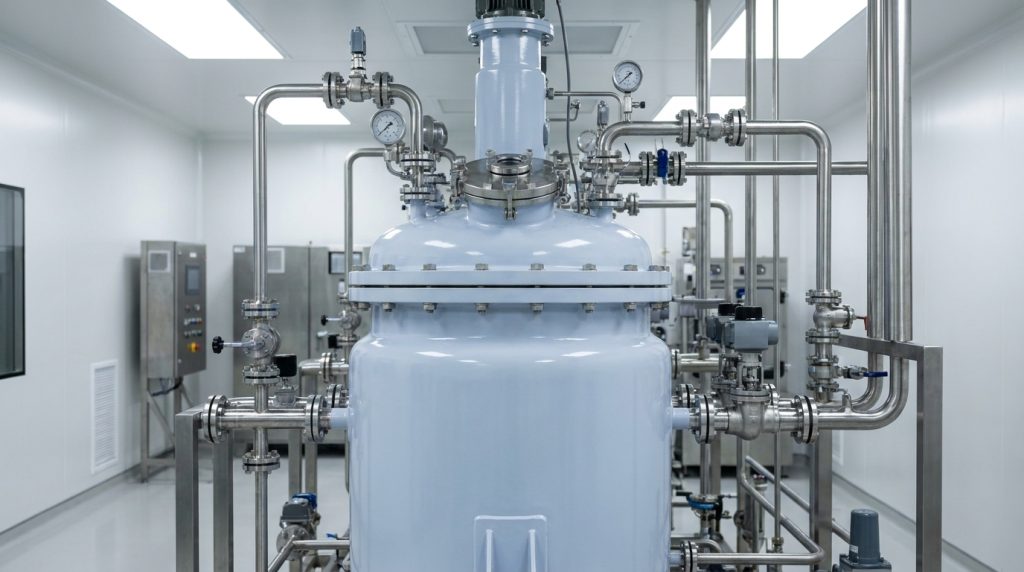
Chemical processing plants rely on glass-lined reactors because the glass lining withstands aggressive reaction environments that would rapidly corrode unlined carbon steel or even stainless steel vessels. The ISO 28721 series specifies requirements for the design, manufacture, and testing of vitreous and porcelain enamel-lined apparatus specifically for chemical plant service, confirming the established role of glass-lined construction in this sector.
As documented in the Encyclopedia of Chemical Processing and Design, specialized processes like the adiabatic nitrobenzene process require glass-lined steel in the nitration and acid concentration sections to survive the aggressive reaction conditions. Chemical plants also use these reactors for agrochemical synthesis, including pesticides, herbicides, and fertilizers, where concentrated acids would destroy conventional metallic surfaces within weeks.
What Role Do Glass-Lined Reactors Play in Food Processing?
Glass-lined reactors play a role in food processing by providing a non-reactive, non-porous surface that prevents flavor contamination and bacterial harboring during production. The smooth glass surface resists staining and absorbs no residual flavors between batches, making it well-suited for processing organic acids, fruit extracts, and fermentation products.
Food-grade applications benefit from the same inertness that serves pharmaceutical production, since the glass lining does not leach metals into edible products. Common food processing uses include acid-based reactions, flavor compound synthesis, and production of food-grade chemicals where product purity directly affects consumer safety.
With applications spanning multiple regulated industries, selecting the right glass-lined reactor also requires understanding how it compares to alternative reactor types.
How Do Glass-Lined Reactors Compare to Other Reactor Types?
Glass-lined reactors compare to other reactor types primarily in corrosion resistance, cost, pressure handling, and contamination prevention. The following subsections examine differences against stainless-steel reactors and clarify when glass-lined designs are the better choice.
What Are the Main Differences Between Glass-Lined and Stainless-Steel Reactors?
The main differences between glass-lined and stainless-steel reactors involve corrosion behavior, contamination risk, pressure capability, and cost structure.
- Glass-lined reactors prevent extractable metal contamination from chromium and nickel, which can leach into products from unlined stainless-steel vessels.
- Stainless-steel reactors handle alkalis and higher pressure conditions more effectively than glass-lined alternatives.
- Glass-lined reactors offer superior resistance to corrosive acids that would attack metallic surfaces directly.
- Glass-lined vessels are generally more cost-effective at equivalent volumes compared to stainless-steel reactors.
According to a lifecycle comparison published by Glasskem, stainless steel (SS 316L) remains a reliable workhorse, yet glass-lined steel is impervious to the metal-ion contamination that unlined reactors introduce. For processes where product purity is non-negotiable, particularly pharmaceutical API synthesis, this distinction often drives the material selection decision.
When Should You Choose a Glass-Lined Reactor Over Other Options?
You should choose a glass-lined reactor over other options when your process involves highly corrosive acids, requires contamination-free surfaces, or demands compliance with DIN Standard 28136 for structural integrity in exothermic reaction studies. Glass-lined designs excel in:
- Batch processes handling hydrochloric, sulfuric, or organic acids below pH 12 and below 80 °C (176 °F).
- Pharmaceutical manufacturing requiring cGMP-compliant, non-catalytic wetted surfaces.
- Pilot-scale reaction studies where runaway exothermic conditions require predictable material behavior.
Stainless-steel or Hastelloy C-276 reactors remain preferable for strong alkaline media above pH 12, operating temperatures exceeding 200 °C (392 °F), or pressures beyond standard glass-lined vessel ratings. The selection ultimately depends on matching the vessel’s chemical and thermal envelope to your specific process conditions.
With material selection clarified, the next step is specifying the right size, certification, and total cost of ownership.
What Should You Consider When Selecting or Purchasing a Glass-Lined Reactor?
You should consider thermal compatibility, vessel sizing, regulatory compliance, and total cost of ownership when selecting or purchasing a glass-lined reactor. The subsections below cover critical specification factors, certification requirements, and lifespan economics.
What Are the Critical Factors in Sizing and Specifying a Glass-Lined Reactor?
The critical factors in sizing and specifying a glass-lined reactor are:
- Design capacity versus working capacity: Working capacity (typically 70–80% of total volume) determines actual batch output and matters more to buyers than nominal vessel size.
- Process temperature range: Glass linings tolerate up to approximately 260 °C (500 °F), but rapid thermal cycling poses risks.
- Pressure rating: Verify both shell-side and jacket-side pressure ratings separately; common designs range from full vacuum to 100 PSI (6.9 bar) on the shell.
- Agitator type and speed: Retreat-curve impellers prevent glass damage, while anchor styles suit viscous media.
- Nozzle configuration: Ensure adequate ports for charging, discharging, temperature probes, and pressure relief.
Industry expert J.F. Louvar highlights that “heating and cooling cycles in a glass-lined reactor can cause thermal shock damage if proper consideration is not given to the batch liquid and heat transfer media temperatures.” This makes differential temperature limits between jacket fluid and batch contents one of the most overlooked specification parameters.
How Important Is Compliance and Certification for Glass-Lined Reactors?
Compliance and certification for glass-lined reactors is critically important because these vessels operate under pressure with corrosive media across regulated industries. Key standards include:
- ASME Section VIII, Division 1: Governs pressure vessel design and fabrication in North America.
- Pressure Equipment Directive (PED) 2014/68/EU: Required for CE marking on equipment sold within the European Union.
- UKCA marking: Mandatory for pressure equipment placed on the Great Britain market.
- ISO 28721 series: Specifies requirements for the design, manufacture, and testing of vitreous enamel-lined apparatus in chemical plants.
- ATEX directive: Required when equipment operates in explosive atmospheres.
- FDA and EMA cGMP guidelines: Govern pharmaceutical-grade glass-lined equipment for drug production.
Always verify that documentation, including material test reports and spark test records, accompanies any reactor purchase.
What Is the Typical Lifespan and Cost of Ownership for Glass-Lined Reactors?
The typical lifespan of a glass-lined reactor is approximately 15 to 20 years with proper and routine maintenance, according to KJHIL’s technical guidance, though actual service life depends heavily on process chemistry and operating conditions. Cost of ownership factors include:
- Initial capital cost: Generally lower than equivalent-volume stainless steel reactors for corrosive service.
- Relining expense: Glass relining extends vessel life but costs 40–60% of a new unit.
- Downtime during repairs: Glass damage requires specialized repair or relining, unlike weldable metal surfaces.
- Inspection frequency: Regular spark testing at 5,000 V to 20,000 V detects pinhole defects before catastrophic failure.
Purchasing quality used glass-lined reactors from a trusted supplier significantly reduces initial capital outlay while preserving most of the vessel’s remaining service life. With proper procurement due diligence, this represents strong lifecycle economics for most batch chemical operations.
How Does International Process Plants (IPP) Support Glass-Lined Reactor Needs?
International Process Plants (IPP) supports glass-lined reactor needs through over 46 years of experience supplying new surplus and quality used process equipment globally. The following sections cover how our expertise benefits your operations and summarize this guide’s key takeaways.
How Can IPP’s Expertise in Glass-Lined Equipment Benefit Your Operations?
IPP’s expertise in glass-lined equipment benefits your operations by providing access to quality used and new surplus reactor vessels through our Universal Glasteel Equipment (UGE) subsidiary, which focuses specifically on glass and glass-lined equipment. With warehouses in South Carolina (US), Germany, and the United Kingdom, we serve procurement engineers across global markets where compliance with ASME Section VIII, the Pressure Equipment Directive (PED), and CE marking is required.
The glass-lined equipment sector is growing rapidly. According to Strategic Market Research, the global glass-lined equipment market was estimated at USD 2,229.3 million in 2024 and is projected to reach USD 4,571.5 million by 2033. This expansion, combined with European market growth at a 9.1% CAGR through 2031, means demand for reliable sourcing partners continues to intensify.
IPP maintains a large inventory of pieces of equipment currently available. For engineers evaluating glass-lined vessels, our team understands critical concerns such as regular spark testing at 5,000V to 20,000V and the importance of preventing mechanical impact that causes glass chipping.
What Are the Key Takeaways About Glass-Lined Reactors from This Guide?
The key takeaways about glass-lined reactors from this guide are:
- Glass-lined steel eliminates contamination from extractable metals like chromium and nickel, which can leach from unlined stainless steel (SS 316L) reactors into sensitive products.
- Glass-lined pharmaceutical equipment must meet FDA and EMA regulatory guidelines to ensure compliance with Current Good Manufacturing Practice (cGMP) standards.
- Proper material selection, maintenance protocols, and compliance with standards such as ASME Section VIII, PED, and ISO 28721 determine long-term reactor performance.
- Sizing decisions should account for both design capacity and working capacity, since working capacity often matters more to buyers.
For procurement engineers seeking glass-lined reactors, IPP’s Universal Glasteel Equipment (UGE) subsidiary specializes in sourcing these vessels. Contact International Process Plants to discuss currently available glass-lined reactor inventory that meets your process specifications.

 ES
ES  EN
EN  FR
FR  PL
PL  DE
DE  AR
AR  UR
UR  HI
HI  NL
NL  TR
TR  IT
IT  UK
UK  RU
RU  JA
JA  PT
PT  ZH
ZH