 Saltar al contenido
An industrial centrifuge is a mechanical separation machine that spins process material at high speed, generating centripetal force thousands of times greater than gravity to separate components by density or size. These machines handle solid-liquid separation, liquid-liquid clarification, and sludge dewatering across chemical, pharmaceutical, food, wastewater, and oil and gas operations.
This guide covers the science and mechanics behind centrifugal separation, the major centrifuge types and how they differ, performance factors and selection criteria, maintenance and safety requirements, and sourcing options through International Process Plants.
Centrifugal separation works by driving denser particles outward toward the bowl wall while lighter components stay near the center. Separation intensity is measured as Relative Centrifugal Force (RCF) in multiples of gravitational acceleration, and different centrifuge designs produce force ranges from under 2,000 Gs to 10,000 Gs depending on the application.
Five primary centrifuge types serve distinct roles: decanters handle continuous high-solids separation, disc stacks capture ultra-fine particles and split immiscible liquids, basket centrifuges process coarser crystalline products in batch mode, tubular designs achieve high-purity liquid clarification, and pusher centrifuges discharge solid crystals continuously.
Performance depends on feed properties (particle size, density differential, viscosity) and adjustable parameters like bowl speed, differential speed, and pond depth. Material selection, including alloys such as 316L stainless steel, Hastelloy, and titanium, determines chemical resistance and service life.
Safe operation requires compliance with frameworks including the EU Machinery Directive 2006/42/EC, ATEX/IECEx certification for hazardous environments, and routine inspection of rotors, bearings, and seals. With over 46 years of experience, International Process Plants connects buyers with quality used and new surplus separation equipment from its global network of warehouses.
Why are industrial centrifuges used in various industries?
Industrial centrifuges are used in various industries because they solve critical separation challenges that gravity alone cannot address efficiently. The following subsections cover the specific problems centrifuges resolve and which sectors rely on them most.
What separation challenges do industrial centrifuges solve?
Industrial centrifuges solve separation challenges involving fine particles, emulsified liquids, and high-throughput slurries where gravity settling is too slow or imprecise. These machines accelerate sedimentation and filtration by applying thousands of times gravitational force, enabling rapid solid-liquid separation, liquid-liquid clarification, and dewatering at continuous production scales.
Key challenges centrifuges address include:
- Separating particles too fine for conventional filters or settling tanks
- Breaking stable emulsions between immiscible liquids
- Dewatering sludge to reduce disposal volumes
- Processing flammable solvents safely under ATEX and IECEx compliance requirements
Sedimentation centrifuges captured 56.6% of market share in 2025, while filtering centrifuges are forecast to expand at a 7.2% CAGR through 2031, according to Mordor Intelligence. This split reflects how different separation problems demand different centrifugal approaches. For procurement engineers evaluating separation equipment, matching the challenge type to centrifuge category remains the most important selection decision. When sourcing used centrifuges, working with an experienced equipment supplier ensures thorough inspection of critical components before purchase. International Process Plants evaluates rotating assemblies, bearings, and seals on used separation equipment to help buyers understand true equipment condition and remaining service life.
Which industries benefit the most from industrial centrifuge applications?
The industries that benefit the most from industrial centrifuge applications include pharmaceuticals, chemical processing, polymer production, food and beverage, wastewater treatment, and oil and gas. Each sector relies on centrifugal separation for distinct process requirements.
- Pharmaceutical plants use tubular centrifuges to separate two liquids or capture small solids at high speeds for precise purification
- Chemical and polymer manufacturers rely on specialized units; GEA Group developed the TTC 300 series in 2021 specifically to remove acidic wash liquid from organic polymer mixtures, according to Grand View Research
- Food processors employ disc stack separators for clarification and cream separation
- Wastewater facilities use decanters for sludge dewatering
- Oil and gas operations separate produced water from crude
Germany leads global exports of centrifuge technology due to advanced manufacturing capabilities, while the overall category is expected to grow at a CAGR of 4.43% from 2023 to 2030. This broad adoption across sectors confirms that centrifugal separation remains foundational process equipment for any facility handling mixed-phase streams.
How does an industrial centrifuge function on a basic level?
An industrial centrifuge functions by spinning a mixture at high speed, generating centrifugal force that separates components based on density differences. The subsections below explain the underlying science and the core mechanical components.
What is the science behind centrifugal force in separation?
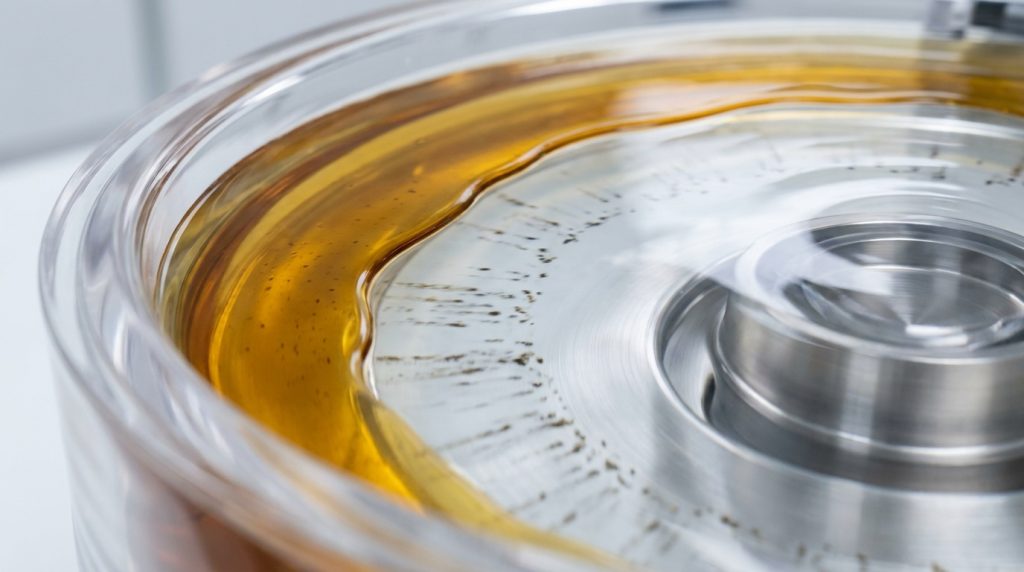
The science behind centrifugal force in separation relies on amplifying gravitational effects through rapid rotation. When a mixture enters a spinning bowl or rotor, denser particles migrate outward toward the bowl wall while lighter components remain closer to the center. This density-driven migration replaces the slow settling that would occur under normal gravity with a dramatically accelerated process.
Separation intensity is measured as Relative Centrifugal Force (RCF), expressed in multiples of gravitational acceleration (Gs). According to Drucker Diagnostics, RCF is calculated using the formula: RCF = 0.0000284 × Rotor Radius (in inches) × (RPM)². A larger rotor radius or higher rotational speed produces greater centrifugal force, which improves separation of fine or closely matched density particles.
Not all centrifuges operate at the same force levels. Basket centrifuges, for example, operate in batch mode where a perforated basket collects solids while liquids pass through, typically generating forces below 2,000 Gs. Disc stack designs, by contrast, can reach 10,000 Gs for finer separations.
What are the main parts and components of an industrial centrifuge?
The main parts and components of an industrial centrifuge include:
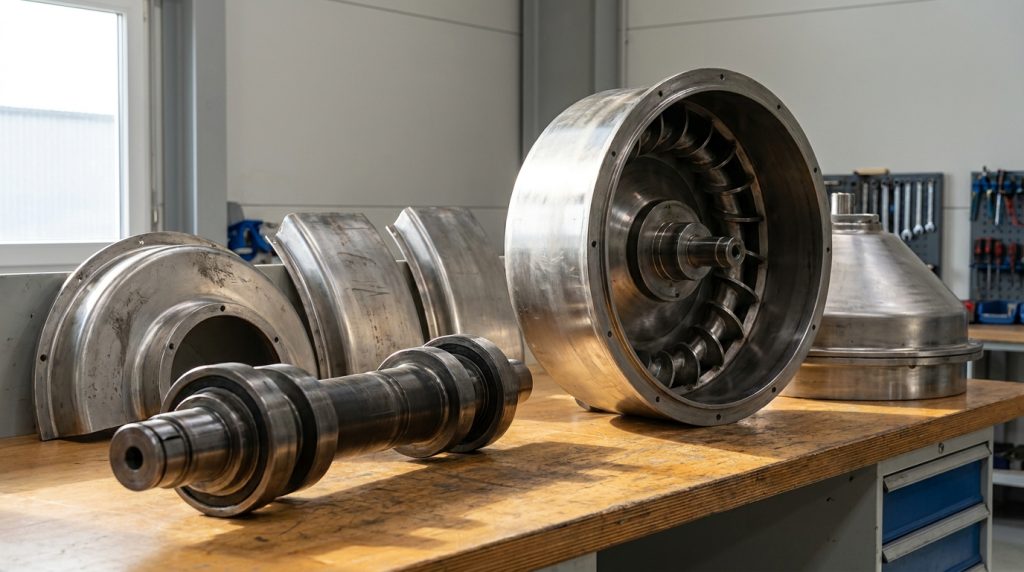
- Bowl or drum: the rotating vessel that contains the process material and generates centrifugal force.
- Rotor or shaft: transmits rotational energy from the drive motor to the bowl.
- Drive motor: provides the power, often measured in HP (kW), to achieve target RPM.
- Bearings: support the rotor shaft while accommodating high-speed rotation and dynamic loads.
- Sellos: prevent leakage of process fluids or hazardous materials from the rotating assembly.
- Feed inlet: introduces the slurry or liquid mixture into the spinning bowl.
- Discharge ports: separate outlets for clarified liquid (centrate) and collected solids (cake).
- Housing or casing: encloses the rotating assembly for safety and containment.
According to Riera Nadeu, regular inspection of rotors, bearings, and seals, combined with scheduled lubrication and cleaning of accumulated solids, prevents unexpected downtime. For procurement engineers evaluating used centrifuges, the condition of these wear components directly determines remaining service life and rebuild cost.
Understanding these fundamentals helps when comparing different centrifuge types and their distinct separation mechanisms.
What are the major types of industrial centrifuges and how do they differ?
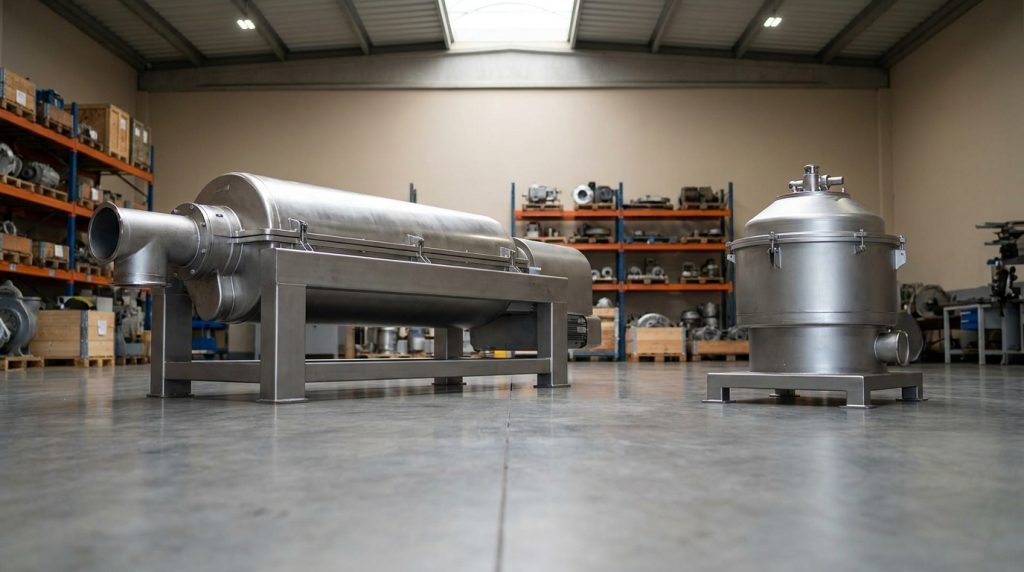
The major types of industrial centrifuges are decanter, disk stack, basket, tubular, and pusher centrifuges. Each type differs in separation mechanism, G-force range, and whether it operates in batch or continuous mode.
How does a decanter centrifuge work compared to a disk stack centrifuge?
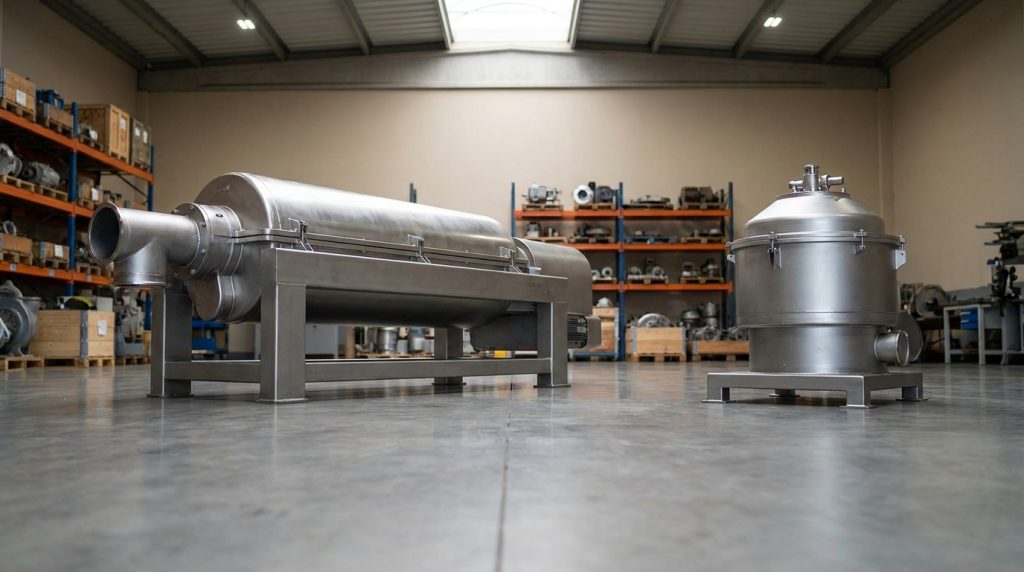
A decanter centrifuge works by using a rotating bowl and internal screw conveyor (scroll) to continuously separate solids from liquids. The scroll rotates at a slightly different speed than the bowl, pushing separated solids toward the discharge end. Key operational parameters include bowl speed (controlling G-force), differential speed between scroll and bowl, and pond depth.
A disk stack centrifuge operates differently. Instead of a scroll, it features a stack of conical discs that dramatically increase the separation surface area, enabling capture of fine particles and separation of immiscible liquids at forces up to 10,000 Gs. According to Dolphin Centrifuge, this design excels at liquid-liquid-solid separations where particle sizes are too small for decanters.
For most continuous solid-liquid applications with higher solids concentrations, decanters are the practical choice; disk stacks become essential when ultra-fine particle capture or three-phase separation is required.
What are the differences between basket, tubular, and scroll centrifuges?
The differences between basket, tubular, and scroll centrifuges involve operating mode, force generation, and solids handling:
- Basket centrifuges operate in batch mode, collecting solids on a perforated basket wall while liquids pass through. They are typically limited to forces below 2,000 Gs, making them suitable for coarser crystalline products.
- Tubular centrifuges use an extended vertical bowl spinning at high speeds, designed primarily to separate two immiscible liquids or capture small amounts of fine solids in pharmaceutical and laboratory applications.
- Scroll (decanter) centrifuges operate continuously, using an internal conveyor to discharge solids without stopping, which makes them ideal for high-throughput processes.
Selecting among these types depends on whether your process demands continuous throughput, batch flexibility, or ultra-high purity in liquid clarification.
What factors influence industrial centrifuge performance and efficiency?
Industrial centrifuge performance and efficiency depend on feed material properties, operational parameters, and construction materials. The subsections below cover how feed characteristics shape separation outcomes and which adjustable settings improve results.
How do feed material properties affect separation outcomes?
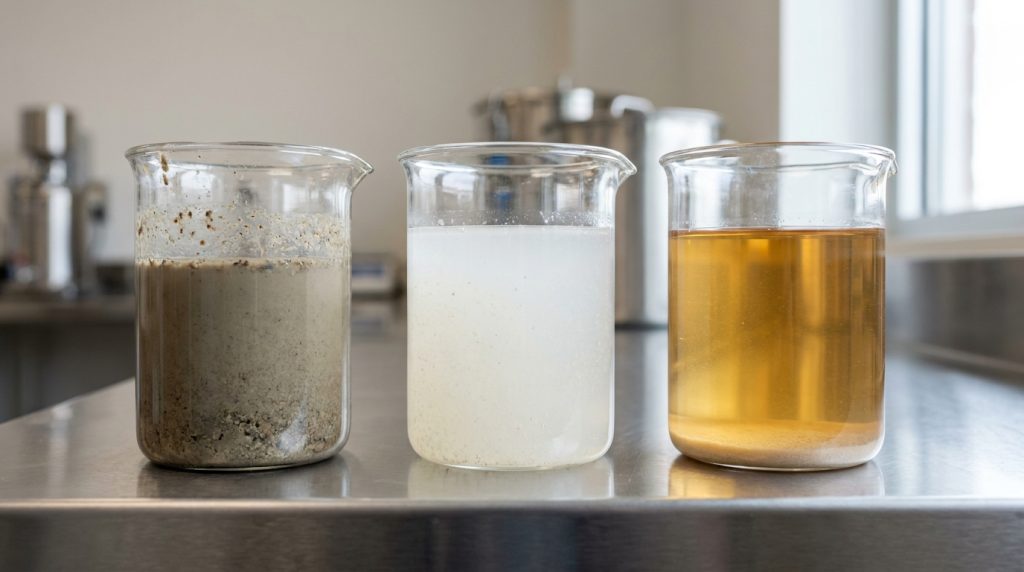
Feed material properties affect separation outcomes by determining how quickly and completely particles migrate under centrifugal force. Particle size, density difference between solids and liquid, and slurry viscosity are the primary variables. Larger particles with higher density differences settle faster, while fine particles suspended in viscous fluids require greater g-force or longer residence time. According to the American Institute of Chemical Engineers (AIChE), particle behavior in physical separations depends on specific surface area and the Sauter Mean Diameter, which represents the diameter of a sphere having the same specific surface as the particle. Solids concentration in the feed also matters; higher concentrations can overload discharge capacity, reducing cake dryness and clarity of the separated liquid.
What operational parameters can be adjusted for better results?
Operational parameters that can be adjusted for better results include bowl speed, differential speed, pond depth, and feed rate. Bowl speed directly controls g-force; increasing rotational speed raises centrifugal acceleration proportionally. Differential speed between the scroll and bowl in decanter centrifuges governs solids transport rate and cake dryness. Pond depth, the liquid level within the bowl, affects clarification time and discharge moisture content.
Material selection also influences long-term efficiency. High-performance alloys such as 316L stainless steel, Hastelloy, and Titanium ensure chemical resistance and durability in corrosive environments. Protective coatings like tungsten carbide on scroll flights reduce erosion at high speeds.
With performance factors understood, selecting the right centrifuge for a specific application becomes the next step.
What are the key considerations for selecting the right industrial centrifuge?
The key considerations for selecting the right industrial centrifuge include throughput capacity, material compatibility with process chemicals, and the particle size distribution of the feed. The following subsections cover how these factors interact and which mistakes to avoid.
How do capacity, material compatibility, and particle size impact selection?
Capacity, material compatibility, and particle size impact selection by defining the centrifuge type, construction material, and G-force range required for effective separation.
Capacity determines whether a batch or continuous centrifuge is appropriate. High-volume processes (above 50 m³/h or approximately 220 gpm) typically require continuous decanter or disc stack designs, while lower-volume specialty applications suit basket centrifuges.
Material compatibility dictates the alloys used in wetted parts. According to product data from Alibaba Product Insights, material selection for centrifuges often involves high-performance alloys such as 316L stainless steel, Hastelloy, and titanium to ensure chemical resistance in corrosive environments. Mismatched materials lead to premature erosion, contamination, or catastrophic failure.
Particle size governs separation efficiency. Finer particles (below 5 microns or 0.0002 in) demand higher centrifugal forces, making disc stack centrifuges (up to 10,000 Gs) the better choice over decanters designed for coarser solids.
What are common mistakes to avoid when choosing a centrifuge for industrial use?
Common mistakes to avoid when choosing a centrifuge for industrial use include:
- Specifying only design capacity while ignoring working capacity, which accounts for real-world feed variability.
- Selecting materials based solely on the primary process fluid without considering cleaning agents, sterilization chemicals, or trace contaminants that contact wetted surfaces.
- Overlooking particle size distribution; a single mean diameter does not capture fines that escape or oversized particles that clog discharge ports.
- Ignoring regulatory requirements such as ATEX/IECEx certification for flammable solvents or the EU Machinery Directive 2006/42/EC for safe operation in European facilities.
- Choosing a continuous centrifuge for applications with highly variable batch compositions, where a batch-mode basket design offers greater flexibility.
For most procurement decisions, matching the centrifuge to worst-case operating conditions rather than average conditions prevents costly retrofits later. Procurement teams benefit from consulting suppliers with deep cross-industry experience when matching centrifuge specifications to demanding process conditions. International Process Plants works with pharmaceutical, chemical processing, and industrial operations worldwide to source separation equipment that meets both typical and worst-case operating parameters
With selection criteria established, proper maintenance and safety protocols ensure long-term centrifuge performance.
What are the maintenance and safety requirements for operating industrial centrifuges?
The maintenance and safety requirements for operating industrial centrifuges include regular inspection of rotating components, adherence to international machinery directives, and protection against erosion and mechanical failure. The subsections below cover inspection frequency and critical safety protocols.
How often should routine inspections and maintenance be performed?
Routine inspections and maintenance should be performed on a scheduled basis that covers rotors, bearings, and seals, along with regular lubrication and cleaning of accumulated solids or sludge. According to Riera Nadeu, industrial centrifuge maintenance requires these inspections to prevent unexpected downtime. A practical inspection schedule includes:
- Daily visual checks of vibration levels and operating temperature
- Weekly lubrication of bearings and verification of seal integrity
- Monthly inspection of scroll flights and bowl surfaces for wear
- Quarterly full disassembly and inspection of rotors and critical contact surfaces
High-speed centrifuges must be protected against erosion using coatings such as tungsten carbide on scroll flights and other contact surfaces. Skipping scheduled maintenance on components rotating at thousands of RPM introduces catastrophic failure risk that far outweighs the cost of planned downtime.
What are the critical safety protocols for centrifuge operation?
The critical safety protocols for centrifuge operation are defined by regulatory frameworks that govern safe design, installation, and daily use. The EU Machinery Directive 2006/42/EC and ISO standards provide the regulatory framework for the safe design and operation of industrial centrifuges in European markets, as documented by IChemE. Essential protocols include:
- ATEX and IECEx compliance for units processing flammable solvents or combustible dusts
- Interlocked guards preventing access to rotating assemblies during operation
- Vibration monitoring with automatic shutdown at preset thresholds
- Proper grounding and bonding in hazardous-area installations
In the United States, EPA 40 CFR Part 437 regulations also influence centrifuge operation in waste treatment applications. For procurement engineers evaluating used equipment, confirming that safety certifications remain valid after recommissioning is as important as verifying mechanical condition.
With maintenance and safety protocols established, sourcing the right centrifuge from a trusted supplier ensures these standards are met from day one.
How can International Process Plants support your industrial centrifuge needs?
International Process Plants supplies new surplus and quality used process equipment, including centrifuges, to chemical, pharmaceutical, and industrial operations worldwide. The following sections cover sourcing options and key article takeaways.
Can International Process Plants help with sourcing used or refurbished centrifuges?
Yes, International Process Plants can help with sourcing used or refurbished centrifuges. With over 46 years of experience, International Process Plants connects buyers with quality used and new surplus separation equipment from its global network of warehouses.
Centrifugation is a mechanical process that replaces gravitational acceleration with centripetal force to separate components by density or size, according to the Encyclopedia of Analytical Science. Because centrifuges operate under demanding conditions, procurement teams benefit from sourcing verified, inspected units rather than waiting months for new-build lead times. International Process Plants maintains equipment constructed from materials such as 316L stainless steel and specialized corrosion-resistant alloys, which are critical for corrosive process environments. Contact International Process Plants directly to discuss currently available centrifuge inventory matched to your specific separation requirements.
What are the key takeaways about industrial centrifuges and their operation?
The key takeaways about industrial centrifuges and their operation are:
- Industrial centrifuges generate centripetal force thousands of times greater than gravity to separate solids from liquids or to split immiscible liquids.
- Major centrifuge types, including decanters, disc stacks, basket, tubular, and pusher designs, each suit different feed characteristics and throughput demands.
- Feed material properties such as particle size, density differential, and viscosity directly determine which centrifuge type delivers optimal separation.
- Operational parameters like bowl speed, differential speed, and pond depth allow operators to fine-tune performance without hardware changes.
- Material selection, routine inspection of rotors, bearings, and seals, and compliance with standards such as the EU Machinery Directive 2006/42/EC and ATEX/IECEx certifications ensure safe, reliable operation.
- Sourcing quality used or new surplus centrifuges from an experienced global supplier like International Process Plants reduces capital expenditure and lead times while maintaining process integrity.
For procurement engineers evaluating centrifuge options, matching the centrifuge type to your process conditions remains the single most consequential decision in the selection process.

 ES
ES  EN
EN  FR
FR  PL
PL  DE
DE  AR
AR  UR
UR  HI
HI  NL
NL  TR
TR  IT
IT  UK
UK  RU
RU  JA
JA  PT
PT  ZH
ZH