 Zum Inhalt springen
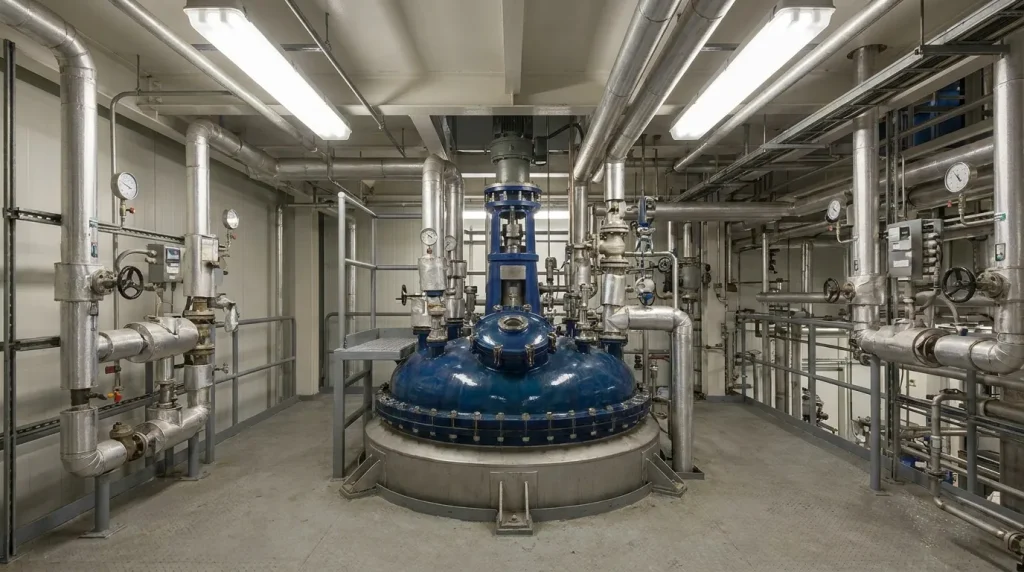
A glass-lined reactor reaches end of life when its vitreous enamel coating can no longer prevent process chemicals from contacting the steel substrate. Replacement becomes necessary once liner defects, structural degradation, or regulatory non-compliance cross the threshold from repairable to irreversible.
This guide covers liner damage and repair escalation, structural integrity assessment, inspection and non-destructive testing practices, regulatory compliance obligations, operational and financial risks, and sourcing replacement equipment through International Process Plants.
Liner damage is the earliest and most visible warning category. Delamination, spalling, chipping, and crazing each represent distinct failure pathways; distinguishing loss-of-containment defects determines when a reactor must be replaced. When repairs recur at increasing frequency, each patch introduces thermal expansion mismatches that can accelerate crack propagation into adjacent zones.
Structural integrity issues confirm what liner inspections suggest. Through-wall cracks, shell bulging, flange leaks, and downward revisions to maximum allowable working pressure all indicate that the vessel’s pressure boundary is compromised. Audible cues like rattling glass fragments or metallic grinding provide supplementary evidence but cannot replace formal testing.
Scheduled inspections using spark testing, ultrasonic thickness measurement, and acoustic emission monitoring generate the objective data needed to justify replacement timing. Documented trends in glass thickness and repair frequency transform subjective concern into defensible engineering decisions.
Regulatory frameworks including PED 2014/68/EU, ATEX, REACH, RIDDOR, and ASME BPE impose continuous compliance obligations on pressure equipment. A reactor that fails conformity assessment cannot legally remain in service, and delayed replacement compounds liability exposure across worker safety, environmental release, and insurance coverage categories.
Operating a failing reactor risks unplanned shutdowns, batch losses, cascading production delays, and catastrophic financial consequences. International Process Plants maintains over 15,000 pieces of equipment across warehouses in the US, Germany, and the United Kingdom, offering procurement engineers a faster, lower-cost path to compliant glass-lined reactor replacement.
What Are the Most Common Warning Signs That a Glass-Lined Reactor Is Reaching the End of Its Usable Life?
The most common warning signs that a glass-lined reactor is reaching the end of its usable life are liner damage, escalating repair frequency, and accelerating corrosion beneath the enamel surface. Each of these indicators signals a distinct failure pathway.
How Does Glass Liner Damage or Delamination Indicate the Need for Reactor Replacement?
Glass liner damage or delamination indicates the need for reactor replacement when defects progress beyond cosmetic surface wear into structural loss-of-containment risks. Not all liner defects carry equal severity. Cosmetic issues like minor crazing or surface abrasion reduce aesthetic quality but may not expose the steel substrate. Loss-of-containment defects, by contrast, breach the glass barrier entirely.
Key damage types that signal replacement include:
- Delamination separates the glass layer from the steel substrate along the bond interface.
- Spalling causes sections of glass to fracture and detach, exposing bare metal.
- Chipping removes localized glass fragments, often near nozzles or baffles.
- Crazing produces fine surface cracks that can propagate deeper under thermal or mechanical stress.
- Star cracks radiate outward from a single impact point and accelerate chip propagation.
When spark testing or discontinuation detection reveals substrate exposure across multiple zones, localized tantalum plug repairs or epoxy patches become insufficient. At that stage, the decision shifts to reglassing or full vessel replacement. Reglassing requires multiple firings, plus non-destructive examination and recertification, often making good used reactor vessels a more cost-effective path than restoration.
Why Are Repeated Repairs on a Glass-Lined Reactor a Sign of Imminent Failure?
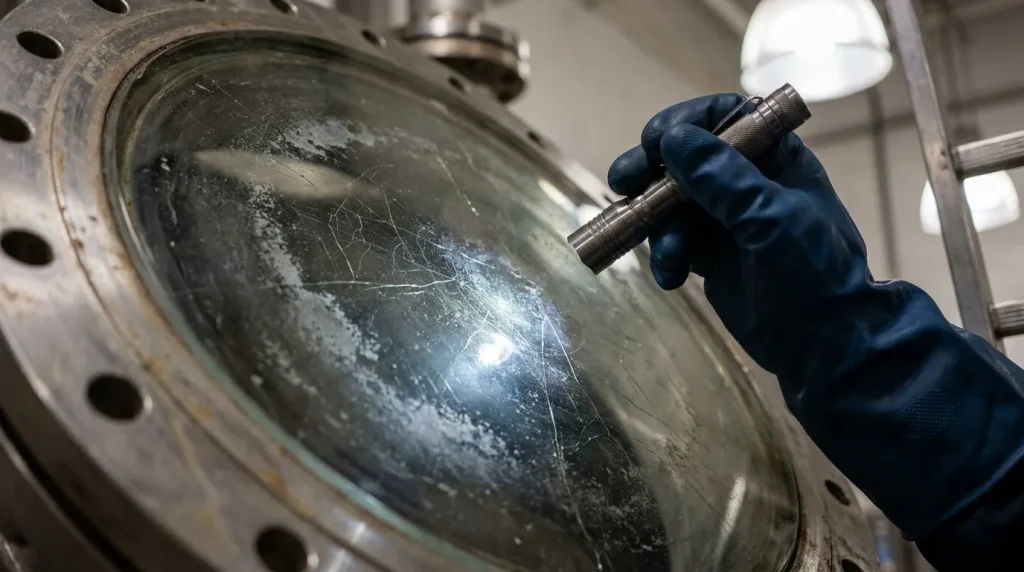
Repeated repairs on a glass-lined reactor are a sign of imminent failure because they reveal progressive, systemic liner degradation rather than isolated damage events. A single tantalum plug or epoxy patch addresses a localized defect. When the same vessel requires repairs at increasing frequency, the underlying glass-to-steel bond is deteriorating across a wider area than any individual repair can address.
Each repair introduces a material discontinuity. Tantalum plugs, while chemically resistant, create thermal expansion mismatches with the surrounding glass. These mismatches concentrate stress at repair boundaries during heating and cooling cycles, accelerating crack propagation into adjacent liner zones. In practical terms, once a reactor requires multiple repairs within a typical inspection cycle, the cumulative repair cost often approaches or exceeds the price of a good used replacement vessel.
What Role Do Corrosion and Material Degradation Play in End-of-Life Assessment?
Corrosion and material degradation play a central role in end-of-life assessment because they compromise the reactor’s primary containment barrier. According to a review published in the Journal of Coatings Technology and Research, degradation due to abrasion negatively affects corrosion protection properties, as cracks can reach the metal substrate and allow direct contact between the substrate and the aggressive environment.
Once process chemicals contact exposed carbon steel or low-alloy steel beneath the glass, corrosion undercutting begins. This undercutting spreads laterally beneath intact glass, widening the delamination front invisibly. Ultrasonic thickness measurement can detect substrate thinning, but by the time wall loss is measurable, the corrosion pathway is well established. For reactors handling acids, solvents, or other aggressive media, even minor substrate exposure accelerates degradation far beyond what surface inspection alone reveals.
With liner, repair, and corrosion indicators established, the next step is evaluating how structural integrity issues confirm these warning signs through measurable changes in vessel performance.
How Can You Identify Structural Integrity Issues in Glass-Lined Reactors?
You can identify structural integrity issues in glass-lined reactors by monitoring for visible defects, tracking pressure and temperature rating changes, and noting abnormal sounds during operation. The subsections below cover cracks, leaks, and bulges; pressure and temperature rating decline; and audible warning signs.
What Types of Cracks, Leaks, or Bulges Signal a Serious Reactor Problem?
The types of cracks, leaks, or bulges that may signal a more serious reactor problem include:
- Through-wall cracks that penetrate from the glass liner into the steel substrate, creating a direct path for process fluid contact with the base metal.
- Visible bulging or deformation of the vessel shell, indicating the steel has yielded under excess pressure or thermal stress.
- Flange leaks or weeping seals that persist after gasket replacement, suggesting warped or corroded sealing surfaces.
- Star cracks radiating from impact points on the glass lining, which propagate under repeated thermal cycling.
According to NIST’s Fractography of Ceramics and Glasses, dye penetrant testing is sometimes used with ceramics to detect grinding-induced cracks, but these defects are often very small and tight, making penetration problematic. When standard inspection methods cannot reliably detect crack propagation, the risk of undetected loss-of-containment failure increases significantly.
How Do Changes in Pressure or Temperature Ratings Demonstrate Structural Decline?
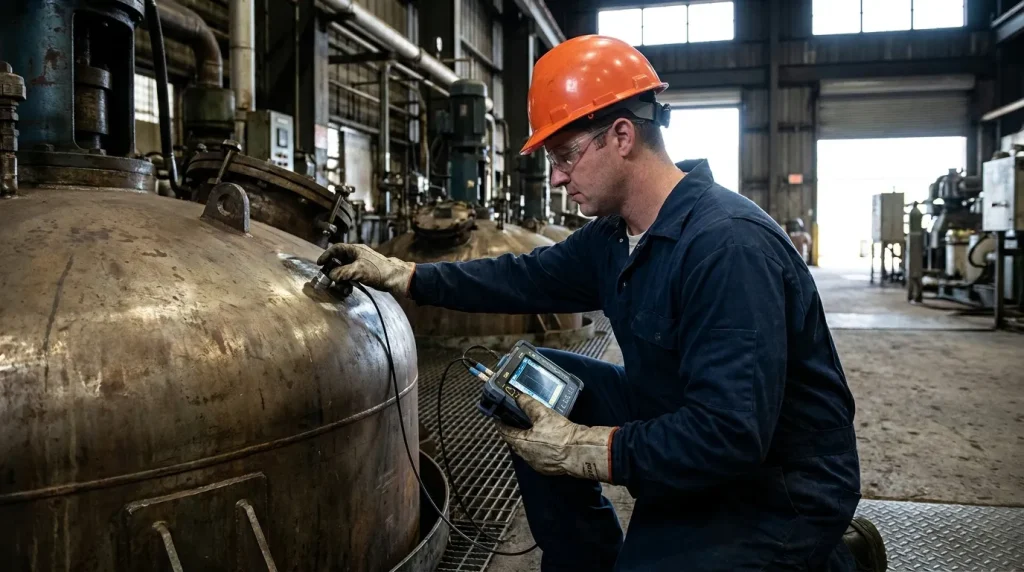
Changes in pressure or temperature ratings demonstrate structural decline when a reactor can no longer safely operate at its original design limits. Wall thinning from corrosion, glass liner erosion, or cumulative thermal fatigue reduces the maximum allowable working pressure (MAWP) and the permissible operating temperature range.
Under the EU Pressure Equipment Directive (PED 2014/68/EU), pressure equipment with a maximum allowable pressure greater than 0.5 bar (7.25 PSI) must meet essential safety requirements covering design, manufacture, and testing. If inspection data shows that a glass-lined reactor’s effective wall thickness has decreased below the minimum required by ASME Section VIII or PED calculations, the vessel’s certified pressure and temperature ratings must be de-rated or the reactor must be removed from service. Any downward revision of these ratings is a clear structural warning that replacement planning should begin.
Are Audible Noises or Vibrations Reliable Indicators of Reactor Health?
Audible noises or vibrations are partially reliable indicators of reactor health, but they should never serve as a sole diagnostic method. Unusual sounds during operation can signal specific mechanical problems:
- Rattling or tinkling may indicate loose glass fragments from liner spalling or chipping inside the vessel.
- Metallic grinding can point to agitator bearing wear, shaft misalignment, or contact between the agitator and a damaged liner surface.
- Cyclic knocking or hammering often results from cavitation in the jacket system or thermal shock events.
These auditory cues are useful early warnings, especially for operators who know the baseline sound profile of their equipment. However, many critical defects, such as subsurface crack propagation and gradual wall thinning, produce no audible signature at all. Pairing auditory monitoring with scheduled non-destructive testing methods provides a far more complete assessment of structural condition.
What Maintenance and Inspection Practices Help Detect a Failing Glass-Lined Reactor?
Maintenance and inspection practices that help detect a failing glass-lined reactor include scheduled internal visual examinations, non-destructive testing (NDT) methods, and systematic documentation of all findings. The following subsections cover inspection frequency, effective NDT techniques, and record-keeping strategies.
How Frequently Should You Conduct Internal Visual Inspections?
You should conduct internal visual inspections at least once per year for glass-lined reactors operating under standard conditions. Reactors processing highly corrosive media or running frequent thermal cycles may require inspections every six months or after any process is upset. Each inspection should include visual examination of the glass lining for chips, crazing, star cracks, and delamination fronts, along with glass-thickness measurement to track liner wear over time. Spark testing should accompany every visual inspection to detect holidays and pinholes invisible to the naked eye. Scheduling inspections during planned maintenance turnarounds minimizes production disruption while maintaining consistent oversight of liner condition.
What Non-Destructive Testing Methods Are Effective for Reactor Assessment?
Non-destructive testing methods effective for reactor assessment include spark testing, ultrasonic thickness measurement, acoustic emission monitoring, and dye penetrant testing. Each method targets a different failure mode:
- Spark testing (holiday detection) identifies discontinuities in the glass lining. According to ASTM D5162-21, wet-sponge holiday testing applies to coatings 0.5 mm (20 mil) or thinner, while high-voltage spark testing applies to linings thicker than 0.5 mm (20 mil).
- Ultrasonic thickness measurement measures wall thickness by comparing ultrasonic echoes from front and back surfaces, revealing thinning in both the glass liner and the steel substrate.
- Acoustic emission monitoring evaluates volumetric integrity during pressure tests, detecting active crack propagation that other methods may miss.
- Dye penetrant testing highlights surface-breaking cracks on accessible surfaces.
Combining multiple NDT methods provides the most reliable assessment, since no single technique covers every failure mode. Regulations such as PED 2014/68/EU and the UK Pressure Systems Safety Regulations require periodic mechanical integrity inspections that often mandate specific NDT protocols for pressure vessels.
What Documentation or Record-Keeping Can Support Timely Reactor Replacement Decisions?
Documentation that supports timely reactor replacement decisions includes inspection logs, NDT results, repair histories, and process deviation records, all maintained in a centralized equipment file. Key records to track include:
- Glass-thickness measurements from each inspection cycle, plotted as a trend over time.
- Spark test and holiday detection results with defect locations mapped on a vessel diagram.
- Dates, scope, and outcomes of every repair, patch, or reglassing event.
- Process excursions such as thermal shock incidents, overpressure events, or unexpected chemical exposure.
- Pressure test results referenced against the reactor’s original maximum allowable working pressure (MAWP).
Trending this data reveals accelerating degradation patterns that justify proactive replacement before a loss-of-containment event. When repair frequency increases or glass-thickness readings approach minimum thresholds, the documented data helps support replacement decisions. With a clear inspection record in place, regulatory requirements and replacement timing become easier to align.
How Do Regulatory Standards and Industry Guidelines Influence Replacement Timing?
Regulatory standards and industry guidelines influence replacement timing by establishing mandatory safety thresholds that aging glass-lined reactors must continuously meet. The subsections below cover elevated risks from delayed replacement and specific compliance requirements that can mandate it.
What Health, Safety, and Environmental Risks Are Elevated by Delaying Reactor Replacement?
The health, safety, and environmental risks elevated by delaying reactor replacement include loss-of-containment events, worker exposure to hazardous chemicals, and uncontrolled releases into the surrounding environment. A compromised glass liner allows corrosive process fluids to attack the steel substrate, raising the probability of catastrophic vessel failure.
Several regulatory frameworks define these risk thresholds:
- PED 2014/68/EU governs the design, manufacture, and conformity assessment of pressure equipment operating above 0.5 bar (7.25 PSI), making degraded reactors a direct compliance concern.
- The ATEX workplace Directive 1999/92/EC sets minimum requirements for protecting workers at risk from explosive atmospheres, which a leaking reactor can create.
- REACH, the EU regulation adopted to protect human health and the environment from chemical risks, treats uncontrolled releases as enforcement triggers.
- RIDDOR in the United Kingdom requires reporting of dangerous occurrences involving pressure system failures with the potential to cause death.
According to a U.S. Environmental Protection Agency Chemical Safety Alert, pressure vessels operated beyond design limits have caused rupture events with severe consequences. Every delay in replacing a failing glass-lined reactor compounds exposure across all of these regulatory categories simultaneously.
Are There Compliance Deadlines or Requirements That Mandate Replacement?
Yes, there are compliance requirements that can effectively mandate replacement when a glass-lined reactor no longer meets essential safety criteria. According to UK Health and Safety Executive guidance on pressure equipment, regulations require that pressure equipment must be safe and meet essential safety requirements covering design, manufacture, and testing. A reactor that fails a conformity assessment or cannot satisfy ASME Section VIII, PED, or Pressure Systems Safety Regulations re-certification criteria cannot legally remain in service.
While most frameworks do not specify a fixed calendar deadline, they impose ongoing compliance obligations. Notified bodies conducting periodic inspections can withdraw certification, and hazardous area classifications under ATEX or IECEx may change if vessel integrity deteriorates. Treating these regulatory requirements as proactive replacement triggers, rather than waiting for an enforcement action, is the most reliable way to maintain uninterrupted production.
What Are the Operational and Financial Risks of Operating a Failing Glass-Lined Reactor?
The operational and financial risks of operating a failing glass-lined reactor include unplanned production shutdowns, regulatory penalties, and catastrophic liability exposure. The sections below cover downtime costs and legal consequences.
How Can Unplanned Downtime from Reactor Failure Affect Production Costs?
Unplanned downtime from reactor failure can affect production costs by halting batch processes, wasting in-progress materials, and triggering cascading delays across dependent unit operations. When a glass-lined reactor fails mid-batch, the entire charge of raw materials and intermediates may be lost to contamination from exposed steel substrate. Downstream scheduling collapses as subsequent process steps wait for reactor availability. Emergency procurement of replacement equipment or reglassing services carries premium pricing and extended lead times, compounding losses well beyond the initial shutdown. According to the U.S. Chemical Safety and Hazard Investigation Board’s Yenkin-Majestic investigation report, a single reactor-related incident resulted in total property damage exceeding $90 million, with the facility ultimately demolished. For most chemical operations, proactive replacement planning eliminates the multiplier effect where one failed reactor disrupts an entire production chain.
What Are the Potential Liabilities from Using a Non-Compliant or Failed Reactor?
The potential liabilities from using a non-compliant or failed reactor span criminal prosecution, civil claims, regulatory shutdown orders, and loss of insurance coverage. According to the UK Health and Safety Executive’s RIDDOR dangerous occurrences guidance, the failure of a pressure system with the potential to cause death applies to any such vessel, whatever its contents. This means a glass-lined reactor operating with known liner defects or beyond certified pressure limits triggers mandatory incident reporting obligations across multiple jurisdictions.
Key liability categories include:
- Regulatory enforcement: Violations of PED 2014/68/EU, ASME Section VIII, or Pressure Systems Safety Regulations can result in facility closure and prosecution of responsible personnel.
- Worker injury claims: Operating degraded pressure equipment exposes employers to personal injury lawsuits and increased workers’ compensation premiums.
- Environmental remediation: Containment loss from a compromised liner can release process chemicals, creating cleanup obligations under REACH and equivalent frameworks.
- Insurance denial: Insurers may void coverage when equipment operates outside documented design parameters or past recommended service intervals.
Replacing a reactor before failure is not just an engineering decision; it is a direct risk-mitigation measure that protects personnel, preserves regulatory standing, and avoids financial consequences that dwarf the cost of a good used or new surplus replacement vessel.
How Should You Approach Glass-Lined Reactor Replacement with International Process Plants’ Equipment Sourcing Services?
You should approach glass-lined reactor replacement with International Process Plants by leveraging our inventory of new surplus and quality used process vessels, jacketed reactors, and glass-lined equipment. The following subsections cover how our sourcing services streamline replacement and summarize the key end-of-life warning signs discussed throughout this article.
How Can IPP’s Used and Refurbished Reactor Inventory Help Streamline Your Replacement Process?
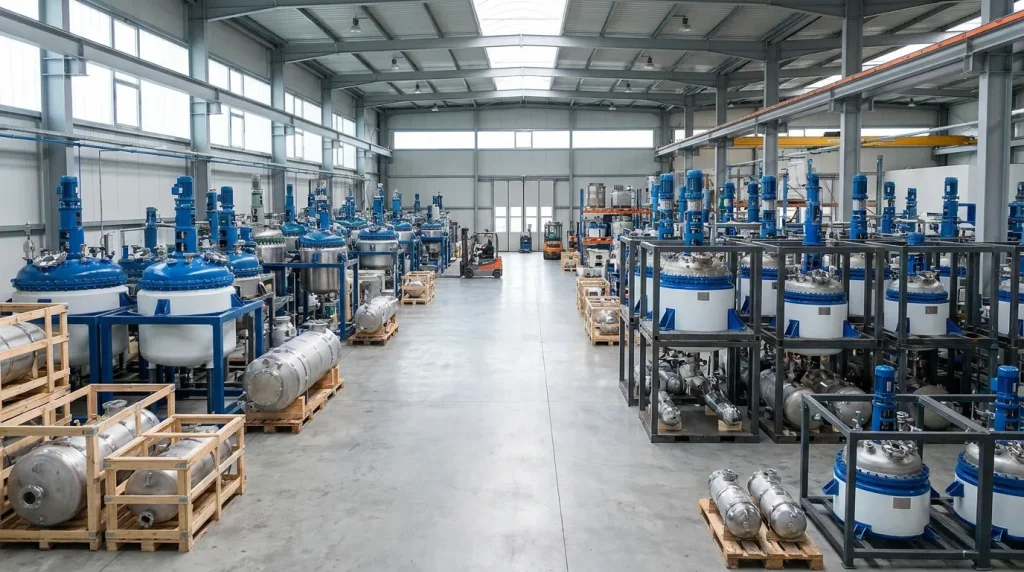
International Process Plants’ used and good used reactor inventory helps streamline your replacement process by reducing lead times and acquisition costs compared to new OEM orders. Our warehouses in the United States, Germany, and the United Kingdom hold over 15,000 pieces of equipment, including glass-lined reactors, enamel-lined reactors, and agitated vessels currently available for global deployment. Since 98% of our reactor inventory consists of batch reactors, procurement engineers can source replacement vessels that match existing process specifications for pressure rating, volume, and jacket configuration. We will purchase your bad or damaged glass line equipment, helping you lower the costs of replacement.
Good used glass-lined reactors typically cost approximately 50% of new OEM price, while reglassing often exceeds that cost. Equipment from International Process Plants ships with documentation supporting compliance with standards such as ASME Section VIII, the Pressure Equipment Directive (PED 2014/68/EU), CE marking, and UKCA marking, so replacement vessels can meet conformity assessment requirements across jurisdictions.
What Are the Key Takeaways About When to Replace a Glass-Lined Reactor and Its End-of-Life Warning Signs?
The key takeaways about when to replace a glass-lined reactor and its end-of-life warning signs center on five decision points:
- Liner integrity determines containment safety. Delamination, spalling, chipping, and crazing that expose the steel substrate to process chemicals signal that the glass lining no longer provides corrosion protection.
- Repeated repairs indicate accelerating degradation. Each repair cycle introduces thermal stress, and a pattern of recurring holidays or pinholes points toward full replacement rather than further patching.
- Structural changes demand immediate action. Cracks, pressure rating reductions, leaks, or visible bulging in the shell compromise the pressure boundary and risk loss-of-containment events.
- Regulatory compliance is non-negotiable. Frameworks including PED 2014/68/EU, ATEX, REACH, RIDDOR, and ASME BPE set mandatory safety thresholds; operating a non-compliant vessel exposes facilities to enforcement action, liability, and catastrophic financial loss.
- Proactive inspection drives timely decisions. Spark testing, ultrasonic thickness measurement, acoustic emission monitoring, and documented inspection histories provide the objective data needed to justify replacement before failure occurs.
For procurement engineers managing this transition, International Process Plants offers a faster, cost-effective path to compliant replacement equipment sourced from our global inventory of glass-lined reactors, kettles, and process vessels.

 DE
DE  EN
EN  ES
ES  FR
FR  PL
PL  AR
AR  UR
UR  HI
HI  NL
NL  TR
TR  IT
IT  UK
UK  RU
RU  JA
JA  PT
PT  ZH
ZH