 Zum Inhalt springen
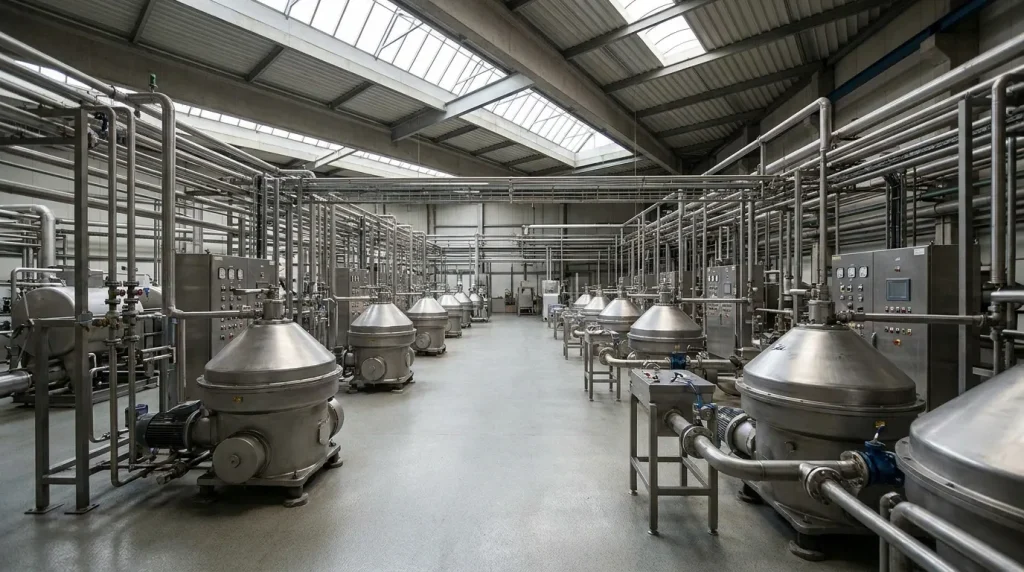
Disc stack and decanter centrifuges are two distinct separation technologies designed for different feed characteristics and throughput requirements. Disc stack centrifuges use high-speed spinning conical discs to separate fine particles and immiscible liquids, while decanter centrifuges employ a rotating bowl with an internal scroll to continuously dewater high-solids slurries.
This guide covers how each centrifuge type operates, their comparative performance metrics, selection criteria based on feed characteristics and facility constraints, and sourcing options through International Process Plants.
Disc stack centrifuges generate centrifugal forces between 5,000 and 15,000 × g, enabling separation of particles as small as 0.1 µm (0.000004 in). These machines handle feeds with 1 to 8% solids concentration and achieve throughputs from 1,000 to 50,000 L/h (264 to 13,200 GPH). Dairy processing, pharmaceutical clarification, and biodiesel washing represent typical applications.
Decanter centrifuges operate at lower G-forces (2,000 to 4,000 × g) but process slurries containing 50 to 75% solids by volume. Industrial units reach throughputs of 10 to 80 tonnes per hour (11 to 88 tons per hour), making them the standard choice for wastewater sludge dewatering, mining tailings, and food processing applications.
Performance comparisons reveal that capital costs range from $50,000 to $350,000 (€46,000 to €320,000) for disc stack units and $100,000 to over $750,000 (€92,000 to €690,000) for larger decanters. Both technologies achieve 15 to 25+ year service life with proper maintenance intervals of 2,000 to 4,000 hours for minor service.
Selection depends on feed viscosity, density differences between phases, and facility constraints affecting footprint and energy consumption. Regulatory requirements additionally apply to both disc-stack and decanter centrifuges.
How Do Disc Stack Centrifuges Work?
Disc stack centrifuges work by spinning a stack of conical discs at high speeds to separate liquids from solids or to split two immiscible liquids. The sections below cover suitable applications, advantages and disadvantages, and the materials best handled by this technology.
What Types of Separation Applications Suit Disc Stack Centrifuges?
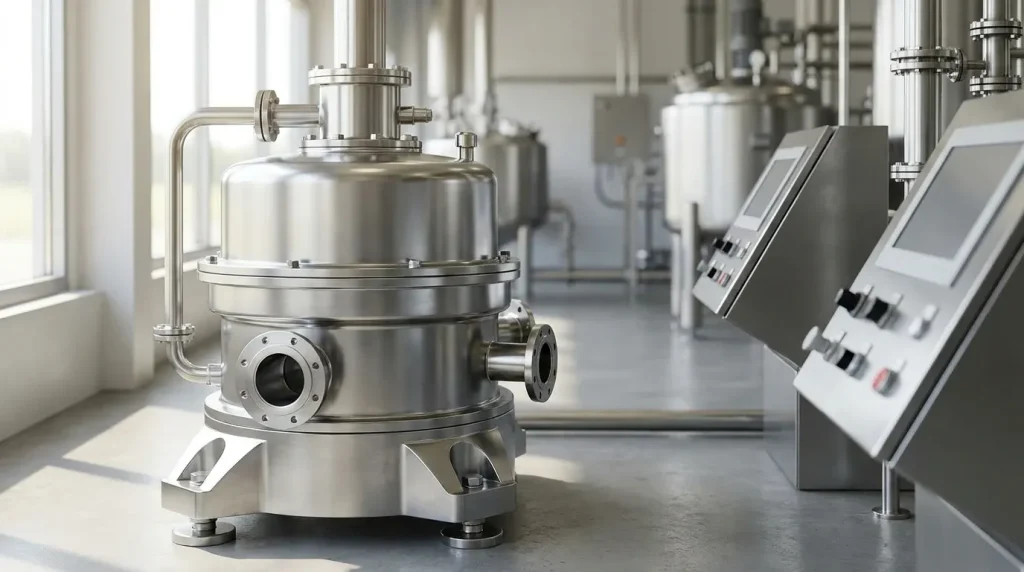
The types of separation applications that suit disc stack centrifuges are those requiring fine-particle removal or liquid-liquid clarification. High-speed disc stack centrifuges generate centrifugal acceleration fields between around 5,000 and 15,000 × g, according to Rheological Characterization of Solids Phase in Biomass Processes of Disc-Stack Centrifuges, published in Chemical Engineering & Technology. This makes them ideal for separating fine particles and liquid-liquid mixtures. Typical applications include:
- Milk and cream separation in dairy processing
- Edible oil polishing and degumming
- Pharmaceutical broth clarification
- Biodiesel washing and glycerin removal
- Beer and wine clarification
The conical discs, usually spaced around 0.4–2 mm (0.016–0.079 in) apart, split the liquid into thin layers and dramatically shorten the settling distance for particles or droplets. This geometry allows efficient separation of particles as small as 0.1 µm (0.000004 in).
What Are the Main Advantages and Disadvantages of Disc Stack Centrifuges?
The main advantages of disc stack centrifuges are exceptional clarification precision and efficient liquid-liquid separation. Key benefits include:
- High G-force capability (5,000–15,000 × g) for sub-micron particle removal
- Compact footprint relative to throughput
- Continuous or semi-continuous operation with automatic solids ejection
- Throughput capacity that can range from around 1,000 to 50,000 L/h (264–13,200 GPH) in dairy and pharmaceutical applications
The main disadvantages relate to solids-handling limitations. Disc stack units typically handle feed streams containing less than 1–8% solids by volume. Higher concentrations risk plugging the disc stack. Capital costs typically range anywhere from $50,000 to $350,000 (€46,000–€320,000), and the tight tolerances demand skilled maintenance.
What Materials or Processes Are Best Handled by Disc Stack Centrifuges?
The materials and processes best handled by disc stack centrifuges are low-solids feeds requiring high-purity liquid recovery. Feed viscosity significantly affects centrifugal separation performance. Literature on centrifugal equipment operation shows that increasing viscosity toward approximately 800–1,000 cP can cause substantial hydraulic losses and efficiency reductions, highlighting the importance of selecting equipment and operating conditions appropriate for viscous feeds.
Ideal process categories include:
- Dairy (skim milk, cream, whey protein)
- Vegetable and marine oils
- Pharmaceutical intermediates and vaccines
- Brewing and winemaking clarification
- Biodiesel and glycerin separation
How Do Decanter Centrifuges Operate?
Decanter centrifuges operate by using a rotating bowl and an internal screw conveyor (scroll) that turns at a differential speed to continuously separate and discharge solids from liquids. The sections below cover ideal applications, strengths and limitations, and best-suited materials.
What Industrial Applications Are Ideal for Decanter Centrifuges?
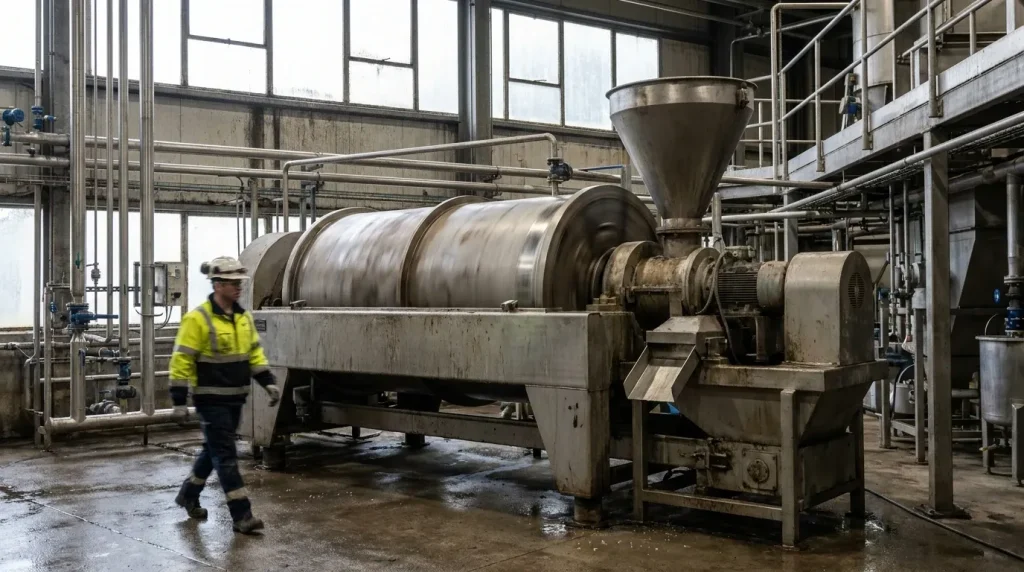
The industrial applications ideal for decanter centrifuges include mining, wastewater treatment, chemical processing, and food production where high solids throughput is required. These machines excel in continuous dewatering operations that generate large volumes of sludge or slurry.
Industrial decanter centrifuges can achieve high throughput rates. For example, in mining and wastewater applications, large decanter centrifuges can achieve throughput rates around 10 to 80 tonnes per hour (11 to 88 tons per hour). This capacity makes decanters the preferred choice for:
- Municipal and industrial wastewater sludge dewatering
- Mining tailings and mineral slurry processing
- Olive oil and edible oil extraction
- Drilling mud recovery in oil and gas operations
- Starch and protein separation in food processing
What Are the Strengths and Limitations of Decanter Centrifuges?
The strengths of decanter centrifuges include continuous solids discharge, high throughput capacity, and the ability to handle feed streams with elevated solids concentrations. Decanters can process slurries up to around 75% solids by volume according to a ProBrewer case study on Decanter Centrifuges in the Brewing Process, far exceeding the lower limit typical of disc stack centrifuges.
Key strengths:
- Continuous operation without manual intervention for solids removal
- Lower sensitivity to particle size variation
- Robust construction tolerates abrasive feeds
- Adjustable scroll differential speed optimizes cake dryness
Limitations include:
- Lower G-forces (2,000 to 4,000 × g) reduce effectiveness with fine particles below 5 µm (0.0002 in)
- Higher capital cost for large-capacity units
- Greater footprint compared to disc stack alternatives
- Less precise liquid-liquid separation capability
What Types of Materials or Mixtures Are Best Separated by Decanter Centrifuges?
The types of materials best separated by decanter centrifuges are high-solids slurries, fibrous suspensions, and coarse particulate mixtures requiring continuous dewatering. As noted in Separation and Purification Technology, decanter centrifuges (also called solid bowl centrifuges) utilize a rotating bowl and internal scroll operating at differential speeds to continuously discharge separated solids.
Best-suited materials include:
- Mineral slurries with particles above 5 µm (0.0002 in)
- Wastewater biosolids and activated sludge
- Fruit and vegetable pulp in juice production
- Drilling fluids containing barite and bentonite
- Polymer and chemical sludges with moderate viscosity
Materials with extremely fine particles or requiring liquid-liquid emulsion breaking typically suit disc stack centrifuges better.
With decanter operating principles established, the next section compares performance and efficiency between disc stack and decanter technologies.
How Do Disc Stack and Decanter Centrifuges Compare in Performance and Efficiency?
Disc stack and decanter centrifuges differ in cost-effectiveness, maintenance requirements, and throughput capabilities based on application demands. The following subsections examine performance factors between the two.
Which Centrifuge Type Is More Cost-Effective for Specific Industries?
The more cost-effective centrifuge type depends on industry-specific throughput requirements and solids concentrations. Disc stack centrifuges typically range from around $50,000 to $350,000 (€46,000 to €320,000) in capital cost, while larger decanters can range from around $100,000 to over $750,000 (€92,000 to €690,000).
Industries handling high-value, low-solids streams often utilize disc stack configurations:
- Pharmaceutical purification
- Dairy cream separation
- Biodiesel polishing
- Beverage clarification
Heavy-solids industries often utilize decanter configurations for:
- Mining slurry dewatering
- Wastewater sludge processing
- Chemical sludge recovery
- Food waste treatment
For mid-volume pharmaceutical applications, disc stack machines often deliver faster payback despite similar operating costs.
What Are the Maintenance and Operational Differences Between These Technologies?
The maintenance and operational differences between disc stack and decanter centrifuges center on component complexity and service intervals. Disc stack units require precise disc alignment and more frequent bowl cleaning due to tight 0.4 to 2 mm (0.016 to 0.079 in) disc spacing. Decanters demand scroll conveyor inspection and wear-part replacement from continuous solids contact.
| Maintenance Factor | Disc Stack | Decanter |
| Minor service interval | Around 2,000 to 4,000 hours | Around 2,000 to 4,000 hours |
| Major overhaul interval | Around 8,000 to 12,000 hours | Around 8,000 to 12,000 hours |
| Primary wear components | Discs, seals, discharge nozzles | Scroll flights, bearings, wear tiles |
| Cleaning frequency | Higher (fine particle buildup) | Lower (continuous discharge) |
Manufacturer documentation and guidelines should always be referenced for accurate service and overhaul interval recommendations. Both technologies can achieve 15 to 25+ year service life with proper maintenance programs.
How Does Throughput and Separation Precision Vary Between Disc Stack and Decanter Centrifuges?
Throughput and separation precision vary significantly between disc stack and decanter centrifuges based on g-force capabilities and solids handling. Disc stack units can generate around 5,000 to 15,000 x g, enabling separation of particles as fine as 0.1 µm (0.000004 in). Decanters typically operate at around 2,000 to 4,000 x g but handle feed streams with higher solids concentration, whereas disc stack centrifuges are limited to significantly lower solids concentrations.
| Parameter | Disc Stack | Decanter |
| G-force range | ~5,000 to 15,000 x g | ~2,000 to 4,000 x g |
| Particle size range | Around 0.1 to 30 µm (0.000004 to 0.0012 in) | Around 2 to 5,000+ µm |
| Solids concentration capacity | Often around 1% to 8% | Often around 75% |
| Typical throughput | Approximately 1,000 to 50,000 L/h (264–13,200 US gal/h) | Approximately 10 to 80 tonnes/h (22,000–176,000 lb/h; 11–88 short tons/h) |
Disc stacks excel at precision liquid-liquid and fine particle separation, while decanters dominate high-volume solids dewatering applications. Understanding your feed characteristics determines which performance profile aligns with process requirements.
What Key Factors Should Be Considered When Selecting Between Disc Stack and Decanter Centrifuges?
The key factors to consider when selecting between disc stack and decanter centrifuges include feed characteristics, facility constraints, energy requirements, and automation needs, with regulatory compliance factors affecting both disc stack and decanter centrifuges. The following subsections examine how each factor shapes equipment selection.
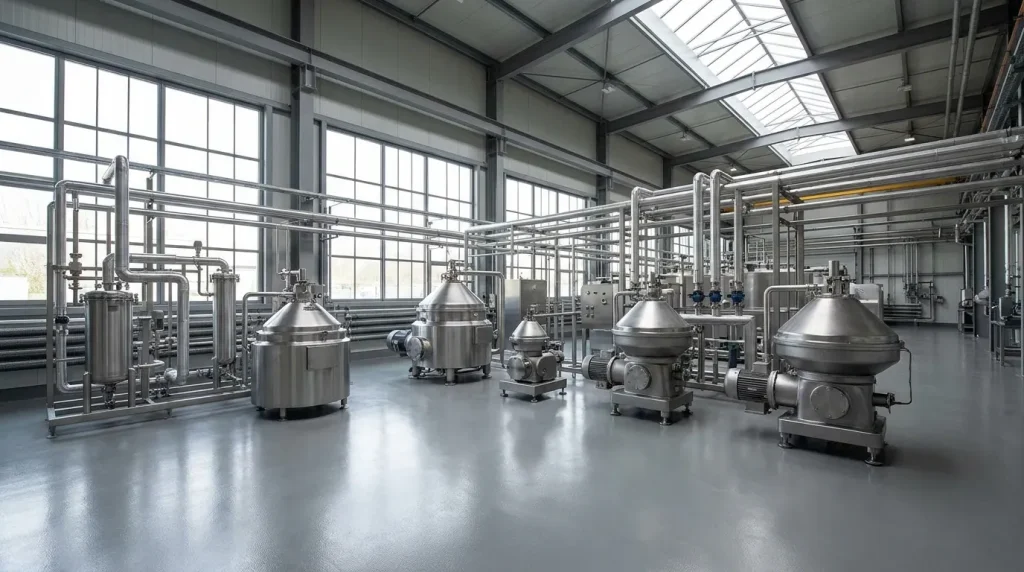
How Do Feed Characteristics Influence Centrifuge Selection?
Feed characteristics influence centrifuge selection by determining which machine design is better suited to your particular process. Solids concentration is a primary differentiator: disc stack centrifuges are typically deployed for feeds with less solids by volume, while decanters are typically deployed for process streams containing significantly more solids without plugging.
Particle size also dictates equipment choice:
- Disc stack centrifuges can separate particles from around 0.1-30 µm (0.000004-0.0012 in.)
- Decanters can handle coarser solids that would overwhelm disc spacing
Viscosity should ideally not approach the 800 to 1,000 cP mark, in order to prevent hydraulic losses and efficiency reductions. Matching parameters to your process stream prevents costly equipment misapplication.
What Role Does Space, Energy Consumption, and Automation Play in Choosing a Solution?
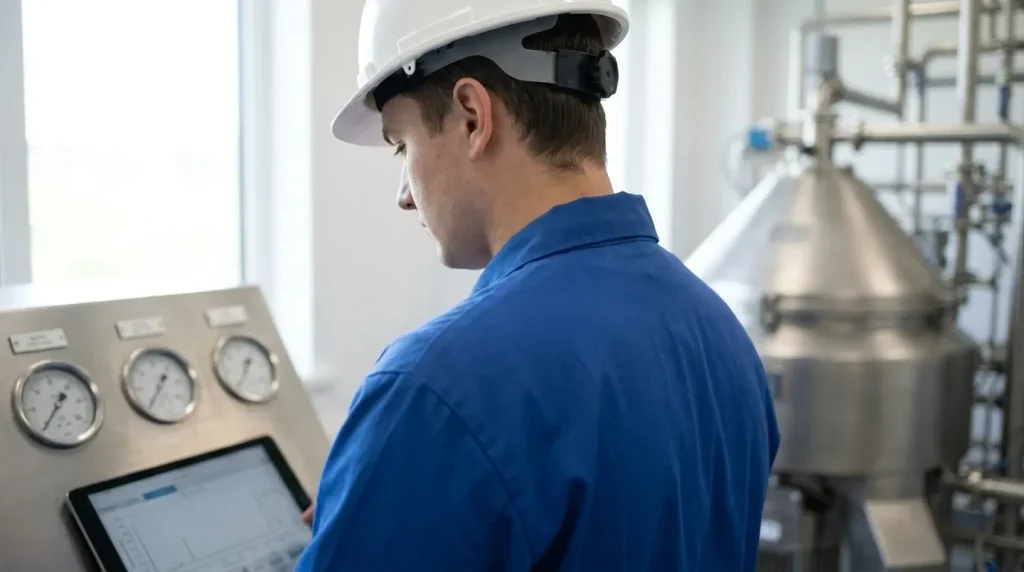
Space, energy consumption, and automation play significant roles in choosing a centrifuge solution because they affect installation feasibility and operating costs. Disc stack units offer compact footprints suited to constrained facilities, while decanters require more floor space but deliver higher throughput per unit.
Modern automation features include:
- Real-time scroll differential speed adjustment
- Vibration monitoring for predictive maintenance
- Remote diagnostics reducing unplanned downtime
These newer industry capabilities can often justify higher capital costs through reduced labor and improved uptime.
How Do Regulatory or Industry-Specific Requirements Affect Equipment Choice?
Regulatory and industry-specific requirements affect equipment choice for any centrifuge configuration. ATEX certification or other equivalent jurisdiction-specific requirements are mandatory for centrifuges operating in potentially explosive atmospheres, common in chemical and biodiesel processing.
Key compliance considerations include:
- FDA 21 CFR Part 11 for pharmaceutical applications requiring electronic record integrity
- CE marking and PED compliance for European installations
- Hygienic design standards for food and pharmaceutical processing
How Can International Process Plants Help You Source the Right Centrifuge Solution?
International Process Plants helps you source the right centrifuge solution by offering access to new surplus and quality used disc stack and decanter centrifuges from our global inventory. The following sections explain our equipment supply capabilities and summarize the key selection factors covered in this guide.
Can International Process Plants Assist with Supplying Used or Refurbished Centrifuge Equipment?
Yes, International Process Plants can assist with supplying used centrifuge equipment through our extensive global network. With over 46 years of experience and warehouses in the United States, Germany, and the United Kingdom, we maintain ready access to both disc stack and decanter centrifuges across a range of capacities and configurations.
Our inventory includes centrifuges suitable for pharmaceutical, chemical, food processing, and alternative fuels applications. For operations in potentially explosive atmospheres, ATEX or other equivalent jurisdiction-specific certification is mandatory, and we can help identify equipment meeting these requirements.
Key sourcing advantages include:
- Access to 15,000+ pieces of process equipment worldwide
- Both new surplus and quality used options
- Equipment compliant with industry and regional-specific standards
- Technical documentation and inspection records where available
Purchasing quality used centrifuges typically delivers around 50% savings compared to new OEM equipment, allowing faster project deployment.
What Are the Key Takeaways About Disc Stack vs. Decanter Centrifuge: Key Differences and Selection Guide We Covered?
The key takeaways about disc stack vs. decanter centrifuge selection are that each technology excels in distinct applications based on solids concentration, particle size, and throughput requirements.
Core disc stack and decanter centrifuge principles include:
- Disc stack centrifuges suit low-solids feeds with fine particles requiring high G-forces up to around 15,000 x g
- Decanter centrifuges handle high-solids feeds (up to around 75% by volume) with coarser particles at throughputs reaching around 80 tonnes per hour (88 tons per hour)
- Keeping feed viscosity below the 800–1,000 cP range is recommended
- Capital costs range from around $50,000-$350,000 (€46,000-€320,000) for disc stacks and around $100,000-$750,000+ (€92,000-€690,000+) for decanters
Matching your feed characteristics to the correct centrifuge type prevents operational problems and maximizes separation efficiency. When you need help navigating these decisions, International Process Plants offers the technical expertise and equipment access to support your project timeline and budget.

 DE
DE  EN
EN  ES
ES  FR
FR  PL
PL  AR
AR  UR
UR  HI
HI  NL
NL  TR
TR  IT
IT  UK
UK  RU
RU  JA
JA  PT
PT  ZH
ZH