 انتقل إلى المحتوى
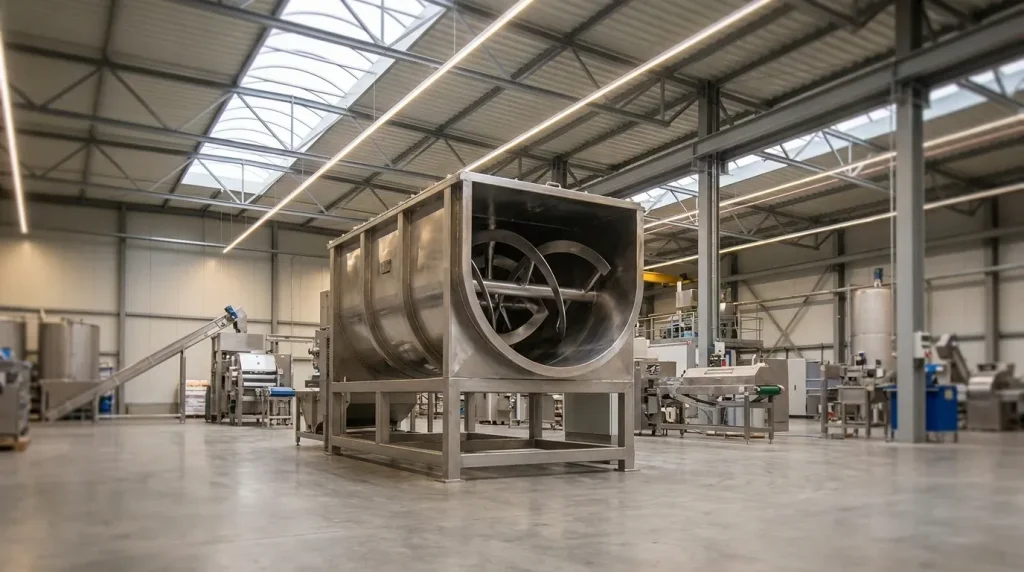
A ribbon blender is a horizontal mixing vessel that uses counter-rotating helical ribbons to blend dry powders and granular materials through continuous folding action. The outer ribbons pull material inward while inner ribbons push material outward, achieving batch homogeneity typically within 15 to 20 minutes.
This guide covers ribbon blender design and components, the mixing mechanism that creates uniform blends, industrial applications across pharmaceutical, food, and chemical sectors, advantages and limitations compared to other mixer types, maintenance protocols for optimal performance, and equipment sourcing options.
The fundamental design centers on a U-shaped trough with dual-helix agitators operating at tip speeds around 300 ft/min (91 m/min). This configuration handles free-flowing solids with bulk densities up to 70 lb/ft³ (1,120 kg/m³), making ribbon blenders suitable for everything from spice blends to pharmaceutical excipients.
The mixing mechanism relies on convective blending, where opposing ribbon movements create continuous back-and-forth folding motion throughout the vessel. Proper batch sizing between 30% and 40% of rated capacity ensures all material participates in the active mixing zone, preventing dead spots that compromise product quality.
Ribbon blenders serve multiple industries because they deliver the consistent homogeneity required for regulatory compliance under cGMP and ISO standards. However, they present limitations with sticky or cohesive materials that adhere to ribbon surfaces, requiring careful material evaluation before equipment selection.
Maintenance requirements include validated cleaning protocols, daily component inspections, and bearing lubrication at specified intervals. We source quality used, new surplus, and refurbished ribbon blenders through our global inventory network spanning the US, Germany, and the United Kingdom.
What is a ribbon blender and what are its main components?
A ribbon blender is a horizontal mixing vessel that uses helical ribbon agitators to blend dry powders and granular materials. The main components include a U-shaped trough, a central shaft, inner and outer ribbon blades, end plates, a discharge valve, and a drive system. The following subsections explain how these components work together.
How does the design of a ribbon blender facilitate mixing?
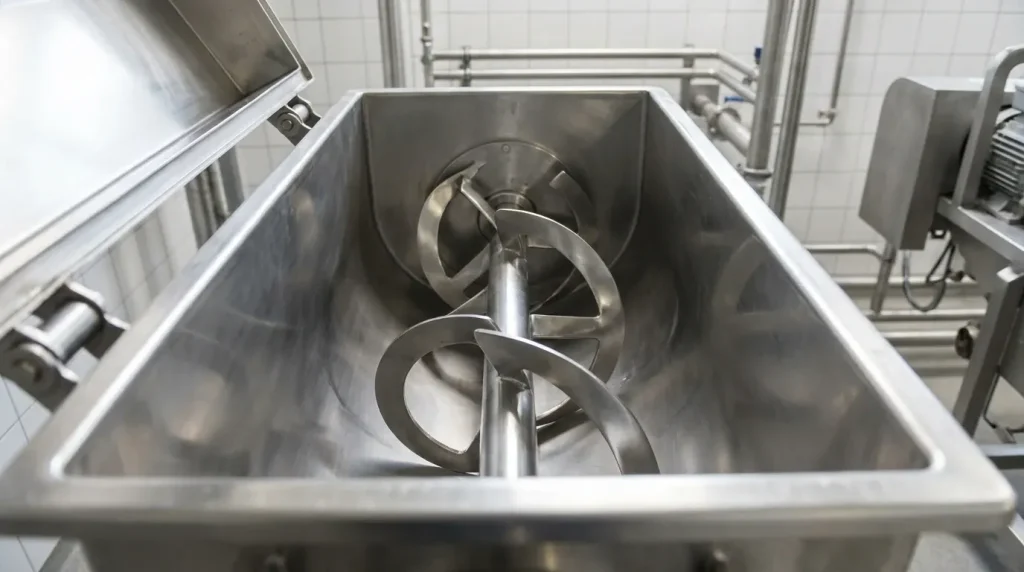
The design of a ribbon blender facilitates mixing through counter-rotating helical ribbons mounted on a central shaft. The outer ribbon pulls material from the ends toward the center, while the inner ribbon pushes material back toward the ends. This opposing motion creates a convective mixing pattern that folds ingredients repeatedly.
Key design elements include:
- U-shaped trough that matches ribbon contour for minimal dead zones
- Dual-helix configuration with inner and outer ribbons at different diameters
- Typical tip speeds around 300 ft/min (91 m/min)
- Working capacities from 0.5 to 1,000 ft³ (0.014 to 28.3 m³)
According to PerMix, a ribbon mixer can produce a highly uniform batch yet still create a production bottleneck at discharge, with problems appearing as slow emptying, retained material, or valve leakage. Proper discharge valve sizing and positioning directly affect throughput efficiency, so specifying the correct valve type matters as much as agitator design.
What types of materials can be mixed using a ribbon blender?
The types of materials that can be mixed using a ribbon blender include dry, free-flowing solids with bulk densities up to 70 lb/ft³ (1,120 kg/m³). Common applications span pharmaceuticals, food ingredients, chemicals, plastics, and agricultural products.
Suitable materials include:
- Powders: spices, protein blends, pharmaceutical excipients
- Granules: fertilizers, catalysts, plastic pellets
- Friable solids: vitamins, nutraceuticals, pigments
According to INC Machine, cohesive or sticky materials cannot be placed in ribbon mixers because they may get hooked on the ribbon blades. This limitation means products like wet cake, high-moisture powders, or adhesive compounds require alternative equipment such as ploughshare mixers. Understanding your material’s flow characteristics before equipment selection prevents costly processing problems.
With the fundamental design and material capabilities established, the next section examines exactly how the inner and outer ribbons create uniform blending.
How does the mixing mechanism of a ribbon blender operate?
The mixing mechanism of a ribbon blender operates through counter-rotating helical ribbons that create a continuous folding motion. The outer ribbons pull material inward while inner ribbons push material outward, generating convective blending throughout the vessel. The following subsections explain ribbon function and homogeneity control.
What is the function of the inner and outer ribbons in achieving uniform blending?
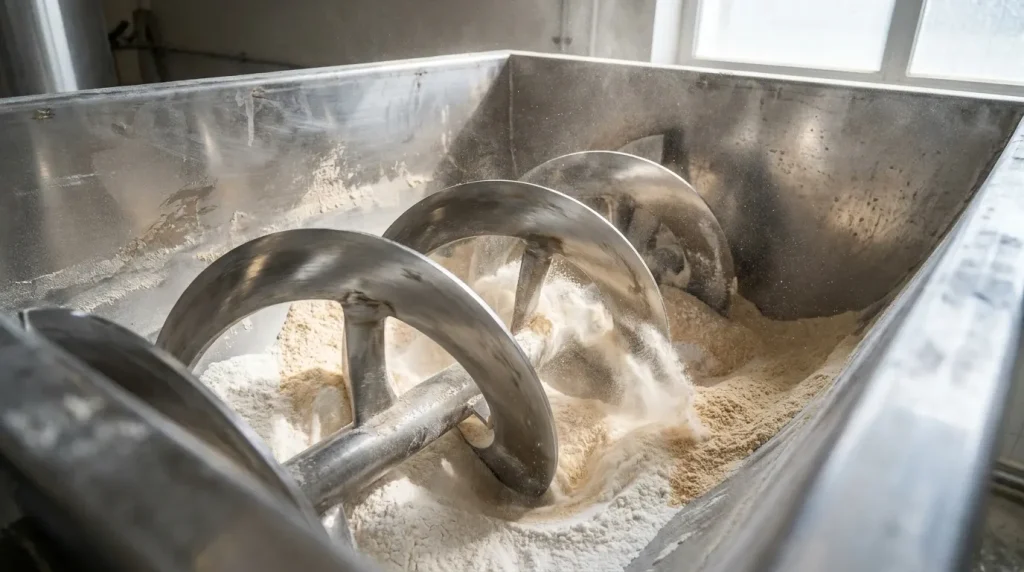
The function of the inner and outer ribbons is to create opposing material flows that achieve uniform blending. According to Palamatic Process, external helical ribbons pull product from the sides of the mixer into the middle while internal ribbons push product back to the sides, creating a convective mixing pattern through continuous back-and-forth folding motion.
This dual-ribbon design ensures ingredients contact each other repeatedly across the entire vessel length. The opposing flows prevent stratification and distribute minor components evenly throughout the batch. Product homogeneity is critical in applications such as pharmaceutical powder blending, where small dosing scales and regulatory compliance demand consistent uniformity.
How does a ribbon blender ensure homogeneity and prevent dead spots?
A ribbon blender ensures homogeneity and prevents dead spots through proper batch sizing and continuous axial movement. Optimal mixing requires batch volumes between 30 and 40 percent of the blender’s rated volumetric capacity at minimum, which keeps material within the active ribbon zone.
Key factors that prevent dead spots include:
- Correct fill level that allows ribbons to engage all material
- Sufficient tip speed, typically around 300 ft/min (91 m/min), to maintain particle movement
- Ribbon pitch angles, commonly 45 degrees, that drive both radial and axial displacement
- Mixing times of approximately 15 minutes for fully loaded batches
When batch sizes fall below minimum thresholds, material may settle beneath the ribbon path, creating unmixed pockets. Proper loading eliminates these zones by ensuring the entire charge participates in the folding action.
What are the typical applications of ribbon blenders across industries?
Ribbon blenders serve diverse industries requiring consistent dry powder mixing. The following sections examine why specific sectors favor this equipment and how it accommodates varying material characteristics.
Why are ribbon blenders popular in the pharmaceutical, food processing, and chemical sectors?
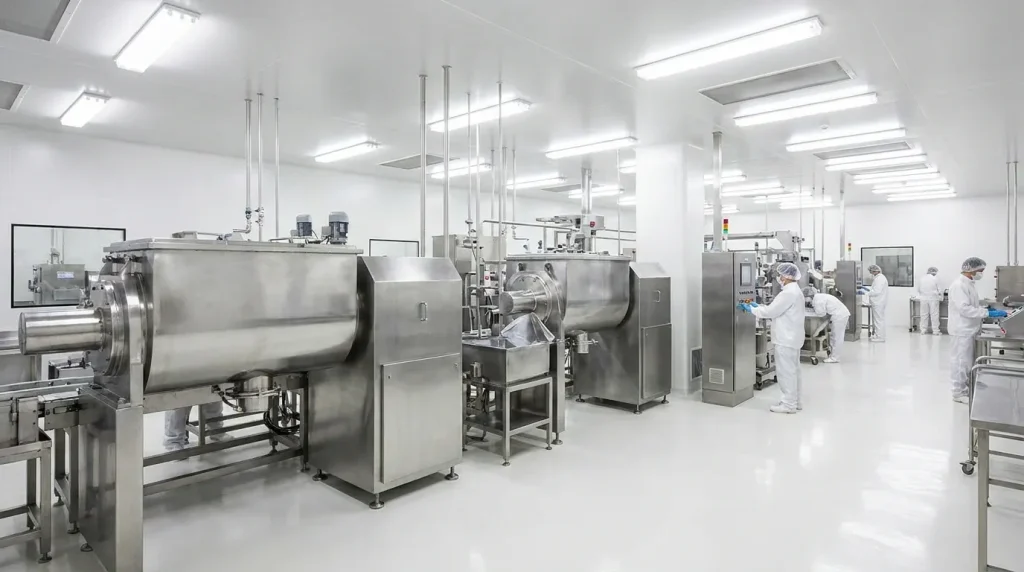
Ribbon blenders are popular in the pharmaceutical, food processing, and chemical sectors because they deliver consistent homogeneity critical to product quality and regulatory compliance. According to Paul O. Abbe, ribbon blenders are used across process industries including pharmaceuticals, food, cosmetics, nutraceuticals, ceramics, fertilizers, pigments, plastic powders, resins, spices, and vitamins.
Pharmaceutical manufacturers require precise blending because small dosage quantities demand uniform active ingredient distribution. Food processors value the equipment’s ability to handle bake mixes, instant drink powders, protein blends, and sugar formulations without degrading particle integrity. Chemical producers rely on ribbon blenders for catalysts, pigments, and resin powders where batch consistency affects downstream reactions.
Each sector benefits from the straightforward design that simplifies cleaning validation between batches, an essential requirement under cGMP and ISO food safety standards.
How do ribbon blenders handle different bulk densities and ingredient properties?
Ribbon blenders handle different bulk densities and ingredient properties through adjustable operating parameters and robust agitator design. According to Paul O. Abbe, ribbon blenders are ideal for blending dry, free-flowing solids with bulk densities up to 70 lb/ft³ (1.1 g/cc), depending on material characteristics.
The counter-rotating ribbon action accommodates density variations by continuously folding heavier particles into lighter components. Key factors affecting performance include:
- Bulk density range: Free-flowing powders from fine pharmaceuticals to coarse fertilizers
- Particle size distribution: Uniform mixing across varying granule sizes
- Moisture content: Low-moisture materials blend most effectively
- Flow characteristics: Best suited for non-cohesive, non-sticky formulations
Materials with higher densities require proportionally more drive power. A general guideline suggests 10 HP per ton (7.5 kW per metric ton) of material for medium-density powders in single-agitator configurations. Sticky or cohesive materials present challenges, as they may adhere to ribbon surfaces and compromise blend uniformity.
Understanding material properties before equipment selection ensures optimal batch quality and prevents operational issues during production runs.
What are the pros and cons of using a ribbon blender for industrial mixing?
The pros of using a ribbon blender include fast cycle times, broad material compatibility, and scalable capacity. The cons include limitations with sticky materials, discharge bottlenecks, and cleaning complexity. The sections below detail specific advantages and challenges.
What advantages do ribbon blenders offer over other industrial mixers?
The advantages ribbon blenders offer over other industrial mixers include efficient convective mixing, short batch times, wide capacity range, and versatility across industries.
- Fast mixing cycles: A fully loaded ribbon blender typically achieves homogeneity in 15 minutes, with proportionally faster times at lower fill levels.
- Scalable capacity: Units range in working capacity, accommodating pilot batches through full production runs.
- Broad material compatibility: Ribbon blenders handle free-flowing solids with bulk densities up to 70 lb/ft³ (1.1 g/cc), covering applications from spice blends to pharmaceutical powders.
- Multi-industry use: These mixers serve animal feed, bake mixes, catalysts, ceramics, cosmetics, fertilizers, nutraceuticals, pharmaceuticals, pigments, and plastic powders.
For procurement teams, this combination of speed and flexibility often makes ribbon blenders the most practical choice for dry powder operations requiring frequent product changeovers.
What are potential limitations or challenges when using ribbon blenders?
Potential limitations when using ribbon blenders include material restrictions, discharge issues, and increased cleaning demands compared to simpler mixer designs.
- Sticky material incompatibility: Cohesive or sticky powders cannot be processed effectively because they hook onto the ribbon blades and cause buildup.
- Discharge bottlenecks: Even with uniform batch quality, problems such as slow emptying, retained material, or valve leakage can create production delays.
- Cleaning complexity: The internal contact surfaces of dual ribbons create more areas where residue accumulates, extending changeover time between batches.
- Motor stress risks: Overloading, low voltage operation, or electrical faults can cause motor overheating, requiring careful load management.
Understanding these constraints helps engineers specify the right mixer for their application. With proper material selection and maintenance protocols, ribbon blenders remain effective workhorses for most dry blending operations.
How can you maintain and operate a ribbon blender for optimal performance?
You can maintain and operate a ribbon blender for optimal performance by following structured cleaning protocols, adhering to regulatory validation requirements, and conducting regular inspections of critical components. The subsections below cover recommended cleaning and maintenance procedures, plus how routine inspection improves both efficiency and safety.
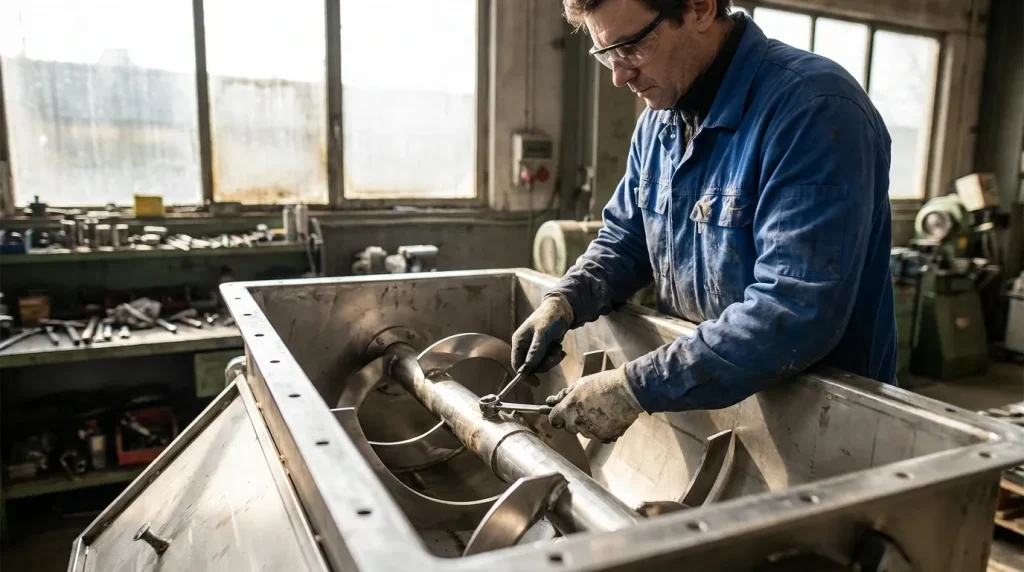
What cleaning and maintenance procedures are recommended for ribbon blenders?
The cleaning and maintenance procedures recommended for ribbon blenders include validated cleaning protocols, daily component checks, and scheduled lubrication of bearings and seals. According to FDA inspection guidance, equipment cleanliness requirements date back to the 1963 GMP Regulations (Part 133.4), which stated that equipment “shall be maintained in a clean and orderly manner.”
A complete maintenance checklist covers these critical areas:
- Daily pre-operation and post-operation inspection of the trough interior
- Seal and gasket condition assessment for wear or product buildup
- Bearing lubrication at manufacturer-specified intervals
- Blade and ribbon integrity checks for cracks or weld fatigue
- Discharge valve inspection for leakage or retained material
For pharmaceutical and food applications, FDA expects a final validation report approved by management confirming that cleaning processes reduce residues to acceptable levels. Ribbon blenders have more internal contact surfaces than paddle mixers, which increases residue buildup potential when handling cohesive powders. This makes thorough cleaning between batches essential for cross-contamination prevention.
How does regular inspection improve efficiency and safety?
Regular inspection improves efficiency and safety by identifying wear patterns, preventing unexpected failures, and maintaining consistent blend quality. Abnormal noise during operation often signals foreign matter in the trough, loose drive chains, or broken welds causing rotor imbalance.
Key inspection targets include:
- Motor temperature monitoring to detect overheating from overload or voltage issues
- Drive chain tension and alignment verification
- Ribbon-to-trough clearance measurement (excessive gaps reduce mixing efficiency)
- Safety interlock and guard functionality testing
Common causes of motor overheating include operation on two phases instead of three, internal winding short circuits, continuous overload, or low voltage conditions. Catching these issues early prevents costly downtime and extends equipment service life. For operations governed by cGMP or ISO, documented inspection records also satisfy audit requirements.
With proper maintenance protocols established, sourcing quality equipment becomes the next consideration for your mixing operations.
How can International Process Plants support your ribbon blender equipment needs?
International Process Plants provides sourcing solutions for ribbon blenders across used, new surplus, and refurbished categories. The following sections explain our equipment options and summarize the essential principles of ribbon blender operation.
What solutions does IPP provide for sourcing used, new, or refurbished ribbon blenders?
IPP provides comprehensive sourcing solutions for ribbon blenders through our global inventory network and industry partnerships. With over 46 years of experience and warehouses in the United States, Germany, and the United Kingdom, we connect buyers with quality equipment across multiple acquisition paths.
Our sourcing options include:
- Good used ribbon blenders: Immediately available units from our 15,000+ piece inventory, typically priced at approximately 50% of new equipment cost
- New surplus equipment: Unused units from canceled projects or facility closures, offering significant savings over direct OEM purchase
- Refurbished units: Equipment restored to operational specifications with documented inspection and testing
We currently stock ribbon blenders in capacities ranging from laboratory scale to production volumes at 450 ft³ (12.74 m³), constructed in 304, 316, and 321 stainless steel. Each unit undergoes inspection at our facilities before shipping, with documentation covering vessel condition, agitator integrity, and seal status.
What are the key takeaways about how a ribbon blender works?
The key takeaways about how a ribbon blender works center on its counter-rotating ribbon design and convective mixing principle. Outer ribbons pull material inward from the trough walls while inner ribbons push material outward, creating continuous folding action that achieves batch homogeneity within approximately 15 minutes at full load.
Critical operational parameters include:
- Maintain batch volumes between 30% and 40% minimum fill for proper ribbon coverage
- Target approximately 300 ft/min (91 m/min) tip speed for standard applications
- Plan for 3 to 5 kW per cubic meter of vessel volume in power requirements
- Reserve ribbon blenders for free-flowing powders; cohesive or sticky materials require alternative mixer types
Understanding these principles helps procurement teams specify the right capacity, construction materials, and drive configuration. Contact International Process Plants to discuss your ribbon blender requirements and explore currently available inventory options

 AR
AR  EN
EN  ES
ES  FR
FR  PL
PL  DE
DE  UR
UR  HI
HI  NL
NL  TR
TR  IT
IT  UK
UK  RU
RU  JA
JA  PT
PT  ZH
ZH