 انتقل إلى المحتوى
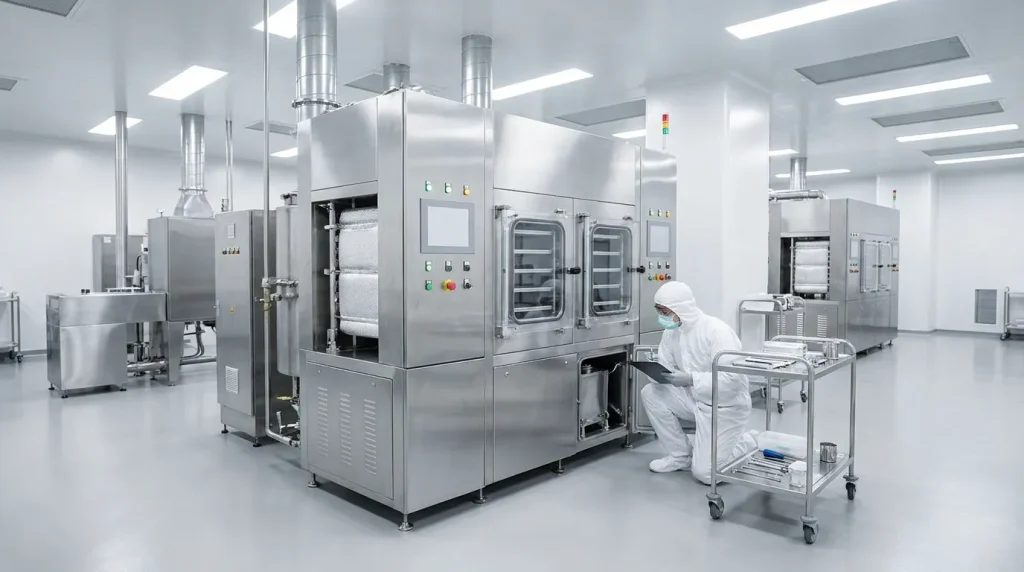
A freeze dryer maintenance schedule is a structured program of inspections, service tasks, and component replacements designed to preserve lyophilizer performance, ensure sterility compliance, and prevent unplanned downtime. Effective schedules align daily visual checks, weekly functional tests, and quarterly comprehensive service with the specific demands of each facility’s operating conditions.
This guide covers lyophilizer components and their maintenance requirements, service frequency and inspection protocols, troubleshooting approaches for common malfunctions, cost and lifespan benefits of preventive programs, and parts planning with digital documentation strategies.
Freeze dryers rely on four core components: drying chambers, vacuum pumps, heat sources, and condensers. The vacuum pump is one of the highest-maintenance components, with oil inspections before and after every run according to many manufacturer guides, and complete changes or servicing performed according to the pump manufacturer’s recommended operating hours or maintenance schedule. Seals, gaskets, and valves demand routine visual assessment since even minor leaks compromise sublimation efficiency and product quality.
Service intervals tend to follow a tiered structure based on component criticality. Daily checks may cover oil condition and chamber cleanliness. Quarterly service should typically include comprehensive leak testing. Routine preventive maintenance should also include vacuum integrity testing to verify chamber leak rates. Because no universal industry acceptance criterion exists, leak-rate limits should be established based on the specific lyophilizer design, chamber volume, operating conditions, manufacturer recommendations, and site qualification procedures. For sterile pharmaceutical freeze dryers, EU GMP Annex 1 guidelines mandate re-sterilization following any maintenance activity, making documentation essential for compliance.
When preventive schedules are enacted to catch degraded components early, facilities can help avoid a cascade of failures that can occur when one neglected part stresses adjacent systems. Predictive maintenance programs can deliver 8% to 12% cost savings over basic preventive approaches according to the Federal Energy Management Program Operations & Maintenance Best Practices Guide. Digital maintenance management using CMMS platforms centralizes task tracking, parts consumption, and historical analysis that refines inspection protocols over time.
What Are the Core Components of a Freeze Dryer That Require Regular Maintenance?
The core components of a freeze dryer that require regular maintenance are the drying chamber, vacuum pump, heat source, and condenser. These four elements work together to enable sublimation, and each demands specific inspection protocols to maintain performance and sterility.
How Do Vacuum Pumps Impact Lyophilizer Performance and Reliability?
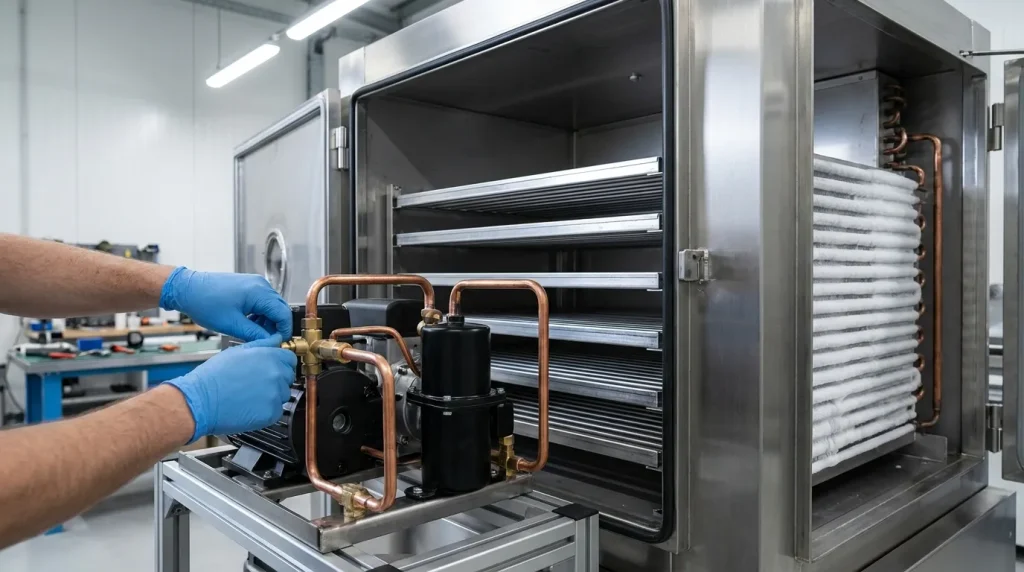
Vacuum pumps impact lyophilizer performance and reliability by creating the low-pressure environment essential for sublimation. These pumps evacuate the chamber to pressures commonly around 0.01 and 0.3 mbar (0.0075 to 0.225 Torr), depending on the product and process requirements, enabling moisture to transition directly from ice to vapor. Oil quality directly influences pump efficiency, and vacuum pumps are one of the highest maintenance components. Visual inspection of oil level and color should occur before and after every run according to many general manufacturer guidelines, with complete oil changes performed according to the pump manufacturer’s recommended operating hours or maintenance schedule. Degraded oil introduces contaminants and reduces ultimate vacuum capability, compromising batch consistency. For facilities running multiple cycles daily, pump maintenance typically becomes the single most frequent scheduled service task.
Which Seals, Gaskets, and Valves Need Routine Inspection in Freeze Dryers?
The seals, gaskets, and valves that need routine inspection in freeze dryers include:
- Door gaskets on the drying chamber
- Vacuum isolation valves between chamber and condenser
- Drain valves on the condenser
- O-rings on shelf fluid connections
- Pressure relief valve assemblies
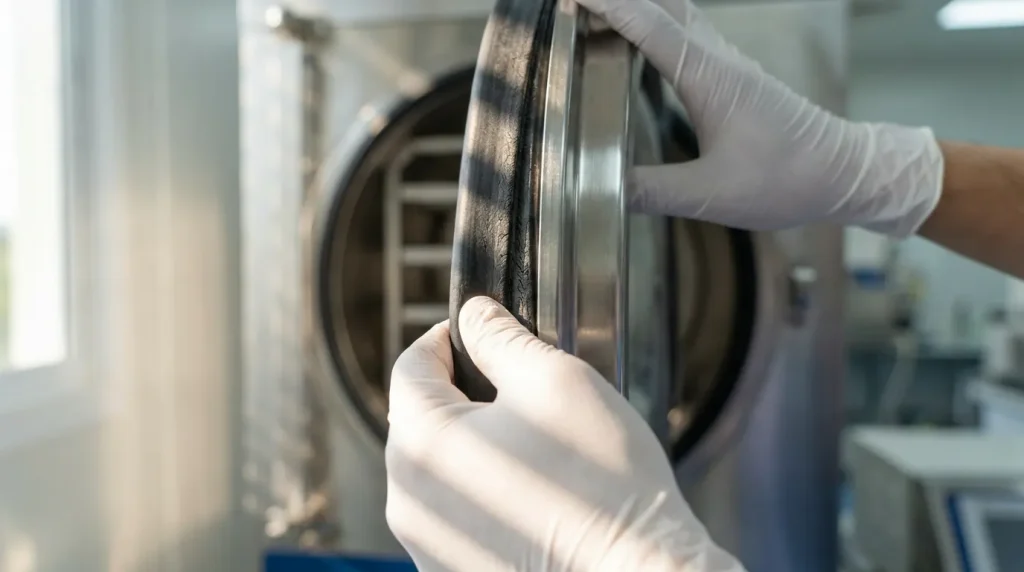
These components help maintain the vacuum integrity critical to sublimation. Even minor leaks allow atmospheric moisture ingress, which can compromise product quality and extend cycle times. The sensitivity of these issues are even more critical for applications that demand strict sterility standards such as in pharmaceutical manufacturing: Peter Timmermans, Product Manager at IMA Life, notes in a blog published on Pharmaceutical Engineering that “loading and unloading of freeze dryers represent one of the most contamination sensitive phases in aseptic manufacturing.” Silicone and EPDM gaskets degrade from thermal cycling and should be inspected visually for cracks, compression set, or discoloration at each preventive maintenance interval.
What Role Do Cooling and Heating Systems Play in Freeze Dryer Upkeep?
Cooling and heating systems play a critical role in freeze dryer upkeep by controlling the precise thermal conditions required for sublimation. The refrigeration system must maintain condenser temperatures appropriate for the application, typically between around -50°C and -85°C (-58°F and -121°F), while keeping the condenser substantially colder than the product throughout the primary drying cycle to promote efficient vapor capture. Shelf heating systems provide the controlled energy input driving sublimation during primary drying. Maintenance tasks include checking refrigerant charge levels, inspecting compressor contactors, cleaning condenser coils, and verifying shelf temperature uniformity. For sterile pharmaceutical freeze dryers, EU GMP Annex 1 has increased focus on contamination-sensitive stages of lyophilization, requiring Grade A continuity during loading and unloading. This regulatory emphasis makes thermal system reliability essential for compliance.
With these core components identified, establishing the right service frequency ensures each receives attention before problems develop.
How Often Should Preventive Maintenance Be Performed on Lyophilizers?
Preventive maintenance on lyophilizers should be performed at multiple intervals according to manufacturer guidelines and operating hours. Common intervals often include: daily visual checks, weekly functional inspections, and comprehensive quarterly or semi-annual service. The subsections below detail recommended service frequencies and how operational variables influence timing.
What Is the Recommended Frequency for Lyophilizer Service Intervals?
The recommended frequency for lyophilizer service intervals follows a tiered schedule based on component criticality, operating hours, and manufacturer specifications. Common manufacturer guidelines specify vacuum pump oil inspection before and after every run, with complete oil changes according to manufacturer guidelines and operating hours. A common interval may be around every 500 operating hours or quarterly, whichever comes first. Routine vacuum leak tests should occur at scheduled intervals, ensuring that pressures commonly around 0.01 and 0.3 mbar (0.0075 to 0.225 Torr) are maintained, depending on the product and process requirements, in order to effectively enable moisture to transition directly from ice to vapor.
Key service intervals may include:
- Daily: Visual oil inspection, chamber cleanliness check, gasket condition assessment
- Weekly: Condenser defrost verification, pressure gauge calibration check
- Quarterly: Complete oil change, comprehensive leak testing, refrigerant level verification
- Annually: Full system calibration, compressor inspection, electrical relay testing
Inspection and service interval timelines should always refer to manufacturer guidelines.
How Can Usage Intensity and Product Type Affect Maintenance Timing?
Usage intensity and product type affect maintenance timing by altering contamination risks and component wear rates. High-throughput operations running multiple cycles daily typically require compressed service intervals, with the potential to halve standard maintenance windows. Aseptic pharmaceutical applications demand the most stringent schedules due to sterility requirements.
Product characteristics that accelerate maintenance needs:
- Corrosive formulations: Increase seal and gasket inspection frequency
- High-sugar content products: Require more frequent condenser cleaning
- Organic solvent residues: Necessitate accelerated oil changes
PIC/S guidelines, specifically GMP Guide PE 009, Annex 1: Manufacture of Sterile Medicinal Products, emphasize that maintaining sterility during aseptic processing requires careful attention to environment, facility design, qualification programs, and maintenance scheduling. Facilities processing sensitive biologics or parenteral products should establish maintenance frequencies based on validation data rather than relying only on generic manufacturer recommendations.
Understanding proper maintenance intervals prepares facilities to execute thorough inspections using standardized checklists.
What Does a Comprehensive Lyophilizer Inspection Checklist Include?
A comprehensive lyophilizer inspection checklist includes visual inspections, functional tests, and component-specific checks that verify system integrity. The following sections cover routine inspection procedures and warning signs of component degradation.
Which Visual and Functional Checks Should Be Performed During Routine Inspections?
Visual and functional checks performed during routine inspections should include oil condition assessment, vacuum integrity testing, seal examination, and condenser surface evaluation. Maintenance of high-quality vacuum pump oil is imperative to continuous operation, and oil should typically be visually inspected before and after every run, according to many manufacturer recommendations.
Key inspection items include:
- Vacuum pump oil: Check color (clear to light amber indicates good condition; dark or milky indicates contamination)
- Chamber door seals: Examine for cracks, compression set, or debris accumulation
- Condenser coils: Inspect for ice buildup patterns and frost distribution uniformity
- Vacuum connections: Verify all fittings and ports for secure seating
- Shelf surfaces: Check for corrosion, scratches, or product residue
Functional testing should include a vacuum leak rate assessment. A 2022 industry survey published in the Journal of Pharmaceutical Sciences recommended that operational leak rates for routine pharmaceutical lyophilizer manufacturing should not exceed 20 μbar L/s, providing a best-practice benchmark for commercial-scale freeze-drying systems.
What Are the Typical Signs of Wear or Imminent Failure in Freeze Dryer Components?
The typical signs of wear or imminent failure in freeze dryer components include extended vacuum pull-down times, inconsistent shelf temperatures, unusual compressor cycling, and visible seal degradation. Refrigeration system performance serves as a primary diagnostic indicator: the system must maintain condenser temperatures appropriate for the application, typically between around -50°C and -85°C (-58°F and -121°F) during operation. Inability to reach or hold specified temperatures suggests refrigerant loss or compressor wear.
Warning signs by component:
- Vacuum system: Longer evacuation times, inability to reach target pressure
- Refrigeration: Compressor short-cycling, elevated condenser temperatures, frost patterns outside normal zones
- Seals and gaskets: Visible cracking, permanent compression, difficulty achieving vacuum
- Electrical controls: Intermittent relay operation, inconsistent temperature readings
When multiple symptoms appear simultaneously, the underlying cause may trace to a single failing component affecting downstream systems. With inspection baselines established, troubleshooting becomes systematic rather than reactive.
How Should You Approach Troubleshooting and Addressing Freeze Dryer Malfunctions?
You should approach troubleshooting freeze dryer malfunctions by systematically identifying the failure category, then determining whether in-house resolution is feasible or professional service is required. The sections below cover common issues and when to escalate repairs.
What Are the Most Common Issues Detected During Maintenance and How Are They Resolved?
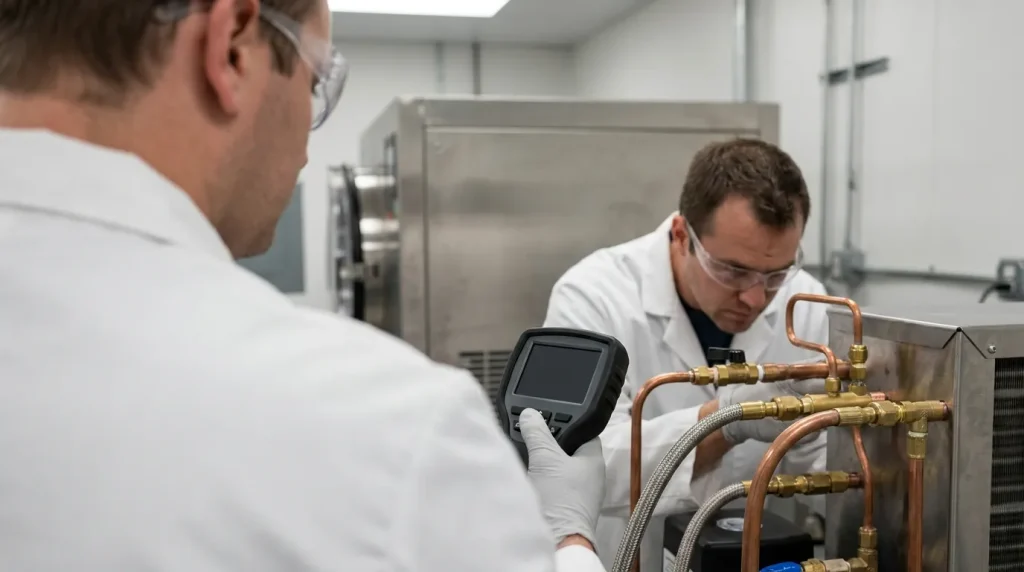
The most common issues detected during maintenance are refrigerant leaks, electrical relay failures, and valve failures according to Mechanical Service Corp. These problems can be mitigated through preventive maintenance programs that catch early warning signs before complete component failure occurs.
Resolution approaches vary by failure type:
- Refrigerant leaks: Locate the leak using electronic detectors or UV dye, repair the breach, evacuate the system, and recharge with the correct refrigerant weight
- Electrical relay failures: Test relay coils for continuity, inspect contacts for pitting or carbon buildup, and replace faulty relays with OEM-specified components
- Valve failures: Disassemble and inspect solenoid valves for debris or corrosion, replace damaged seats or diaphragms, and verify actuation after reassembly
- Vacuum degradation: Perform a rate-of-rise test; if the rise exceeds mbar/min specifications, systematically check door seals, feedthrough connections, and pump oil condition
For most facilities, addressing these issues promptly helps prevent potential cascading damage to more expensive components like compressors or condenser coils.
When Is It Advisable to Call a Professional for Lyophilizer Repairs?
It is advisable to call a professional for lyophilizer repairs when the malfunction involves refrigeration circuit integrity, high-voltage electrical systems, or any repair requiring specialized certifications. Refrigerant handling, for example, requires EPA Section 608 certification in the United States and equivalent F-gas certifications in the EU.
Professional service is also typically warranted when:
- Vacuum levels cannot be restored after replacing seals and pump oil
- Compressor noise, overheating, or short-cycling persists after basic troubleshooting
- Temperature deviations exceed specified tolerances despite calibration and troubleshooting attempts
- The system requires requalification under certain compliance frameworks, such as GMP, WHO Annex 6, or EU Annex 1
With malfunctions addressed systematically, the next step is understanding how structured maintenance schedules deliver measurable operational benefits.
What Are the Benefits of Following a Structured Maintenance Schedule for Freeze Dryers?
The benefits of following a structured maintenance schedule for freeze dryers include potential for extended equipment lifespan, reduced unplanned downtime, and significant cost savings over the equipment’s service life. The subsections below detail how preventive maintenance protects your investment and delivers measurable financial returns.
How Does Preventive Maintenance Extend Equipment Lifespan and Reduce Downtime?
Preventive maintenance extends equipment lifespan and reduces downtime by identifying wear patterns before they escalate into catastrophic failures. Scheduled inspections catch degraded seals, contaminated vacuum pump oil, and refrigerant leaks early, when repairs remain straightforward. This proactive approach keeps vacuum pumps operating within their design parameters, preserving sublimation efficiency across thousands of cycles.
Unplanned shutdowns carry hidden costs beyond the repair itself: batch losses, missed production windows, and expedited parts shipping. Structured maintenance intervals also help prevent cascading failures that can occur when one neglected component stresses adjacent systems. For facilities running high-value pharmaceutical batches, even a single avoided failure can justify years of preventive service costs.
What Cost Savings Can Be Achieved by Routine Lyophilizer Service?
Cost savings achieved by routine lyophilizer service typically range from reduced emergency repair expenses to lower energy consumption and extended intervals between major overhauls. According to a U.S. Department of Energy operations and maintenance guide, predictive maintenance programs can result in an estimated 8% to 12% cost savings over preventive maintenance programs alone, demonstrating that data-driven scheduling amplifies returns.
Key areas where routine service delivers savings:
- Vacuum pump oil changes prevent compressor damage that can cost 5 to 10 times more than scheduled fluid replacement
- Seal and gasket inspections avoid vacuum leaks that force pumps to work harder, increasing energy draw
- Refrigeration system checks maintain condenser temperatures between specifications, preventing inefficient overcycling
For process engineers evaluating total cost of ownership, consistent maintenance transforms unpredictable repair budgets into manageable operating expenses. With freeze drying equipment demand growing through 2033, well-maintained lyophilizers also retain higher resale value when facilities upgrade capacity.
How Should You Plan for Parts Replacement and Consumables in Lyophilizer Maintenance?
You should plan for parts replacement and consumables by maintaining a critical spares inventory, working with an established supplier, and tracking consumption patterns through digital maintenance systems. The following sections cover emergency spares and sourcing strategies.
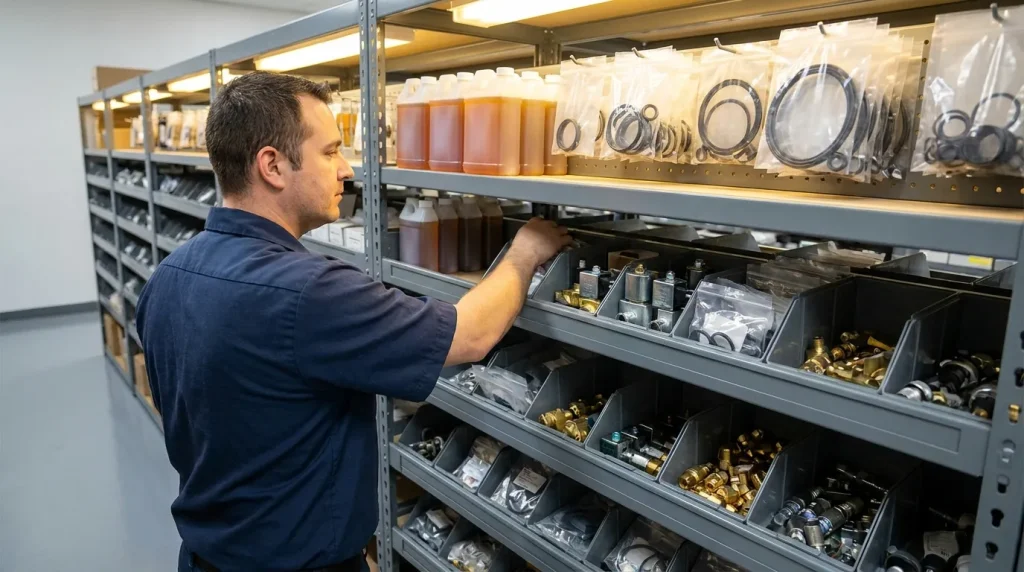
Which Spare Parts Should Be Kept on Hand for Emergency Repairs?
The spare parts that should be kept on hand for emergency repairs include components most likely to fail during operation or cause extended downtime if unavailable. Vacuum pump oil ranks first, as oil degradation directly impacts chamber pressure and sublimation efficiency. Door gaskets and chamber seals require immediate replacement when leaks develop, since vacuum integrity determines cycle success.
Critical spares inventory should include:
- Vacuum pump oil (sufficient for two complete changes)
- Door gaskets and O-rings for chamber seals
- Solenoid valves and pneumatic actuators
- Temperature sensors and pressure transducers
- Electrical relays and contactors
- Refrigerant charge (if permitted by local regulations)
Maintaining these components on-site eliminates procurement delays during unplanned failures. For pharmaceutical operations, having spare parts available helps support compliance with WHO GMP requirements that emphasize uninterrupted sterility assurance.
How Should Facilities Track, Document, and Optimize Freeze Dryer Maintenance Activities?
Facilities should track, document, and optimize freeze dryer maintenance activities using digital maintenance management systems combined with structured data analysis. The following subsections cover digital tools for scheduling and how historical data refines inspection protocols.

What Digital Tools or Record-Keeping Methods Streamline Maintenance Scheduling?
Digital tools that streamline maintenance scheduling include computerized maintenance management systems (CMMS) designed to centralize task tracking and documentation. A CMMS records task completion, observations, and parts replaced, creating a searchable maintenance history for each lyophilizer unit. Key features that improve scheduling efficiency include:
- Automated work order generation based on operating hours or calendar intervals
- Digital checklists that standardize inspection procedures across shifts
- Parts inventory tracking with reorder alerts for consumables like vacuum pump oil and gaskets
- Integration with equipment sensors for real-time condition monitoring
Paper-based logs can create compliance gaps and make trend analysis difficult. Facilities operating multiple freeze dryers benefit most from centralized digital platforms that aggregate maintenance records across units.
How Can Maintenance Data Help Fine-Tune Inspection Protocols Over Time?
Maintenance data helps fine-tune inspection protocols by revealing failure patterns, component lifespans, and intervention timing specific to each unit’s operating conditions. Analyzing historical records can help identify which components fail prematurely under high-intensity cycles versus standard production loads.
Effective data-driven optimization involves:
- Tracking mean time between failures (MTBF) for vacuum pumps, seals, and refrigeration components
- Correlating leak rate test results with subsequent repairs to establish predictive thresholds
- Adjusting service intervals based on actual wear rates rather than relying only on manufacturer recommendations
- Documenting root causes of unplanned downtime to prevent recurrence
How Can International Process Plants Support Freeze Dryer Maintenance and Equipment Optimization?
International Process Plants supports freeze dryer maintenance and equipment optimization by supplying quality used and new surplus lyophilization equipment. The following subsections explain our equipment services and summarize key maintenance principles.
Can IPP’s Used and Refurbished Equipment Help With Lyophilizer Replacement Parts or Upgrades?
Yes, IPP’s used and refurbished equipment can help with lyophilizer replacement. We maintain an inventory of over 15,000 pieces of process equipment, including vacuum pumps, condensers, and ancillary components compatible with freeze drying systems. When existing lyophilizers require component replacement or capacity expansion, sourcing quality used equipment offers a cost-effective alternative to new OEM purchases.
Our global warehouses in Eastover, South Carolina (US), Germany, and the United Kingdom enable faster delivery across international markets. For facilities planning upgrades, we can supply complete lyophilization systems or individual components such as refrigeration units and control systems. Contact our team to discuss your specific lyophilizer replacement or upgrade requirements.
What Are the Key Takeaways About Freeze Dryer Maintenance Schedules and Lyophilizer Service?
The key takeaways about freeze dryer maintenance schedules and lyophilizer service are:
- Vacuum pump oil should be inspected frequently, with some manufacturers specifying before and after every run, and full changes at manufacturer-specified intervals
- Leak rate testing should occur at scheduled intervals, with industry recommendations below 20 μbar L/s for commercial-scale routine pharmaceutical lyophilizer manufacturing
- Seals, gaskets, and valves require routine visual inspection to detect wear before failure occurs
- Refrigeration systems must maintain condenser temperatures between specified operating ranges for effective sublimation
- Digital maintenance management systems (CMMS) improve task tracking and parts documentation
- Structured preventive and predictive maintenance programs reduce unplanned downtime and extend equipment lifespan
When maintenance reveals the need for component replacement or full system upgrades, International Process Plants offers quality used and new surplus lyophilization equipment to support your facility’s requirements.

 AR
AR  EN
EN  ES
ES  FR
FR  PL
PL  DE
DE  UR
UR  HI
HI  NL
NL  TR
TR  IT
IT  UK
UK  RU
RU  JA
JA  PT
PT  ZH
ZH