 انتقل إلى المحتوى
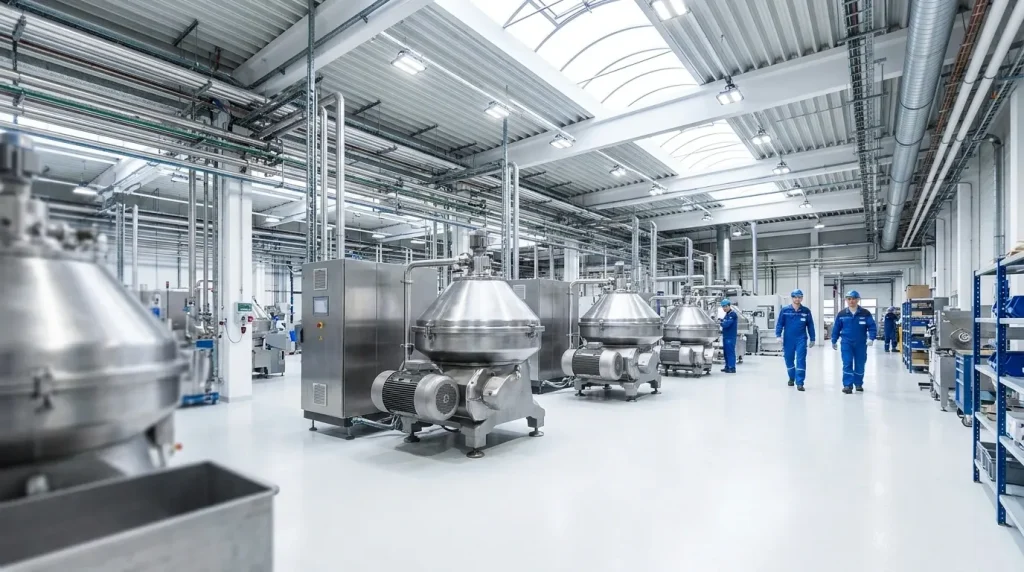
A peeler centrifuge is a batch-operated filtration system that uses a horizontal rotating basket and mechanical knife to separate solids from liquids, while a pusher centrifuge runs continuously using a reciprocating plate to transport solids through a perforated basket. The choice between these two technologies depends on crystal fragility, throughput requirements, energy costs, and regulatory constraints.
This guide covers operating principles and performance characteristics, industry applications and suitability factors, maintenance and lifecycle cost comparisons, and equipment selection considerations with International Process Plants’ offerings.
Manufacturer pages typically specify peeler centrifuge g-forces around 1,060 g and 2,030 g while handling particle sizes from around 2 μm to 500 μm (0.079 to 19.68 mils). Their batch operation and gentle discharge make them dominant in pharmaceutical API production and fine chemical processing where crystal integrity determines product quality.
Pusher centrifuges are designed for high-throughput continuous processing of free-draining crystalline solids, with large industrial units capable of handling throughputs approaching 150 t/h (330,693 lb/hr) under suitable operating conditions. Feed solids concentrations can reach high levels, depending on material characteristics and process requirements. Their continuous operation suits large-scale salt production, fertilizer manufacturing, and petrochemical separation where 24/7 throughput outweighs batch flexibility.
Energy consumption differs between technologies. Typical reported values may be approximately 3 kW per metric tonne (2.72 kW per short ton) for large pusher centrifuges and around 9 kW per metric tonne (8.16 kW per short ton) for peeler centrifuges, although actual consumption depends on equipment size, material characteristics, throughput, and operating conditions.
Selection involves matching crystalline fragility to discharge method, verifying feed solids concentrations meet minimum thresholds, and confirming regulatory compliance with GMP, ATEX, ASME, or other relevant applicable standards depending on application and jurisdiction.
How Does a Peeler Centrifuge Work and What Are Its Main Features?
A peeler centrifuge works by rotating a filtration basket on a horizontal axis, using centrifugal force to separate solids from liquids in batch cycles. The following sections cover its operating principle, advantages and disadvantages, and primary industry applications.
What Is the Operating Principle of a Peeler Centrifuge?
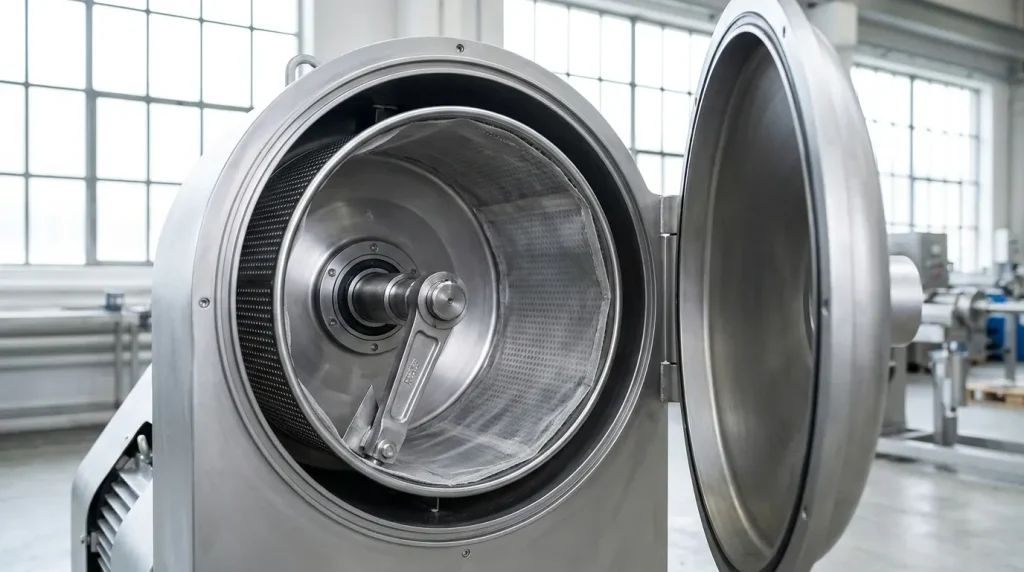
The operating principle of a peeler centrifuge relies on centrifugal force generated by a horizontal rotating basket to drive liquid through a filter medium while solids accumulate on the basket’s inner surface. Slurry feeds into the spinning basket, where G-forces press the liquid outward through the filter cloth, leaving a solid cake behind. A mechanical peeler knife then scrapes the dried cake from the basket wall for discharge.
Horizontal peeler centrifuges can handle particle sizes from around 2 μm to 500 μm (0.079 to 19.68 thousandths of an inch), making them versatile for fine particle separation. The siphon peeler variant, developed in the 1970s, creates a vacuum beneath the filter cloth to boost filtration rates beyond what centrifugal pressure alone achieves. Peeler centrifuges are attractive where filtration and/or basket speed can be adjusted so that the feed matches the filtration rate.
Units operating in potentially explosive atmospheres must comply with the ATEX Directive 2014/34/EU in the European Union, Class I Division classifications in North America, or IECEx, an international certification framework for explosive atmospheres. Many manufacturer guidelines often specify bearing replacement around intervals of every 15,000 operating hours to help prevent reactive replacement due to mechanical failure.
What Are the Advantages and Disadvantages of Peeler Centrifuges?
The advantages of peeler centrifuges include gentle product handling, high purity output, and operational flexibility for batch processing.
Key advantages:
- Gentle separation preserves fragile crystalline structures
- Adjustable basket speed and filtration parameters for varying feed conditions
- Thorough cake washing capability between cycles
- Complete basket accessibility via cantilever-mounted rotor and full-opening housing door
Key disadvantages:
- Lower throughput compared to continuous centrifuges
- Higher energy consumption, approximately 9 kW per tonne (8.16 kW per short ton) of product
- Batch operation requires downtime between cycles
- Greater operator involvement for loading, washing, and discharge sequences
For processes requiring maximum product integrity over raw throughput, peeler centrifuges remain a practical choice despite their energy trade-off.
In Which Industries Are Peeler Centrifuges Commonly Used?
Peeler centrifuges are commonly used in pharmaceutical, chemical, and food processing industries where product purity and gentle handling are critical requirements.
Primary industry applications:
- Pharmaceutical: API production requiring high purity standards and gentle handling of sensitive crystalline products
- Fine chemicals: Specialty compounds where batch flexibility and thorough washing matter
- Food processing: Dewatering native and modified starches, as well as products such as caffeine and lactulose
- Agrochemical: Intermediate compounds requiring contamination-free separation
The pharmaceutical sector relies heavily on peeler centrifuges because they maintain the crystal integrity essential for consistent drug formulation. With diverse application requirements across these sectors, the following sections examine how pusher centrifuges offer an alternative approach for different processing demands.
How Does a Pusher Centrifuge Operate and What Distinguishes It?
A pusher centrifuge operates by using a reciprocating pusher mechanism inside a rotating perforated basket to continuously transport solids while liquid passes through the filter medium. The sections below explain the operating principle, advantages and disadvantages, and ideal applications for this continuous separation technology.
What Is the Operating Principle of a Pusher Centrifuge?
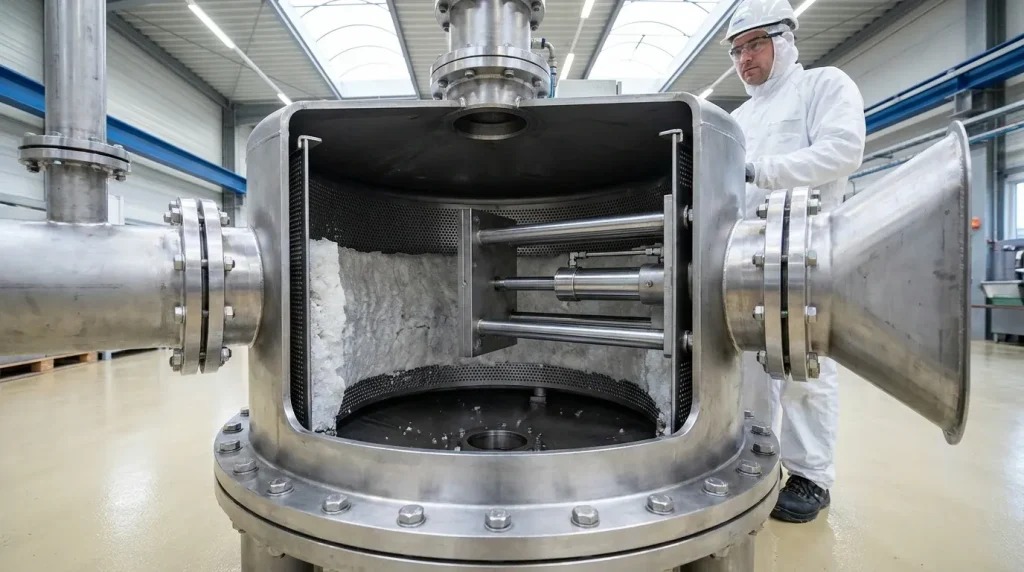
The operating principle of a pusher centrifuge combines centrifugal force with mechanical pushing action for continuous solid-liquid separation. Slurry enters the rotating perforated basket, where centrifugal force presses solids against the filter medium. A reciprocating pusher plate then advances the accumulated cake toward the discharge end in steady increments.
This continuous motion distinguishes pusher centrifuges from batch designs. Pusher centrifuges can achieve solids throughput capacities up to around 150 t/h (330,693 lb/hr) and handle high feed solids concentrations. The reciprocating mechanism operates at controlled stroke frequencies, typically around 30 to 60 strokes per minute, to maintain consistent cake transport without excessive compaction.
What Are the Advantages and Disadvantages of Pusher Centrifuges?
The advantages of pusher centrifuges center on continuous operation and high throughput capacity:
- Uninterrupted 24/7 operation without batch cycling downtime
- Throughput rates up to around 150 t/h (330,693 lb/hr) for large-scale production
- Energy consumption typically lower than peeler centrifuges, at approximately 3 kW per tonne (2.72 kW per short ton)
- Consistent cake moisture due to steady mechanical discharge
- Reduced labor requirements compared to batch centrifuges
The disadvantages include limitations that affect certain applications:
- Higher mechanical complexity from the reciprocating pusher system
- Requires sufficient feed solids to form a stable, permeable filter cake
- Risk of crystal breakage with fragile or needle-shaped particles
- Less flexibility for multi-product facilities needing frequent changeovers
- Higher maintenance demands on pusher seals and bearings
For high-volume commodity production, these trade-offs typically favor the pusher design. However, facilities processing delicate crystals or running varied product campaigns may find the mechanical stresses problematic.
Which Applications Are Best Suited for Pusher Centrifuges?
The applications best suited for pusher centrifuges involve high-volume, continuous production of robust (coarse or medium-sized) crystalline materials. Salt production and fertilizer manufacturing represent the primary use cases, where 24/7 throughput requirements align perfectly with continuous pusher operation.
Key application areas include:
- Salt production: Large-scale sodium chloride crystallization with consistent particle characteristics
- Fertilizers: Ammonium sulfate, potassium chloride, and other granular products
- البتروكيماويات: Intermediates such as paraxylene and adipic acid separation
- Bulk chemicals: Soda ash, sodium bicarbonate, and similar commodity products
The petrochemical industry often relies on large pusher centrifuges where continuous operation is critical for plant efficiency. These applications share common characteristics: robust crystals that tolerate mechanical transport, high production volumes exceeding around 50 t/h (110,231 lb/hr), and processes where continuous feed streams are available.
Pusher centrifuges are less suitable for pharmaceutical APIs, fine chemicals with fragile crystals, or facilities requiring frequent product changeovers. Understanding these boundaries helps procurement teams match centrifuge technology to specific process demands.
What Are the Core Differences Between Peeler and Pusher Centrifuges?
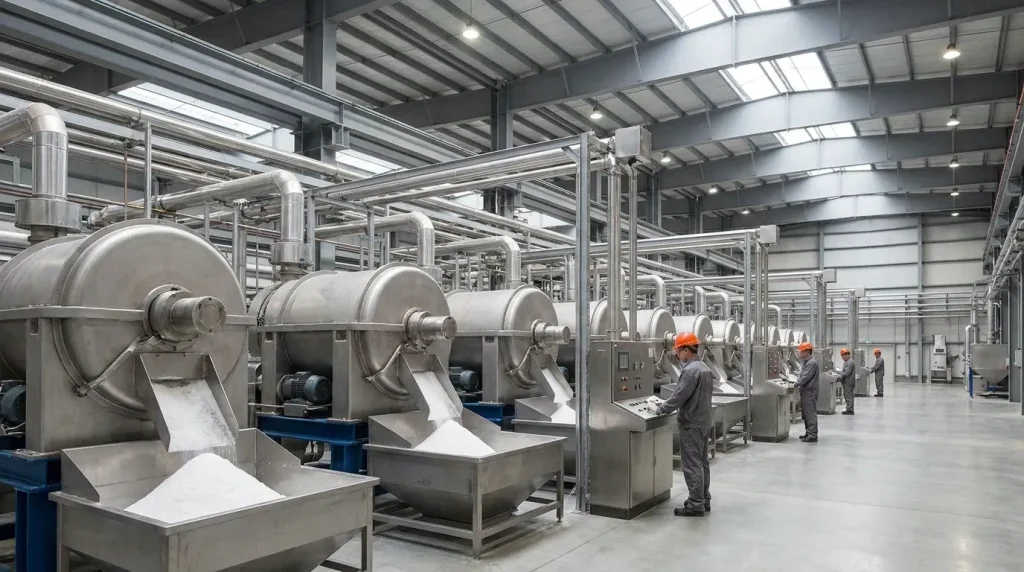
The core differences between peeler and pusher centrifuges center on operating mode, discharge method, and throughput capacity. Peeler centrifuges run batch cycles with knife-based cake removal, while pusher centrifuges operate continuously using reciprocating plates. The sections below compare performance, maintenance, and cost factors.
How Do Performance and Efficiency Compare Between the Two Types?
Performance and efficiency between peeler and pusher centrifuges differ significantly in g-force, throughput, and energy consumption.
| Parameter | Peeler Centrifuge | Pusher Centrifuge |
| Operating Mode | Batch | مستمر |
| G-Force Range | 1,060G to 2,030G (standard); 200G to 1,895G (siphon) | 300G to 1,200G (typical) |
| Throughput | Lower; suited for smaller batches | Up to 150 t/h (330,693 lb/hr) |
| Energy Use | ~9 kW/tonne (8.16 kW/short ton) | ~3 kW/tonne (2.72 kW/short ton) |
| Feed Solids | Variable concentrations | Higher solids concentrations |
Horizontal peeler centrifuges can generate approximately 1,060 g to 2,030 g, with siphon variants operating at around 200 g to 1,895 g. Pusher centrifuges consume roughly one-third the energy per tonne, making them more efficient for high-volume continuous operations.
How Do Maintenance and Operational Requirements Differ?
Maintenance and operational requirements differ based on each centrifuge type’s mechanical complexity and cleaning protocols.
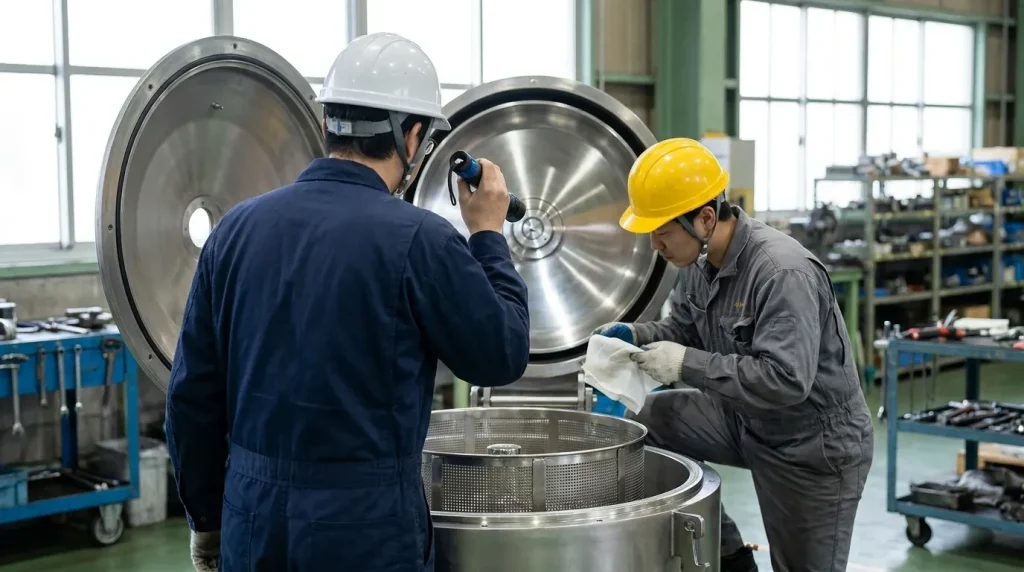
- Peeler centrifuges feature cantilever-mounted rotors with full-opening doors, simplifying basket access for inspection and filter cloth changes
- Pusher centrifuges have more moving components, including reciprocating mechanisms that require regular alignment checks
- GMP-compliant units need smooth, residue-free surfaces and integrated CIP systems for validated cleaning between batches
- Filter cloth replacement varies from weeks in abrasive applications to years in less demanding processes
How Do Cost, Capacity, and Throughput Vary?
Cost, capacity, and throughput vary substantially between peeler and pusher centrifuges based on production scale and application requirements.
- Capital expenditure exceeds initial purchase price: Installation can add approximately 25–55% of purchased equipment cost, with piping, instrumentation, electrical systems, and commissioning, as noted in Plant Design and Economics for Chemical Engineers
- Peeler centrifuges may suit lower-volume, high-value products where batch flexibility justifies higher per-unit processing costs
- Pusher centrifuges deliver strong throughput economics for continuous 24/7 operations processing bulk commodities
For pharmaceutical and fine chemical buyers, the batch flexibility and gentle handling of peeler centrifuges make it a strong choice. Procurement teams evaluating both options should factor in total lifecycle costs rather than initial purchase price alone.
What Factors Should Be Considered When Choosing Between Peeler and Pusher Centrifuges?
The factors to consider when choosing between peeler centrifuges and pusher centrifuges include material properties, process requirements, and total lifecycle costs. Regulatory compliance and safety standards additionally apply to both types. The following sections examine how each factor influences the optimal centrifuge selection for your application.
What Material, Product, and Process Factors Influence Selection?
Material, product, and process factors that influence selection include particle size distribution, crystalline fragility, feed solids concentration, and required throughput rates. Pusher centrifuges require a higher percentage of solids in the feed to form a stable cake for transport, making them unsuitable for dilute slurries.
Crystalline fragility is a decisive selection factor. Peeler centrifuges are chosen for fragile crystals to avoid the high shear forces inherent in pusher reciprocating mechanisms. Key process considerations include:
- Particle size range and distribution
- Crystal hardness and breakage sensitivity
- Required product purity and moisture content
- Batch versus continuous production needs
- Washing and rinsing requirements
For applications requiring gentle handling of pharmaceutical intermediates or fine specialty chemicals, peeler centrifuges typically deliver superior product quality despite lower throughput.
How Do Budget and Lifecycle Costs Impact the Choice?
Budget and lifecycle costs impact the choice by extending the financial analysis beyond initial capital expenditure to include energy consumption, maintenance intervals, and spare parts availability. Lifecycle cost analysis demonstrates that equipment with higher initial investment can result in lower net present costs when operational efficiency gains are factored in.
Energy consumption differs significantly between technologies. Some pusher centrifuges consume approximately 3 kW per tonne (2.72 kW per short ton) of product, while peeler centrifuges typically require more energy, with some models consuming about 9 kW per tonne (8.16 kW per short ton) depending on specifications, according to Process Worldwide filtration equipment selection guidelines.
| Cost Factor | Peeler Centrifuge | Pusher Centrifuge |
| Energy per tonne | ~9 kW (8.16 kW/short ton) | ~3 kW (2.72 kW/short ton) |
| Operating mode | Batch | مستمر |
| Best fit | Low-to-medium volume, high purity | High volume, 24/7 operation |
For high-volume continuous operations running 8,000+ hours annually, pusher centrifuges often deliver lower total cost of ownership despite comparable capital costs. Sourcing quality used equipment can reduce initial expenditure by around 40-60% while maintaining performance specifications.
How Do Regulatory and Safety Considerations Affect the Decision?
Essential safety requirements, standards, and frameworks for centrifuges vary by operating environment, industry, and jurisdiction. Some standards that vary by jurisdiction and can apply to centrifuges may include but are not limited to:
- ATEX Directive 2014/34/EU for centrifuges operating in potentially explosive atmospheres within the EU
- CE marking for EU markets
- UKCA marking for UK installations
- NEC/NFPA 70 Class I Division classifications for potentially explosive atmospheres in North American applications
- ASME standards internationally for pressure-containing equipment
- IECEx as an international certification system for equipment in potentially explosive atmospheres
Pharmaceutical and food-grade applications typically favor peeler centrifuges because batch operation simplifies validation documentation and product traceability.
How Should You Approach Peeler vs. Pusher Centrifuge Selection With International Process Plants’ Offerings?
You should approach peeler vs. pusher centrifuge selection with International Process Plants by first defining your process requirements, then exploring cost-effective new surplus and quality used options. The following sections explain how we can help reduce capital costs and summarize the key selection factors covered in this guide.
Can International Process Plants Provide Cost-Effective Used or New Centrifuge Solutions for Your Needs?
Yes, International Process Plants can provide cost-effective used or new surplus centrifuge solutions for your needs. Capital expenditure for very large centrifuges can sometimes exceed USD 2 million per unit, with installation adding up to around 40% more. Our inventory of new surplus and quality used equipment offers significant savings compared to new OEM pricing.
International Process Plants maintains over 15,000 pieces of process equipment across warehouses in the United States, Germany, and the United Kingdom. We source peeler and pusher centrifuges in materials including 316L, 316, 304, and 304L stainless steel, as well as Hastelloy C-276 for corrosive applications.
Key advantages of sourcing through International Process Plants:
- Reduced capital expenditure compared to new OEM purchases
- Faster delivery than new equipment lead times
- Global inventory accessible from multiple warehouse locations
- Technical support for equipment selection and specifications
Some manufacturer guidelines recommend major centrifuge overhauls around every 2 to 3 years, while service checks should occur much more frequently and be performed in accordance with manufacturer documentation timelines. Our team can help you evaluate maintenance history and remaining service life when selecting used equipment.
What Are the Key Takeaways About Peeler vs. Pusher Centrifuge Differences, Applications, and Selection Tips We Covered?
The key takeaways about peeler vs. pusher centrifuge differences, applications, and selection tips are:
- Operating mode: Peeler centrifuges operate in batch mode; pusher centrifuges run continuously
- Crystal handling: Peeler centrifuges protect fragile crystals from high shear forces inherent in pusher reciprocating mechanisms
- Energy consumption: Pusher centrifuges typically consume less energy than peeler centrifuges
- Feed requirements: Pusher centrifuges require a higher minimum percentage of solids in the feed to form a stable cake for transport
- Particle breakage: Can occur before centrifugation, with slurry pumping often representing a significant source of crystal attrition, making pump selection and slurry transport design important considerations for preserving particle integrity
Crystalline fragility is often a decisive selection factor. For procurement engineers evaluating options, International Process Plants offers the expertise and inventory to match your specific process requirements with cost-effective equipment solutions.

 AR
AR  EN
EN  ES
ES  FR
FR  PL
PL  DE
DE  UR
UR  HI
HI  NL
NL  TR
TR  IT
IT  UK
UK  RU
RU  JA
JA  PT
PT  ZH
ZH