 انتقل إلى المحتوى
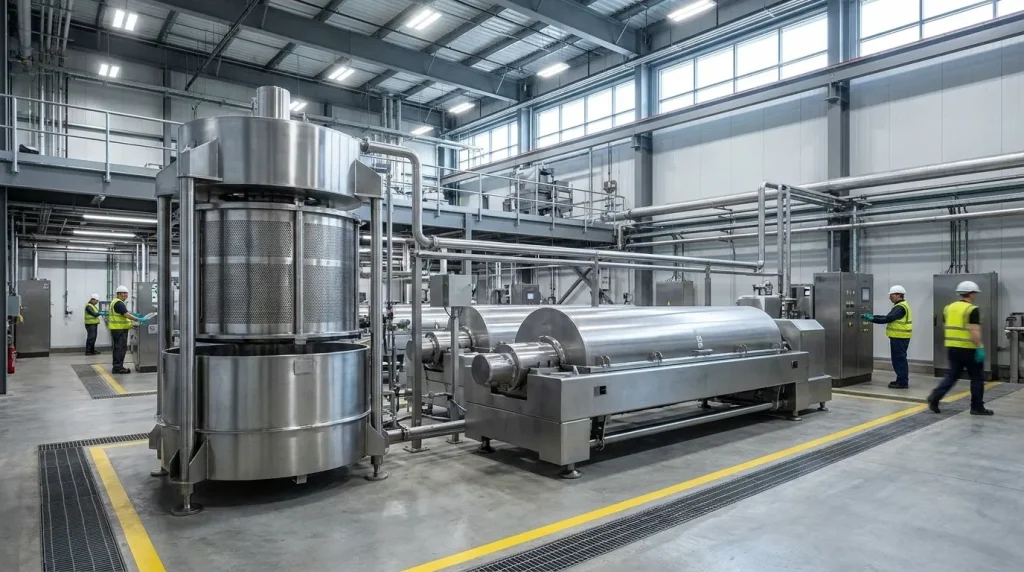
Basket and decanter centrifuges are two distinct solid-liquid separation technologies that use centrifugal force to isolate solids from liquids, with basket types employing filtration through a perforated bowl while decanters use continuous sedimentation against a solid bowl wall and a scroll.
This guide covers how each centrifuge type operates, the key differences in separation method and material suitability, the advantages of each design, and how to source the right equipment.
Basket centrifuges spin at around 1,000 to 3,000 rpm to collect filter cake inside a rotating basket, making them well suited for batch processing where high cake purity matters, such as pharmaceutical crystal recovery and fine chemical production. Decanter centrifuges operate continuously at g-forces exceeding around 3,000 times gravity, reducing slurry volume by up to 95% and producing solids concentrations of around 15% to 35%, depending on the application.
The right choice depends less on particle size alone, and includes particle characteristics and separation objectives. Basket centrifuges are best suited to crystalline materials forming a stable, permeable filter cake, while decanter centrifuges excel at continuously separating fine particles from difficult to filter higher-solids slurries. Throughput needs also factor heavily: decanters dominate high-volume continuous applications in wastewater treatment and chemical processing, while baskets excel where batch flexibility and cake washing are priorities.
Maintenance costs differ significantly between the two designs. Decanters incur higher ongoing expenses due to internal scroll mechanisms, while basket centrifuges offer simpler internals but require batch loading cycles. Both types can integrate CIP systems for GMP compliance, while decanters require carefully engineering CIP systems because of their internal scroll geometries, feed zones, and other complex product contact surfaces.
International Process Plants maintains inventory of both centrifuge types across our warehouses in the United States, Germany, and the United Kingdom, with units built to industry and region-specific regulatory standards.
What Are Basket and Decanter Centrifuges and How Do They Work?
Basket and decanter centrifuges are two distinct solid-liquid separation technologies that serve different process requirements. The following sections explain how each operates and where their mechanisms differ.
How Does a Basket Centrifuge Operate in Industrial Applications?
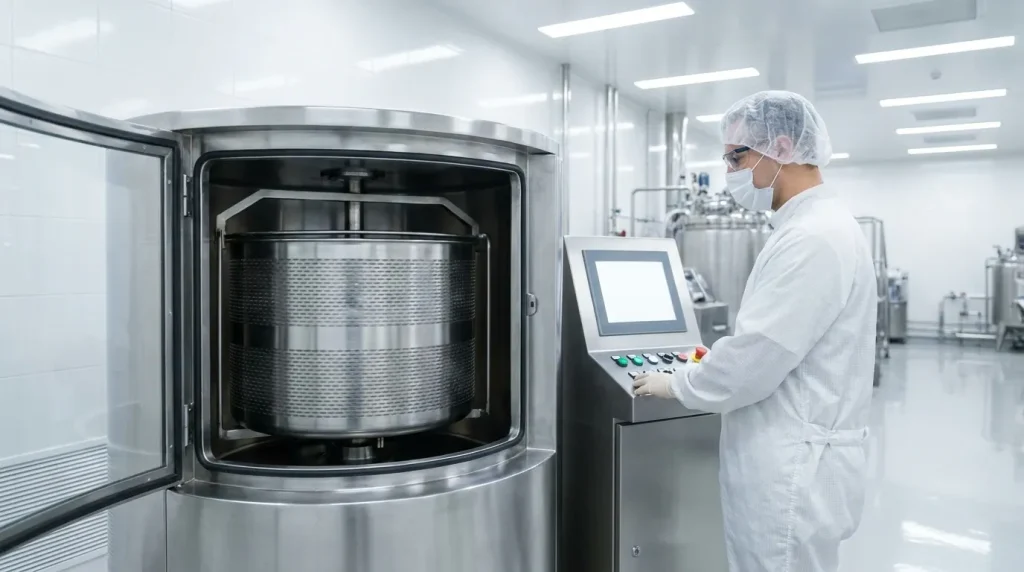
A basket centrifuge operates by spinning a perforated or solid basket at high speed, using centrifugal force to separate solids from liquids. The feed slurry enters the rotating basket, where solids collect against the basket wall as a filter cake while liquid passes through perforations or overflows the rim.
Vertical basket centrifuges typically revolve between around 1,000 and 3,000 rpm, generating the centrifugal forces necessary for separation. These units excel in batch processing applications where high cake purity is essential, such as:
- Algae harvesting
- Pharmaceutical crystal recovery
- إنتاج المواد الكيميائية الدقيقة
- Sugar processing
وفق Mordor Intelligence, the global industrial centrifuges market is projected to grow from USD 9.19 billion in 2026 to USD 12.59 billion by 2031, reflecting a 6.49% CAGR. CIP (Clean-in-Place) and SIP (Sterilization-in-Place) systems are essential for centrifuges in industries such as pharmaceutical and food-and-beverage to meet GMP validation requirements.
How Does a Decanter Centrifuge Function Differently Than a Basket Centrifuge?
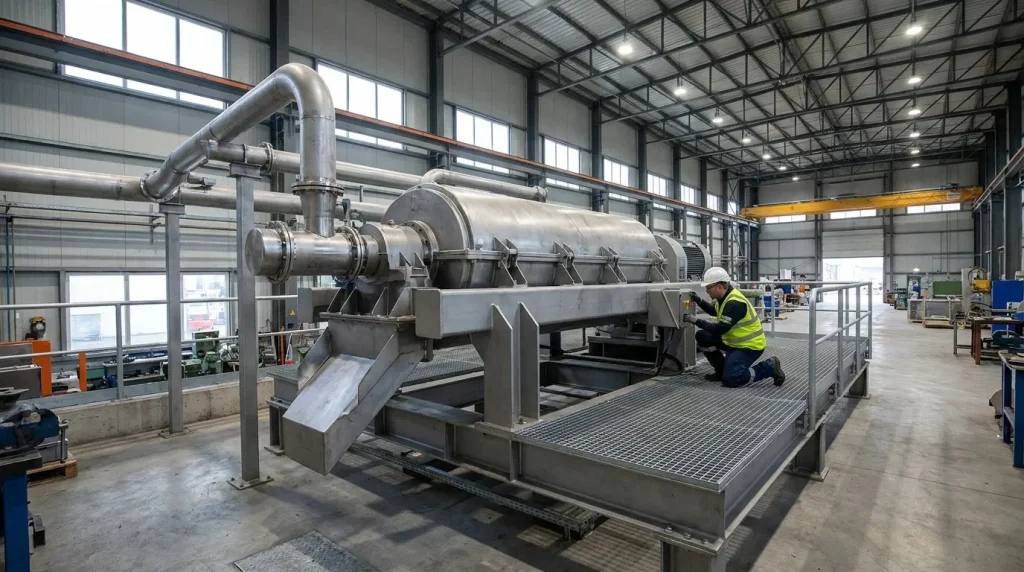
A decanter centrifuge functions differently than a basket centrifuge by using continuous sedimentation rather than filtration. While a basket centrifuge collects filter cake inside a perforated rotating basket, a decanter uses centrifugal force to settle solids against a solid bowl wall, with an internal scroll conveyor continuously discharging the separated solids.
Key operational differences include:
| Parameter | Basket Centrifuge | Decanter Centrifuge |
| Operation Mode | Batch | مستمر |
| Particle Size | Greater than 1 mm (0.039 in) | 50 µm (0.0020 in) and larger |
| G-Force Range | Approximately 500–3,000 × g | Approximately 400–1,800 × g |
| Separation Method | Filtration | Sedimentation |
Mechanical dewatering with a decanter centrifuge can achieve around 95% solids capture, and producing solids concentrations around 15% to 35%. Decanter efficiency depends on centrifugal force, feed rate, weir diameter, and scroll differential speed. For facilities with limited floor space, vertical decanter designs can offer up to around 40% space savings, a key benefit in cleanroom settings, according to Mordor Intelligence.
The continuous operation of decanters makes them preferable for high-volume processes, while basket centrifuges remain a better choice when product purity and batch-specific control take priority.
What Are the Key Differences Between Basket and Decanter Centrifuges?
The key differences between basket and decanter centrifuges involve separation method, material suitability, and maintenance requirements. The following sections examine how each centrifuge type approaches solid-liquid separation, which materials work best with each design, and what operational demands you should anticipate.
How Do Separation Methods Vary Between Basket and Decanter Centrifuges?
Separation methods vary between basket and decanter centrifuges based on how each machine retains and removes solids. Basket centrifuges use a perforated bowl that collects a filter cake while liquid passes through the screen. Decanter centrifuges employ a solid bowl wall where centrifugal force settles solids, which an internal scroll then conveys to a discharge port.
Vertical basket centrifuges typically revolve between around 1,000 and 3,000 rpm, generating the centrifugal forces required for filtration. Decanters operate at higher g-forces, often exceeding around 3,000 times gravity, which accelerates sedimentation from hours to minutes. This fundamental difference makes basket units better suited for batch filtration while decanters excel at continuous sedimentation.
What Types of Materials and Solids Are Suited for Each Centrifuge?
The types of materials and solids suited for each centrifuge depend on particle size and process requirements:
- Basket centrifuges: particles larger than 1 mm (0.04 in), crystalline solids, batch loads requiring high cake purity
- Decanter centrifuges: particles as fine as 50 microns (0.002 in), slurries with lower solid content, continuous feed applications
Basket units can handle coarser solids where cake washing or dryness is critical. Decanters can manage finer particles and deliver sufficient dry solids concentration with up to 95% solids capture. For chemical and pharmaceutical applications, material construction typically involves corrosion-resistant stainless steels such as 316L or 304, or stronger hastelloy construction for product contact surfaces.
How Do Maintenance and Operation Requirements Compare?
Maintenance and operation requirements compare differently based on mechanical complexity and process mode.
| عامل | Basket Centrifuge | Decanter Centrifuge |
| Operation Mode | Batch | مستمر |
| Internal Mechanism | Simple basket, no scroll | Complex scroll conveyor |
| Typical Maintenance Cost | Lower | Higher |
| CIP Integration | More straightforward | More specialized due to more complex internal components |
Decanter centrifuges may incur higher maintenance costs over time due to internal scroll mechanisms and continuous operation wear. Basket centrifuges offer simpler internals but require batch loading and unloading cycles.
وفق Biotech CIP Cycle Development documentation published in ISPE, centrifuges in general present one of the most challenging equipment types for CIP cycle development due to complex internal geometry and validation requirements. Both types can integrate CIP systems, though decanter centrifuges present geometries requiring careful engineering of cleaning cycle systems due to their more complex internal structure.
What Are the Main Advantages of Basket Centrifuges?
The main advantages of basket centrifuges include high cake purity, gentle handling of crystalline solids, and batch flexibility. The main limitations involve lower throughput capacity and manual discharge requirements in some designs. The following subsections examine where basket centrifuges excel and where they fall short.
In Which Applications Are Basket Centrifuges Frequently Used?
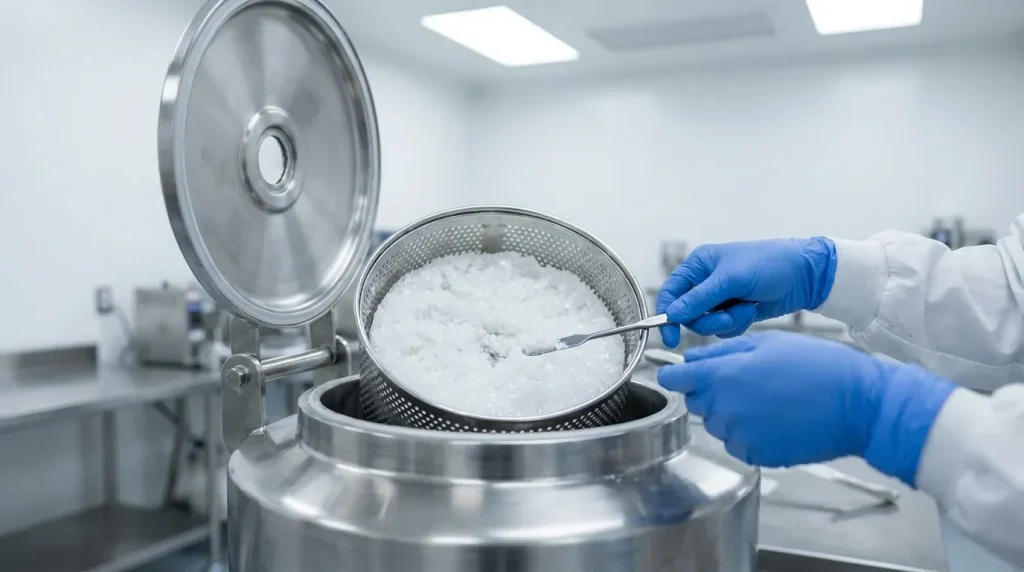
Basket centrifuges are frequently used in applications requiring high-purity filter cake and batch processing flexibility. Pharmaceutical manufacturers favor these units for crystal recovery, salt production, and fine chemical separations where product contamination must be minimized.
Key applications include:
- Algae harvesting and biomass dewatering where cake purity is critical
- Sugar crystal separation in food processing
- Pharmaceutical intermediate recovery requiring GMP compliance
- Specialty chemical batch production with frequent product changeovers
- Pigment and dye manufacturing where color contamination causes batch rejection
The perforated basket design allows thorough washing of the filter cake while it remains in the centrifuge, which reduces downstream processing steps. For operations handling particles larger than 1 mm (0.04 in), basket centrifuges deliver strong cake dryness compared to some continuous alternatives. The ability to visually inspect the cake before discharge gives operators quality assurance that continuous systems often do not match in the same way.
Selecting the right centrifuge requires matching equipment capabilities to your specific process requirements.
What Are the Main Advantages of Decanter Centrifuges?
Decanter centrifuges offer continuous operation and high throughput for solid-liquid separation, but they also present specific challenges. The following sections examine where these machines excel and where they fall short.
In Which Industries or Processes Are Decanter Centrifuges Frequently Used?
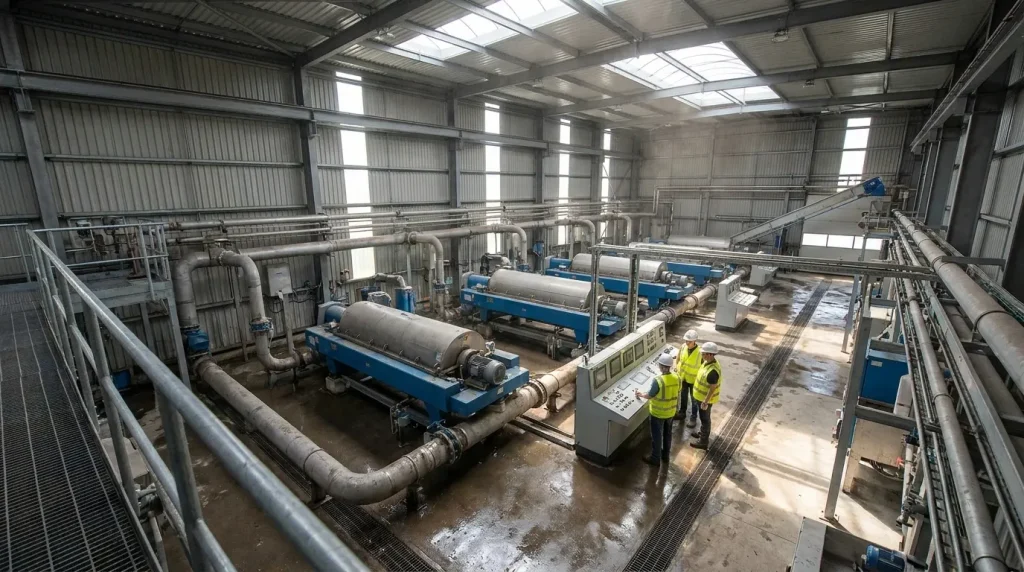
Decanter centrifuges are frequently used in industries requiring continuous, high-volume solid-liquid separation with fine particle handling. These machines dominate applications where batch processing would create bottlenecks.
Key industries include:
- Wastewater treatment: Municipal and industrial sludge dewatering
- المعالجة الكيميائية: Continuous resin washing and drying
- Oil and gas: Drilling mud recovery and produced water treatment
- المأكولات والمشروبات: Olive oil extraction, wine clarification, and dairy processing
- تصنيع الأدوية: API recovery and intermediate purification
In applications where continuous solid-liquid separation is required, decanter centrifuges are a strong choice.
What Factors Should You Consider When Choosing Between Basket and Decanter Centrifuges?
The factors to consider when choosing between basket and decanter centrifuges include throughput requirements, available floor space, capital and operating costs, and automation needs, with safety and regulatory compliance standards affecting both configurations. The sections below examine how each factor influences your selection.
How Do Throughput, Space, and Cost Influence Your Decision?
Throughput, space, and cost influence your decision by determining which centrifuge type aligns with your production scale and facility constraints. Decanter centrifuges often excel in continuous, high-volume operations where uninterrupted flow matters. Basket centrifuges are often utilized for batch processing with defined load cycles.
Space requirements differ significantly between the two designs. According to Mordor Intelligence, vertical decanter designs can achieve up to 40% space savings compared to other separation technologies, particularly beneficial in cleanroom settings. Basket centrifuges typically require additional clearance for batch loading and unloading cycles.
Cost considerations include:
- Capital investment
- Energy consumption
- Maintenance expenses
- Throughput value (decanters typically process continuously)
For operations processing large volumes with lower solid content, a decanter centrifuge typically delivers strong long-term value through continuous operation and reduced labor.
How Important Are Safety Compliance Requirements for Your Application?
Safety compliance requirements apply to all centrifuge design configurations. ISO 12100:2010 specifies hazard identification, risk assessment, and protective measure requirements for machinery design. Both centrifuge types must meet these standards, though implementation differs based on operating speeds and batch versus continuous processing modes.
For GMP-regulated environments, centrifuges used in pharmaceutical and other hygienic applications may incorporate CIP or SIP systems to support validated cleaning procedures and contamination control. Basket centrifuges can offer simpler cleaning validation in some applications due to fewer internal components, while decanter centrifuges may require more extensive cleaning assessment because of their internal mechanisms.
What Role Does Automation and Ease of Use Play in Selection?
Automation and ease of use play a significant role in selection because they influence labor costs, process consistency, and operator safety. Decanter centrifuges inherently support continuous, automated operation with minimal operator intervention once parameters are set. Operational variables such as centrifugal force, feed rate, weir diameter, and scroll differential speed can be adjusted during operation using programmable controls.
Basket centrifuges traditionally require more manual oversight for loading, cycle initiation, and cake discharge. However, modern automated designs can often nowadays incorporate programmable logic controllers that reduce operator involvement.
Key automation considerations include:
- Process continuity requirements (continuous versus batch)
- Available operator hours
- Integration with upstream and downstream equipment
- Data logging and validation documentation needs
For facilities prioritizing minimal operator intervention and consistent output, decanters are a frequent choice. For operations requiring flexibility between product runs or handling sensitive materials, automated basket centrifuges provide batch-level control.
With differences between basket and decanter centrifuges established, working with an experienced equipment supplier ensures you find the right centrifuge configuration for your specific application.
How Should You Approach Choosing Centrifuge Equipment with International Process Plants?
You should approach choosing centrifuge equipment with International Process Plants by matching your needs to our inventory of new surplus and quality used separation equipment. The following sections explain how we source centrifuges and summarize the key decision factors covered in this guide.
Can International Process Plants Help Source Used, New, or Refurbished Centrifuges for Your Needs?
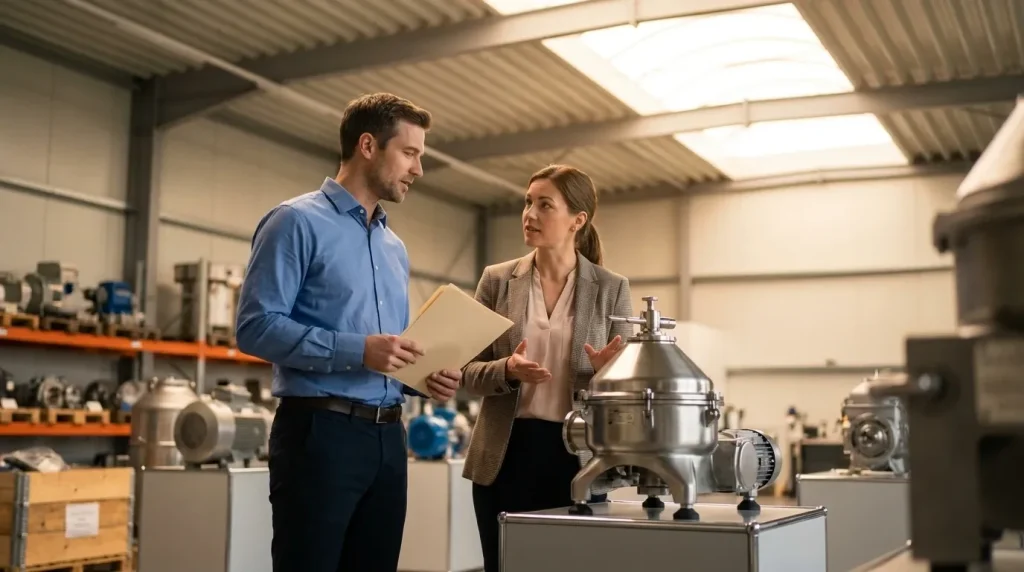
Yes, International Process Plants can help source used, new surplus, and refurbished centrifuges for your separation requirements. With over 46 years of experience and warehouses in the United States, Germany, and the United Kingdom, we maintain access to basket centrifuges, decanter centrifuges, and related separation equipment across multiple sizes and configurations.
Our inventory includes units built to recognized standards:
- ISO 21940 balance quality grades for rotor safety
- ATEX and IECEx certifications for potentially explosive environments
- CIP/SIP-compatible designs for pharmaceutical, food, and other hygienic applications
International Process Plants evaluates each piece of equipment for mechanical condition, material compatibility, and compliance documentation. Whether you need a vertical basket centrifuge for batch pharmaceutical processing or a horizontal decanter for continuous wastewater dewatering, we can match available inventory to your throughput, particle size, and regulatory requirements.
What Are the Key Takeaways About Choosing Between Basket and Decanter Centrifuges?
The key takeaways about choosing between basket and decanter centrifuges center on matching your process mode, particle characteristics, and operational priorities to the right technology.
- Basket centrifuges are frequently used in batch operations requiring high cake purity, particles larger than 1 mm (0.04 in), and applications where wash cycles matter
- Decanter centrifuges are frequently used in continuous operations, finer particle separation down to 50 microns (0.002 in), and high-volume throughput applications
- Space constraints may favor vertical decanter designs, which can save up to 40% floor space, particularly valuable in cleanroom settings
For procurement engineers balancing capital cost against long-term performance, quality used equipment from International Process Plants offers a practical path to acquiring proven centrifuge technology at reduced lead times. Contact us to discuss your separation requirements and explore currently available inventory.

 AR
AR  EN
EN  ES
ES  FR
FR  PL
PL  DE
DE  UR
UR  HI
HI  NL
NL  TR
TR  IT
IT  UK
UK  RU
RU  JA
JA  PT
PT  ZH
ZH